
Freeze-Dried Protein Production: How to Choose a Freeze Dryer for Protein Powder
A practical guide to raw-material suitability, process design, equipment sizing, food safety, milling and packaging for meat, seafood, dairy, egg, plant-protein and pet-food ingredients.
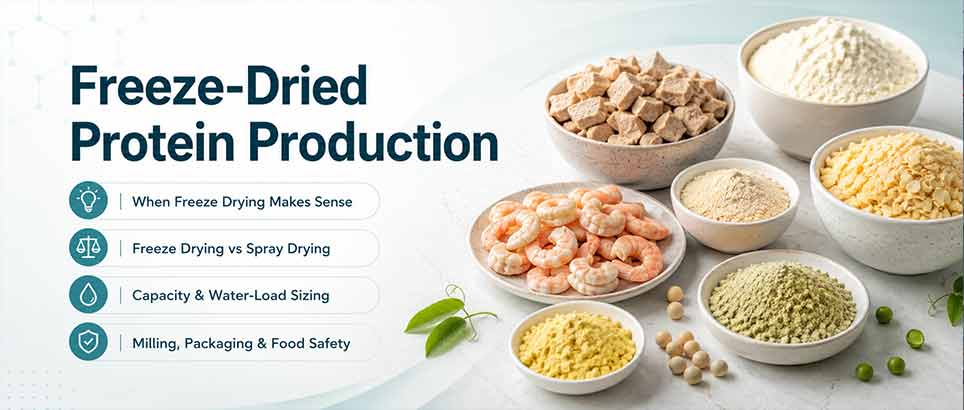
Scope: This guide covers food and pet-food protein ingredients. It does not address pharmaceutical biologics, injectable protein formulations or household supplement use.
Food manufacturers that freeze dry proteins at scale should define the wet-feed form, water load, tray depth and final powder specification before selecting equipment.
Key answer: commercial freeze-dried protein is normally made by freeze-drying a wet protein material, such as cooked meat, seafood, liquid egg, dairy concentrate, plant-protein extract or protein slurry, and then milling the dry cake or dry pieces when a powder is required.
Freeze drying can suit high-value, heat-sensitive or small-batch protein ingredients that require a porous structure, rapid rehydration or careful separation between formulations. It is not automatically the best choice for high-volume commodity powders. The spray dryer and freeze dryer comparison explains the decision factors when the feed is pumpable, the product tolerates the thermal history and the required output is high.
What Does “Freeze-Dried Protein” Mean?
The term covers several products with very different processing requirements. Equipment selection therefore starts with the physical form and formulation of the feed, not with the word “protein.”
Solid animal protein
Cooked meat, fish, shrimp, poultry, organs and formed pet-food pieces can be freeze-dried as slices, cubes or granules. Thickness, fat content and pre-cooking determine the cycle and final texture.
Liquid or slurry feed
Liquid egg, dairy concentrate, meat slurry, hydrolysate and plant-protein extract are filled into trays as controlled layers. Solids concentration, viscosity and foaming behavior become critical.
Powder after milling
The freeze dryer creates a dry porous cake or dry pieces. A separate crusher or mill converts that material into powder. Milling capacity and packaging speed must match the dryer output.
Procurement distinction: a request for a “freeze dryer for protein powder” should state whether the incoming feed is a solution, extract, slurry, emulsion, paste, cooked solid or an existing dry powder. That distinction changes tray design, freezing method, shelf area, condenser load and downstream equipment.
When Is Freeze-Dried Protein Production Suitable?
A protein ingredient is a strong freeze-drying candidate when product value and quality requirements can justify a batch process. Typical reasons include temperature sensitivity, a need for porous structure, small production lots, premium positioning, rapid rehydration, or a formulation that is difficult to spray dry.
| Production situation | Likely fit | Reason |
|---|---|---|
| High-value functional or specialty protein | Often suitable | Higher product value can support longer cycle time and batch cost. |
| Premium meat, seafood or pet-food ingredient | Often suitable | Freeze drying can create porous, lightweight pieces with rapid rehydration. |
| Small-batch R&D or multiple formulations | Suitable | Tray loading offers flexibility and easier separation between formulations. |
| Viscous feed that is difficult to atomize | Worth testing | A tray-based route may avoid spray-nozzle limitations, although thick layers can extend drying time. |
| Large-volume commodity protein powder | Usually compare alternatives first | Spray drying generally offers higher continuous throughput and lower unit cost for pumpable feeds. |
| Existing dry, shelf-stable protein powder | Usually unsuitable | There is little removable water, so a second drying step adds cost without a clear process benefit. |
When freeze drying is usually the wrong choice: an already dry protein powder has little removable water; a commodity powder may not support batch-drying cost; freeze drying cannot replace a validated food-safety kill step; and one cycle cannot be copied across meat, dairy, egg and plant proteins.
The decision should be confirmed by pilot batches. A lab or pilot freeze-drying program can establish freezing behavior, loading thickness, cycle time, final moisture, rehydration and milling performance before production equipment is selected.
Freeze Drying vs. Spray Drying for Protein Powder
Neither method is universally superior. Research on egg, dairy and plant proteins shows that drying method can change powder structure, solubility, foaming, emulsifying behavior and other functional properties. The result depends on the protein source, extraction method, formulation and operating conditions.1, 2, 8
| Decision factor | Freeze drying | Spray drying |
|---|---|---|
| Feed form | Liquids, slurries, pastes and solids can be tray-loaded. | Feed normally needs to be pumpable and atomizable. |
| Production mode | Batch process with freezing, primary drying and secondary drying. | Continuous or semi-continuous high-throughput process. |
| Product structure | Usually porous cake or pieces that are milled after drying. | Powder is formed directly from droplets. |
| Temperature exposure | Product remains frozen through primary drying, but freezing and dehydration can still alter proteins. | Short residence time but higher air temperatures; actual product response depends on formulation and outlet conditions. |
| Typical economic fit | Premium, specialty, heat-sensitive or flexible small-to-medium batches. | High-volume powders where feed and product properties suit atomization. |
| Scale-up question | Shelf area, layer thickness, condenser load and cycle time. | Evaporation rate, atomization, inlet/outlet conditions and powder recovery. |
For whey protein concentrate that has already gone through commercial heat treatments, freeze drying may not meaningfully improve bioactive protein retention compared with spray drying. One commercial WPC study found that freeze-dried WPC had higher average solubility than spray-dried WPC, but the authors concluded that freeze drying did not meaningfully improve the retention of several bioactive whey proteins under the tested commercial processing conditions.9
Selection rule: choose the drying method from measured product requirements, not from the assumption that lower temperature always produces a better protein powder. A side-by-side pilot comparison is justified when solubility, emulsification, foaming, digestibility, oxidation, redispersion or unit cost is commercially important.
Protein Raw Materials and Their Processing Challenges
Meat and seafood protein
Solid meat and seafood should be cut or formed to a consistent thickness. Thick or irregular pieces create a dry outer region while the center remains wet. For commercial meat processing, pieces below about 15 mm and loading below roughly 14 kg/m² are a practical starting range, but the correct target must be confirmed for each formulation. The commercial meat freeze-drying guide covers these product-specific decisions in more detail.
Fat level also matters. High-fat materials transfer heat differently, can become difficult to mill and need stronger oxygen-control measures after drying. Reviews of meat and aquatic products note that freezing and dehydration stresses may affect protein structure and oxidation, so quality cannot be inferred from appearance alone.3
Freeze-dried meat powder is not only a moisture-removal problem. A pork-powder study found higher protein oxidation, lower protein solubility, higher cooking loss and lower gel hardness after freeze drying compared with freeze-thawed pork. For meat-protein ingredients, test rehydration, color, lipid oxidation and the intended downstream function before scaling.10
Dairy and whey protein
Dairy concentrates are normally processed as liquids or viscous extracts. Solids concentration, lactose, fat, viscosity and foaming influence freezing and vapor transport. A higher solids feed reduces the water that must be removed, but an overly thick or viscous layer may increase internal resistance. The existing milk freeze-drying guide explains liquid dairy loading and final-product handling.
Egg protein
Liquid whole egg or egg white requires controlled tray depth and a validated safety treatment before drying. The dry cake can then be broken into flakes or milled. Published comparisons confirm that different drying methods produce different egg-white powder properties, which reinforces the need to test the exact formulation rather than copy a generic cycle.1 See the dedicated egg freeze-drying production guide for handling and packaging considerations.
Plant-protein isolates and concentrates
Plant-protein extracts vary widely in pH, salts, carbohydrates, fiber, viscosity and particle content. These factors affect freezing, phase separation, drying resistance and redispersion. In peanut protein isolate, freeze drying improved oil binding, water holding and solubility and produced more stable emulsions, while spray drying showed stronger emulsifying activity under many pH conditions. Therefore, selection should follow the required emulsion behavior, redispersion, powder flow and unit cost.2, 8
Pet-food protein ingredients
Pet-food applications may use meat, organs, seafood, egg or blended formulations. Equipment must be considered together with cooking or another validated safety step, hygienic transfer, allergen control, milling and packaging. The commercial dog-food and treat guide addresses product formats, while the safety plan must be developed for the individual facility and market.
Commercial Freeze-Dried Protein Production Process
- Define the product target: powder, granule, flake, cube, pet-food piece, instant ingredient or functional protein component.
- Prepare the raw material: cook, blend, filter, concentrate, hydrolyze, pasteurize or form the material according to the product and safety plan.
- Load trays consistently: control piece thickness, layer depth, loading density and tray coverage.
- Freeze the product: freeze uniformly enough to avoid local melting, phase separation or poor vapor channels.
- Primary drying: remove ice by sublimation under vacuum while controlling product temperature.
- Secondary drying: remove bound water to the target final moisture without damaging product quality.
- Unload and inspect: confirm dryness, color, odor, texture, batch weight and any product-specific quality markers.
- Mill or size-reduce: convert dry cake or pieces into powder or granules when required.
- Package quickly: protect the dry protein from moisture uptake, oxygen exposure, crushing and contamination.
Liquid and slurry feeds need additional attention to viscosity, foaming and layer depth. The freeze dryer for liquids guide explains tray loading and liquid-product handling in more detail.
How Tray Loading Affects Drying Time
Tray loading is one of the strongest cycle-time variables. Buyers should compare equipment on usable shelf area and verified loading conditions, not only on chamber volume or the number of trays.
- Solid pieces: control thickness and avoid overlapping pieces.
- Liquids and extracts: maintain a repeatable layer depth across every tray.
- Viscous slurries: confirm that the frozen structure allows vapor to escape without local collapse.
- High-solids feeds: calculate the lower water load but also test whether viscosity increases drying resistance.
- Scale-up: preserve product thickness and loading density before increasing total shelf area.
For solid meat pieces, thickness is a validated cycle variable, not just a loading convenience. In ham and tenderloin trials, increasing thickness extended total drying time. The result should not be copied directly to other proteins, but it shows why shelf temperature and product temperature cannot be selected from chamber size alone.11
A dry surface does not prove that the product center is dry. The plant should use defined endpoint checks rather than extending every cycle by an arbitrary safety margin. Supporting resources include the freeze-dryer tray and loading guide, the commercial freeze-drying time chart and the guide to freeze-drying temperature and pressure.
How to Size a Freeze Dryer for Protein Production
A reliable quotation starts with wet feed and water removal. Finished powder demand alone is not enough because two products with the same dry output can place very different loads on the condenser and shelves.
Water to remove = wet feed mass − final product mass
Worked capacity example
A plant plans to process 1,000 kg of protein slurry containing 20% solids. The batch contains 200 kg of dry solids. At a target final moisture of 2%, the expected final product is about 204 kg, so approximately 796 kg of water must be removed.
This calculation is only the first step. Final selection must also account for shelf loading, layer thickness, peak sublimation rate, condenser capture capacity, vacuum-system performance, freezing method, defrost time, cleaning time and realistic production utilization.
Data required for sizing
- Wet feed per batch and per 24 hours
- Initial moisture or solids concentration
- Target final moisture
- Feed form and viscosity
- Tray thickness and loading density
- Expected batch cycle
- Cleaning, defrost and loading allowance
- Required annual operating days and peak-season margin
Lab, Commercial or Industrial Freeze Dryer?
The following capacities describe typical 24-hour wet-material capability at approximately 15% solids. Protein products can differ substantially, so these figures are a starting framework rather than a guaranteed product-specific output.
| Equipment group | Models | Typical 24-hour wet-feed capacity | Best use |
|---|---|---|---|
| Lab / pilot | SDG60 / SDG90 | 60–80 kg / 90–120 kg | Feasibility testing, formulation comparison, loading studies and scale-up data. |
| Commercial | SDG350 / SDG700 / SDG1100 | 340–450 kg / 680–900 kg / 1.02–1.36 t | Small and medium food, ingredient and pet-food factories. |
| Industrial | SDG1600 / SDG3000 / SDG6000 | 1.2–2 t / 3–4 t / 6–8 t | Stable, high-volume production with planned utilities, logistics and downstream packaging. |
Buyers can compare the lab and pilot series, commercial freeze dryers and industrial freeze dryers. Selection should follow product trials and water-load calculations rather than model naming alone.
Need a preliminary capacity check? Buyers can submit wet-feed mass, solids concentration, tray depth and required daily output for an initial equipment-sizing review.
Equipment Specifications That Matter for Protein Ingredients
Shelf-temperature uniformity
Uneven shelf temperature can create different endpoints between trays and between the center and edge of a shelf. The supplier should explain the heating medium, shelf construction, temperature sensing and test method.
Vacuum pull-down and stability
Slow evacuation can allow frozen material to warm before stable sublimation is established. The vacuum system must be sized for the chamber, piping, water-vapor load and expected leakage. A capacitance diaphragm gauge is preferable for process pressure because its reading is not distorted by water-vapor composition in the same way as thermal gauges.
Condenser capture rate and area
The cold trap must capture the batch water load at the expected peak sublimation rate. A low minimum temperature does not compensate for insufficient condenser surface or weak refrigeration capacity. Protein slurries with high initial moisture can create a large vapor load even when dry-product output appears modest.
Sanitary chamber, shelves and trays
Food-contact materials, weld quality, drainage, access for cleaning and removal of residues should be assessed. Multi-product plants must also consider allergen cross-contact and odor carryover between dairy, egg, meat, seafood and plant-protein batches.
Monitoring and batch records
The control system should record product temperature, shelf temperature, condenser temperature, chamber pressure, phase time and alarms. These records support troubleshooting, repeatability and process improvement. See the guide to freeze-dryer monitoring and batch records.
Defrost and turnaround
A production calculation should include loading, unloading, defrost, cleaning and inspection. For continuous factory output, an external dual-condenser arrangement may allow alternating defrost, but the benefit must be evaluated against capital cost and line balance.
Quality Checks and Food-Safety Controls
Freeze drying removes water but does not replace a kill step. FDA states that freezing and drying do not kill Salmonella; organisms can survive in dry environments.4 Human-food and animal-food facilities therefore need hazard-based controls appropriate to the product, facility, equipment and target market.
Critical safety point: raw meat, seafood, egg, dairy and pet-food ingredients require a validated food-safety strategy before and after freeze drying. Equipment cleaning, low final moisture and cold storage of raw material are not substitutes for a validated control of biological hazards.
For U.S. food production, FDA explains that covered facilities generally require facility-specific hazard analysis and risk-based preventive controls; procedures must reflect the actual equipment, layout and raw materials.5 FDA also requires animal food, including pet food, to be safe, produced under sanitary conditions and truthfully labeled.6
Practical product and process checks
- Final moisture content
- Product-center dryness
- Mass stability after an appropriate extension check
- Rehydration or redispersion performance
- Solubility, foaming or emulsification when relevant to product use
- Color, odor, taste and texture
- Oxidation or rancid notes in high-fat products
- Powder particle size and flow behavior
- Batch-to-batch consistency
- Packaging and shelf-life verification
Related guidance is available in the articles on whether freeze drying kills bacteria and viruses, cleaning a food freeze dryer and food freeze-dryer validation and acceptance testing.
Milling and Packaging After Freeze Drying
The dry product begins absorbing moisture as soon as it is exposed to factory air. Unloading, inspection, milling and packaging should therefore be designed as one connected process rather than separate departments with long waiting periods.
Milling considerations
- Select a mill and screen for the required particle-size distribution.
- Limit heat generation when protein functionality or fat stability is sensitive.
- Test whether high-fat material smears, cakes or blocks the screen.
- Provide dust control and safe access for cleaning.
- Validate allergen and species changeover procedures.
Packaging considerations
- Use a moisture barrier suited to the target shelf life.
- Evaluate oxygen protection for meat, seafood, egg and other fat-containing products.
- Match packaging speed to the dryer batch discharge.
- Protect the product from crushing if a porous piece rather than powder is sold.
- Confirm seal integrity and storage conditions through shelf-life work.
The commercial freeze-dried food packaging guide explains barrier selection and line planning in more detail.
Toll Processing or Buying a Freeze Dryer?
| Outsourcing may be better when | Buying may be better when |
|---|---|
| The formulation and market are not yet proven. | Demand is stable and the production schedule needs direct control. |
| Annual volume is low or irregular. | Repeated tolling, transport and waiting costs are becoming significant. |
| The factory lacks utilities, trained operators or packaging capability. | The facility already has suitable utilities, hygiene systems and downstream equipment. |
| Several process routes need to be compared before investment. | Formulation confidentiality and batch traceability are strategic priorities. |
| A launch quantity is needed before capital approval. | Projected utilization can support equipment ownership and maintenance. |
The full decision framework is available in commercial freeze-drying services vs. buying a freeze dryer. A pilot test should still precede a production purchase when the product has not previously been processed at the planned thickness and loading density.
Relevant Animal-Protein Project Experience
The following projects demonstrate related animal-protein food processing and equipment scale-up. They are not presented as protein-powder projects; a protein slurry, isolate or hydrolysate still requires its own trial.
Mongolia meat project – SDG350
Meat pieces were standardized at approximately 10 mm thickness and loaded at 12.1 kg/m². The recorded cycle was 12 hours, with final moisture of 1.49%. The case supports practical decisions on piece thickness, loading and endpoint control for animal-protein foods.
India shrimp project – SDG6000
A 200 m² industrial system processed shrimp at a recorded loading density of 11.6 kg/m². The cycle was 8 hours and final moisture was 1.68%. This project demonstrates large-scale seafood loading, condenser demand and production planning.
Published work on freeze-dried beef powder also shows that temperature control can influence protein digestibility, reinforcing the need to validate the actual product and cycle rather than treating “protein” as one uniform material.7
What Data Should a Buyer Send Before Requesting a Quote?
A useful equipment evaluation should include the following information:
- Protein source and complete ingredient list
- Solid, liquid, extract, emulsion, paste or slurry form
- Initial moisture or solids concentration
- Fat content and any oxidation sensitivity
- Required wet-feed capacity per batch and per day
- Target final product: pieces, flakes, granules or powder
- Target final moisture and functional specifications
- Expected particle size after milling
- Packaging format and target shelf life
- Available electricity, cooling water, steam, floor area and ceiling height
- Required food-safety, allergen and local regulatory standards
- Samples or prior trial data, when available
Frequently Asked Questions
Can protein powder be freeze-dried?
A wet protein solution, slurry, concentrate or cooked protein material can be freeze-dried and then milled into powder. An existing dry protein powder normally contains too little removable water to justify another freeze-drying step.
Is freeze drying better than spray drying for protein?
Not in every case. Freeze drying is attractive for some high-value, heat-sensitive or difficult-to-spray products. Spray drying is often more economical for high-volume pumpable feeds. The correct decision depends on measured powder functionality, quality, throughput and unit cost.
Can whey or dairy protein be freeze-dried?
Yes, but the project must account for solids concentration, viscosity, lactose, fat, foaming, tray depth and final redispersion. Pilot trials are needed before shelf area and condenser load are finalized.
Can plant protein be freeze-dried?
Yes. Plant-protein isolates and extracts can be freeze-dried, especially for research and specialty ingredients. Commercial feasibility still depends on extraction conditions, viscosity, required functionality and whether the product price can support batch drying.
How long does protein freeze drying take?
There is no universal time. Feed form, thickness, loading density, solids, fat, freezing behavior, shelf heat transfer, vacuum performance and condenser capacity all affect the cycle. Food-production cycles often fall within 8–15 hours, but thick, sensitive or extract-based products may take longer.
Does freeze drying kill bacteria in meat or protein ingredients?
No. Freeze drying should not be treated as a sterilization or pasteurization step. A validated hazard-control process and hygienic post-drying handling are still required.

About the Author
Zheng Wei is the Founder and Freeze-Drying System Engineer at Fuzhou Xing Shun Da Refrigeration Facility Project Co., Ltd. He participates in freeze-drying trials, equipment selection, vacuum-system configuration, refrigeration planning, installation guidance and process optimization for fruit, vegetable, prepared food, seafood, meat and botanical projects.
References and External Resources
- Zafar, H. S., et al. “Preparation of egg white powder using electrohydrodynamic drying method and its effect on quality characteristics and functional properties.” Food Chemistry, 2023. DOI: 10.1016/j.foodchem.2023.136567.
- Nie, H.-N., et al. “Effects of spray drying and freeze drying on the structure and emulsifying properties of yam soluble protein: A study by experiment and molecular dynamics simulation.” Food Chemistry, 2023. DOI: 10.1016/j.foodchem.2022.135238.
- Lee, S., et al. “The impacts of freeze-drying-induced stresses on the quality of meat and aquatic products: Mechanisms and potential solutions to acquire high-quality products.” Food Chemistry, 2024. DOI: 10.1016/j.foodchem.2024.140437.
- U.S. Food and Drug Administration. “Get the Facts about Salmonella.” FDA resource.
- U.S. Food and Drug Administration. “Frequently Asked Questions on FSMA.” FDA resource.
- U.S. Food and Drug Administration. “Pet Food.” FDA resource.
- Lee, S., Jo, K., Jeong, S.-K.-C., Choi, Y.-S., & Jung, S. “Production of freeze-dried beef powder for complementary food: Effect of temperature control in retaining protein digestibility.” Food Chemistry, 2024;433:137419. DOI: 10.1016/j.foodchem.2023.137419.
- Gong, K.-J., Shi, A.-M., Liu, H.-Z., Liu, L., Hu, H., Adhikari, B., & Wang, Q. “Emulsifying properties and structure changes of spray and freeze-dried peanut protein isolate.” Journal of Food Engineering, 2015. DOI: 10.1016/j.jfoodeng.2015.09.011.
- Haas, J., Kim, B., Atamer, Z., Wu, C., & Dallas, D. C. “Effects of spray drying and freeze drying on the protein profile of whey protein concentrate.” Journal of Food Science, 2024. DOI: 10.1111/1750-3841.17349.
- Lee, S., Choi, Y.-S., Jo, K., Jeong, H. G., Yong, H. I., Kim, T.-K., & Jung, S. “Processing Characteristics of Freeze-Dried Pork Powder for Meat Emulsion Gel.” Food Science of Animal Resources, 2021;41(6):997-1011. DOI: 10.5851/kosfa.2021.e51.
- Ma, Y., Wu, X., Zhang, Q., Vigna, G., & Meng, X. “Key composition optimization of meat processed protein source by vacuum freeze-drying technology.” Saudi Journal of Biological Sciences, 2018. DOI: 10.1016/j.sjbs.2017.09.013.
Equipment capacities and process examples in this article are planning references, not guaranteed performance for every protein formulation. Final capacity, cycle and product specification should be confirmed through product testing and a project-specific engineering review.