
Commercial Freeze Drying Services vs Buying a Freeze Dryer
Commercial freeze drying services can reduce risk while a food product, sales forecast, or factory plan is still uncertain. Buying equipment becomes more attractive when orders repeat, outsourced lead time limits sales, and the manufacturer needs direct control of cost, quality, recipe confidentiality, and process data.
Short answer: outsource to validate an uncertain product; use a hybrid path while demand becomes predictable; calculate in-house production once the same product runs regularly and the monthly savings, scheduling value, and process-control benefits can justify the installed investment.
Transparent perspective: Fuzhou Xing Shun Da Refrigeration Facility Project Co., Ltd. manufactures food freeze-drying equipment; the company is not presented here as a toll-processing provider. This guide is designed to help food brands decide when a service is the lower-risk choice and when owning capacity deserves a serious calculation.
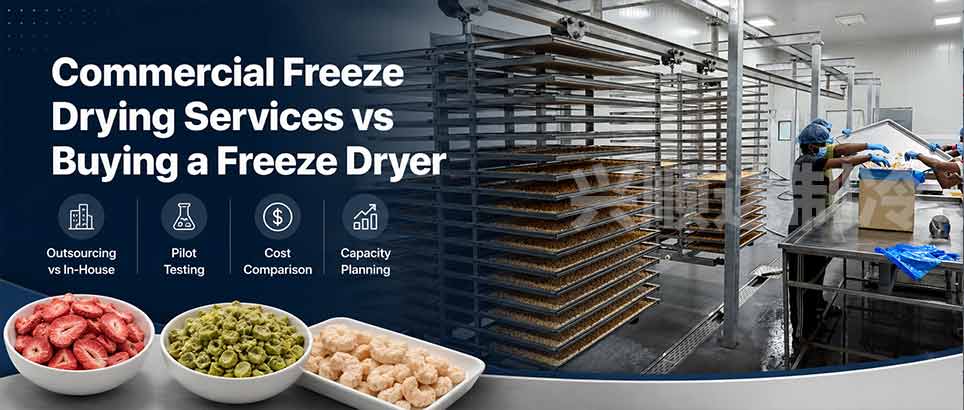
Commercial Freeze Drying Services or In-House Equipment: Quick Decision
The correct choice depends less on company size than on uncertainty, utilization, and the value of controlling the process. The three paths should be compared against the same accepted-product specification.
| Business condition | Best starting direction | Decision reason |
|---|---|---|
| Formula, packaging, or market demand is unproven | Outsource pilot batches | Preserve capital while testing whether customers will accept the product and price. |
| Volume is seasonal, irregular, or below a full economic load | Outsource | A service converts fixed equipment cost into a variable production cost. |
| Demand is growing, but the factory or operators are not ready | Hybrid | Keep a service provider for production while validating an in-house cycle and site plan. |
| The same product runs regularly and external queues delay orders | Calculate in-house production | Utilization and schedule control can create measurable savings and sales value. |
| Formula confidentiality, customer IP, or batch records are critical | Hybrid or in-house | Direct control reduces third-party access and makes data ownership clearer. |
| The product changes often or needs repeated cycle adjustment | Pilot equipment plus outsourced volume | Own the development data without purchasing full production capacity too early. |
Order frequency alone is not sufficient. A weekly order does not justify a machine if batches are too small, the site is not ready, or accepted output cannot cover finance, labor, utilities, cleaning, maintenance, packaging, and downtime.
What Are Commercial Freeze Drying Services?
Commercial freeze drying services are third-party arrangements for development or production. The customer may deliver prepared material for drying, or the provider may handle a wider manufacturing scope. Because the scope changes both price and responsibility, the service model should be identified before quotations are compared.
Toll Freeze Drying
The provider processes customer material for a fee. Preparation, pre-freezing, milling, packing, storage, and testing may be separate.
Pilot or R&D Service
Small batches establish product preparation, loading, cycle, endpoint, yield, rehydration, and packaging requirements.
Contract Manufacturing
The provider may source, prepare, freeze dry, mill, blend, pack, store, and document the finished product.
Private Label
The provider supplies an existing product or formula under the buyer’s brand. Launch speed is higher, but process ownership is usually lower.
Companies planning to sell processing rather than purchase it should use the separate freeze drying business feasibility guide; this page remains focused on the customer’s outsource-versus-own decision.
How Are Commercial Freeze Drying Services Priced?
A price per kilogram is useful only when the kilogram and included work are defined. A quote based on wet input cannot be compared directly with one based on accepted dry output.
| Quote basis | What it can hide | What to normalize |
|---|---|---|
| Wet input weight | Initial moisture, trim loss, rejected material, and dry yield | Total cost per accepted dry kilogram |
| Dry output weight | Acceptance limits, breakage, fines, moisture, and packing format | Accepted—not merely produced—output |
| Tray, batch, or machine hour | Usable loading, partial loads, cycle time, cleaning, and defrosting | Cost for the same product, load, and turnaround boundary |
| Complete project | Development runs, preparation, tests, storage, documentation, and freight | A written inclusion and exclusion schedule |
Questions Buyers Should Ask Before Comparing Quotes
- Is price based on wet input, gross dry output, or accepted dry output?
- What are the pilot MOQ, production MOQ, normal lead time, and peak-season lead time?
- Are preparation, pre-freezing, loading, unloading, milling, packing, testing, storage, and freight included?
- How are cleaning, allergen changeover, failed trials, rework, and rejected product charged?
- What yield, final moisture, breakage, sensory, and packaging limits define acceptance, and is water activity required by the product specification or regulatory plan?
- Which batch records, retained samples, photographs, and cycle data will the customer receive?
- Who owns the formula, pretreatment, drying cycle, improvements, and scale-up data?
How to Compare Outsourcing Cost with Buying a Freeze Dryer
Both options should be compared within the same boundary: the same product, accepted output, packaging state, production period, and quality specification. A low service rate can become expensive after freight and loss, while a low equipment price can become expensive when utilization is poor.
Monthly net savings should include only costs and benefits that can be documented. If the result is zero or negative, simple payback does not exist under the current production plan.
| Worksheet input | Outsourced production | In-house production |
|---|---|---|
| Accepted dry output per month | _____ kg | _____ kg |
| Total variable cost | _____ / month | _____ / month |
| Fixed cost and finance | Contract commitment, if any | _____ / month |
| Loss, rework, and rejected output | _____ | _____ |
| Lead time and missed-order value | _____ | _____ |
| Total cost per accepted dry kg | _____ / kg | _____ / kg |
| Utilization and downtime assumption | Provider commitment: _____ | Loaded batches/month: _____ |
For the equipment side, use wet load, water removed, tested loading per square meter, verified cycle time, cleaning, defrosting, and available production days. Installed power by itself is not energy consumption. See the freeze drying cost calculation guide and freeze dryer electricity guide for the full input method. If the remaining question is product margin and equipment ROI—not outsourcing—use the freeze dryer ROI guide for food businesses.
Compare a Service Quote with an In-House Capacity Scenario
Project information should include the product, three months of accepted output, wet load, initial moisture or solids, thickness, target endpoint, current service quote, freight, lead time, production days, and site utilities.
The engineering review can then identify a candidate equipment range, the cycle and loading assumptions that still require testing, likely condenser and utility requirements, and the data needed for a defensible cost comparison.
How to Evaluate a Freeze Drying Service Provider
A provider should be evaluated as a food-production partner, not only as available machine time.
Product and Process Capability
- Evidence with the same product form, formulation, or risk profile
- Documented loading, freezing, temperature, vacuum, condenser condition, cycle, and endpoint
- Repeatability across more than one batch
- Capacity for high-sugar, high-fat, viscous, mixed, or allergen-containing products where relevant
Food Safety and Quality
- Written sanitation, traceability, allergen, foreign-material, and recall procedures
- Calibrated measurement and defined sampling responsibility
- Packaging matched to moisture and oxygen sensitivity
- Product-specific acceptance and release criteria
Commercial Terms
- Pilot and production MOQ, scheduling window, and change policy
- Responsibility for failed batches, rework, scrap, and retained samples
- Price-adjustment, storage, freight, and cancellation terms
- Contingency capacity if the agreed production slot changes
Confidentiality and Data Ownership
- Ownership of formula, pretreatment, cycle, improvements, and records
- Permission rules for samples, photographs, and customer names
- Data release if production moves to a different factory
- Confidentiality obligations for employees and subcontractors
Regulatory boundary: the buyer remains responsible for determining which rules apply in the destination market. U.S. businesses can use the FDA’s Preventive Controls for Human Food overview and water activity guidance as starting points; neither replaces a product-specific food-safety review.
What Pilot-Test Data Must Be Retained?
A successful sample is not enough for transfer or equipment sizing. Research on food freeze-drying monitoring shows that even a fixed recipe does not guarantee identical freezing and drying conditions; endpoint behavior can change with the product, load, and cycle setup.[1]
| Data group | Records to retain | Decision supported |
|---|---|---|
| Raw material | Recipe, incoming condition, initial moisture or solids, sugar/fat/salt, pretreatment, and lot | Whether the next batch is genuinely comparable |
| Geometry and loading | Piece size, thickness, weight per tray, kg/m², tray count, total wet load, and product depth | Usable tray area, scale-up basis, and expected cycle risk |
| Freezing | Freezing method, product temperature, hold time, and condition at loading | Structure, repeatability, and starting state |
| Drying cycle | Shelf or heating temperature, chamber pressure, condenser temperature, stages, time, alarms, and interruptions | Cycle transfer and root-cause review |
| Endpoint and quality | Final moisture; center dryness; mass stability; appearance; texture; sensory result; rehydration; and, where required by the product specification or regulatory plan, water activity | Whether the batch meets the written commercial specification |
| Yield and packaging | Accepted yield, breakage, fines, rejects, exposure time before sealing, package structure, sealing result, and stability plan | Real cost, released quantity, and storage risk |
Loading and product thickness change the heat- and mass-transfer path, so one food’s kg/m² or cycle should not be reused as a universal capacity rule.[4] Final moisture is also not the only storage consideration: moisture uptake, physical state, and package environment can affect structure and quality after drying.[3] The freeze-dried food packaging guide explains barrier, sealing, oxygen-control, and handling factors that should be evaluated after drying.
How to Move from Outsourced Production to In-House Freeze Drying
Moving in-house is not a tray-count exercise. A food-powder engineering review notes that geometry, tray contact, radiation, and heat transfer differ between laboratory and commercial equipment and can change product temperature and batch uniformity.[2]
The Product Specification Is Fixed
The formulation, wet load, geometry, target endpoint, accepted quality, yield, and package should be defined. A material change should trigger a new verification decision.
The Process Record Is Transferred
The actual loading and cycle data should be obtained from the provider. If critical data are unavailable, the trial should be repeated on a pilot unit before production capacity is selected.
Equipment Is Sized by Water Removal, Not Only Tray Area
Equipment sizing should account for usable tray area, product load, water to be removed, condenser capture, refrigeration, vacuum stability, cycle time, defrosting, and cleaning. The batch freeze dryer capacity guide explains how these inputs are converted into a practical production range.
The Site and Real Product Are Verified
Power, cooling, drainage, ventilation, steam where applicable, floor loading, rigging, maintenance space, and packaging flow should be confirmed. An acceptance batch should then be run with the real product and a written endpoint.
The food freeze dryer validation guide covers product trials, FAT, SAT, training, and acceptance planning, while the commercial freeze dryer installation guide covers utilities and site preparation.
What Product-Specific Project Data Show
The following company case records demonstrate why product name, load, cycle, final moisture, and energy boundary must stay together. They are project examples, not universal performance guarantees.
Cooked Fried Rice
An SDG350 project record reports about 125 kg per batch at 12.5 kg/m², a 6-hour drying cycle, 1.28% final moisture, and approximately 1.67 kWh/kg of fresh cooked material.
Frozen-and-Cut Durian
An SDG1100 project record reports about 390 kg per batch at 13 kg/m², a 13-hour cycle, 2.09% final moisture, and approximately 1.73 kWh/kg of fresh material.
Pear Slices
An SDG3000 project record reports about 1,200 kg per batch at 12 kg/m², a 12-hour cycle, 2.21% final moisture, and separate electricity and steam consumption boundaries.
How to use these cases: compare the evidence fields, not just the headline capacity. A different recipe, thickness, pretreatment, loading, endpoint, equipment configuration, or utility boundary can produce a different result.
Which Equipment Fits Each Production Stage?
Equipment should follow verified wet load, water removal, cycle, turnaround, and operating schedule. Product trials determine which model range deserves a detailed utility and cost calculation.
| Production stage | Main objective | Relevant equipment path |
|---|---|---|
| Product development | Own the recipe, loading, cycle, endpoint, and packaging data | SDG60 and SDG90 pilot freeze dryers |
| Repeat commercial batches | Replace regular outsourced capacity with scheduled in-house production | SDG350, SDG700, and SDG1100 commercial models |
| Factory-scale production | Integrate larger wet loads, industrial utilities, material flow, and production planning | SDG1600, SDG3000, and SDG6000 industrial systems |
Frequently Asked Questions
How much do commercial freeze drying services cost?
There is no reliable universal rate. Cost depends on the quote basis, product water load, cycle, MOQ, preparation, cleaning, testing, packaging, storage, freight, accepted yield, and lead time. Compare total cost per accepted dry kilogram using one specification.
What is the minimum order for contract freeze drying?
MOQ depends on the provider’s pilot equipment, production chamber, cleaning burden, and schedule. Buyers should request the smallest development batch and the normal production minimum as separate figures.
Do freeze drying services include packaging?
Sometimes. Bulk packing, milling, portioning, retail packing, oxygen control, labeling, testing, and storage may be separate. The quote should identify the package structure, fill quantity, acceptance test, and responsibility for materials.
Who owns the drying cycle and production data?
Ownership is contractual. Rights to the formula, pretreatment, cycle, improvements, batch records, samples, photographs, and transfer data should be defined before the first trial.
When should a food company buy its own freeze dryer?
Ownership should be calculated when accepted volume is repeatable, the machine can be loaded regularly, external lead time restricts sales, or process control and confidentiality have measurable value. The calculation should include site, finance, labor, utilities, maintenance, cleaning, packaging, and downtime.
Can outsourced test data be used to size a commercial freeze dryer?
Yes, if the data include the exact formulation, wet load, geometry, kg/m², tray area, freezing method, temperature, pressure, condenser conditions, time, endpoint, yield, and package. A sample labeled “successfully dried” is not a transferable sizing record.
Is final moisture enough to prove shelf stability?
No. The release plan may also need water activity, package barrier and seal verification, oxygen control, storage conditions, microbiological or chemical criteria, and a product-specific stability study. Requirements depend on the food and destination market.
Final Decision: Outsource, Use a Hybrid Path, or Buy?
Outsourcing is appropriate when uncertainty is the main risk, while a hybrid path suits growing demand when product data, staff, or site readiness remains incomplete. Equipment ownership becomes defensible only when accepted output, utilization, monthly net savings, process ownership, and schedule value support the investment. The product should first be validated, the complete pilot record retained, and equipment sized from actual water load and cycle data.
Ready to Test the In-House Case?
Project information should include the product, wet load, moisture or solids, thickness, target endpoint, current outsourced cost, monthly accepted output, production schedule, and available utilities.
The resulting comparison helps determine whether the project should remain outsourced, add pilot capability, or move toward a commercial or industrial freeze dryer.

Reviewed by Zheng Wei, Founder & Freeze-Drying System Engineer
Zheng Wei participates in food-product trials, equipment selection, vacuum and refrigeration planning, installation guidance, and drying-process optimization at Fuzhou Xing Shun Da Refrigeration Facility Project Co., Ltd.
Evidence basis: product-specific project records, equipment-selection practice, and the cited freeze-drying literature. Last reviewed: July 6, 2026. Product trials remain necessary before capacity, cycle, energy, or quality commitments are made.
References
- Pisano R, Barresi AA, Fissore D. Innovation in Monitoring Food Freeze Drying. Drying Technology. 2011;29(16):1920–1931. Innovation in Monitoring Food Freeze Drying — DOI: 10.1080/07373937.2011.596299
- Ratti C. Freeze drying for food powder production. In: Handbook of Food Powders: Processes and Properties. Woodhead Publishing; 2013:57–84. Freeze Drying for Food Powder Production — DOI: 10.1533/9780857098672.1.57
- Nowak D, Jakubczyk E. The Freeze-Drying of Foods—The Characteristic of the Process Course and the Effect of Its Parameters on the Physical Properties of Food Materials. Foods. 2020;9(10):1488. The Freeze-Drying of Foods — DOI: 10.3390/foods9101488
- Liu Y, Liu Y, Zhang Z, Hu L. High efficient freeze-drying technology in food industry. Critical Reviews in Food Science and Nutrition. 2022;62(12):3370–3388. High Efficient Freeze-Drying Technology in Food Industry — DOI: 10.1080/10408398.2020.1865261