
Does Freeze Drying Kill Bacteria? Food Safety Facts for Commercial Production
Freeze drying is excellent for preserving food quality, shape, color, flavor, and shelf stability. However, it should not be treated as a reliable sterilization or pathogen-kill step.
For food manufacturers, the real question is not only whether a freeze dryer removes water. Instead, the important question is whether the full process can control raw material risk, sanitation, pre-treatment, drying consistency, water activity, packaging, and storage.
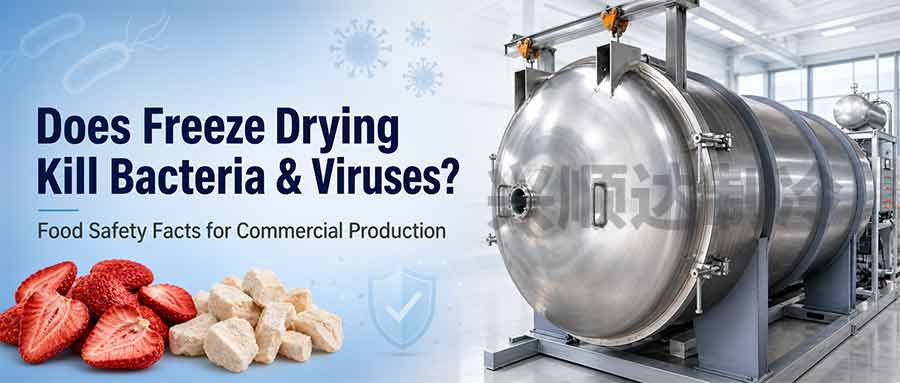
Quick Answer: No, Freeze Drying Does Not Reliably Kill Bacteria or Viruses
Freeze drying preserves food by freezing the product and removing water under vacuum. However, it does not include a validated heat sterilization step, so bacteria, viruses, molds, and spores may survive if they are present before drying.
Therefore, commercial producers should control raw materials, sanitation, pre-treatment, water activity, packaging, and storage instead of relying on the freeze dryer alone.
Does Freeze Drying Kill Bacteria?
Freeze drying may stress or reduce some bacteria, but it should not be considered a reliable bacterial kill step. During drying, bacterial cells may face low temperature, dehydration, vacuum, and osmotic stress. Nevertheless, many cells can survive.
In addition, bacterial spores are often more resistant than ordinary bacterial cells. For this reason, products such as raw meat, seafood, dairy, eggs, pet food, and ready meals need product-specific safety controls before production begins.
Pathogens Need Validated Controls
- Salmonella
- E. coli
- Listeria monocytogenes
- Staphylococcus aureus
- Bacillus spores
- Clostridium spores
Do Not Use Appearance as Proof of Safety
A product can look dry while still containing uneven moisture inside thick pieces. Therefore, commercial producers should test final moisture and water activity, especially when product thickness, loading density, or recipe composition changes.
Moreover, a food safety plan should be based on the product type, raw material risk, intended use, and local regulations.
External reference: University of Minnesota Extension explains that freeze drying has no heat treatment step and does not kill illness-causing microorganisms such as bacteria and viruses. Read the UMN Extension food safety guide.
Does Freeze Drying Kill Viruses?
Freeze drying also should not be treated as a reliable virus inactivation method. Viruses do not grow in food like bacteria, but they may survive in contaminated raw materials, surfaces, or finished products.
For example, produce, seafood, dairy-based products, raw pet food, and animal-derived ingredients may require special attention. Therefore, virus control should come from supplier control, sanitation, validated pre-treatment, approved processing steps, and regulatory review.
Products That Need More Attention
- Freeze-dried berries and cut produce
- Freeze-dried seafood products
- Raw meat and raw pet food
- Dairy-based freeze-dried products
- Ready-to-eat freeze-dried meals
Raw Pet Food Requires Extra Caution
In the United States, the FDA has required certain cat and dog food manufacturers using uncooked or unpasteurized poultry, cattle, milk, or egg materials to reanalyze food safety plans for H5N1 risk.
As a result, raw pet food producers should not assume that freeze drying alone controls virus hazards.
External reference: For raw or unpasteurized animal-derived ingredients, review the FDA update on H5N1 in cat and dog food safety plans.
Why Freeze Drying Preserves Food but Does Not Sterilize It
Freeze drying is a preservation process, not a sterilization process. First, the product is frozen. Next, ice is removed by sublimation under vacuum. Finally, bound moisture is reduced during secondary drying.
Because this process removes available water, microbial growth becomes strongly limited when the final product remains dry and properly packaged. However, low water activity does not mean that all microorganisms have been destroyed.
Freezing
Freezing slows microbial activity. However, it does not necessarily kill microorganisms that are already present in the raw material.
Primary Drying
During sublimation, ice changes directly into vapor under vacuum. This removes moisture, but it is not a validated sterilization step.
Secondary Drying
Secondary drying reduces remaining bound moisture. Therefore, the product becomes more shelf-stable when packaging and storage are controlled.
What Microorganisms May Survive Freeze Drying?
Different microorganisms respond differently to freezing, vacuum, and drying. Therefore, commercial producers should evaluate risks by organism type, raw material, recipe, and intended use.
| Microorganism Type | Can Freeze Drying Reliably Kill It? | Main Risk | Recommended Control |
|---|---|---|---|
| Bacteria | No | Some cells may survive and become active after rehydration or moisture exposure. | Supplier control, cooking, pasteurization, sanitation, environmental monitoring, and water activity testing. |
| Viruses | No | Some viruses may remain infectious depending on ingredient source and product matrix. | Validated pre-treatment, approved processing steps, supplier verification, and regulatory review. |
| Mold | Not reliably | Mold growth stops when the product remains dry, but spores may survive. | Sorting, sanitation, low water activity, moisture-proof packaging, and dry storage. |
| Bacterial Spores | No | Spores are more resistant than many vegetative bacterial cells. | Product-specific hazard analysis, validated controls, and careful shelf-life testing. |
Moisture Content and Water Activity Are Not the Same
Moisture content measures the total amount of water in a product. Water activity measures how much water is available for microorganisms to grow. Therefore, a freeze-dried product should not be judged only by touch, appearance, or final moisture percentage.
For commercial production, water activity testing is important because low water activity helps limit microbial growth during storage. However, low water activity does not mean that all microorganisms have been destroyed.
Why Water Activity Matters
A product can have low moisture content but still contain areas with higher available water. As a result, testing should focus on real product data, not only machine settings.
- Test water activity after drying.
- Test different pieces or tray positions when needed.
- Retest after packaging or shelf-life trials.
What Producers Should Avoid
Do not assume that a crispy texture automatically means the product is safe. In addition, do not treat a low final moisture value as proof that pathogens are destroyed.
- Avoid relying only on appearance.
- Avoid over-drying without a clear quality target.
- Avoid using one product result for a different recipe.
External reference: The FDA explains that controlling water activity helps inhibit microbial growth, and 0.85 is an important reference point in food safety regulations. Read the FDA water activity guide.
Which Freeze-Dried Foods Need More Safety Control?
Not all freeze-dried foods carry the same level of risk. Therefore, each product category should be evaluated separately before production scale-up.
| Product Category | Main Risk | What Manufacturers Should Control |
|---|---|---|
| Raw meat and pet food | Pathogens, viruses, fat oxidation, and cross-contamination. | Supplier control, validated kill step, hygienic handling, packaging, and local regulations. |
| Seafood | Bacteria, parasites, viruses, and handling contamination. | Raw material inspection, cold chain control, pre-treatment, and process validation. |
| Eggs and dairy | Pathogens from raw or unpasteurized materials. | Pasteurization or another validated safety control before freeze drying. |
| Berries and cut produce | Contamination from soil, water, washing, handling, or equipment. | Supplier verification, washing, sorting, sanitation, and water activity testing. |
| Ready meals | Mixed ingredients with different drying and safety risks. | Recipe testing, cooking validation, uniform drying, and final moisture control. |
What Should Food Manufacturers Control Before Freeze Drying?
Food safety starts before the product enters the freeze dryer. Therefore, raw material control, sanitation, pre-treatment, and loading practices should be confirmed before a commercial production plan is finalized.
Raw Material Control
- Choose reliable suppliers.
- Inspect raw materials before processing.
- Reject spoiled or visibly contaminated materials.
- Maintain cold chain where required.
Pre-Treatment and Kill Steps
- Use cooking, blanching, pasteurization, or other validated controls when needed.
- Confirm product thickness and loading density.
- Test full recipes instead of single ingredients only.
- Document the process before scale-up.
Hygienic Loading
- Clean and sanitize trays and carts.
- Control worker hygiene and traffic flow.
- Reduce cross-contamination during transfer.
- Separate raw and ready-to-eat areas where necessary.
Process tip: If the product is new, start with sample testing before buying a larger system. This helps confirm thickness, drying time, final moisture, water activity, texture, color, and packaging direction.
What Should Be Controlled During and After Freeze Drying?
During freeze drying, equipment performance affects product consistency. After drying, packaging and storage conditions become critical because freeze-dried food can absorb moisture quickly from the air.
During Freeze Drying
Process Stability
Stable freezing, vacuum control, heat transfer, and condenser performance help each batch follow a repeatable drying curve. Moreover, uniform drying reduces the risk of wet spots.
- Monitor shelf temperature and product temperature.
- Track chamber vacuum and condenser status.
- Confirm cold trap capacity for the product load.
Drying Validation
A validated drying process should match the product, thickness, loading density, and target final moisture. Therefore, operators should not rely only on a preset recipe for different foods.
- Check different tray positions.
- Test thick products in the center.
- Record process data for future batches.
After Freeze Drying
Testing and Packaging
After drying, manufacturers should test final moisture and water activity. In addition, packaging should happen quickly in a clean and controlled environment.
- Use moisture-proof packaging.
- Consider oxygen absorbers or nitrogen flushing when needed.
- Control humidity during packing.
Storage and Shelf-Life
Finally, shelf-life testing should be based on real product data. Temperature, humidity, packaging material, oxygen exposure, and product composition can all affect stability.
- Store finished products in a cool, dry place.
- Check moisture absorption risk.
- Validate shelf life for each product category.
How Industrial Freeze Dryer Design Supports Food Safety and Stability
A freeze dryer does not replace food safety management. However, good equipment design can support a cleaner, more repeatable, and more stable production process.
Cleanable Design
Easy-to-clean chamber surfaces, food-grade trays, smooth welds, and practical access help reduce residue buildup and cross-contamination risk.
Drying Consistency
Uniform heating, stable vacuum, and sufficient condenser capacity help reduce uneven moisture. As a result, finished products are easier to test and package.
Process Records
Recipe storage, temperature records, vacuum data, and drying logs help operators repeat successful batches and identify process problems faster.
For equipment selection, read the industrial food freeze dryer selection guide, compare industrial freeze dryer models, or review the freeze dryer condenser guide.
Planning Commercial Freeze-Dried Food Production?
Before choosing equipment, confirm product type, pre-treatment, drying time, final moisture, water activity target, packaging method, and factory sanitation conditions.
Our team can help food manufacturers review product process, daily capacity, factory layout, and freeze dryer configuration before investment.
FAQ About Freeze Drying, Bacteria, and Viruses
These answers help food manufacturers understand the limits of freeze drying and the controls needed for commercial freeze-dried food production.
Does freeze drying kill Salmonella?
Not reliably. Salmonella may survive freeze drying, especially in raw meat, eggs, dairy, or low-moisture foods. Therefore, manufacturers should use validated controls when Salmonella risk exists.
Does freeze drying kill E. coli?
No, freeze drying should not be treated as a reliable E. coli kill step. Raw material control, sanitation, cooking, pasteurization, or other validated methods may be needed.
Does freeze drying kill Listeria?
Freeze drying is not a reliable Listeria control method. Instead, Listeria risk should be managed through sanitation, environmental monitoring, temperature control, and validated food safety steps.
Does freeze drying kill mold?
Freeze drying can stop mold growth by removing available water. However, mold spores may survive, so manufacturers should control raw material quality, water activity, packaging, and storage.
Can bacteria grow in freeze-dried food?
Bacteria usually cannot grow well when freeze-dried food remains dry and properly packaged. However, if the product absorbs moisture or is rehydrated, surviving bacteria may become active again.
Does freeze drying sterilize food?
No. Freeze drying is a preservation method, not a sterilization method. Sterilization requires validated processes such as heat, pressure, irradiation, chemicals, or other approved treatments.
Does freeze drying make food shelf-stable?
Freeze drying can help make food shelf-stable when final moisture, water activity, packaging, and storage conditions are properly controlled. However, shelf stability does not mean the product has been sterilized.
What water activity should freeze-dried food reach?
The target water activity depends on product type, regulation, packaging, and shelf-life goal. Therefore, food manufacturers should test water activity instead of relying only on appearance or final moisture percentage.
Is freeze-dried raw pet food safe?
Freeze-dried raw pet food requires strict raw material control, sanitation, pathogen control, packaging, and regulatory review. Freeze drying alone should not be treated as a kill step.
Does freeze drying kill H5N1?
Manufacturers should not assume that freeze drying kills H5N1. Animal-derived raw materials should be managed according to current food safety regulations and validated control measures.
Freeze Drying Preserves Food, but Food Safety Needs a Complete Process
Freeze drying is a powerful technology for preserving flavor, color, shape, nutrition, and shelf life. However, it does not reliably kill bacteria or viruses.
For commercial production, food safety depends on raw material selection, sanitation, pre-treatment, drying control, water activity testing, packaging, and storage. In addition, the right industrial freeze dryer can support more consistent drying, cleaner operation, and better production stability.
Therefore, food manufacturers should design the full process before choosing equipment. This approach reduces production risk and helps build a safer, more reliable freeze-dried food business.