
Food Freeze Dryer Validation: FAT, SAT and Acceptance Tests
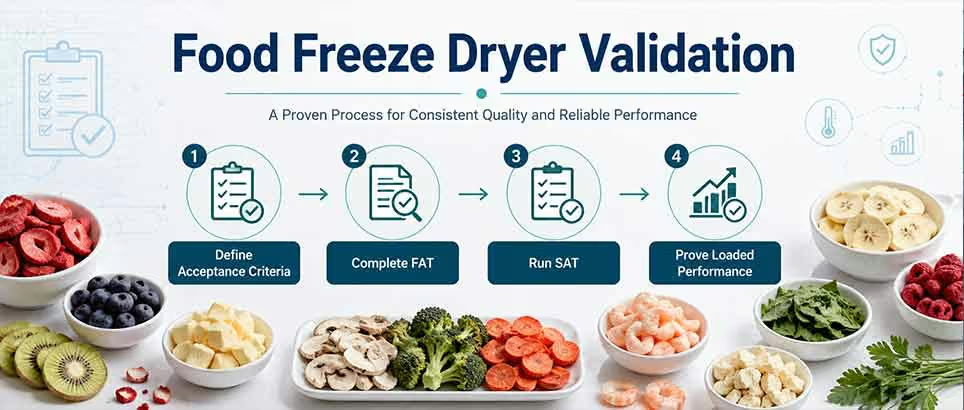
Freeze dryer validation for a food factory should confirm that the delivered system matches the agreement, operates safely, produces trustworthy records, and can dry an agreed real-food load to a defined result.
Quick Answer
A practical food freeze dryer qualification plan normally includes a design and document review, factory acceptance testing (FAT), site acceptance testing (SAT), commissioning, functional checks, and one or more loaded performance runs. The buyer and manufacturer should agree on the product, loading density, thickness, initial moisture, cycle target, final moisture, sampling positions, utilities, records, and failure procedure before testing begins.
An empty-chamber vacuum test proves only part of the system. A published equipment case found that two refrigeration circuits appeared similar without load, while a sublimation run exposed unequal cooling and impaired condenser performance.[1] The case involved pharmaceutical equipment, so it supports the need for load testing—not a universal food acceptance limit.
Reviewed: July 1, 2026 · Scope: food-production freeze dryers, not sterile pharmaceutical lyophilizers.
What Should Food Freeze Dryer Validation Prove?
The purpose of a food freeze dryer acceptance test is to create objective evidence that the delivered system matches the agreement and can perform the intended production task. The protocol should answer six questions.
Was the Correct System Delivered?
The model, chamber, drying area, vacuum package, refrigeration package, heating arrangement, controls, trays, spares, and electrical requirements should match the approved technical agreement.
Is It Installed Correctly?
Power, cooling water, steam where applicable, drainage, grounding, access, ventilation, and maintenance space should satisfy the approved installation conditions.
Do Core Systems Work Together?
The vacuum, condenser, heating, temperature measurement, pressure measurement, controls, alarms, and interlocks should operate as one stable system.
Are Measurements Trustworthy?
Critical instruments should have suitable ranges, identification, calibration records, and enough accuracy for the acceptance decision.
Can It Dry the Agreed Food Load?
A representative loaded run should evaluate real water removal, pressure stability, condenser loading, drying time, and uniformity across the chamber.
Does the Product Meet the Target?
Final moisture, product-center dryness, mass stability, texture, rehydration, batch consistency, and packaging suitability should meet the buyer’s written specification.
Three Values That Should Not Be Confused
- Ultimate vacuum is not the same as the pressure used during drying.
- Minimum condenser temperature is not the same as water-capture capacity under load.
- Nominal drying area is not proof of wet-material throughput.
For a deeper technical explanation, see the guides to freeze dryer vacuum pump sizing, condenser capacity, and freeze-drying temperature and pressure.
FAT vs SAT vs Commissioning vs Qualification
These terms are related, but they do not describe the same work. Project documents should define each stage, its location, responsibilities, required evidence, and approval authority.
| Stage | Typical Location | Primary Purpose | Typical Evidence | Approval |
|---|---|---|---|---|
| Design review | Before manufacture | Confirm that the proposed system and utilities fit the product and capacity target. | Technical agreement, layout, utility sheet, component list. | Buyer and manufacturer. |
| FAT | Manufacturer’s factory | Confirm configuration, workmanship, controls, safety, vacuum, cooling, heating, and documentation before shipment. | Signed protocol, raw readings, trends, photographs, videos, deviations. | Manufacturer and buyer or buyer’s representative. |
| SAT | Buyer’s site | Confirm that transport, installation, utilities, and site connections have not affected performance. | Installation checks, utility records, functional retests. | Buyer and manufacturer. |
| Commissioning | Buyer’s site | Place each subsystem into a stable, operable condition and train personnel. | Startup records, settings, alarm tests, training records. | Project and engineering teams. |
| Functional qualification | Buyer’s site | Show that the equipment operates within the agreed functional ranges. | Approved protocol, calibrated readings, pass/fail records. | Buyer’s designated quality or project authority. |
| Loaded performance test | Factory or buyer’s site | Demonstrate performance with an agreed representative food load. | Batch record, product data, pressure and temperature trends, final test results. | Buyer’s final acceptance authority. |
Food Equipment Scope
Formal DQ, IQ, OQ, and PQ terminology is common in regulated pharmaceutical projects. A food factory may adopt similar documentation, but it should not assume that every pharmaceutical requirement applies automatically. The correct scope depends on the contract, product risk, buyer quality system, customer requirements, and local regulations.
Define Acceptance Criteria Before the Test
Freeze dryer validation fails most often when the parties begin testing without a shared definition of “pass.” The criteria should be written into the technical agreement or an approved protocol before manufacture, shipment, or final payment.
Equipment and Utility Basis
- Machine model and approved configuration
- Usable drying area and tray quantity
- Vacuum system and agreed pump-down test
- Condenser arrangement and test conditions
- Heating method and temperature-control range
- Electrical supply, cooling water, drainage, and steam where required
- Control, recording, remote access, alarm, and interlock functions
Product and Performance Basis
- Representative product and batch preparation
- Wet batch mass and loading density in kg/m²
- Slice thickness, bed depth, or piece dimensions
- Initial moisture or solids content
- Pre-freezing condition
- Target drying time and turnaround basis
- Final moisture, center dryness, quality, and uniformity targets
When the buyer has not yet developed a commercial cycle, a food R&D and pilot freeze-drying test should be completed first. Pilot data can establish product thickness, loading, process limits, endpoint evidence, and a realistic basis for scale-up.
Documents Buyers Should Review Before FAT
A strong FAT begins with document control. The buyer should not rely only on a product brochure or a final summary sheet.
| Document | Why It Matters |
|---|---|
| Approved technical agreement | Defines the contractual configuration and performance basis. |
| General arrangement and installation drawing | Confirms footprint, access, interfaces, drainage, and maintenance space. |
| Electrical and control documentation | Supports inspection, maintenance, troubleshooting, and safe handover. |
| Utility requirement sheet | Prevents site performance problems caused by inadequate power, cooling, steam, or drainage. |
| Instrument list and calibration records | Shows which readings support the acceptance decision. |
| Alarm and interlock list | Defines the faults that will be simulated during testing. |
| FAT/SAT protocol | States the method, evidence, acceptance limits, responsibilities, and signatures. |
| Operating and maintenance manuals | Supports training and post-handover operation. |
| Spare-parts and consumables list | Reduces avoidable downtime after commissioning. |
| Deviation and retest form | Prevents unresolved failures from being hidden in a final report. |
For food facilities serving the United States, equipment design, installation, maintenance, and process controls should also be reviewed against the applicable food-safety system. The official 21 CFR Part 117 includes requirements for cleanable equipment, installation that facilitates cleaning and maintenance, accurate process instruments, and adequate process controls.[2]
Factory Acceptance Test Checklist


1. Equipment Identity and Configuration
The FAT team should compare the nameplate, model, serial number, chamber, drying area, tray count, vacuum equipment, refrigeration components, heating components, controls, accessories, and spare parts with the approved order. Substituted components should be documented and approved before shipment.
2. Visual, Mechanical and Cleanability Inspection
The inspection should cover fabrication, doors, seals, piping, drainage, defrost arrangements, trays, loading structures, service access, guards, labeling, and food-contact areas. The chamber and adjacent spaces should be accessible for inspection and cleaning. The separate vacuum chamber buying checklist explains why shell integrity, door sealing, deformation resistance, drainage, and maintenance access matter.
3. Empty-Chamber Vacuum Test
The chamber should be clean, dry, and at a recorded starting condition. The protocol should identify the pressure instrument, its range, calibration status, starting pressure, target pressure, time to target, isolation method, hold time, and acceptable pressure rise.
The result should be compared with the specification for the exact model. A universal pump-down time should not be applied to every chamber size. Moreover, the test should distinguish between:
- pump-down capability;
- pressure stability;
- leak tightness;
- instrument response; and
- production pressure under water-vapor load.
4. Refrigeration and Condenser Test
The FAT should record condenser pull-down, stable temperature, alarms, defrosting, drainage, and relevant protection functions. However, the lowest empty condenser temperature is only a functional check. The decisive performance question is whether the condenser can capture the expected water-vapor load while the chamber pressure remains stable.

5. Heating and Temperature-Control Test
The test should verify programmed heating steps, sensor identification, temperature response, uniform operation, over-temperature protection, and recorded trends. For this manufacturer’s food freeze dryers, heat is transferred by radiation from hollow anodized-aluminum heating plates using the specified intermediate heating arrangement. The acceptance document should describe the actual supplied design rather than borrowing pharmaceutical shelf-system language that does not match the machine.

6. Controls, Records, Alarms and Interlocks
The operator should be able to set, save, run, stop, and review the agreed recipe. The FAT should also test temperature, pressure and condenser records; alarm history; emergency stop; power-loss behavior; user access; remote monitoring where included; and data export.

7. Instrument Calibration and Traceability
Critical temperature, pressure, mass, energy, and utility measurements should be suitable for the required decision. Calibration records should identify the instrument, date, method, result, uncertainty or tolerance where applicable, and next action. NIST explains that metrological traceability depends on a documented, unbroken chain of calibrations and is a property of the measurement result—not simply a label attached to an instrument or certificate. See the official NIST metrological traceability guidance.[3]
Freeze Dryer SAT and Commissioning at the Buyer’s Site
A freeze dryer SAT confirms that shipment, positioning, assembly, installation, and site utilities have not affected the approved equipment performance. A passed FAT does not remove the need for site testing.

Site and Utility Checks
- Transport damage and completeness
- Ground-level installation and adequate structural support
- Rigging and maintenance access
- Electrical supply, voltage, phase, grounding, and protection
- Cooling-water flow, temperature, quality, and return conditions
- Steam pressure and supply capacity for applicable industrial systems
- Drainage, defrost-water handling, and ventilation
Functional Retests
- Vacuum pump-down and pressure stability
- Condenser pull-down
- Heating and temperature response
- Sensor and control checks
- Alarm, interlock, and emergency-stop tests
- Recipe operation and data recording
- Operator, maintenance, and cleaning training
The buyer is normally responsible for preparing the site and utilities to the agreed specification. The commercial freeze dryer setup guide explains delivery access, equipment location, utilities, drainage, maintenance space, and installation responsibilities in more detail.
Loaded Performance Test with Real Food
The loaded test connects subsystem checks to the intended production task. Under water-vapor load, the vacuum system, condenser, heating process, and product must perform together.
Define the Test Product and Load
The protocol should record the food, batch source, preparation, wet mass, initial moisture or solids, piece dimensions, thickness or bed depth, tray count, loading density, pre-freezing method, target final moisture, and target cycle time. The selected product should represent the intended commercial challenge, not an unusually thin or lightly loaded sample chosen only to pass the test.
Why record these details? In a controlled vegetable study, 1, 2 and 3 mm carrot slices followed different drying curves, and capsicum, mushroom and carrot did not behave alike under the same laboratory conditions.[4] For buyers, the practical implication is simple: a supplier cannot reproduce or guarantee a loaded test if the product and geometry are left undefined.
Record the Complete Cycle
The batch record should include product temperatures, chamber pressure, condenser temperature, heating steps, alarms, stage durations, total drying time, defrosting and turnaround, electricity use, and steam consumption where applicable. Original trend data should be retained with the signed report.
Sample the Difficult Positions
Product testing should include the thickest pieces and the product center. It should also cover top, middle, and lower positions; central and peripheral trays; and any location suspected of weaker heat transfer or vapor removal. Testing only the driest sample gives a misleading result.
Evaluate the Finished Product
For this manufacturer’s routine food-project verification, the main checks are final moisture content, product-center dryness, mass stability, sensory and texture evaluation, rehydration performance, batch consistency, and packaging or shelf-life verification. Water activity may be added when the buyer’s specification, risk assessment, market requirement, or third-party laboratory program requires it; it is not presented as a routine test performed in every project.
Engineering Experience: Why Load Details Matter
According to the linked company case study, an Oregon pear project used a 100 m² SDG3000 for approximately 1,200 kg of pear slices at 12 kg/m². The case records a cycle of about 12 hours, a 26–100 Pa operating range, and 2.21% final moisture. These figures are meaningful because product, thickness, loading, drying area, time, pressure, final moisture, and utilities were evaluated together. Read the 100 m² freeze-dried pear case study.
Sample Freeze Dryer Acceptance Matrix
The following matrix can be adapted to a specific model and product. Numerical limits should come from the signed technical agreement, not from a generic web article.
| Acceptance Item | Test Method | Required Evidence | Acceptance Basis | Result |
|---|---|---|---|---|
| Delivered configuration | Compare machine and documents item by item. | Configuration list, nameplates, photographs. | Technical agreement. | Pass / Fail |
| Empty pump-down | Record time from defined starting condition to target pressure. | Raw pressure trend and calibration status. | Model-specific FAT protocol. | Pass / Fail |
| Pressure hold | Isolate chamber and record pressure rise for the stated period. | Original readings and test conditions. | Approved leak/hold criterion. | Pass / Fail |
| Condenser function | Record pull-down and stable operation; verify under agreed loaded conditions where required. | Temperature trend and loaded-run data. | Project specification. | Pass / Fail |
| Heating control | Run programmed steps and verify sensors, response, and protection. | Temperature records and alarm tests. | Project specification. | Pass / Fail |
| Alarms and interlocks | Simulate defined fault conditions. | Alarm history and signed checklist. | Approved alarm list. | Pass / Fail |
| Representative loaded batch | Run agreed food, loading, thickness, and cycle. | Complete batch record. | Contracted performance basis. | Pass / Fail |
| Finished product | Sample multiple and worst-case locations. | Moisture, center dryness, mass, texture, rehydration, consistency records. | Buyer’s product specification. | Pass / Fail |
| Training and handover | Review manuals, spares, training, and open issues. | Signed handover list. | Supply scope. | Pass / Fail |
Eight Common Freeze Dryer Validation Mistakes
- Checking only the brochure. Marketing specifications cannot replace raw test records.
- Treating ultimate vacuum as production performance. Drying occurs under water-vapor load and controlled heat input.
- Skipping the loaded test. An empty chamber does not prove throughput or product uniformity.
- Using an easy demonstration load. Thin, lightly loaded samples can hide condenser, heat-transfer, and drying limitations.
- Failing to define thickness and kg/m². Batch mass without product geometry is not a reproducible test condition.
- Using unverified measurements. A pass/fail decision is weak when critical instruments lack suitable calibration evidence.
- Leaving deviations unresolved. A failed item should remain open until the cause, correction, and retest are documented.
- Accepting the machine before handover is complete. Manuals, spares, training, recipes, records, and support responsibilities are part of an operable system.
What Happens When a Test Fails?
A failed test should not be deleted, rewritten, or hidden inside a final report. The project team should:
- record the deviation and affected requirement;
- confirm whether the test setup, utility condition, operating method, instrument, product preparation, or equipment caused the result;
- identify the root cause;
- implement and document the correction;
- define which tests are invalidated and must be repeated;
- retain the original result and the retest result; and
- obtain the buyer’s approval before closing the deviation.
Final acceptance and payment milestones should follow the agreed contract. A functional test pass should not automatically override a failed loaded-performance requirement.
When Should a Freeze Dryer Be Requalified?
Risk-based retesting should be considered after relocation, major vacuum-system changes, condenser or refrigeration replacement, heating or control modification, critical-instrument replacement, major repair, unexplained capacity loss, repeated out-of-specification batches, or a new product/load beyond the previously tested operating range.
How Many Successful Batches Are Required?
There is no universal batch count for every food freeze dryer project. The number should reflect product risk, equipment novelty, process knowledge, the buyer’s quality system, customer requirements, and local rules. Even FDA’s pharmaceutical process-validation guidance does not reduce validation to a simplistic fixed number of batches. The food project should use a documented, risk-based rationale rather than copying a pharmaceutical convention without context.
For readers comparing terminology, the peer-reviewed paper Recommended Best Practices for Lyophilization Validation provides a detailed pharmaceutical framework.[5] It is useful background, but it should not be presented as a mandatory food-equipment standard.
Information to Send the Freeze Dryer Manufacturer
A useful freeze dryer validation proposal requires product, capacity, utility, and documentation details—not a daily capacity number alone.
Product Information
- Food name and formulation
- Wet load per batch or per day
- Initial moisture or solids content
- Piece size, thickness, and planned loading density
- Pre-freezing method
- Target final moisture and product quality
- Maximum acceptable cycle time
Project Information
- Country and installation location
- Electrical supply
- Cooling-water conditions
- Steam conditions for applicable industrial models
- Required FAT, SAT, loaded test, and training scope
- Required documents and language
- Buyer quality-system or customer-specific requirements
After commissioning, the production team should also follow a controlled operating and recordkeeping method. The guide on how to use a commercial freeze dryer covers pre-start checks, loading, freezing, vacuum drying, endpoint confirmation, unloading, defrosting, cleaning, and routine records.
Request a Food Freeze Dryer FAT, SAT and Acceptance Plan
Send the product, load target, thickness, initial moisture or solids, available utilities, installation country, and required documents to discuss a model-specific FAT/SAT scope and acceptance matrix.
Food Freeze Dryer Validation FAQs
What is freeze dryer validation?
It is the documented process of confirming that the delivered freeze dryer matches the agreed design, is installed and operated correctly, produces trustworthy records, and can achieve the defined result with the intended food load.
What is the difference between FAT and SAT?
FAT is completed before shipment at the manufacturer’s facility. SAT is completed after installation at the buyer’s site to confirm transport condition, utility connections, site installation, and functional performance.
Can an empty-chamber vacuum test prove production capacity?
No. It can evaluate pump-down, pressure stability, leak tightness, and instruments under defined dry conditions. It cannot prove condenser loading, heat and mass transfer, commercial drying time, or finished-product uniformity.
Should the loaded test use water or the buyer’s real food?
Water, ice, or another surrogate can be useful for a defined subsystem test. For example, researchers used ice tests on a 5 m² food freeze-dryer to verify the relationship between heating-plate temperature and heating power.[6] That is useful equipment evidence, but final production acceptance should still use an agreed representative food or a technically justified challenge load because geometry, solids, thickness, freezing behavior, and loading density affect the result.
Is IQ/OQ/PQ mandatory for a food freeze dryer?
Not universally. A food factory may use this structure when required by its quality system, customers, contract, or local regulations. The project should define the applicable documentation instead of assuming pharmaceutical requirements automatically apply.
What should the manufacturer provide after acceptance?
The handover package should include the signed test reports, deviations and closures, approved settings or recipes, manuals, drawings, calibration records, spare-parts list, training records, and agreed after-sales contacts.
References and Technical Sources
- Peer-reviewed Chinese article: 过星. 冻干机制冷系统的典型问题及案例分析[J]. 机电信息, 2014(11): 31-33. DOI: 10.19514/j.cnki.cn32-1628/tm.2014.11.007.
- Official regulation: Electronic Code of Federal Regulations: 21 CFR Part 117 — food CGMP, equipment, instruments, sanitation, and process controls.
- Official technical source: NIST: Metrological Traceability — documented calibration chains and the meaning of traceable measurement results.
- Peer-reviewed English article: George JP, Datta AK. Development and validation of heat and mass transfer models for freeze-drying of vegetable slices. Journal of Food Engineering. 2002;52(1):89-93. DOI: 10.1016/S0260-8774(01)00091-7.
- Peer-reviewed English article: Jameel F, Alexeenko A, Bhambhani A, et al. Recommended Best Practices for Lyophilization Validation 2021 Part II: Process Qualification and Continued Process Verification. AAPS PharmSciTech. 2021;22(8):266. DOI: 10.1208/s12249-021-02107-6.
- Peer-reviewed Chinese article: 陈海涛, 张力生, 李新秋. 食品真空冷冻干燥机加热系统[J]. 食品科技, 2007(3): 140-142. DOI: 10.13684/j.cnki.spkj.2007.03.039.
About the Author: Zheng Wei
Founder & Freeze-Drying System Engineer
Fuzhou Xing Shun Da Refrigeration Facility Project Co., Ltd.
Zheng Wei participates in food freeze-drying trials, equipment selection, vacuum-system configuration, refrigeration planning, installation guidance, process optimization, and project handover. The project experience covers fruit, vegetables, cooked foods, seafood, meat, dairy products, herbs, and extracts.