
How to Freeze Dry Meat for Commercial Production: Process, Safety & Capacity
How to freeze dry meat commercially is a process-development question before it is an equipment question. A repeatable project connects product dimensions, raw or cooked status, fat content, kilograms per square metre, freezing, drying endpoint, packaging, and practical daily output.
For meat processors, prepared-meal manufacturers, ingredient producers, protein-food businesses, and food R&D teams evaluating a commercial meat freeze dryer. This is not a household preservation recipe.
Can Meat Be Freeze Dried?
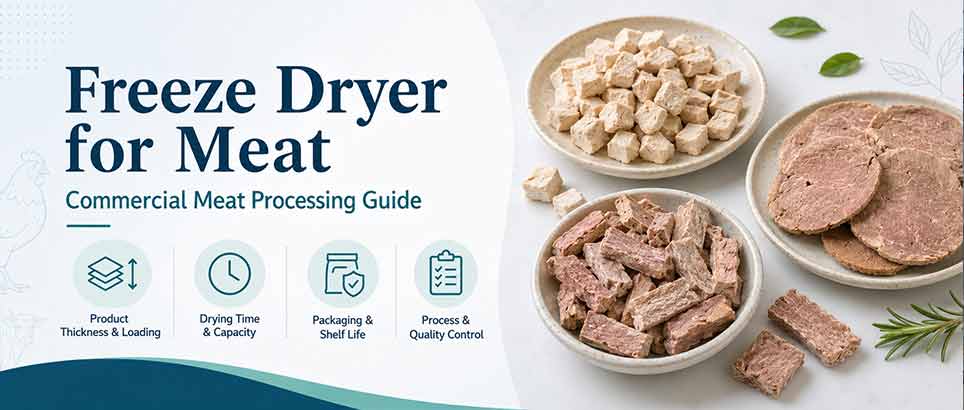
Yes. Beef, chicken, pork, lamb, minced meat, meat ingredients, and prepared meat meals can be developed for freeze-dried production. Frozen water is removed by sublimation under vacuum while controlled shelf heat supplies energy.
Commercial feasibility still depends on the exact product: cut, formulation, maximum dimension, pretreatment, tray load, final-moisture specification, package, food-safety controls, and wet kilograms required per day. Those inputs determine whether the process can be repeated and whether the freeze dryer is sized correctly.
Topic boundary: Fish and seafood and pet food and treats have separate process pages. This page covers human-food and food-ingredient meat production.
Raw vs Cooked Meat: Which Should Be Freeze Dried?
The right choice follows the intended product and its validated food-safety system. Cooked meat is often the more controllable first commercial development product because heat treatment, cutting specification, texture, and loading can be fixed before drying. Raw meat can also be freeze dried for further cooking or another validated control; drying must not be presented as a pathogen kill step.
| Decision factor | Raw meat | Cooked meat |
|---|---|---|
| Typical process position | Ingredient or product requiring further control or cooking | Prepared ingredient, meal component, snack, or ready-to-use product |
| Food-safety planning | Strict raw-material and pathogen controls | Validated cooking where applicable, plus post-cook contamination control |
| Scale-up rule | Validate the exact raw product | Validate the exact cooked formulation and dimensions |
How to Freeze Dry Meat: Commercial Process
1. Fix the product specification
Record species, cut, raw/cooked status, fat level, formulation, maximum piece dimensions, intended use, target final moisture, and package format. Without a fixed product, cycle comparisons are weak.
2. Standardize cutting and pretreatment
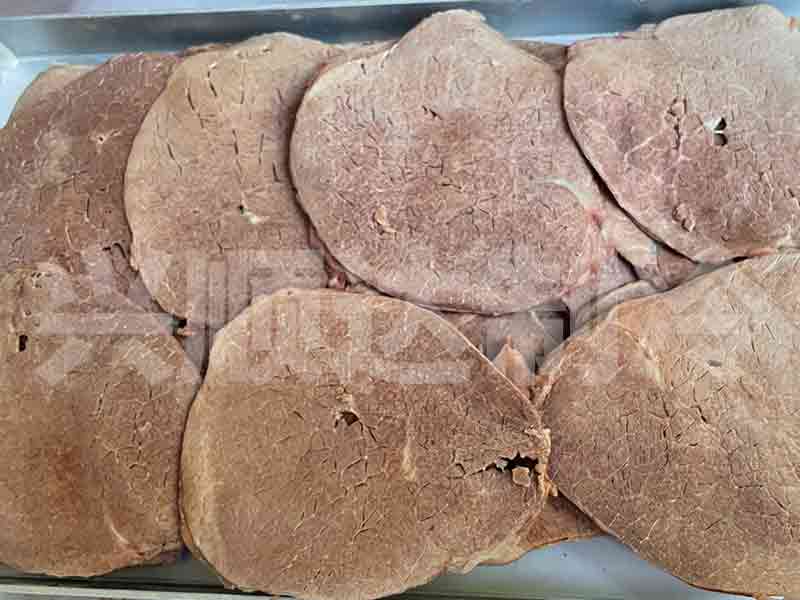
Control trimming, deboning, cooking, marination, draining, slicing, and dicing before loading. For some commercial sliced-meat pilot tests, approximately 8–10 mm can be used as an internal engineering starting range, subject to product-specific validation.
Separately, Ma et al. tested ham and tenderloin samples at 1–5 mm thickness and found that material thickness affected freeze-drying rate; rehydration was also included in the product-quality evaluation.[1] That published test range should not be treated as the required setting for a different meat product.
3. Record tray loading in kg/m²
Commercial scale-up should not rely only on “kilograms per tray.” Kilograms per square metre, layer depth, spacing, and overlap should be recorded so pilot data can be compared with equipment of a different tray size. A commonly used internal development range is about 10–13 kg/m² for many food products. Meat projects still require separate validation because fat, geometry, and initial water change the drying and condenser load.
4. Freeze completely, then develop the cycle
The product centre must be fully frozen before the main vacuum-drying stage. During primary drying, shelf heat, product temperature, chamber pressure, dry-layer resistance, and condenser behavior interact; pressure alone cannot define a successful cycle. See how sublimation works and freeze-drying temperature and pressure.
5. Verify the endpoint and package promptly
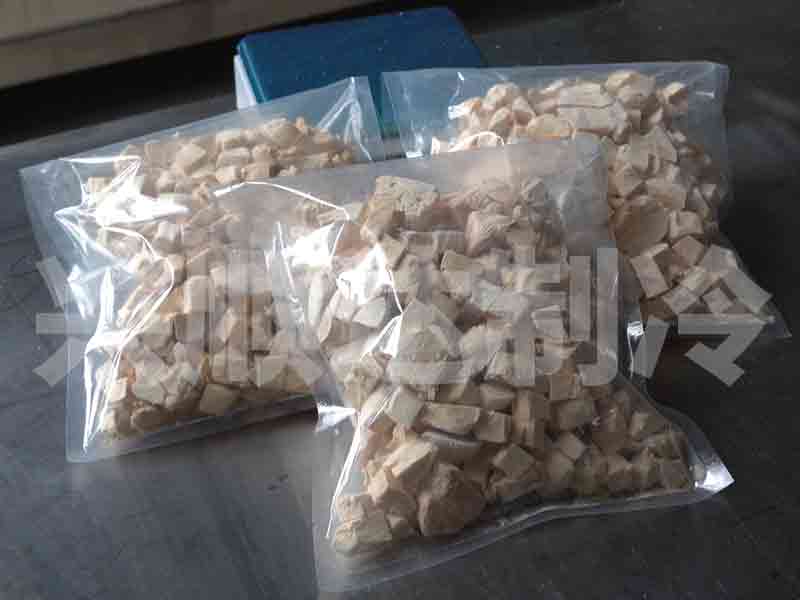
Check representative centres of the thickest pieces, final moisture, mass stability where appropriate, texture, visual dryness, rehydration, and tray-to-tray variation. A precooked-beef experiment found texture changed with the tested plate-temperature and rehydration combinations; for buyers, that means moisture alone may not qualify a product that must rehydrate well.[2] Freeze-dried meat can reabsorb moisture after unloading, so integrate barrier selection, oxygen control where appropriate, seal integrity, storage conditions, and shelf-life verification with the process. See the freeze-dried food packaging guide.
What Controls Meat Freeze-Drying Time?
There is no universal answer to “How long does meat take to freeze dry?” Drying time changes with the product and complete process—not with one machine setting.
For broader timing context, see the freeze-drying time chart. For condenser sizing, see the condenser water-load guide.
Freeze Drying Does Not Replace Meat Food-Safety Controls
For U.S. operations, use USDA FSIS HACCP guidance and the safe minimum internal temperature chart. Outside the United States, use the applicable authority and market requirements. See also why freeze drying is not sterilization.
From Pilot Batch to Commercial Meat Freeze-Dryer Capacity
Scale-up sequence: daily wet-material target → practical kg/batch → validated kg/m² loading → required usable shelf area → expected water removal per batch → realistic cycle and changeover time → practical batches/day.
A processor targeting 500 kg of wet cooked meat per day cannot choose equipment from “500 kg/day” alone. A 10-hour validated cycle and a 16-hour validated cycle require different shelf-area assumptions. Likewise, a product tested at 8 kg/m² must not be scaled as if it were validated at 13 kg/m². Compare initial/final moisture, condenser load, defrost, drainage, and changeover as well as shelf area.
Commercial meat project example
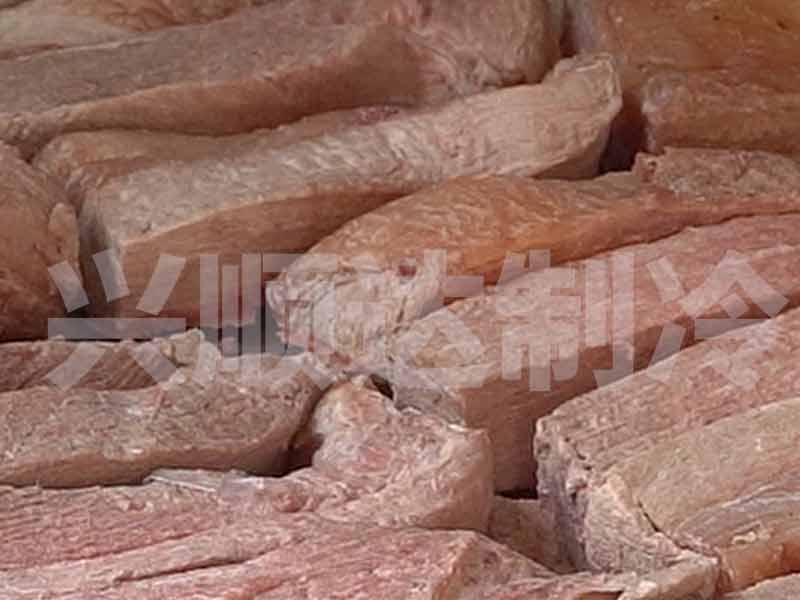
The linked 10 m² meat case study reports approximately 10 mm pieces, 12.1 kg/m² loading, approximately 12 hours, and 1.49% final moisture. These are project-specific figures, not a promised cycle for other beef, chicken, pork, organ-meat, or prepared-meal products.
How to Choose Freeze-Dryer Capacity for Meat Production
A freeze dryer for meat production should be selected from validated product requirements, not nominal tray count. A buyer should request the assumptions behind claimed capacity, including usable shelf area, wet kg/batch, kg/m², water removal, cycle and changeover time, product and pressure monitoring, condenser capacity, utilities, recipe control, alarms, batch records, training, service, and spare-parts scope.
- Lab/pilot: compare product thickness, raw vs cooked status, loading, cycle time, moisture, texture, rehydration, and packaging before production equipment is fixed. Review lab and pilot freeze dryers.
- Commercial: plan utilities, loading, heating, condenser management, maintenance access, and production scheduling. Review commercial freeze dryers.
- Industrial: confirm factory integration, realistic batches/day, and operating risk with pilot evidence. Review industrial freeze dryers.
Use the commercial freeze-dryer selection guide for a broader capacity comparison.
Common Meat Freeze-Drying Problems and Likely Checks
| Observed issue | Likely check |
|---|---|
| Soft or wet centre | Maximum thickness, centre sample, cycle time, kg/m², product-temperature history |
| Tray-to-tray variation | Cutting specification, load distribution, product probes, and batch record |
| Capacity shortfall | Wet kg, initial water, shelf area, condenser load, defrost, and changeover against the pilot basis |
| Moisture pickup after drying | Final-moisture method, unloading exposure, package barrier, and seal integrity |
| Storage instability in fatty products | Formulation, oxygen exposure, package/storage plan, and shelf-life validation |
Turn the Meat Process Into an Equipment Specification
The engineering review can begin with the meat type, raw or cooked state, maximum dimensions, wet kg/batch, daily output target, initial and final moisture, package format, utilities, and any pilot results. The engineering team can use these inputs to prepare an equipment-range and pilot-data checklist for shelf-area and condenser-load evaluation. It is not a guaranteed production cycle.
Send Meat Project DataFAQ: How to Freeze Dry Meat
Can raw meat be freeze dried?
Yes, but the product needs a food-safety plan appropriate to its intended use and destination market. Do not assume freeze drying is the microbial kill step.
Is cooked meat better for a first commercial pilot?
Often it is more controllable because pretreatment, cutting, texture, and loading can be standardized. The final product and validated food-safety system decide.
How long does commercial meat freeze drying take?
There is no universal meat cycle. Thickness, formulation, kg/m², freezing, shelf heat, pressure, condenser load, moisture target, and scale all matter. The 10 m² case example is explicitly project-specific.
How to Freeze Dry Chicken for Commercial Production?
Define raw/cooked status, standardize dimensions and kg/m², freeze the centre completely, verify primary/secondary drying with representative centre samples, and qualify packaging. Validate chicken separately from beef or other meats.
How is capacity calculated?
Use wet kg/batch, validated kg/m², usable shelf area, water removal, cycle/defrost/changeover time, and practical operating hours—not tray count alone.
References
- Ma Y, Wu X, Zhang Q, Giovanni V, Meng X. Key composition optimization of meat processed protein source by vacuum freeze-drying technology. Saudi Journal of Biological Sciences. 2018;25(4):724–732. https://doi.org/10.1016/j.sjbs.2017.09.013
- Ayrosa AMIB, Pitombo RNM. Influence of plate temperature and mode of rehydration on textural parameters of precooked freeze-dried beef. Journal of Food Processing and Preservation. 2003;27(3):173–180. https://doi.org/10.1111/j.1745-4549.2003.tb00510.x