
How to Clean a Freeze Dryer in a Food Plant
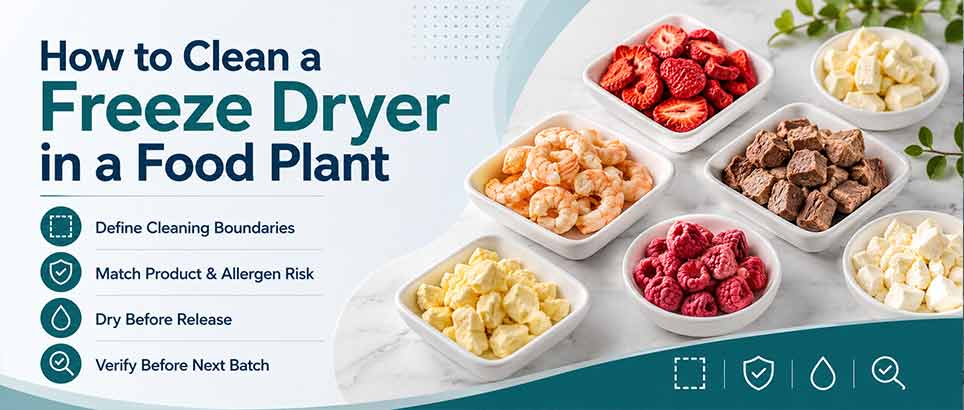
Knowing how to clean a freeze dryer in a food plant means more than wiping the chamber. A useful procedure removes the actual product soil, controls allergen cross-contact, protects vacuum and electrical systems, verifies dryness and records why the machine is safe to release to the next batch.
Quick Answer: How to Clean a Freeze Dryer
To clean a commercial freeze dryer, the operator should complete the cycle, unload product, defrost and drain the condenser, isolate the equipment according to the factory safety procedure, remove permitted food-contact parts, and clear loose residue before applying an approved cleaning method. The chamber, trays, rack components, door, gasket and drain area should then be cleaned within their defined cleaning boundaries. Detergent or soil residue must be removed, required surfaces must be thoroughly dried, and the machine should pass a documented pre-operational inspection before the next batch.
Important: These freeze dryer cleaning instructions are a planning framework, not a replacement for the equipment manual, cleaning-chemical label, factory sanitation program or local regulatory requirements. Operators should not pressure-wash, flood, dismantle or chemically treat vacuum, refrigeration, sensor or electrical components unless the equipment design and manufacturer instructions specifically permit it.
Define the Boundary
Separate food-contact parts, seals, drains, vacuum components and electrical areas before cleaning.
Match the Product Risk
Match the procedure to sugars, fats, proteins, powders, allergens and flavor carryover.
Dry and Release
Dry required surfaces, reassemble correctly and complete the release check before production restarts.
Article Contents
Why Freeze Dryer Cleaning Matters in Food Production
Freeze drying removes water at low temperature and under vacuum, but it should not be treated as a sterilization step. The separate evidence review on whether freeze drying kills bacteria and viruses explains that boundary in more detail. Utah State University Extension also notes that bacteria can survive freeze drying and emphasizes strict sanitation throughout food handling.[6] For a factory, this means raw-material controls, any required lethality step, hygienic loading, equipment cleaning, complete drying and protected packaging must work together.
A commercial machine may process sticky fruit, cooked meals, meat, seafood, dairy, egg, herbs, coffee or extracts. Residue can remain on trays, chamber walls, rack components, door seals and drainage areas. Product spill, foam or powder may also reach locations that are not part of routine cleaning. A cleaning procedure should therefore address the actual product and equipment design rather than relying on one universal wipe-down instruction.
A food-equipment case study shows why that distinction matters. After seven days of strawberry slicing, a 75% alcohol treatment left visible fruit residue between closely spaced blades and the sampled rinse still contained bacteria. A combined cleaning-and-disinfection treatment removed the visible residue and had no detected bacteria under that study’s conditions.[1] The result does not prescribe one chemical for every freeze dryer; it shows that disinfecting over retained soil is not a substitute for removing the soil first.
Cleaning also supports allergen changeover
Milk, egg, fish, crustacean shellfish, peanuts, tree nuts, wheat, soybeans and sesame are major food allergens under U.S. FDA requirements. A shared freeze dryer can create cross-contact risk when ineffective cleaning leaves residue from one product before a different product enters the chamber.[5] The factory should connect freeze dryer cleaning with its production sequence, allergen controls, labeling controls and changeover release process.
Define the Cleaning Boundary Before Starting
The first step in commercial freeze dryer cleaning is to decide which components are food-contact surfaces, which parts may be removed, which fixed areas may be wet-cleaned, and which systems require a separate maintenance procedure. The following table is a practical starting point; the final boundary must follow the equipment documentation.
| Area | Typical Components | Cleaning Principle |
|---|---|---|
| Removable food-contact parts | Trays, approved removable rack parts, loading accessories | Remove only as designed, clean under the site procedure, inspect, dry and protect from recontamination. |
| Fixed product-exposed area | Chamber walls, door interior, fixed shelves or heating plates, drain vicinity | Control liquid volume, avoid forcing soil into openings, and clean from cleaner/high areas toward drains. |
| Sealing area | Door gasket, gasket groove, mating surface, locking area | Use non-abrasive tools, remove embedded particles, and inspect for cuts, deformation or chemical damage. |
| Vacuum system | Vacuum ports, valves, pipework, sensors, booster and backing pump | Do not clean as an ordinary food-contact surface. Follow the separate manufacturer maintenance procedure. |
| Refrigeration and electrical area | Control cabinet, cables, motors, refrigeration components, instrument connections | Keep cleaning liquid out unless the component and enclosure are specifically designed for washdown. |
| External non-food-contact surfaces | Machine frame, handles, outside door, HMI surround | Clean at a frequency that prevents transfer of soil to operators, tools and food-contact areas. |
Food manufacturers evaluating a new machine should review the freeze dryer chamber design and cleaning access, not only chamber volume. The FDA equipment provisions in 21 CFR 117.40 also emphasize that food equipment should be adequately cleanable, appropriately installed, corrosion-resistant where required, and able to withstand its intended cleaning procedures.[4]
When Should a Commercial Freeze Dryer Be Cleaned?
There is no responsible universal statement that every freeze dryer requires the same full wet-cleaning procedure after every batch. Cleaning frequency should be established from product residue, microbiological and allergen risks, production sequencing, process interruptions, equipment design and the factory sanitation program.
| Trigger | Typical Scope | Why It Matters |
|---|---|---|
| Routine batch completion | Remove product, trays, loose particles, visible residue, condensate and drain water; inspect seals and chamber. | Prevents buildup and makes abnormal residue easier to detect. |
| Product changeover | Clean defined food-contact and product-exposed areas according to the next product risk. | Controls flavor, color, powder and ingredient carryover. |
| Allergen changeover | Apply the factory’s validated allergen cleaning and release procedure. | Reduces the risk of unintended allergen cross-contact and incorrect labeling. |
| Abnormal event | Expanded inspection and cleaning after overflow, foaming, melting, broken packaging, vacuum-side contamination or extended interruption. | Routine cleaning may not reach the affected system boundary. |
| Scheduled deep cleaning | Planned access to areas not included in daily cleaning, with maintenance support where needed. | Addresses hidden buildup, wear and difficult-access locations. |
| Long shutdown or restart | Cleaning, drying, protective storage and pre-start inspection based on shutdown duration and environment. | Controls dust, moisture, pest and corrosion concerns during idle periods. |
Under 21 CFR 117.35, food-contact surfaces must be cleaned as frequently as necessary to protect against allergen cross-contact and contamination. The same provision states that food-contact surfaces used for low-moisture food should be clean, dry and sanitary before use; when wet-cleaned, they must be sanitized when necessary and thoroughly dried before subsequent use.[3]
Prepare the Freeze Dryer Safely
A safe cleaning procedure begins before any detergent, water or tool enters the work area.
- Complete or safely terminate the cycle. Follow the operating procedure for pressure equalization, door opening and product unloading. The separate guide on how to use a commercial freeze dryer covers the operating sequence in more detail.
- Remove and identify product. Prevent finished product, rejected product and cleaning waste from becoming mixed.
- Defrost and drain the condenser. The condenser should be fully defrosted by its approved arrangement, and meltwater should be directed to the designated drain or collection point.
- Apply the factory energy-isolation procedure. Electrical, vacuum, refrigeration, heating and moving systems should be placed in a safe condition before access or disassembly.
- Allow surfaces to reach a safe condition. Trays, shelves, condenser surfaces and piping may be extremely cold or warm after operation.
- Protect sensitive openings. The cleaning plan should prevent loose product, water and chemical solution from entering vacuum ports, instrument connections, pump lines, electrical enclosures or refrigeration components.
Step-by-Step Commercial Freeze Dryer Cleaning Procedure
The following framework explains how to clean a freeze dryer without treating the vacuum, refrigeration and electrical systems as ordinary food-contact surfaces.
-
Remove loose product residue
Operators should first collect crumbs, flakes, powder and larger deposits using approved tools. Dry removal limits the amount of product carried into drains, gasket grooves and inaccessible openings. Compressed air should not be used casually because it can spread allergens, dust and contamination; any gas used around food-contact equipment must be controlled under the facility program.
-
Remove approved trays and rack components
Only components intended for routine removal should be detached. Trays should be handled without bending, dropping or damaging their edges. Large racks or shelf assemblies may require lifting equipment and maintenance authorization. The commercial freeze dryer tray guide explains why tray construction, flatness, loading and food-contact handling affect production performance.
-
Select an approved cleaning method
The cleaning method should match the soil and material. Sugar and fruit residues, fats, proteins, starches and botanical pigments do not respond identically. The factory should approve cleaning compounds based on the chemical label, concentration, contact time, temperature, rinsing requirement, wastewater rules and compatibility with stainless steel, anodized aluminum, plastics, coatings and elastomer seals.
-
Clean removable food-contact parts
Trays and permitted removable components should be cleaned in a designated area that prevents recontamination. Non-abrasive tools help protect food-contact finishes. Operators should pay attention to edges, corners, welds, joints and any location where residue can collect.
-
Clean the chamber from high areas toward the drain
The chamber should be cleaned in a consistent pattern so that no area is skipped. Soil should not be pushed into vacuum openings, sensors or service penetrations. Liquid should not pool behind fixed structures. For sticky product or spill events, the affected area may need controlled pre-treatment rather than excessive water volume.
-
Clean the door, gasket and sealing surfaces
The gasket groove and mating surface should be free of particles, fibers and dried product. Hard scrapers and aggressive chemicals can cut, swell or permanently deform the seal. After cleaning, the gasket should be checked for cracks, flattening, cuts and incomplete seating because seal damage can slow pump-down or prevent stable vacuum.
-
Clean the drain path within its design limits
The drain area should be cleared of ice, food particles and cleaning residue. Operators should confirm where meltwater and cleaning liquid travel and whether any valve must be opened, closed or removed under the equipment procedure. Drain configuration and floor drainage should also be reviewed during commercial freeze dryer installation planning.
-
Remove soil and cleaning-compound residue
Cleaning is not complete if detergent film, loosened soil or pooled liquid remains. Where rinsing is required, the rinse method should avoid uncontrolled spraying. Visual inspection should include lighting that can reveal films, streaks and residue at corners and under fixed structures.
-
Sanitize when required by the factory procedure
Sanitizing should follow cleaning, not replace it. The selected sanitizer must be suitable for the surface, used under labeled conditions and compatible with the equipment. The need for sanitizing depends on the food, process, regulatory scope and facility food-safety plan.
-
Dry and prepare the equipment for release
Thoroughly dry the required surfaces and reassemble approved components. Complete the documented pre-operational inspection below before the machine returns to production.
How to Clean a Freeze Dryer After Different Food Products
The same chamber can face very different soil and carryover problems. The sanitation team should use actual product observations rather than assigning one cleaning method to every recipe.
| Product Group | Typical Cleaning Challenge | Priority Check |
|---|---|---|
| Fruit, juice and sweet products | Sticky sugar, fruit acids, color and pectin deposits | Tray corners, chamber floor, door area, drain flow and dried syrup films |
| Ice cream, milk and dairy products | Fat, protein and milk-allergen residue | Product changeover, seams, tray surfaces, splash areas and cleaning release |
| Egg products | Protein films and egg-allergen carryover | Thin dried films, rack contact points, tray edges and changeover controls |
| Meat, seafood and pet food | Protein, fat, raw-material fluid, odor and higher hygiene concern | Spill control, loading tools, chamber corners, drains and separation from ready-to-eat products |
| Cooked meals, soup and sauces | Mixed fat, starch, salt, seasoning and overflow risk | Tray depth, spill areas, rack undersides, chamber floor and drain openings |
| Coffee, herbs and extracts | Fine powder, pigment and strong aroma carryover | Dust migration, door seals, difficult-access ledges and flavor-sensitive changeover |
High-risk product categories deserve product-specific procedures. Related engineering guides cover cleaning considerations within commercial meat freeze drying, fish and seafood freeze drying, dairy freeze drying, egg freeze drying and freeze-dried ice cream production.
Cleaning vs Sanitizing: They Are Not the Same Step
Cleaning removes product, fat, protein, sugar, mineral deposit, dirt and cleaning-compound residue. Sanitizing is a separate treatment applied to an already clean surface when required by the sanitation program. Applying sanitizer over visible soil does not create a clean surface.
The procedure should also distinguish food-contact cleaning from mechanical maintenance. Vacuum pumps, booster pumps, valves and instruments should not be flushed with the same solution used on trays or chamber walls. Pump type and service requirements differ; the separate freeze dryer vacuum pump oil guide covers oil selection and pump-side maintenance boundaries.
FDA information on food allergies and allergen cross-contact explains why ineffective cleaning on shared equipment can create unintended allergen presence.[5] The facility’s written controls should determine when visual inspection is sufficient and when additional verification is required.
Pre-Operational Inspection Before the Next Batch
A documented pre-operational check converts cleaning from an activity into a release decision. The inspector should be able to identify the previous product, the next product, the cleaning scope, any allergen change, abnormal findings and corrective action.
- No visible food residue or foreign material
- No visible cleaning-compound residue
- No pooled liquid in the chamber or drain area
- No unexpected odor from the previous product
- Required food-contact surfaces are dry
- Door gasket and mating surface are clean
- Drain valve and vacuum valves are correctly positioned
- Trays and rack parts are correctly installed
- Instrument connections appear intact
- All tools and cleaning materials are removed
- Cleaning record is complete
- Corrective action is closed before release
After deep cleaning, seal replacement or work near the vacuum boundary, an empty-system pump-down check can help confirm correct reassembly. It should be compared with the machine’s established baseline and should not be misrepresented as proof of product drying capacity.
How to Verify That Cleaning Worked
A completed checklist proves that work was recorded; it does not by itself prove that the selected method removed the relevant soil. Verification should be risk-based and should focus on the hardest-to-clean locations, such as seal grooves, drain transitions, rack joints, sheltered surfaces and any point affected by a spill.
| Verification Level | What It Can Show | Important Limit |
|---|---|---|
| Documented visual and odor check | Visible product, film, pooled water, damage, tools and obvious carryover | Cannot by itself confirm allergen or microbiological control. |
| Targeted swab or rinse check | Evidence from selected difficult-to-clean locations | The method, locations and acceptance criteria must match the site’s hazard and validation plan. |
| Allergen- or product-specific test | Whether a defined residue remains after a high-risk changeover | A nonspecific hygiene test should not be presented as proof that a specific allergen is absent. |
| Empty-system functional check | Correct reassembly, valve position, gasket seating and pump-down behavior | Confirms equipment function, not food-safety release on its own. |
A freeze-drying-line paper from the pharmaceutical sector offers a useful management principle: define the cleaning boundary, chemistry, method, monitoring, acceptance criteria and pre-use inspection in advance, then sample the locations with the greatest cleaning risk.[2] Food plants should adapt that logic to their own hazard analysis and legal requirements; the paper’s pharmaceutical residue limits and test conditions are not food-industry standards.
Commercial Freeze Dryer Cleaning Record Template
The following fields provide a practical starting point for an internal record. Each factory should adapt them to its hazard analysis, sanitation program and audit requirements.
| Record Field | What to Enter |
|---|---|
| Date, time and equipment ID | Cleaning start, completion, machine model and asset number |
| Previous product and batch | Product name, recipe or batch reference |
| Next product | Used to evaluate flavor, color, hygiene and allergen changeover |
| Allergen status | Allergens in the previous and next product and required changeover procedure |
| Cleaning scope | Trays, racks, chamber, door, gasket, drain, exterior and any exceptional area |
| Method and chemicals | Approved procedure number, chemical identification and required operating conditions |
| Inspection result | Cleanliness, dryness, damage, abnormal odor, drainage and reassembly findings |
| Corrective action | Recleaning, repair, replacement, hold or escalation |
| Operator and reviewer | Name, signature or electronic approval |
What Buyers Should Check Before Purchasing a Freeze Dryer
Cleaning cost is part of production cost. A machine that is difficult to inspect, drain or reassemble can create more downtime than a slightly longer drying cycle. Procurement teams should therefore request drawings, cleaning limits and access information instead of accepting the phrase “easy to clean.”
| Buyer Question | Evidence to Request | Red Flag |
|---|---|---|
| Which internal parts are removable? | Drawings, removal method, component weight and handling requirement | Operators are expected to improvise disassembly after delivery. |
| How does the chamber drain? | Drain location, slope, valve arrangement and defrost-water path | Flat pockets or low points retain water. |
| How is the gasket cleaned and replaced? | Seal profile, groove access, replacement method and spare-part information | The seal is difficult to inspect or requires major dismantling. |
| Can fixed shelves or heating plates be wet-cleaned? | Written cleaning limits, material details and protected penetrations | The supplier gives a washdown claim without an enclosure or cleaning specification. |
| How are vacuum ports and sensors protected? | Port location, protective covers and maintenance boundary | Openings sit directly in spill or rinse paths. |
| What cleaning procedure is supplied? | Written procedure covering chamber, trays, seals, drains and restricted areas | The manual only says “wipe the machine clean.” |
| Is there enough service and cleaning space? | Installation drawing and access envelope | The machine is sized without considering operator access or adjacent-space cleaning. |
Buyers can compare commercial freeze dryer models and industrial freeze dryer systems. Capacity selection should be completed together with chamber access, drainage, cleaning downtime, utilities and factory layout.
Frequently Asked Questions About Cleaning a Freeze Dryer
Should a freeze dryer be cleaned after every batch?
The machine should be inspected and routine residue should be removed after each batch, but the depth and method of cleaning should follow the product risk, allergen changeover, visible residue, equipment design and factory sanitation program. A universal full wet-clean after every batch is not appropriate for every machine or product.
Can water be sprayed inside a commercial freeze dryer?
Only when the manufacturer identifies the area and method as suitable for wet cleaning. Uncontrolled spraying or pressure washing can force water into vacuum ports, sensors, seals, insulation and electrical components.
What cleaning agent can be used in a freeze dryer?
The cleaner should be approved by the facility and compatible with the actual soil, food-contact material, seal material, cleaning temperature and rinse requirement. The equipment manual and cleaning-chemical label should take priority over a generic online recommendation.
Why does the vacuum take longer after cleaning?
Common cleaning-related causes include retained water, a drain valve left open, incorrect gasket seating, disturbed fittings, wet pump oil or liquid entering the vacuum path. These items should be checked against the established empty-system baseline.
How should allergen changeover be handled?
The factory should identify allergens in the previous and next product, apply its written allergen cleaning procedure, inspect or verify cleaning as required, document the release and confirm that the product label matches the formulation and manufacturing conditions.
What design makes a commercial freeze dryer easier to clean?
Useful features include accessible chamber surfaces, practical tray removal, inspectable gasket grooves, controlled drainage, protected sensors and vacuum openings, suitable materials, documented cleaning limits and enough space for operators and maintenance personnel.
Conclusion
For a food plant, how to clean a freeze dryer depends on the product soil, equipment design and next production batch. A reliable food-plant procedure defines the cleaning boundary, protects vacuum and electrical systems, controls changeover, verifies dryness and documents release. Buyers should evaluate these requirements together with tray capacity, condenser load, vacuum performance, installation and service access.
Technical References
- 郭俊华. 草莓冻干设备消毒清洗剂的应用初探[J]. 中国洗涤用品工业, 2021(10):52-56. DOI: 10.16054/j.cnki.cci.2021.10.007.
- 张海燕, 吴亚玲, 董俊. 浅谈冻干生产线的清洁验证[J]. 科技视界, 2014(4):276,231. DOI: 10.19694/j.cnki.issn2095-2457.2014.04.217.
- Electronic Code of Federal Regulations. 21 CFR 117.35 — Sanitary Operations.
- Electronic Code of Federal Regulations. 21 CFR 117.40 — Equipment and Utensils.
- U.S. Food and Drug Administration. Food Allergies.
- Utah State University Extension. Can I Freeze-Dry That? A Practical Guide to Safe and Effective Freeze-Drying.
The literature findings are scoped to the equipment and conditions studied. Regulatory references are general technical background; food manufacturers should confirm the requirements that apply to their product, country, facility and market.
Technical Review by Zheng Wei
Founder & Freeze-Drying System Engineer
Fuzhou Xing Shun Da Refrigeration Facility Project Co., Ltd.
Zheng Wei participates in food freeze-drying trials, equipment selection, vacuum-system configuration, refrigeration planning, installation guidance and drying-process optimization for fruit, vegetables, meat, seafood, cooked food, dairy, herbs and food ingredients.