
Freeze Dryer for Eggs: Commercial Egg Powder, White, and Yolk Guide
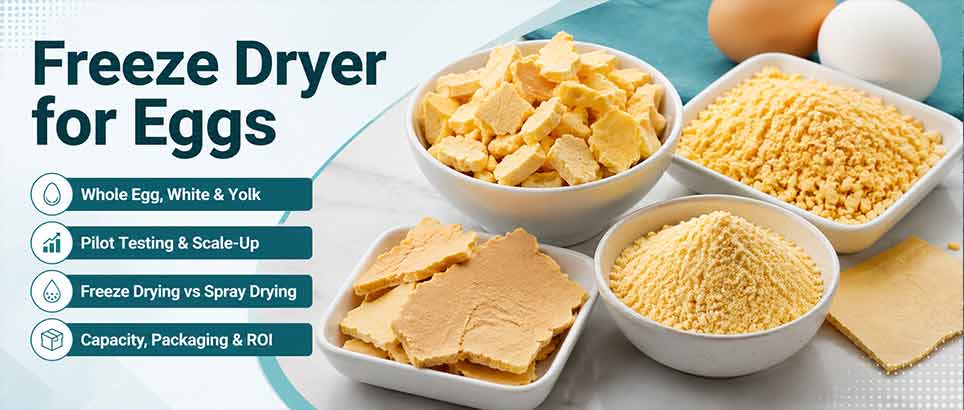
A freeze dryer for eggs can process selected pasteurized whole egg, egg white, egg yolk, cooked egg, and egg-based formulations. However, the correct business decision depends on food safety, product functionality, batch capacity, packaging, and cost per kilogram—not only on whether the material can be dried.
This commercial guide is written for egg processors, farms, ingredient manufacturers, nutrition brands, emergency-food producers, and food factories. It explains when freeze drying makes sense, what pilot testing must prove, and when spray drying may be more suitable.
Quick answer: Yes, pasteurized egg products can be freeze dried. Nevertheless, commercial production requires separate validation for microbial control, liquid depth, drying endpoint, powder functionality, hygienic milling, and moisture- and oxygen-resistant packaging.
Can Egg Products Be Freeze Dried Commercially?
Yes. Commercial processors can freeze dry selected pasteurized liquid whole egg, egg white, egg yolk, cooked scrambled egg, egg-containing soup, and formulated foods. Depending on the recipe and handling method, the product may leave the chamber as a porous sheet, block, flake, granule, or material suitable for milling into powder.
Eggs are not one uniform raw material. Egg white is protein-rich and may foam during filling. Egg yolk contains more fat and needs stronger oxidation control. Whole egg is an emulsion, while salt, sugar, starch, oil, dairy, seasoning, cooking, and aeration can change freezing behavior and final product performance.


Commercial requirement: a dry appearance is not enough. Pilot testing should confirm final moisture, water activity, rehydration, flavor, powder flow, foaming, emulsification, baking performance, and storage stability.
Potential applications
- Premium freeze-dried egg ingredients
- Specialty whole-egg or yolk formulations
- Rapidly rehydrating egg white products
- Outdoor, emergency, and expedition foods
- Nutrition blends and high-protein foods
- Cooked egg meal components and instant soup blocks
Products needing extra validation
- High-fat yolk products
- Salted or sugared egg formulations
- Aerated egg-white systems
- Recipes containing starch, dairy, oil, or seasoning
- Products requiring preserved whipping or emulsification
- Products intended for long ambient shelf life
For a broader material overview, see what foods can be freeze dried. Egg products also share challenges with other liquids, including foaming, tray leveling, long vapor paths, and slow center drying. The freeze dryer for liquids guide covers those general engineering issues.
Is Freeze Drying the Right Process for Egg Products?
Freeze drying is usually strongest when the finished product can support a premium price. For example, porous structure, rapid wetting, lower-temperature drying, small-batch flexibility, or specialty positioning may justify the additional cycle time and operating cost.
| Freeze drying may fit when | Another process may fit better when |
|---|---|
| The product is a premium ingredient, nutrition formulation, outdoor meal, or specialty food. | The target is low-cost, high-volume commodity egg powder. |
| Rehydration, structure, flavor, or functional performance has commercial value. | Direct powder production and continuous throughput are the main priorities. |
| Expected volume suits batch processing and multiple product recipes. | The factory requires very high annual output with minimum labor per kilogram. |
| The factory can control pasteurization, sanitation, allergens, milling, and packaging. | The project lacks a validated food-safety or post-drying packaging system. |
Therefore, buyers should compare annual volume, product value, utility cost, labor, functional targets, and allowable production cost. A technically successful batch may still be a poor investment when the selling price cannot support batch drying.
Food Safety Before Freeze Drying Eggs
Commercial egg processing should begin with a food-safety plan, not with the dryer. The USDA FSIS egg-products guidance describes processing steps that may include breaking, filtering, blending, pasteurizing, cooling, freezing or drying, and packaging. Pasteurization and moisture removal are separate controls.
Important: freeze drying should not be treated as a stand-alone Salmonella kill step. The FDA egg-safety guidance notes that even clean, uncracked shell eggs may contain Salmonella. Consequently, processors need pasteurized material or another validated treatment, regulatory compliance, and controls that prevent recontamination.
Typical preparation flow
- Receive and inspect shell eggs or pasteurized liquid egg.
- Break, separate, filter, and blend as required.
- Apply validated pasteurization or another approved treatment.
- Cool promptly and transfer through hygienic containers or closed piping.
- Load sanitized trays in a controlled area.
- Freeze and dry under a validated product recipe.
- Unload, mill, and package under low-humidity hygienic conditions.
Raw and pasteurized product areas should remain separated. In addition, trays, filling tools, milling equipment, air handling, and packaging zones need documented sanitation. Egg is a major allergen, so cleaning validation and cross-contact control are also required when other foods use the same facility.
For a broader explanation of microbial limits, read does freeze drying kill bacteria and viruses?
Whole Egg vs Egg White vs Egg Yolk
| Material | Main process concerns | Quality tests after drying |
|---|---|---|
| Liquid whole egg | Protein-fat balance, emulsion stability, loading uniformity, oxidation, and powder flow | Rehydration, color, odor, baking performance, and emulsion behavior |
| Egg white | Foaming during filling, viscosity, protein functionality, and surface structure | Whipping capacity, foam stability, solubility, color, and baking performance |
| Egg yolk | Higher fat, oxidation sensitivity, sticky handling, and different milling behavior | Emulsification, aroma, oxidation, dispersibility, and package stability |
A successful whole-egg test does not validate egg white or yolk. Likewise, a product may meet its final-moisture target but fail the buyer’s functional test. For this reason, functionality should be part of the release specification.
Commercial Egg Freeze-Drying Process
-
Define the product specification
Document product type, solids content, added ingredients, final form, target moisture or water activity, rehydration target, and required foaming, emulsifying, or baking performance.
-
Prepare and pasteurize the material
Filter and blend the liquid egg, apply the validated food-safety treatment, and cool the product. Then minimize the time between pasteurization, filling, and freezing.
-
Load trays consistently
Record wet weight, usable tray area, and liquid depth. Keep trays level, control foam, and prioritize repeatable shallow loading over one heavy batch with an excessively long cycle.
-
Pre-freeze completely
Measure product temperature rather than relying only on freezer-air temperature. The center of the liquid layer must be fully frozen before vacuum drying begins.
-
Control primary drying
Reduce chamber pressure and add shelf heat gradually. Product temperature, vapor flow, vacuum stability, and condenser performance must remain balanced.
-
Confirm secondary-drying endpoint
After most ice has sublimated, remove part of the remaining bound moisture. Confirm completion through product temperature, pressure behavior, moisture, water activity, or another validated method—not surface appearance alone.
-
Mill and package under controlled humidity
Move dry material into a low-humidity area. When powder is required, control particle size, dust, and heat generation during milling. Package promptly in a suitable moisture barrier and evaluate oxygen protection for yolk-containing products.
Packaging material, oxygen exposure, storage temperature, and water activity all affect stability. The freeze-dried food shelf-life guide explains the broader storage framework.
Key Process Variables for Egg Products
Liquid depth and wet loading
Liquid depth affects freezing time, sublimation distance, center drying, and batch uniformity. Consequently, the correct loading should come from pilot testing rather than a fruit, soup, or coffee recipe.
Solids content
Solids content changes finished yield and condenser load. Two batches with the same wet weight may remove different quantities of water, so whole egg, white, yolk, and formulated products should not share one capacity assumption.
Freezing conditions
Freezing rate influences ice-crystal structure and the vapor channels created during sublimation. Each recipe should therefore be checked for cracking, foaming, texture, rehydration, and final powder behavior.
Shelf temperature and chamber pressure
Lower pressure is not automatically better. Shelf heat, product temperature, chamber pressure, vapor resistance, and condenser temperature work together. See the guide to freeze-drying temperature and pressure for the general process relationship.
Cold-trap capacity
The condenser must capture the water removed from the batch and manage the peak vapor load during primary drying. Buyers should compare condensing area, capture rate, trap temperature under load, and defrost time.
Engineering observation: increasing wet load without adding usable shelf area, heat-transfer capacity, vapor flow, and condenser performance usually extends the cycle. As a result, a heavier batch can produce lower daily output.
How to Size a Freeze Dryer for Eggs
Machine sizing should start with prepared wet egg, not finished powder weight. The calculation also needs solids content, removable water, validated loading density, usable tray area, full cycle time, defrost, cleaning, and required batches per day.
Step 1: Calculate dry solids
Step 2: Estimate finished product weight
Step 3: Estimate water removed
Step 4: Estimate required tray area
Illustrative calculation
Assume a test batch contains 100 kg of liquid egg at 25% total solids, with a target final moisture of 2%. This is a calculation example, not a process guarantee.
- Dry solids: 100 × 0.25 = 25 kg
- Estimated finished product: 25 ÷ 0.98 = 25.51 kg
- Estimated water removed: 100 – 25.51 = 74.49 kg
The condenser and refrigeration system must manage approximately 74.49 kg of water from this batch. Next, pilot-test loading data should determine tray area, cycle time, defrost time, and daily production. The food freeze dryer selection guide explains this sizing method across commercial foods.
Need an Egg Freeze-Dryer Capacity Estimate?
Send the wet egg capacity, solids content, target product form, required batches per day, and available utilities. The engineering team can review tray area, water removal, condenser load, and suitable equipment category.
Request an Egg Capacity ReviewFreeze Drying vs Spray Drying for Egg Powder
For conventional high-volume egg powder, spray drying is often the first technology to evaluate. Freeze drying should compete on product value, porous structure, specialty positioning, batch flexibility, and verified functionality rather than low-cost bulk throughput.
| Factor | Freeze drying | Spray drying |
|---|---|---|
| Operation | Batch process | Usually continuous or semi-continuous |
| Best-fit scale | Specialty, premium, pilot, and small- to medium-volume | Medium- to very high-volume powder production |
| Product form | Porous sheets, blocks, flakes, granules, or milled powder | Direct powder production |
| Heat exposure | Lower product temperature under vacuum, but longer cycles | Short exposure to hot drying gas; effects depend on process conditions |
| Rehydration | Porous structure may support rapid wetting | Depends on particle design, agglomeration, and powder treatment |
| Commercial fit | Best justified by premium value or special functionality | Often more practical for commodity throughput |
Neither method is universally better. Peer-reviewed research comparing drying methods for egg-white protein products found differences in solubility, foaming, emulsification, structure, and other functional properties. Research on spray-dried whole egg also shows that drying conditions affect moisture, water activity, oxidation, emulsion stability, gel texture, foaming, and color. Therefore, the final choice should be based on the actual formulation, target specification, and verified production economics.
Equipment Specifications Buyers Should Compare
Food-contact design
- Chamber and tray materials
- Surface finish, drainage, and cleaning access
- Material certificates
- Raw and pasteurized area separation
Shelf and heating system
- Usable shelf area
- Heating method and control range
- Product-probe arrangement
- Recipe storage and batch recording
Vacuum system
- Pump configuration
- Time to reach operating pressure
- Vacuum measurement technology
- Water-vapor handling and maintenance
Condenser and refrigeration
- Water capture per batch
- Condensing area and capture rate
- Trap temperature under load
- Defrost time and condenser arrangement
When selecting a freeze dryer for eggs, a commercial machine should record shelf temperature, product temperature, chamber pressure, condenser temperature, alarms, and recipe steps. These records support batch comparison, deviation review, and scale-up.
A lab or pilot freeze dryer is suitable for formulation trials. After loading and cycle validation, a commercial freeze dryer can support regular specialty production. Higher-throughput factories may require an industrial freeze dryer, integrated utilities, material handling, and a complete economic study.
Pilot Testing Before Equipment Purchase
Egg products should be tested before a large system is ordered. The pilot must reproduce the intended formulation, pasteurization status, loading, freezing method, drying endpoint, milling method, packaging environment, and quality tests.
| Category | Required records |
|---|---|
| Raw material | Whole egg, white, yolk, formulation, solids, added ingredients, and pasteurization status |
| Loading | Tray area, wet weight, kg/m², liquid depth, and foam condition |
| Freezing | Freezer conditions, product-center temperature, and freezing time |
| Drying | Shelf temperature, product temperature, pressure, condenser temperature, and total cycle |
| Finished product | Yield, moisture, water activity, color, odor, rehydration, and powder flow |
| Functionality | Whipping, foam stability, emulsification, baking, dispersibility, and oxidation |
| Economics | Energy, labor, defrost, cleaning, rejected product, and packaging |
During scale-up, keep product depth and loading density comparable, confirm condenser load per square metre, use similar heat-transfer and vacuum-control methods, and validate the commercial endpoint. Moreover, daily capacity must include loading, unloading, defrost, cleaning, milling, and packaging time.
The freeze-drying time chart explains why structure and loading affect cycle length. However, the final egg recipe must come from the actual formulation.
Commercial Cost and ROI
A practical egg-project model should focus on saleable yield, product price, annual machine utilization, utility use, labor, packaging, quality testing, and rejected batches. In particular, functional failure matters: a powder can be dry but commercially unusable if foaming, emulsification, flavor, or baking performance does not meet the specification.
Compare this result with the target selling price and with alternative drying methods. For a wider equipment and lifecycle framework, review the guide to the real cost of an industrial freeze dryer.
Common Mistakes in Commercial Egg Freeze Drying
- Treating freeze drying as the microbial kill step.
- Using unpasteurized material without a validated safety process.
- Loading liquid too deeply to maximize one batch.
- Sizing equipment by tray count instead of usable area and water removal.
- Applying one drying cycle to whole egg, white, yolk, and formulated products.
- Ending the cycle because the upper surface looks dry.
- Ordering production equipment before pilot validation.
Information to Send a Freeze Dryer Manufacturer
A useful quotation starts with process data. Buyers should provide:
- Whole egg, egg white, egg yolk, cooked egg, or formulated product
- Raw or pasteurized status
- Solids content and added salt, sugar, oil, starch, dairy, or seasoning
- Daily wet capacity and required batches per day
- Target powder, flakes, granules, block, or complete-meal format
- Target moisture, water activity, and required functional properties
- Packaging method and shelf-life target
- Factory voltage, frequency, cooling water, steam, drainage, and installation space
Best next step: send a representative sample for pilot drying. A reliable supplier should return loading, process, yield, moisture, and equipment-selection data—not only a machine model.
FAQ About a Freeze Dryer for Eggs
Does freeze drying kill Salmonella in eggs?
No validated commercial process should assume that freeze drying replaces pasteurization or another approved kill step. Microbial control and moisture removal must be designed separately.
Is freeze drying better than spray drying for egg powder?
Not always. Freeze drying may suit premium, specialty, pilot, or lower-volume products. Spray drying is often more practical for conventional high-volume egg powder.
How long does commercial egg freeze drying take?
There is no universal time. Liquid depth, solids content, egg type, loading, freezing, shelf heat, pressure, condenser capacity, and final-moisture target all influence the cycle.
Can freeze-dried eggs be milled into powder?
Yes. Dried sheets or blocks can be milled and sieved. The plant should control humidity, particle size, milling temperature, dust, allergens, and packaging.
What machine size is required for liquid eggs?
Sizing should use wet weight, solids content, removable water, validated loading per square metre, complete cycle time, defrost, and required batches per day.
Can the same dryer process eggs and other foods?
Often yes, provided the factory validates allergen control, cleaning, odor management, scheduling, sanitation, and cross-contamination prevention.
Request an Egg Freeze-Drying Pilot Test
Before recommending tray area or machine size, the engineering team needs the egg product type, solids content, wet capacity, target form, required functionality, packaging method, and factory utilities. Pilot data can then support loading selection, condenser sizing, vacuum configuration, cycle planning, and daily output.