
Freeze Dryer for Liquids: How to Size Equipment for Coffee, Tea, Soup and Food Extracts
A freeze dryer for liquids should be selected from solids content, removable water, liquid depth, product stability, condenser load and required daily output—not from tray count or raw-liquid weight alone.
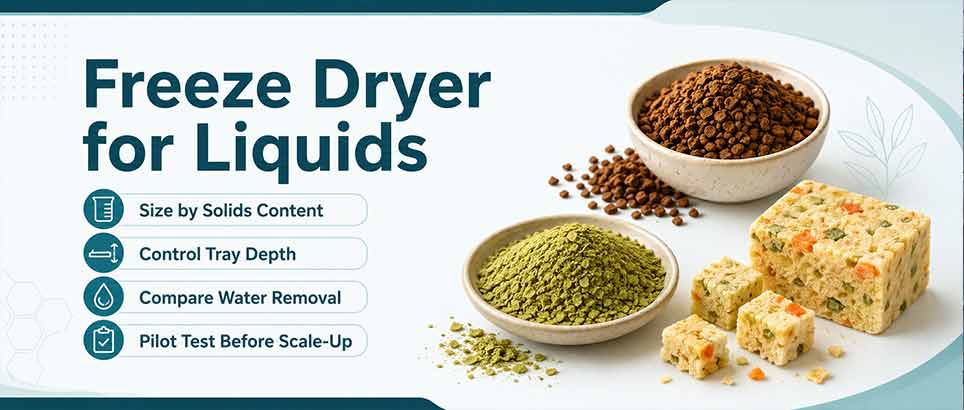
Can a Freeze Dryer Process Liquids?
Yes. Coffee extract, tea extract, soup, juice, dairy mixtures and botanical extracts can be freeze-dried when the formulation first forms a stable frozen structure. The process must then keep the product below its critical temperature while ice is removed by sublimation.
This guide is for commercial food processors, equipment buyers and engineering teams. It explains how to size a freeze dryer for liquids from solids, water removal, tray depth, condenser duty and validated product quality rather than from a generic “kilograms per batch” claim.
Can Liquids Be Freeze-Dried?
Liquid food can be freeze-dried when its water freezes and the remaining solids can support the product during drying. First, the product becomes a frozen layer. Next, controlled vacuum and heat allow ice to sublime. Water vapor then travels to the colder condenser, leaving pores where the ice crystals were located.
This porous structure can produce rapid rehydration and help preserve shape, color and heat-sensitive quality. However, freezing a liquid and turning on a vacuum pump are not enough. Formulation, liquid depth, freezing structure, product temperature, heat input, vapor flow and endpoint must work together. Food freeze-drying reviews describe the same freezing, primary-drying and secondary-drying sequence. Review the food freeze-drying research.
| Product Group | Common Preparation Direction | Main Process Risk | Typical Final Form |
|---|---|---|---|
| Coffee and tea extracts | Filtration and concentration, followed by direct loading, foaming or frozen granulation | Aroma loss, oxidation, foaming and slow mass transfer | Powder, flakes, porous blocks or granules |
| Soup and cooked mixtures | Recipe control, uniform mixing and molding or tray filling | Uneven solids, oil separation and a wet center | Instant blocks, sheets or milled powder |
| Juice and fruit puree | Concentration or formulation support when required | High sugar, stickiness, collapse and moisture pickup | Sheets, pieces or powder |
| Botanical, dairy and emulsified liquids | Clarification, homogenization and product-specific stability testing | Low collapse temperature, fat oxidation, phase separation or sanitation risk | Extract powder, flakes or porous blocks |
Why Liquid Products Are More Difficult Than Sliced Foods
A liquid freeze dryer uses the same sublimation principle as a machine processing fruit slices. However, liquids create different loading, freezing and mass-transfer conditions. They can move before freezing, settle during filling and form a thick continuous layer that gives water vapor a longer path to escape.
More Water Must Be Removed
A low-solids extract may contain 85–95% water. Consequently, most batch weight becomes condenser load instead of saleable output. This is why two equal wet loads can require very different machines and cycle times.
Foaming and Spills Are Possible
Incomplete freezing, dissolved gas, excessive filling or rapid pressure reduction can expand the product. Liquid may then foam over the tray edge or dry with an irregular structure.
Sugar-Rich Products Can Collapse
Juice, coffee extract and botanical concentrates can soften when product temperature exceeds the formulation’s safe limit. Therefore, cycle development must consider collapse behavior rather than only the freezing point of water.
Aroma Needs Protection
Coffee, tea and plant extracts contain volatile components. Concentration method, oxygen exposure, holding time, freezing speed and product temperature can all influence the final aroma.
Factories should therefore treat liquid depth as a process dimension, just as a fruit processor treats slice thickness. The freeze-drying temperature and pressure guide explains why product temperature, vacuum and heat input must be balanced during sublimation.
Solids Content Is the First Number to Confirm
Solids content determines theoretical dried output and the amount of water the system must remove. It should appear on every liquid test sheet and quotation request. Brix can be useful for some sugar-rich liquids, but it is not a universal replacement for total-solids analysis.
Dry solids = Liquid batch weight × Solids fraction
Estimated final product = Dry solids ÷ (1 − Target final moisture fraction)
Water removed = Liquid batch weight − Estimated final product
Example: 500 kg of Liquid at 20% Solids
The liquid contains 100 kg of dry solids. If final moisture is 2%, estimated final product weight is about 102.0 kg. The freeze dryer must therefore remove approximately 398.0 kg of water before allowing for residue, sampling and process loss.
| Indicative Solids Level | Likely Processing Effect | Planning Implication |
|---|---|---|
| Below 10% | Very high water load and low dried yield | Pre-concentration may improve economics; condenser duty needs careful review |
| 10–18% | Direct liquid loading may be possible for some formulations | Shallow loading and product-specific testing remain necessary |
| 18–30% | Higher yield, but viscosity and mass-transfer resistance may increase | Compare direct loading, foaming or frozen granulation |
| Above 30% | Material may become thick, sticky or difficult to level | Confirm pumpability, freezing behavior and product stability |
Concentration can reduce removable water and operating cost. However, excessive concentration may increase viscosity, stickiness or rehydration time. Research on instant soup found that partial water removal could shorten drying, while excessive pre-removal reduced recovery and rehydration performance. The concentration target should therefore be validated as a quality decision, not treated only as an energy-saving measure. See the cited instant-soup study.
Engineering experience for coffee extract: in the manufacturer’s project practice, coffee extract below 18% solids can be loaded as a liquid, frozen and freeze-dried without nitrogen foaming or low-temperature granulation. This route is simple, but it creates a higher water-removal load.
When a project requires a conventional porous instant-coffee granule, nitrogen foaming or frozen granulation may still improve pore formation, handling and aroma protection. This 18% reference applies to the stated coffee experience and should not be applied automatically to juice, soup, dairy or botanical extracts.
The detailed coffee freeze dryer guide explains coffee-specific process routes. Botanical processors can review the freeze dryer for herbs and extracts.
Direct Liquid Loading vs. Nitrogen Foaming or Frozen Granulation
The required final product should determine the loading route. Direct tray loading uses fewer handling steps and suits blocks, sheets or material that will be milled after drying. Nitrogen foaming can create pores in selected coffee formulations, while frozen granulation can shorten internal vapor paths and produce a more consistent instant-product shape.
| Method | Main Advantage | Main Limitation | Best Fit |
|---|---|---|---|
| Direct liquid loading | Simple process and fewer transfer steps | Longer vapor path and heavier water load at low solids | Blocks, sheets and powders produced by post-drying milling |
| Nitrogen foaming | Creates pores and can reduce oxygen exposure around aroma-sensitive coffee | Requires gas control and formulation validation | Porous instant-coffee structures |
| Frozen granulation | More uniform particles and a shorter internal vapor path | Adds cold handling, granulation and transfer equipment | Premium instant granules and higher-throughput extract production |
How Deep Should Liquid Be Loaded in a Freeze Dryer Tray?
There is no universal depth for every recipe. A shallow layer usually dries faster because heat and water vapor travel a shorter distance. Loading too little reduces output per square meter, while loading too deeply can create surface bubbling, a wet lower layer, high energy demand or structural collapse.
| Liquid Type | Pilot-Test Starting Direction | Main Risk | What to Validate |
|---|---|---|---|
| Coffee extract | Approximately 10–16 mm, depending on solids and final form | Aroma loss, foaming, uneven drying or poor solubility | Product temperature, moisture, aroma and dissolution |
| Tea extract | Approximately 12–16 mm as an initial pilot range | Surface bubbling and lower-layer under-drying | Moisture by layer, color and extract quality |
| Soup and viscous mixtures | Validate from viscosity and required block thickness | Wet center, oil separation or weak structure | Rehydration, block strength and water removed |
| Juice and puree | Start shallow and adjust after stickiness and collapse checks | High sugar, caking and moisture pickup | Powder flow, water activity and dry-room handling |
One published instant-tea study reduced a 20 mm layer to 15 mm and used staged heating to control bubbling and lower-layer moisture. Published coffee research also showed that loading thickness, heating temperature and chamber pressure influence drying rate; the reported optimized coffee thickness was approximately 1.58 cm. These values are useful starting references, but the actual formulation still requires testing. See the instant-tea study and review the coffee study.
Do not use tray-wall height as the loading specification. A tray that can physically hold 25 mm of liquid does not prove that a 25 mm frozen layer will dry evenly within the required cycle.
Commercial Liquid Freeze-Drying Process
A stable process begins before the product enters the drying chamber. Engineering review should therefore cover upstream concentration, controlled loading and downstream packaging as well as the freeze dryer itself.
- Define the product target. Record formulation, solids, viscosity, final moisture, water activity, aroma, rehydration and required particle form.
- Filter, homogenize or clarify. Create a repeatable liquid and remove unwanted particles before filling.
- Concentrate when justified. Reduce water load only after confirming that viscosity and quality remain acceptable.
- Select the structure route. Choose direct loading, foaming, molding or frozen granulation.
- Fill trays uniformly. Control weight per tray, liquid depth, headspace and filling sequence.
- Freeze the full product depth. Confirm representative product-center temperature rather than relying only on air temperature.
- Reduce pressure under control. Avoid a pull-down profile that causes foam, overflow or melt-back.
- Complete primary and secondary drying. Supply controlled heat while protecting the product from collapse and excess temperature.
- Verify the endpoint. Use product temperature, pressure behavior, moisture, water activity or another validated method.
- Mill and package promptly. Complete dry handling in a controlled environment with suitable moisture and oxygen barriers.
The broader food freeze dryer selection guide explains how wet load, shelf area, condenser performance, vacuum stability and factory utilities work together.
Common Problems When Freeze-Drying Liquids
Liquid-processing faults usually reveal a mismatch between formulation, loading and equipment conditions. Troubleshooting should use batch records and change one major variable at a time.
| Symptom | Likely Cause | Practical Correction |
|---|---|---|
| Top bubbling or overflow | Incomplete freezing, excessive early heat, high dissolved gas, excessive depth or rapid pressure reduction | Confirm center temperature, reduce early heat, add headspace, lower depth and slow the vacuum ramp |
| Collapsed or sticky product | Product temperature exceeded the critical limit or the formulation has high sugar | Lower the product-temperature target and review formulation support and dry-room handling |
| Dry surface but wet lower layer | Layer too deep, inadequate time or poor heat transfer | Reduce depth, check shelf contact and sample moisture by position |
| Very long drying time | Low solids, excessive water load, dense frozen structure or insufficient condenser performance | Calculate water removal, test safe concentration and check condenser frost and loaded vacuum stability |
| Weak aroma | Oxidation, long warm holding, unsuitable concentration or excessive temperature | Shorten holding, reduce oxygen exposure and validate aroma after storage |
| Powder cakes after unloading | High moisture, humid handling or inadequate package barrier | Check water activity, shorten exposure and improve humidity control and packaging |
How to Select a Freeze Dryer for Liquids
A commercial liquid freeze dryer should be sized from the real production duty. First calculate water removal. Next determine validated loading density and the full cycle. Finally confirm that the condenser, refrigeration, vacuum and heating systems can support the peak load.
Calculate Water Removal, Not Only Batch Weight
A 500 kg liquid at 10% solids and a 500 kg liquid at 30% solids create very different dried output and condenser demand. Every quotation should state assumed solids, estimated final product, removable water and target cycle.
Match the Condenser to Peak Vapor Load
Condenser temperature alone does not describe performance. Buyers should compare water capture rate, total ice capacity, vapor path, frost distribution and defrost time. The manufacturer’s production-system reference is a capture rate of at least approximately 2 kg water/m²·h, although final design must match the actual liquid load.
Confirm Vacuum Performance Under Load
An empty-chamber ultimate vacuum does not show how the system behaves while a large water load is sublimating. Food projects commonly operate within a controlled range such as 26–100 Pa. Stable loaded pressure, pull-down speed and pump protection matter more than the lowest advertised number.
For traceable pressure measurement, a capacitance diaphragm gauge such as the INFICON Porter CDG020D measures absolute pressure independently of gas type. This characteristic is useful while water-vapor composition changes during drying.
Review Heat Transfer, Cleaning and Production Scale
Liquid products need controlled heat across the full layer and practical cleaning after spills. Buyers should therefore review heating method, shelf control, product sensors, tray edges, chamber access, drainage and recipe records. The freeze dry vacuum chamber guide provides additional structural and inspection points.
| Production Stage | Equipment Direction | Main Purpose |
|---|---|---|
| Recipe and process development | SDG60 or SDG90 pilot lab freeze dryer | Compare solids, depth, freezing, cycle and product quality |
| Regular commercial batches | SDG350, SDG700 or SDG1100 commercial freeze dryer | Produce repeatable market batches after process validation |
| Factory-scale extract production | SDG1600, SDG3000 or SDG6000 industrial freeze dryer | Support multi-ton wet capacity and industrial utilities |
Not Sure Whether the Liquid Should Be Concentrated First?
A pilot test can compare direct loading, concentration level, liquid depth and final product quality before a production machine is selected.
Real Liquid Freeze-Drying Project Data
Project records provide a stronger reference than a general claim that a machine can process liquid. However, each result remains product-specific and should not be copied directly to a new formulation.
Concentrated Instant Black Tea Extract
A 2024 instant-tea project used an SDG1600 with 50 m² of drying area. The customer loaded 600 kg of membrane-concentrated tea liquid at 12 kg/m². Drying operated at 26–90 Pa and finished in 12 hours. Final moisture reached 2.31%.
The recorded energy use was approximately 1.12 kWh electricity plus 1.62 kg steam per kilogram of raw material. Read the full instant tea powder freeze-drying case study.
Instant Tremella Soup Blocks
A 2017 instant-soup project used an SDG700 with 20 m² of drying area. The formulation was loaded at an unusually high 30 kg/m², giving approximately 600 kg per batch. The cycle required about 20 hours and final moisture reached 1.94%.
The original project record shows approximately 3.49 kWh electricity per kilogram of raw material. The high loading density explains why this cycle was longer and more energy-intensive than the usual 10–13 kg/m² loading range. Read the freeze-dried instant soup case study.
Engineering lesson: both projects loaded about 600 kg, yet they required different shelf areas, loading densities, energy systems and drying times. Raw batch weight alone cannot select a freeze dryer for liquids.
How to Estimate Commercial Liquid Freeze Dryer Capacity
Capacity planning should begin with required saleable output and work backward to liquid feed, water removal, batch count and shelf area.
- Define finished product per day. Use saleable powder, granules or blocks after expected process loss.
- Confirm solids and target moisture. These values determine required liquid feed and removable water.
- Validate loading density or liquid depth. Do not borrow a value from another formulation.
- Confirm the full cycle. Include filling, freezing, vacuum pull-down, drying, unloading, defrosting and cleaning.
- Calculate realistic batches per day. A 12-hour drying step does not automatically mean two complete batches every 24 hours.
- Check utilities and packaging. Confirm power, steam where used, cooling water, drainage, dry-room conditions and downstream capacity.
Required liquid feed = Required dry solids ÷ Solids fraction
Wet load per batch = Required daily liquid feed ÷ Realistic batches per day
Required shelf area = Wet load per batch ÷ Validated loading density
For operating-cost planning, calculate energy per kilogram of removed water and per kilogram of saleable product. The freeze-drying cost analysis guide provides a broader framework.
Pilot Testing and Liquid Freeze Dryer Quote Checklist
Pilot testing replaces assumptions with measurable process data. A useful test records product properties, loading, temperatures, vacuum, drying time, final moisture, water activity, rehydration and scale-up calculations. Freeze-drying should not automatically be treated as a microbial kill step, so the food manufacturer must also complete a product-specific hazard analysis. The U.S. FDA provides guidance on water activity in foods and HACCP principles.
Data the Processor Should Provide
- Liquid name, main ingredients and formulation type
- Solids or Brix where relevant, viscosity and feed temperature
- Wet load per batch or required daily liquid feed
- Target moisture, water activity and shelf-life target
- Required form: block, sheet, powder or granule
- Available power, steam, cooling water and drainage
Data the Supplier Should Provide
- Assumed dry solids and removable water per batch
- Validated liquid depth or loading-density basis
- Usable shelf area and complete cycle assumption
- Condenser capture rate, total ice capacity and defrost plan
- Loaded vacuum performance and pressure measurement method
- Installation, training, test support and first-batch assistance
Procurement warning: a claim such as “500 kg per batch” is incomplete unless it also states product type, solids, liquid depth, water removed, shelf area, drying time, condenser basis and final moisture.
Frequently Asked Questions About Freeze Dryers for Liquids
Do liquids need to be frozen before vacuum is applied?
For conventional freeze-drying, the full product depth should be frozen before primary drying. Applying vacuum to an inadequately frozen liquid can cause foaming, boiling, spills or structural damage.
How deep can liquid be loaded in a freeze dryer tray?
There is no universal depth. The correct value depends on solids, viscosity, freezing behavior, safe product temperature, heat transfer, condenser performance and required cycle time. A pilot test should validate depth and tray weight.
Should liquid food be concentrated before freeze-drying?
Concentration can reduce water removal, cycle demand and cost. However, excessive concentration may increase viscosity, stickiness, collapse risk or rehydration time. The best level should be confirmed through product testing.
How long does it take to freeze-dry a liquid?
Time depends on liquid depth, solids, formulation, water load, freezing structure, condenser performance and endpoint. The project examples on this page required 12 hours for concentrated tea liquid and 20 hours for heavily loaded tremella soup.
What determines the capacity of a liquid freeze dryer?
Capacity depends on liquid feed, solids, removable water, validated loading depth, usable shelf area, condenser capture rate, complete cycle time and realistic batches per day.
Does a liquid freeze dryer require liquid nitrogen?
No. The freeze dryer uses refrigeration, vacuum and controlled heat. Nitrogen may be introduced in some coffee processes to create pores or reduce oxygen exposure, but it is a product-processing option rather than a basic requirement of the machine.
Is spray drying cheaper than freeze-drying liquids?
Spray drying is often faster and less expensive for large-volume powders that tolerate the process. Freeze-drying is selected when premium aroma, solubility, structure or heat-sensitive quality justifies the higher equipment and operating cost.
Request a Liquid Freeze Dryer Recommendation
Send the liquid type, solids content, daily feed, target moisture, desired product form and factory utilities. The engineering team can prepare a preliminary mass balance, test direction, shelf-area estimate and suitable model range.
References and Technical Sources
- 胡荣锁等. 冻干咖啡粉的研制及风味品质特性研究. 热带作物学报, 2019, 40(8): 1618-1625.
- 黄丽卿等. 速溶茶中试冻干过程模拟研究. 食品安全质量检测学报, 2023, 14(14): 245-253.
- 焦瑞婷等. 真空冷冻干燥技术在速食汤中的应用. 食品安全导刊, 2023(22): 158-161.
- Nowak D, Jakubczyk E. The Freeze-Drying of Foods. Foods. 2020;9(10):1488.
- Bhatta S, Stevanovic Janezic T, Ratti C. Freeze-Drying of Plant-Based Foods. Foods. 2020;9(1):87.
- INFICON Porter CDG020D Capacitance Diaphragm Gauge
- U.S. FDA: Water Activity in Foods
- U.S. FDA: HACCP Principles and Application Guidelines
External references provide general scientific or regulatory context. Product recipes, equipment settings and food-safety controls still require project-specific testing and validation.