
How to Freeze Dry Fruit for Commercial Production: Process, Pilot Testing & Scale-Up
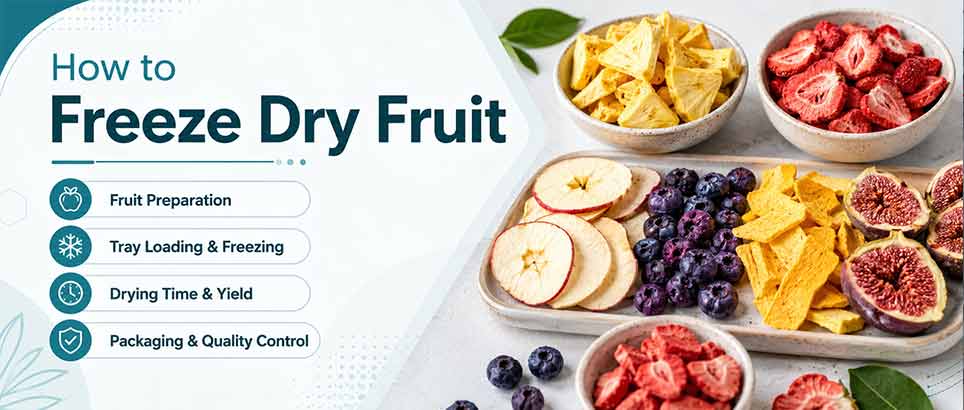
How to freeze dry fruit commercially is not a single recipe. A reliable process begins with the fruit itself. Variety, ripeness, skin, sugar level, product form, slice thickness, tray loading, freezing condition, heat transfer, vapor resistance, condenser load, and the final product specification all matter.
This guide is written for food factories, fruit processors, farms, snack brands, ingredient manufacturers, and project buyers. It focuses on the decisions needed to move from a fruit trial to repeatable commercial production. It does not provide household freeze-drying instructions.
Technical review: Zheng Wei, Freeze-Drying System Engineer | Last reviewed: July 29, 2026 | Evidence base: first-party fruit project records, process engineering experience, FDA guidance, and peer-reviewed literature.
How to Freeze Dry Fruit: The Commercial Process in 7 Steps
A commercial freeze-dried fruit process can be reduced to seven operating decisions: select consistent fruit, prepare a repeatable product form, standardize thickness and tray loading, freeze the product completely, control primary drying, verify the final drying endpoint, and package the product before it reabsorbs moisture.
| Step | Production objective | Main risk |
|---|---|---|
| 1. Select fruit | Keep ripeness, variety, size, and solids reasonably consistent | Batch-to-batch process variation |
| 2. Prepare | Create a predictable geometry and vapor path | Uneven pieces, browning, resistant skin |
| 3. Load trays | Control kg/m² and layer depth | Overloading and wet centers |
| 4. Freeze | Solidify product water before vacuum drying | Partial thawing or incomplete freezing |
| 5. Dry | Balance heat input, product temperature, pressure, and vapor removal | Collapse, slow drying, condenser overload |
| 6. Verify endpoint | Confirm the center is dry and the batch meets specification | Dry surface with residual center moisture |
| 7. Package | Protect the porous dry product from moisture and oxygen | Softening and quality loss after unloading |
The underlying science is explained separately in how freeze-drying works, the triple point in freeze-drying, and sublimation during primary drying. This page keeps the focus on fruit production decisions.
Lemon Freeze-Drying Test: 11 h 15 min Drying, 14.5% Yield & 2.07% Moisture
This first-party lemon freeze-drying test documents the complete workflow from sample preparation and pre-freezing through pre-drying weighing, monitored freeze-drying, final weighing, moisture testing, and finished-product inspection. The drying stage was continuously monitored with timestamps, and the main drying period is shown at 1000× speed in the video.
Video published on YouTube on August 14, 2026. The title rounds the drying time to 11 h 15 min; the recorded start and end timestamps give a precise drying time of 11 h 15 min 21 s.
The test used three trays with a combined area of 0.30 m². Initial lemon weight was 3,317.02 g, and final freeze-dried product weight was 480.15 g, equivalent to a product output of 1.60 kg/m². Freeze-drying started at 08:41:03 and ended at 19:56:24. These values are an observed batch record and should not be treated as a universal lemon freeze-drying cycle.
Fruit Type Changes the Freeze-Drying Process
A commercial fruit processor should not copy the same cycle across every product. The vapor path through an 8 mm apple slice is different from the path through a whole blueberry. Sugar concentration, skin resistance, lipid content, internal structure, and product geometry can change freezing behavior and drying resistance.
A peer-reviewed review of plant-based freeze-drying identifies cuticle resistance and high sugar or lipid concentration as important technological challenges in plant products.[1]
Whole berries
Blueberries and similar berries can retain an external skin that restricts vapor release. Perforation, scratching, cutting, or another validated skin-opening method may be required. The dedicated blueberry process guide explains this problem in more detail.
Sliced fruit
Apple, pear, pineapple, and similar products are easier to standardize when thickness and cutting direction are controlled. Uniform slices support more repeatable heat transfer, drying time, and endpoint checks.
High-sugar or high-fat fruit
Soft, sugary, or high-fat products require tighter pilot validation because stickiness, collapse risk, product temperature, and final texture can differ substantially from ordinary sliced fruit. The avocado scale-up guide is an example of a product that should not inherit a standard sliced-fruit cycle.
Strawberries and raspberries also have their own preparation and scale-up constraints. Related production guides include commercial strawberry freeze-drying and commercial raspberry freeze-drying.
Step 1: Prepare Fruit for Consistent Drying
Commercial consistency starts before the freeze dryer. A factory should define the acceptable fruit variety, ripeness, damage level, product form, and cutting method. It should also set a maximum delay between cutting and freezing. The objective is to make each batch behave as similarly as practical.
Control the raw material first
Overripe fruit may be softer and more difficult to handle, while underripe fruit may not meet the required flavor or aroma target. Processors should therefore combine incoming inspection with a defined preparation specification.
Standardize cutting and pretreatment
For sliced fruit, uniform geometry is usually more important than pursuing the thinnest possible slice. Excessive cutting can increase oxidation, juice loss, labor, and breakage.
For many sliced-fruit projects, 8 mm is a useful company pilot-test baseline. Thinner and thicker samples can then be tested when the product requires optimization.
Apple and pear processors may need to control browning between cutting and freezing. Pineapple requires consistent removal of peel, core, and fibrous areas. Whole berries may need skin opening. Purees and concentrates require controlled layer depth rather than piece thickness.
Step 2: Control Slice Thickness and Tray Loading
Thickness changes the distance moisture must travel from the center of the product to the surface. Therefore, thicker pieces generally require a longer validated drying cycle. Uneven thickness also creates a common factory problem: thin pieces finish first while the thickest pieces still contain moisture.
Tray loading creates a second constraint. For many sliced-fruit pilot tests, 10–13 kg/m² of prepared fresh material is a practical starting range. It is not a universal recipe. Whole fruit, puree, concentrated products, and products with poor vapor channels may require a lower loading density.
For example, a project requiring 1,000 kg of prepared fruit per batch at a validated loading density of 12.5 kg/m² would need approximately 80 m² of usable tray area.
That number alone is not enough to select equipment. The water load, cycle duration, condenser capacity, defrost time, and required batches per day must also be checked.
Step 3: Freeze the Fruit Completely Before Vacuum Drying
The product should be fully frozen before primary drying begins. If the center is not adequately frozen, the transition to vacuum can produce uneven structure, juice movement, meltback, or collapse.
External pre-freezing can improve equipment utilization because the next batch can be prepared while the freeze dryer is running. In-chamber freezing reduces product transfers but occupies the chamber for a longer total cycle.
The correct choice depends on factory layout, product sensitivity, batch scheduling, and the required number of cycles per day.
The engineering team should evaluate the actual product center condition rather than relying only on freezer-air temperature. This is particularly important for thick pieces, dense fruit, puree layers, and high-sugar products.
Step 4: Control Heat, Pressure and Vapor Load During Drying
Primary drying is a balance between heat transfer and mass transfer. Shelf heat supplies the energy required for sublimation. The vacuum system maintains the required chamber pressure, while the condenser captures released water vapor.
If heat input is too low, the cycle becomes unnecessarily long. If it is too aggressive, product temperature can rise beyond the safe structural limit.
Company food projects commonly operate within approximately 26–100 Pa absolute pressure, but pressure should never be copied as an isolated setpoint. Product temperature, heat input, dry-layer resistance, vapor release, condenser behavior, and vacuum stability need to be read together.
The condenser is also a production limit. In the company’s food freeze-drying projects, approximately 2 kg of captured water per m² of drying area per hour is used as an engineering reference when evaluating condenser capacity. It is not presented as a universal industry standard.
If the product releases vapor faster than the condenser can capture it, chamber pressure can rise and drying can slow. The documented 20 m² pineapple project used a condenser design reference of 2 kg water/m²/hour. The dedicated freeze dryer condenser guide explains this relationship without turning this fruit page into a component-design article.
Do Not Size Fruit Production by Chamber Area Alone
A 20 m² freeze dryer does not have one fixed daily fruit capacity. Output depends on the prepared load per square meter and the amount of water that must be removed.
Cycle time, condenser capture rate, defrost time, and the number of complete daily batches also affect real production capacity.
| Capacity variable | Why it matters |
|---|---|
| Prepared kg/m² | Defines wet material loaded on usable shelf area |
| Initial water content | Determines how much water must leave the product |
| Drying hours | Controls how many batches can be completed each day |
| Condenser capacity | Limits the vapor load that can be captured during primary drying |
| Defrost and turnaround | Reduces available production time between batches |
| Preparation and packaging | Can become the factory bottleneck even when the freeze dryer has spare capacity |
The freeze-drying time chart provides additional context for cycle-time planning, while the commercial freeze dryer selection guide focuses on equipment sizing after process data have been established.
Step 5: Verify the Drying Endpoint
A batch should not be released simply because the programmed time has ended. The thickest or most difficult pieces should be checked because the surface can appear dry before the center is complete.
For commercial food projects, endpoint verification can combine:
- final moisture measurement using a suitable validated method;
- center dryness checks on representative thick pieces;
- mass stability or expected batch weight loss;
- appearance, texture, aroma, and break structure;
- rehydration behavior when it is part of the product specification;
- sampling from different shelves and tray positions; and
- batch-to-batch consistency before the process is considered ready for scale-up.
In the company’s food freeze-drying projects, approximately 1–2% final moisture is a common engineering target range. The validated product specification always takes priority.
First-party fruit projects can finish outside that range when the product specification supports it. The pineapple example below reached 2.31% final moisture.
20 m² Pineapple Case: Commercial Production Data
The existing Indonesian pineapple case shows how first-party process data can support production planning. It is not a universal pineapple recipe.
The case connects tested loading density, cycle time, vacuum range, and final moisture in one documented production reference.
| Parameter | First-party project data |
|---|---|
| Product | Round pineapple slices |
| Drying area | 20 m² |
| Prepared batch load | Approximately 244 kg |
| Loading density | 12.2 kg/m² |
| Drying time | 12 hours |
| Final moisture | 2.31% |
| Vacuum range | 26–92 Pa absolute pressure |
The full 20 m² freeze-dried pineapple case study contains the project evidence. This pillar page uses the case only to show how processors can connect product preparation, loading, drying time, and final moisture without duplicating the case-study search intent.
How to Freeze Dry Apples Commercially
The same framework applies to processors researching how to freeze dry apples. The process should standardize ripeness, control browning, and use consistent geometry.
Loading density should then be validated before the fruit is fully frozen and dried. The center should be checked before packaging.
An 8 mm slice is a practical starting point for pilot work because it provides enough thickness to evaluate structure while keeping the moisture path manageable. However, the final production specification should be based on the buyer’s apple variety, desired texture, appearance, package format, and target throughput.
The site already contains a dedicated 20 m² freeze-dried apple case study. Keeping the apple process explanation here and the detailed project evidence in the case study avoids creating another generic apple URL that competes with the existing fruit pillar page.
Run a Pilot Test Before Commercial Scale-Up
A pilot test should answer a business question, not merely produce an attractive sample. It determines how to freeze dry fruit consistently before full-scale capacity is selected.
The test should show whether the selected product form can be dried at a loading density and cycle time that make sense for commercial production.
A useful pilot matrix for sliced fruit can begin with:
| Variable | Example test range | Decision produced |
|---|---|---|
| Slice thickness | 6 / 8 / 10 mm | Balances texture, center drying, cutting labor, and cycle time |
| Loading density | Several kg/m² levels around the proposed production load | Finds the loading point before time or endpoint variation rises too far |
| Absolute pressure | Product-specific range within validated system capability | Confirms stable sublimation and vapor removal |
| Drying time | Recorded by stage and total cycle | Supports daily batch planning |
| Final moisture | Measured at representative positions | Confirms release endpoint |
| Appearance and texture | Pass/fail against the product specification | Prevents scale-up of a technically dry but commercially poor product |
| Rehydration or use test | When relevant to the final application | Checks performance as an ingredient or rehydrated food |
The food R&D and pilot testing guide explains how small-scale testing can be used before commercial or industrial equipment selection.
Scale From Pilot to Commercial and Industrial Production
Scale-up should preserve the process relationships proven during testing. A factory should not simply copy the same clock time, shelf temperature, or pressure from a small machine to a large chamber.
The engineering review should compare:
- product thickness and geometry;
- prepared kg/m²;
- product temperature response;
- shelf heat transfer;
- dry-layer resistance and vapor path;
- total water load per batch;
- condenser capture rate;
- vacuum-system behavior;
- endpoint uniformity; and
- loading, unloading, defrost, and packaging time.
Once those relationships are stable, the buyer can compare commercial freeze dryers and industrial freeze dryers using production data instead of model names alone.
Common Reasons Freeze-Dried Fruit Fails
| Failure | Likely cause | Corrective direction |
|---|---|---|
| Wet center | Pieces too thick, loading too high, or cycle ended too early | Standardize thickness, reduce loading, or extend the validated endpoint |
| Tray-to-tray variation | Uneven piece size, poor spreading, or inconsistent load | Standardize preparation and loading before changing the drying recipe |
| Whole berries dry slowly | Skin limits vapor release | Validate perforation, scratching, cutting, or lower loading |
| Collapse or excessive shrinkage | Incomplete freezing or excessive product-temperature exposure | Improve freezing discipline and reduce aggressive heat input |
| Pressure rises during primary drying | Excess vapor release, condenser overload, leakage, or inadequate vacuum capacity | Check vapor load, condenser behavior, leakage, and vacuum-system performance |
| Product softens after unloading | Delayed packaging, high final moisture, or weak moisture barrier | Verify endpoint and shorten exposure before sealing |
Package Freeze-Dried Fruit Immediately After Drying
Freeze-dried fruit has a porous structure and can pick up moisture quickly after unloading. Packaging should therefore be treated as part of the production process, not as a separate downstream task.
The factory should control the time between unloading and sealing, keep the handling area appropriately dry, and select a package with the required moisture and oxygen barrier. Seal integrity, product breakage, storage temperature, light exposure, and the intended shelf-life claim also need to be considered.
Detailed package design belongs in the dedicated freeze-dried food packaging guide. The broader freeze-dried food shelf-life guide covers storage and validation factors.
What Information Should a Fruit Processor Provide Before Requesting a Freeze Dryer?
A useful equipment discussion starts with production inputs. A buyer that provides only a model size or chamber area cannot receive a reliable capacity estimate.
| Project input | Why the engineering team needs it |
|---|---|
| Fruit type and variety | Helps assess structure, skin, sugar, and handling behavior |
| Whole / sliced / diced / puree | Defines geometry and vapor path |
| Slice thickness or layer depth | Directly affects center drying and cycle development |
| Prepared fresh kg/day | Sets the real production target after trimming |
| Required operating hours/day | Determines practical batches per day |
| Initial moisture or solids data | Helps estimate total water removal |
| Target final moisture | Defines the required endpoint |
| Packaging format | Connects the drying specification to final product stability |
| Available electricity / steam / cooling | Determines utility and installation constraints |
| Factory location | Supports electrical, logistics, installation, and service planning |
Frequently Asked Questions
These questions address common production decisions when processors evaluate how to freeze dry fruit at commercial scale.
How long does fruit take to freeze dry commercially?
There is no single commercial drying time. Prepared sliced fruit projects may complete within roughly 8–15 hours, while whole berries, thick products, extracts, or difficult high-sugar products can require longer. The correct cycle should be verified by the product endpoint rather than time alone.
What thickness should fruit be cut for freeze drying?
Many sliced-fruit projects begin pilot testing around 8 mm, with thinner and thicker samples tested when necessary. The final thickness should balance appearance, cutting cost, center drying, texture, and total cycle time.
How much fruit can a commercial freeze dryer process per batch?
Batch capacity depends on usable tray area and the validated loading density. For many sliced-fruit trials, 10–13 kg/m² is a practical starting range, but the water load, condenser capacity, cycle time, and required batches per day must also be considered.
Can apples and pineapple use the same freeze-drying cycle?
They should not be assumed to use the same cycle. Apples and pineapple differ in structure, juice content, sugar profile, cutting method, and vapor resistance. Each product should be validated with its own preparation, loading, drying, and endpoint data.
How does a processor know when freeze-dried fruit is finished?
The process should use a defined endpoint that can include final moisture, center dryness, mass stability, appearance, texture, representative sampling, and batch consistency. The programmed time alone is not a release criterion.
How should a fruit freeze-drying recipe be scaled to commercial production?
Scale-up should preserve the validated product thickness, loading density, heat-transfer behavior, vapor-removal capacity, condenser load, vacuum behavior, and endpoint rather than simply copying a small-machine time and temperature recipe.
Conclusion
Understanding how to freeze dry fruit commercially means controlling a production system, not following a household recipe. Fruit preparation, slice thickness, and tray loading affect both quality and daily output.
Complete freezing, product temperature, absolute pressure, vapor resistance, condenser performance, endpoint verification, and packaging are equally important.
The lowest-risk route from trial to production is to test the actual fruit, record the process, confirm the endpoint, calculate the water and batch load, and then select equipment from validated data. That approach gives a food processor a stronger basis for capacity planning and gives an equipment supplier enough information to recommend a system that can be scaled with less uncertainty.
References
- Bhatta S, Stevanovic Janezic T, Ratti C. Freeze-Drying of Plant-Based Foods. Foods. 2020;9(1):87. DOI: 10.3390/foods9010087.
- U.S. Food and Drug Administration. Guidance for Industry: Guide to Minimize Microbial Food Safety Hazards of Fresh-cut Fruits and Vegetables.
- U.S. Food and Drug Administration. FSMA Final Rule for Preventive Controls for Human Food.

About the Author
Zheng Wei — Freeze-Drying System Engineer
Zheng Wei participates in food freeze-drying projects at Fuzhou Xing Shun Da Refrigeration Facility Project Co., Ltd., including pilot testing, equipment selection, vacuum-system configuration, refrigeration planning, installation guidance, and process optimization for fruit and other food products.