
How to Freeze Dry Strawberries for Commercial Production
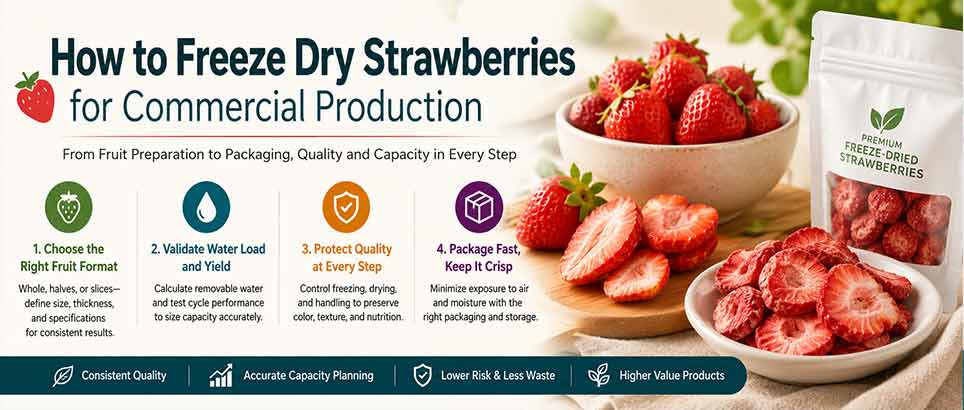
Food processors searching how to freeze dry strawberries need a production decision, not a home recipe. This guide shows how to define the strawberry product, validate a representative cycle, calculate the drying duty, protect the finished product, and give an equipment supplier the data needed for a useful quotation.
Commercial decision in one sentence: select the fruit format first, then size the line from removable water, usable tray area, tested cycle time, and packaging throughput – not from fresh-fruit kilograms alone.
| Decision | What to validate | Why it matters |
|---|---|---|
| Product format | Whole, halves, slices, pieces, or milling feedstock | Geometry changes vapor escape, breakage, appearance, and endpoint risk. |
| Process window | Frozen state, loading pattern, product temperature, pressure, endpoint | A workable sample is not yet a repeatable production cycle. |
| Capacity | Water load, tray area, loading density, cycle and turnaround | Fresh weight does not define refrigeration or condenser duty. |
| Finished quality | Moisture, center dryness, texture, seal integrity, storage behavior | Product can lose crispness after it leaves the chamber. |
Can Strawberries Be Freeze-Dried Commercially?
Yes. Food processors can produce strawberry slices, halves, pieces, inclusions, and material for milling. The important distinction is that each format is a separate process specification. Whole berries, for example, need more control of size grading and center dryness than uniformly cut slices.
For project planning, define the variety or representative lot, maturity range, cut size, target texture, final-moisture specification, packaging format, and acceptance test before equipment capacity is finalised. This keeps product development, process development, and equipment selection connected.
Choose the Product Format Before You Develop the Cycle
| Format | Commercial advantage | Control point |
|---|---|---|
| Whole berries | Recognisable premium appearance | Grade size tightly; verify the centre of the largest fruit. |
| Halves or slices | More uniform thickness and portioning | Maintain cut specification and one-layer tray loading. |
| Pieces | Flexible cereal, bakery, dairy, and confectionery ingredient | Control breakage and post-drying transfer. |
| Powder feedstock | Ingredient route after milling | Include milling loss, dust control, and moisture pickup in the trial. |
A whole-strawberry laboratory study found that changing the vapor-escape path with five laser micro-perforations reduced primary drying from 26.7 to 22.3 hours under that study’s equipment and conditions.[1] This is not a commercial cycle-time promise. It is practical evidence that whole-fruit geometry and mass-transfer resistance deserve separate pilot validation rather than being treated like a slice recipe.
For broader fruit processing guidance, see how to freeze dry fruit for commercial production. This page remains focused on strawberry-specific process decisions.
How to Freeze Dry Strawberries Commercially: 5-Step Workflow
- Receive and specify the fruit. Use a representative lot. Record maturity, firmness, soluble-solids or other agreed incoming checks, defects, and the intended cut range. The USDA FoodData Central can support early composition estimates, but sizing should use the processor’s own lot data.
- Wash, sort, and prepare under the plant programme. Remove unsuitable fruit and keep the preparation method the same across trials.
- Load repeatably and freeze completely. Record usable tray area, total load, loading density, thickness, and loading pattern. Freezing may be in-chamber or external; the operational requirement is a controlled frozen product before primary drying.
- Run and monitor primary drying. Use absolute chamber pressure. Product temperature, heat input, dried-layer resistance, vapor flow, condenser performance, and vacuum stability interact; lower pressure alone is not a recipe for a faster or safer cycle. For the engineering background, see freeze-drying temperature and pressure for food production.
- Complete secondary drying and release the batch. Confirm the agreed moisture endpoint, center dryness, texture, appearance, and batch consistency. Do not release a batch on elapsed time alone.
For processors learning how to freeze dry strawberries at production scale, representative pilot data is more useful than copying a household cycle time. The same fruit format, cut specification, loading pattern, and acceptance criteria should be carried into scale-up testing.
Real Engineering Test: Freeze-Dried Strawberry Slices
The engineering team has also tested sliced strawberries under controlled production-development conditions. This test provides a real reference for loading, finished yield, final moisture, and cycle duration. It should be treated as project-specific engineering data, not as a universal strawberry recipe.
Key test results are shown above for quick mobile reading. The detailed table below provides the complete batch data.
Watch the Full Strawberry Freeze-Drying Test
This video documents the same strawberry-slice engineering test reported on this page, including product preparation, completed freezing, pre-drying weighing, monitored freeze-drying, post-drying weighing, and final moisture-content testing. The recorded measurements provide visual evidence for the batch data shown below.
Recorded test stages: finished-product preview, preparation, freezing, pre-drying weight, drying start, monitored drying at accelerated playback, freeze-drying completion, post-drying weight, and final moisture-content testing.
| Test item | Measured result |
|---|---|
| Total tray area | 0.30 m² |
| Fresh strawberry load | 3.1689 kg |
| Fresh loading density | 10.56 kg/m² |
| Freeze-dried product | 0.34258 kg |
| Finished output per area | 1.14 kg/m² |
| Finished-product yield | 10.8% |
| Measured final moisture | 2.32% |
| Total drying time | 11 h 54 min 24 sec |

Based on the measured weights, the batch removed approximately 2.826 kg of water from 3.1689 kg of fresh strawberries. The measured finished yield was 10.8%, which agrees with the recorded 342.58 g final batch weight. Across the 0.30 m² tray area, the test produced approximately 1.14 kg/m² of finished freeze-dried strawberry slices.
Calculate Yield and Capacity Separately
Yield estimates finished product. Capacity asks whether the system can remove the water within the planned production schedule. Both calculations need actual or representative incoming moisture and the agreed final-moisture specification.
Estimated finished mass = dry solids ÷ (1 − target final-moisture fraction, wet basis)
Estimated removable water = fresh mass − estimated finished mass
Use the same moisture-basis convention throughout the calculation. Treat the result as a planning estimate, then confirm sorting, calyx removal, trimming, cutting, breakage, milling, and filling losses in a representative trial.
For equipment selection, submit these inputs together:
- fresh strawberries required per day and operating shifts;
- form, size range, and slice thickness where applicable;
- initial moisture data or representative samples;
- target final moisture and finished-product acceptance criteria;
- usable tray area and tested loading density;
- cycle time, defrost, loading, unloading, and packaging turnaround;
- available electricity, cooling conditions, installation space, and packaging format.
Use the freeze-dryer specifications guide to compare condenser duty, usable tray area, vacuum performance, heating control, and utilities as one system.
Prevent Soft, Sticky, Uneven, or Broken Product
| Observed issue | Investigate first | Useful confirmation |
|---|---|---|
| Wet or soft centre | Thickness, size mix, loading, cycle endpoint | Check the largest pieces and compare centre dryness. |
| Sticky product | Residual moisture, high-sugar lot, humid transfer | Review moisture result and time from unloading to seal. |
| Uneven batch | Mixed maturity, thickness, or tray loading | Separate incoming lots and repeat the loading pattern. |
| High breakage | Fragile product or aggressive handling | Observe unloading, transfer, filling, and vibration points. |
Package Immediately and Validate Storage
For freeze-dried strawberries, packaging is part of the process, not a downstream afterthought. In a strawberry study, moisture uptake was associated with lower glass-transition temperature, and the researchers reported a sharp rise in equilibrium moisture above a water activity of 0.648 at 25 °C.[2] The numerical threshold belongs to that study; it is not a universal batch-release limit or a substitute for the product’s final-moisture specification. Its practical implication is to validate the package, seal, storage humidity, and shelf life for the actual strawberry formula and format.
Plan a short, controlled transfer from unloading to sealing; select a package with appropriate moisture-barrier performance; verify seal integrity; and validate the finished product under its intended storage conditions. See the related internal pages on freeze-dried food packaging, commercial storage, and shelf-life validation.
Pilot First, Then Choose the Equipment Range
Use a pilot test to define the strawberry product and establish the data that a quotation needs. A product-development project normally benefits from a food R&D and pilot freeze-dryer. Once the process is repeatable, compare the validated daily requirement with the commercial or industrial food freeze-dryer range.
For broader purchasing criteria, see the commercial food freeze-dryer selection guide. A separate 30 m² blueberry case study also shows how a berry project can be documented; however, its process results should not be transferred directly to strawberry cycle design.
A time chart can help form an initial test plan, but it cannot replace strawberry-specific validation. See the freeze-drying time chart for planning context.
Request a Strawberry Freeze-Drying Capacity Review
Send your product form, dimensions, fresh material per day, operating shifts, target finished product, packaging format, utilities, and, if available, representative strawberries. The engineering review can return the missing test inputs, removable-water basis, estimated tray loading, and a suitable equipment range for the next decision.
Request a Strawberry Processing Test View Commercial Freeze Dryer RangeFrequently Asked Questions
Can whole strawberries be freeze-dried commercially?
Yes, but whole berries need tighter size grading and endpoint verification because the largest fruit has the greatest wet-centre risk. Validate whole fruit as its own product specification.
Should strawberries be sliced before freeze-drying?
Slices often make loading and thickness control easier. The best thickness is the one that meets the required appearance, breakage, drying, and packaging results in your representative trial.
How long does commercial strawberry freeze-drying take?
There is no transferable fixed time. Product form, thickness, loading, freezing condition, product-temperature limit, vacuum behavior, condenser duty, and endpoint all affect the cycle. Use tested data, not a household recipe.
Why are freeze-dried strawberries soft after packaging?
Investigate residual moisture, centre dryness, time exposed before sealing, package barrier, seal integrity, and storage humidity. A soft product is a reason to review the full process and shelf-life validation.
Which freeze-dryer size is right for strawberry production?
Size from daily demand, removable water, usable tray area, validated loading density, tested cycle time, turnaround, and packaging capacity. Fresh-fruit kilograms alone are not enough.
What should I send for a capacity quotation?
Provide fruit form and size, throughput per day, operating hours, initial-moisture data or a representative sample, target final moisture, packaging, utilities, and available installation space.
Evidence and Scope
Last literature review: 21 July 2026. The published studies below support the scoped claims beside their citations. The strawberry-slice loading, yield, final-moisture, and 11 h 54 min 24 sec drying-time data presented above are separate engineering test data from the manufacturer’s own process-development work. Neither the literature nor a single engineering test replaces plant-specific process development, food-safety validation, packaging validation, or final equipment documentation.
- Pinto M, Kusch C, Belmonte K, et al. Application of CO2-Laser Micro-Perforation Technology to Freeze-Drying Whole Strawberry (Fragaria ananassa Duch.): Effect on Primary Drying Time and Fruit Quality. Foods. 2024;13:1465. https://doi.org/10.3390/foods13101465
- Ostrowska-Ligęza E, Szulc K, Jakubczyk E, et al. The Influence of a Chocolate Coating on the State Diagrams and Thermal Behaviour of Freeze-Dried Strawberries. Applied Sciences. 2022;12:1342. https://doi.org/10.3390/app12031342

About the Author: Zheng Wei
Zheng Wei is a freeze-drying systems engineer focused on food freeze-drying process evaluation, equipment configuration, water-load and capacity planning, and commercial scale-up. His engineering approach uses measurable production inputs such as product form, loading density, removable water, vacuum behavior, condenser duty, cycle time, final moisture, and batch consistency rather than relying on generic machine-capacity claims.
Where published research is cited, laboratory findings are kept separate from project-specific engineering data. The strawberry-slice test in this article is identified separately as engineering test data rather than a universal process guarantee. Project-specific equipment specifications and final engineering documentation are issued by Fuzhou Xing Shun Da Refrigeration Facility Project Co., Ltd. according to the selected configuration.