
Freeze-Dried Food Shelf Life: What Manufacturers Must Validate
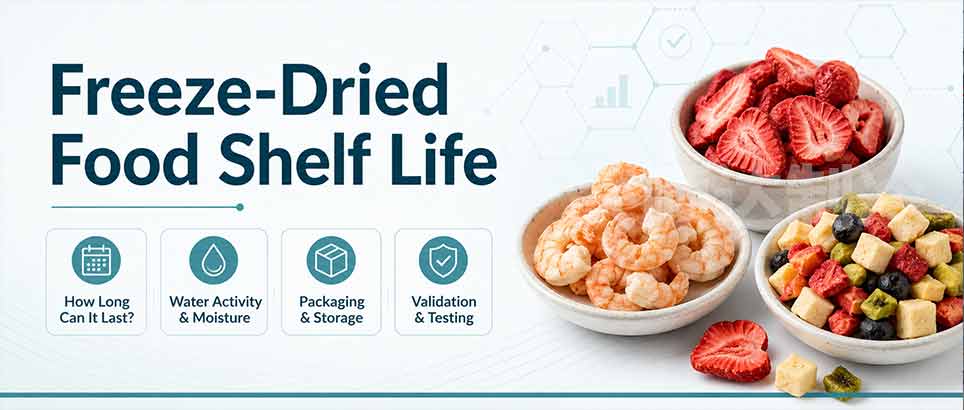
Freeze-dried food shelf life can range from months to decades. However, no universal number applies to every product. A defensible shelf-life claim depends on the recipe, drying endpoint, water activity, oxygen exposure, packaging barrier, seal integrity, transport conditions, and actual test data.
Quick answer: Unopened freeze-dried food can remain acceptable for years when the product is fully dried, sealed in a suitable high-barrier package, and stored under controlled conditions. Some commercial emergency-food products target 20–30 years, while short-cycle retail products may be designed for months or a few years. However, no universal term applies. Each manufacturer must validate the actual food, process, package, and storage conditions.
How Long Can Freeze-Dried Food Last?
A practical freeze-dried food shelf life depends on the intended market and the evidence available. The ranges below are planning categories rather than automatic label claims.
| Use Scenario | Typical Planning Approach | What Must Be Confirmed |
|---|---|---|
| Short-cycle retail product | Often planned in months or a few years rather than decades | Water activity, package barrier, seal quality, sensory life, and expected retail conditions |
| Commercial ingredient | No default term; the buyer specification and distribution route usually control the claim | Functional performance, moisture pickup, oxidation, microbiology, and package integrity |
| Long-term emergency food | Some commercial products target 20–30 years | Suitable formulation, strong moisture and oxygen barriers, controlled storage, and long-term supporting data |
| Product after opening | Useful life may fall to days or weeks | Ambient humidity, oxygen exposure, handling, resealing, and the food’s fat and sugar content |
Labeling rule: These are development ranges, not guarantees. The final best-before or shelf-life statement should be supported by the finished commercial product and package under relevant storage conditions.
Freeze-Dried Food Shelf Life Is Not One Number
When buyers ask how long freeze-dried food is good for, they usually expect a number of years. Food manufacturers need a more precise answer. Shelf life ends when a defined safety or quality limit is reached under stated storage conditions.
Microbiological Stability
The product must remain within validated safety limits. Low water activity limits microbial growth, but freeze-drying does not reliably destroy pathogens already present in the raw material.
Sensory Acceptability
Color, aroma, flavor, crispness, structure, and rehydration may deteriorate before the product becomes microbiologically unsafe.
Barrier Performance
A stable product can still fail early if the package admits moisture or oxygen, develops pinholes, or has an incomplete seal.
Therefore, the printed best-before date should not be copied from a competing product. It should reflect the actual food, process, package, and distribution route. In addition, regulatory requirements vary by market, so the manufacturer should confirm the applicable food-safety and labeling rules.
Important: A low final moisture percentage is useful process data, but it does not prove a multi-year shelf life by itself. Manufacturers also need water activity, packaging, oxidation, microbiological, and sensory evidence.
Freeze-Dried Food Shelf-Life Planning Matrix
The following matrix is a product-development guide, not a label guarantee. It shows why different foods need different validation plans.
| Product Category | Relative Shelf-Life Potential | Typical Limiting Factors | Priority Tests |
|---|---|---|---|
| Low-fat fruits and vegetables | Often high when fully dried and protected from moisture, oxygen, heat, and light | Moisture pickup, color change, aroma loss, browning, loss of crispness | Water activity, moisture, color, texture, sensory quality, package integrity |
| High-sugar or sticky fruits | Moderate to high, depending on glass transition, formulation, and storage temperature | Stickiness, collapse, browning, flavor change, moisture migration | Water activity, texture, storage temperature study, package barrier |
| Meat, seafood, and pet food | Often limited by oxidation and raw-material safety rather than moisture alone | Lipid oxidation, rancidity, pathogens, uneven drying in thick pieces | Water activity, microbiology, peroxide or oxidation indicators, sensory tests |
| Cooked meals, soups, and mixed formulas | Variable because different ingredients dry and age at different rates | Wet pockets, fat oxidation, flavor migration, ingredient-specific failure | Component sampling, water activity, oxidation, rehydration, sensory evaluation |
| Dairy and egg products | Variable to moderate, depending on fat, protein, and pretreatment | Oxidation, off-flavor, caking, microbial risk from unpasteurized ingredients | Microbiology, water activity, oxidation, solubility, sensory tests |
| Powders, extracts, tea, and coffee | Product-specific | Aroma loss, hygroscopicity, caking, active-compound degradation | Water activity, aroma or active markers, flowability, package barrier |
For product feasibility, manufacturers can also review which foods can be freeze-dried and their expected yield. That guide helps estimate water removal, finished weight, loading, and packaging volume before shelf-life trials begin.
What Determines Freeze-Dried Food Shelf Life?
1. Final Moisture Content
Residual moisture affects crispness, structural stability, chemical reactions, and the risk of local wet spots. However, the average result can hide variation. A thick center piece or an overloaded tray may remain wetter than the batch average.
Consequently, processors should sample difficult locations, including thick pieces, center trays, and areas with the highest loading. The target must match the product instead of relying on one universal percentage.
2. Water Activity
Moisture content measures the total water in a food. Water activity measures the water available for microbial growth and chemical reactions. The two values are related, but they are not interchangeable.
The U.S. Food and Drug Administration uses a water activity of 0.85 as an important regulatory reference in specific food-regulation contexts. Still, reaching 0.85 does not automatically deliver crisp texture, slow oxidation, or a long quality life. Many freeze-dried products need a much lower product-specific target.
Research Evidence: Moisture and Water Activity Need Product-Specific Targets
In Qiang Limin’s full-text study of freeze-dried figs, the optimized process produced 4.05% moisture, a water activity of 0.612, vitamin C retention of 95.09%, and a rehydration ratio of 6.16. These results support the stability of that tested fig product under its study conditions. However, they should not be copied to meat, seafood, dairy, prepared meals, or powders.
A separate berry powder storage study reached a different conclusion: at 25°C, the critical moisture content for stable storage was below 0.90 g/100 g. Therefore, powder products may require glass-transition, humidity, caking, and flowability checks in addition to basic moisture testing.
Practical control: Measure water activity after drying and again during shelf-life testing. If the recipe, thickness, loading density, or package changes, the manufacturer should recheck the result.
3. Raw-Material Microbial Load
Freeze-drying preserves by removing available water. It is not a validated sterilization step. Therefore, microorganisms that survive processing may remain dormant and become relevant after rehydration or moisture exposure.
Raw-material approval, sanitation, cooking, blanching, pasteurization, environmental controls, and hygienic transfer remain essential. For a detailed risk explanation, see does freeze-drying kill bacteria and viruses?
4. Fat and Oxygen Sensitivity
Freeze-drying removes water but does not remove oil. As a result, meat, seafood, dairy, eggs, nuts, pet food, and rich prepared meals may develop rancid flavors even when water activity is low.
For these products, oxygen control can become the shelf-life limit. The development plan may need headspace-oxygen measurement, peroxide value, other oxidation markers, and sensory evaluation.
5. Formula and Physical Structure
Salt, sugar, acids, proteins, fats, starches, and hydrocolloids change drying behavior and storage stability. Moreover, a single-ingredient fruit behaves differently from a meal that combines rice, sauce, meat, and vegetables.
Therefore, manufacturers should validate the finished commercial formula. Testing one ingredient cannot establish the shelf life of a mixed product.
Powder formulation evidence: A freeze-dried mulberry powder study found that storage at 5°C gave the best quality retention among the tested conditions. It also reported that carrier agents such as maltodextrin, arabic gum, and whey protein isolate could improve powder stability by slowing quality deterioration. Thus, powder shelf-life development may require formulation work as well as dryer-cycle optimization.
How the Freeze-Drying Cycle Affects Shelf Life
A repeatable shelf-life result starts with a repeatable drying process. The basic stages are freezing, primary drying, and secondary drying. The industrial freeze-drying process guide explains how these stages interact.
Freezing and Product Preparation
Uniform dimensions make water removal more predictable. In contrast, whole fruit, thick meat, dense extracts, and deep liquid layers create longer vapor paths. Freezing history also affects pore structure and product resistance.
For this reason, processors should define slice thickness, fill depth, pretreatment, freezing temperature, and holding time as controlled production parameters.
Primary Drying
During primary drying, frozen water leaves the product by sublimation. Chamber pressure, product temperature, heat input, vapor flow, and condenser capacity must remain balanced. If the process ends too early, ice or concentrated moisture may remain inside the product.
Secondary Drying
Secondary drying removes more strongly bound water. It can improve storage stability, but excessive heat may damage sensitive flavors, colors, nutrients, or structure. Therefore, the endpoint should be confirmed with product data rather than a timer alone.
Loading Density and Batch Uniformity
Higher loading adds more water and can restrict vapor movement. The same food may require a different cycle when tray depth or kilograms per square meter change. The freeze-drying time chart shows why product form, thickness, and loading must be considered together.
Engineering Evidence: Final Moisture Is a Starting Point, Not the Full Claim
First-party project records show how product type changes process results. A cooked-rice project reached 1.28% final moisture after a six-hour drying stage, while an industrial pear project reached 2.21% after 12 hours. A large shrimp project reached 1.68% after eight hours. These results support process and equipment evaluation; however, they do not independently prove a specific commercial shelf life.
Manufacturers can review the cooked-rice case, pear case, and shrimp case to compare loading, cycle time, vacuum range, and final moisture.
Packaging Requirements for a Long Shelf Life
Packaging has a direct effect on freeze-dried food shelf life because the product is often highly porous and hygroscopic. Therefore, an acceptable product can lose crispness quickly after it leaves the chamber. Packaging is part of the preservation system, not a separate cosmetic step.
Package Quickly After Drying
The transfer time between unloading and sealing should be controlled. In humid rooms, exposed product can absorb water from the air within a short period. Manufacturers should use a clean, low-humidity packing area and define a maximum exposure time.
Specify Moisture and Oxygen Barriers
Package selection should be based on measured water-vapor and oxygen transmission performance, expected storage duration, product sensitivity, package size, and distribution temperature. A transparent retail pouch may be acceptable for a short sales cycle, while long-term storage often requires a stronger barrier.
In addition, the converter’s material specification should match the finished package. Printed film structure alone does not guarantee seal quality or resistance to pinholes.
Research Evidence: Package Material Can Change the Result Within 90 Days
A freeze-dried bayberry study compared aluminum foil bags, PET plastic bottles, and glass containers during 90 days of dark storage at 25°C. The aluminum foil bag maintained the lowest final moisture at 6.52%, compared with 8.65% in glass and 9.73% in PET. It also retained vitamin C, total phenols, anthocyanins, color, and texture better than the other tested formats.
The practical lesson is that a freeze-dried food shelf-life claim belongs to the finished product and the finished package. Changing from a foil pouch to a clear bottle, plastic jar, paper pouch, or different film structure may require new storage testing.
Use Oxygen Control for the Right Product
Oxygen absorbers or nitrogen flushing may help protect oxygen-sensitive foods. However, neither method can correct incomplete drying or a leaking package. The selected system must suit the food, headspace volume, barrier material, and intended market.
Oxygen-control evidence: In a freeze-dried goji berry study, carotenoid degradation and color fading were linked to oxygen-related quality loss during storage. Freeze-thaw pretreatment combined with nitrogen-filled packaging extended carotenoid half-life under the tested room-temperature conditions. This does not mean every product requires nitrogen flushing; instead, it shows why oxygen control should be tested when pigments, vitamins, oils, or active compounds are important.
Validate Seal Integrity
Powder, oil, crumbs, wrinkles, or incorrect heat-sealing settings can create hidden leak paths. Therefore, manufacturers should control seal temperature, pressure, dwell time, cooling, and cleanliness. They should also establish leak, burst, dye, vacuum, or seal-strength checks that suit the package format.
Storage and Distribution Conditions Matter
Temperature
Higher temperatures accelerate many chemical reactions, including oxidation, browning, flavor loss, and nutrient degradation. Thus, a product tested in a cool laboratory should not automatically receive the same shelf-life claim for a hot warehouse or shipping container.
Humidity
High external humidity increases pressure on the package barrier and seal. It also increases the damage caused by small leaks. Products sold in tropical or coastal markets may require a different package specification from products stored in a controlled inland warehouse.
Research Evidence: Storage Temperature and Humidity Change Powder Stability
In a freeze-dried blueberry and blue honeysuckle berry powder study, samples were stored at 4°C, 25°C, and 37°C under relative humidity levels of 43%, 75%, and 95%. After 12 weeks, 25°C with 43% RH and 4°C with 75% RH performed better than the harsher conditions for moisture control, color, antioxidant retention, flowability, and anthocyanin retention.
For manufacturers, the storage market should be defined before the label claim is selected. A product intended for a cool warehouse may need a different package, carton, desiccant strategy, or best-before date when distributed in tropical conditions.
Light
Light can accelerate pigment loss, vitamin degradation, and lipid oxidation. Consequently, light-sensitive foods need opaque packaging or secondary cartons when the display environment exposes them to strong light.
Transport and Handling
Vibration, abrasion, compression, and sharp product pieces can damage the package. Distribution trials should therefore consider carton design, product settling, pallet loads, and long-distance transport.
How Food Manufacturers Should Validate Shelf Life
Shelf-life testing should measure the point at which the product no longer meets defined safety or quality criteria. The Institute of Food Technologists describes failure as unacceptable physical, chemical, microbiological, or sensory change. Therefore, each project needs measurable acceptance limits before testing starts.
Step 1: Define Failure Criteria
- Maximum water activity and residual moisture
- Microbiological limits required for the product and market
- Acceptable color, aroma, flavor, and texture
- Rehydration time, yield, and eating quality
- Oxidation or rancidity limits for fat-containing foods
- Minimum package integrity and maximum headspace oxygen
- Critical nutrient or active-ingredient retention, when relevant
Step 2: Build a Representative Sampling Plan
The plan should cover multiple production batches, tray positions, package lots, and storage time points. For mixed foods, it may also need samples from the slowest-drying ingredient or the thickest piece.
Sampling only one easy location can miss local wet spots. Instead, the protocol should deliberately test the most difficult product and process conditions.
Step 3: Select Product-Specific Tests
| Test | What It Shows | When It Is Especially Important |
|---|---|---|
| Water activity | Available water related to microbial and chemical stability | All shelf-stable freeze-dried foods |
| Moisture content | Total residual water and batch consistency | All products; especially thick or dense foods |
| Microbiology | Safety and hygiene performance | Meat, seafood, dairy, eggs, produce, pet food, ready-to-eat products |
| Oxidation indicators | Development of rancidity and chemical deterioration | High-fat foods and oxygen-sensitive ingredients |
| Headspace oxygen | Effectiveness of flushing, absorbers, and package barrier | Long-term packages and oxidation-sensitive products |
| Texture and sensory tests | Consumer acceptability and loss of crispness, flavor, or aroma | Snacks, fruits, meals, dairy, coffee, tea, and premium ingredients |
| Rehydration test | Water uptake, structure recovery, and serving performance | Meals, vegetables, meat, seafood, powders, and ingredients |
| Package integrity | Seal strength, leaks, pinholes, and transport damage | Every commercial package format |
Step 4: Combine Real-Time and Accelerated Testing
First, real-time testing stores the product under intended conditions and provides the strongest evidence for the final claim. Accelerated testing uses higher temperature, humidity, light, or other stresses to compare formulas and packages more quickly.
However, acceleration is not a simple linear conversion. Different deterioration mechanisms can dominate under harsher conditions. Therefore, accelerated results should support development and risk screening, while real-time data confirms the claim.
Step 5: Document the Complete System
In addition, the test record should connect the shelf-life result to the raw material, formula, pretreatment, freezing method, tray loading, cycle data, final moisture, water activity, package structure, sealing settings, storage conditions, and laboratory results.
When one of these variables changes materially, the manufacturer should assess whether revalidation is required.
Six Common Reasons Shelf-Life Claims Fail
- The product looks dry but contains wet centers or inconsistent tray results.
- The factory measures moisture but does not verify water activity.
- The sampling plan covers only one tray, one location, or one production batch.
- The product absorbs moisture before sealing, or the package barrier is too weak.
- Fat-rich products receive the same claim as low-fat fruits without oxidation testing.
- The validation ignores hot transport, warehouse humidity, retail light, or package damage.
Production Checklist Before Printing a Shelf-Life Claim
- Define the commercial formula, serving method, target market, and failure criteria.
- Standardize pretreatment, thickness, fill depth, loading density, and freezing conditions.
- Confirm that the freeze-drying cycle reaches a repeatable endpoint.
- Sample difficult tray positions, thick pieces, and multiple batches.
- Measure both residual moisture and water activity.
- Select packaging from barrier and sealing data, not appearance alone.
- Validate oxygen control and seal integrity when required.
- Run real-time testing and use accelerated testing carefully.
- Include transport, warehouse, and retail conditions in the protocol.
- Keep process, packaging, laboratory, and sensory records for the final claim.
When Freeze Dryer Performance Becomes a Shelf-Life Problem
Equipment cannot establish shelf life by itself. Nevertheless, unstable equipment can prevent the factory from producing consistent test samples.
Slow or Unstable Vacuum
Long evacuation, leaks, or poor pressure control can disrupt sublimation and increase cycle variation.
Insufficient Condenser Capacity
An overloaded condenser may reduce vapor capture, extend drying, and make the process less repeatable.
Inconsistent Heat Input
Uneven or poorly controlled heating can leave wet zones or overheat sensitive areas.
Excessive Loading
Loading beyond the validated kilograms per square meter changes the water load and drying resistance.
Limited Process Records
Without temperature, vacuum, condenser, and recipe records, operators cannot reproduce or investigate a batch.
Poor Scale-Up Data
A laboratory result may fail at commercial scale when heat transfer, vapor flow, tray depth, or loading changes.
Equipment Evidence: Performance Confirmation Protects Repeatability
A freeze-dryer performance-confirmation study describes the need to verify refrigeration capacity, cooling rate, shelf-temperature uniformity, vacuum pull-down, leakage rate, and control records. Although the paper focuses on pharmaceutical freeze drying, its engineering lesson also applies to food production: inconsistent vacuum, shelf temperature, or condenser performance can create inconsistent residual moisture and unreliable shelf-life data.
For food manufacturers, equipment review should therefore include practical production records such as shelf-temperature trends, chamber-pressure trends, condenser condition, loading density, batch endpoint, water activity, final moisture, and packaging time after unloading.
For equipment planning, the food freeze dryer selection guide explains pilot testing, wet-material capacity, loading density, condenser performance, process recording, and scale-up.
Conclusion
A defensible freeze-dried food shelf life is the result of a controlled system. The food must reach a validated drying endpoint. Next, the package must prevent moisture and oxygen damage. Finally, the manufacturer must test the actual product under relevant storage and distribution conditions.
Therefore, a long shelf-life claim should be treated as a documented product specification, not a general benefit of owning a freeze dryer. A well-designed pilot test can reduce this risk before a factory commits to a commercial or industrial production line.
Frequently Asked Questions About Freeze-Dried Food Shelf Life
Storage and Packaging Questions
How long is freeze-dried food good for?
Depending on the food, package, and storage conditions, useful life can range from months to decades. A manufacturer should not print a specific term until the finished product and package data support it.
Does all freeze-dried food last 25 years?
No. A 25-year claim may be achievable for selected products in validated high-barrier packages, but it is not universal. Fat, oxygen, temperature, formulation, and seal quality can shorten the quality life.
Is vacuum sealing enough for freeze-dried food?
Not necessarily. A vacuum package may still have inadequate moisture or oxygen resistance. Long-term products need a package structure, seal, and oxygen-control method that match the food and storage conditions.
How long does freeze-dried food last after opening?
Opening exposes the product to moisture, oxygen, light, and handling. The useful period may shrink to days or weeks. Product-specific resealing and storage instructions should appear on the label.
Safety and Validation Questions
What water activity should freeze-dried food have?
The target is product-specific. The FDA uses 0.85 as an important reference in certain regulatory contexts, but many crisp freeze-dried foods need a much lower value for texture and long-term quality. A qualified food-safety professional should set the final specification.
Is residual moisture the same as water activity?
No. Residual moisture measures total water, while water activity measures water available for microbial and chemical activity. Both tests can be useful, and one cannot automatically replace the other.
Does freeze-drying kill bacteria?
Not reliably. Freeze-drying can stop growth while the product remains dry, but microorganisms may survive. Safety still depends on raw-material control, sanitation, validated pretreatment, water activity, packaging, and storage.
How can a manufacturer verify a shelf-life claim?
The manufacturer should define failure criteria, test representative batches, monitor water activity and moisture, evaluate microbiology and oxidation when relevant, verify package integrity, and combine real-time testing with carefully designed accelerated studies.
Technical References
- U.S. FDA: Water Activity (aw) in Foods
- U.S. FDA Draft Guidance: Sanitation Programs for Low-Moisture Ready-to-Eat Human Foods
- Institute of Food Technologists: Shelf-Life Testing
- Institute of Food Technologists: Accelerated Shelf-Life Testing
- University of Minnesota Extension: Minnesota Cottage-Food Freeze-Drying Rules (State-Specific Guidance)
Selected Literature Evidence Used
This guide also uses full-text literature notes from an internal freeze-drying paper database. The studies improve technical accuracy and show how product type, package material, temperature, humidity, oxygen, formulation, and equipment repeatability can affect storage results. However, none of these results should be treated as a universal label claim; each manufacturer must test its own finished product and package.
- Qiang Limin. Study on Vacuum Freeze-Drying Processing Technique of Ficus carica L. Graduate thesis. Used for moisture content, water activity, vitamin C retention, and rehydration evidence in freeze-dried figs.
- Hu Xia, Chen Linhe, Zheng Yaoyao, Yin Wen. Effect of Different Packaging Materials on Quality Characteristics of Vacuum-Freeze Dried Bayberry. Science and Technology of Food Industry, 2020, 41(9): 260–263, 268. Used for aluminum foil bag, PET bottle, and glass-container comparisons during 90-day storage.
- Zhang Xing. Stability of Mixed Blueberry and Blue Honeysuckle Berry During Freeze Drying and Storage and Product Development. Master’s thesis, Chinese Academy of Agricultural Sciences, 2021. Used for storage temperature, humidity, anthocyanin retention, powder flowability, and critical-moisture evidence.
- Wang Mengze. Effect and Action Mechanism of Freeze-Thaw Treatment on the Color Stability of Lyophilized Goji Berry. Doctoral thesis, Beijing Forestry University. Used for carotenoid degradation, oxygen-related color loss, and nitrogen-packaging evidence.
- Li Haoxin, Dong Nan, Luo Fangwu, Wang Shiruo, Li Xin. Effect of Excipients on the Storage Stability of Freeze-Dried Mulberry Powder. Food Research and Development, 2023, 44(13): 20–27, 52. DOI: 10.12161/j.issn.1005-6521.2023.13.004. Used for carrier agents, low-temperature storage, anthocyanin, color, antioxidant, and powder-stability evidence.
- Lin Hong, Deng Kai, Ning Zhongling, Yang Zisheng. Study on the Method of Confirming the Performance of Vacuum Freeze Dryer. Popular Science & Technology, 2023, 25(1): 74–77. Used for refrigeration, vacuum, leakage, shelf-temperature uniformity, and repeatability evidence.

About the Author
Zheng Wei — Founder & Freeze-Drying System Engineer
Zheng Wei has participated in the company’s freeze-drying projects, including product testing, equipment selection, vacuum and refrigeration planning, installation guidance, and drying-process optimization. His work covers fruit, vegetables, prepared meals, seafood, meat, herbs, and food ingredients.
This article was reviewed against the company’s project records, public food-safety references, and selected full-text literature evidence from an internal freeze-drying paper database.