
How to Freeze Dry Blueberries for Commercial Production
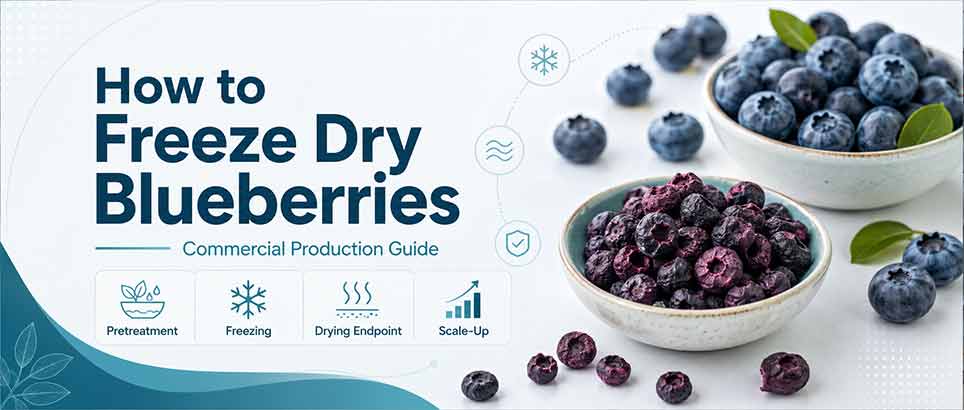
How to freeze dry blueberries commercially is a process-development question, not a timer setting. Whole berries have a skin barrier, and freezing history, pretreatment, load, vapor removal, endpoint and packaging all need to work together. Use this guide to define a pilot and request a comparable equipment proposal—not to copy a laboratory or customer cycle.
Decision in one line: validate a vapor pathway and product-release criteria first; then size drying area, refrigeration and condenser duty from the proven batch rather than from tray count alone.
Why Whole Blueberries Need a Separate Process
For whole blueberries, the skin is part of the drying problem. A full-text laboratory study of vacuum infrared freeze drying found that the waxy cuticle restricted water transport and could contribute to bursting; it evaluated skin pretreatments precisely because the untreated whole berry had this resistance.[2] This is why a cycle developed for sliced fruit is not a valid starting specification for whole berries.
The practical implication is simple: do not compensate for slow moisture removal by raising heat or extending the timer without checking pretreatment consistency, product temperature, vapor path and condenser behavior. Those actions can change appearance and quality without resolving the bottleneck.
How to Freeze Dry Blueberries Commercially: The Pilot Sequence
- Define the product. Record cultivar or raw-material specification, berry-size range, maturity, damaged-fruit limit, intended format (whole, cut or ingredient), target texture and packaging system.
- Prepare a representative batch. Sort consistently and remove excess surface water after the plant’s approved washing and draining procedure. Surface water belongs in the water balance; it is not free production capacity.
- Compare pretreatments at a controlled load. Test an untreated control against only approved options that preserve the intended appearance. Record juice leakage, burst rate, drying behavior and yield.
- Freeze and dry under measured conditions. Log product temperature, chamber pressure, shelf or heat profile, condenser behavior and sampling position. A pressure setpoint alone does not describe a successful cycle.
- Release against a written endpoint. Confirm moisture using the selected validated method, center dryness, texture, batch variation and packaging readiness before treating the cycle as transferable.
For early process development, the food R&D and pilot freeze-dryer guide explains how pilot work can be structured before commercial scale-up.
Food-safety boundary: low moisture is not a substitute for raw-material, hygiene, allergen, packaging or shelf-life validation. Build those controls into the factory’s food-safety plan and validate the finished product for its intended market.
Choose Pretreatment by Product Evidence, Not by a Generic Recipe
Perforation can be a strong pilot candidate when whole-berry appearance matters. In one controlled blueberry study, nine CO2-laser microperforations reduced primary drying from 17 to 13 hours and increased the share of berries that did not burst from 47% to 86% under that study’s conditions.[1] That result supports testing a controlled vapor pathway; it does not prescribe a perforation count, machine type or cycle for another cultivar or plant.
A separate study compared laser perforation, ultrasound and freeze–thaw pretreatments before infrared freeze drying. Its results reinforce the need to compare drying rate with color, shrinkage, rehydration and bioactive measures rather than choose the fastest treatment automatically.[2]
| Option to test | What to measure | Decision rule |
|---|---|---|
| Controlled mechanical or laser perforation | Drying curve, burst rate, juice leakage, appearance | Use only if the benefit is repeatable at the target load and product format. |
| Other approved surface treatment | Residue/quality controls, water path, finished-product acceptance | Do not transfer a method from another berry without product and regulatory validation. |
| Freeze–thaw or ultrasound comparison | Color, structural change, rehydration, practical throughput | Keep only options that meet both quality and plant-operability requirements. |
Freeze, Load and Dry as One System
Prior freezing is a quality variable, not merely a waiting period. In a study of two highbush blueberry cultivars, faster prior freezing altered ice-crystal structure and was associated with longer drying time in that experimental system. Rapid freezing also preserved more of the measured volatile aroma compounds.[3] For commercial buyers, the useful conclusion is to validate this trade-off on the actual product and production line.
For the equipment logic behind these checks, see the site’s guides to condenser and cold-trap capacity and freeze-drying temperature and pressure. For a broader fruit workflow, start with how to freeze dry fruit commercially.
Release and Package the Product Against Defined Criteria
Crunch is a useful observation, but it is not a complete release decision. Before routine production, define a representative sampling plan and acceptance criteria for the product and package.
Use a Real Case Study as a Benchmark, Not a Promise
The site already has a distinct owner for project-specific numbers: the Czech 30 m2 freeze-dried blueberry case study. It reports a 2014 customer project with perforation, approximately 360 kg fresh load, 13 hours, 1.97% final moisture, 26–90 Pa and a stated condenser reference. Those values are useful questions for a buyer to ask about their own trial; they are not a guaranteed recipe, capacity, energy-use figure or acceptance specification for a new facility.
Keep the detailed project table, customer story and equipment-specific performance on that case page. This article should remain focused on the transferable decision process: what to test, what to record and which data make an RFQ comparable.
Request a Blueberry Pilot and Sizing Review
A comparable commercial estimate requires defined process inputs. These should include the product form, berry-size range, wet batch or daily target, raw-material moisture or solids if available, pretreatment under consideration, loading geometry, intended package, target endpoint, production schedule and available utilities.
The engineering review can then map pilot evidence to drying area, water load, condenser duty, cycle allowance and project data requirements.
Need a Commercial Blueberry Freeze-Drying Plan?
Submitting the pilot inputs above allows the engineering team to identify the next validation step and the information required for an equipment comparison—instead of selecting a machine from tray count alone.
FAQ: Commercial Blueberry Freeze Drying
Do whole blueberries need a pretreatment?
Whole blueberries often need a validated vapor-path strategy because their skin can restrict moisture movement. Compare an untreated control with approved pretreatments on the target product; do not copy another study’s settings as a production recipe.
How long does commercial blueberry freeze drying take?
There is no universal cycle time. Berry size, pretreatment, freeze history, loading, heat transfer, vapor removal and endpoint all change the result. Use the linked 30 m2 case only as a scoped project reference.
Can a freeze dryer be sized from tray area alone?
No. Commercial sizing should start with proven fresh load per usable drying area and the required production schedule, then evaluate cycle time, turnaround, removable water, peak vapor load and utilities.
Which endpoint should a commercial blueberry process use?
The endpoint should be product-specific. Moisture, center dryness, texture and packaging criteria should be defined and then validated with the selected analytical method and shelf-life plan.
References
- Munzenmayer, P.; Ulloa, J.; Pinto, M.; Ramirez, C.; Valencia, P.; Simpson, R.; Almonacid, S. Freeze-Drying of Blueberries: Effects of Carbon Dioxide (CO2) Laser Perforation as Skin Pretreatment to Improve Mass Transfer, Primary Drying Time, and Quality. Foods. 2020;9(2):211. https://doi.org/10.3390/foods9020211
- Chen, F.; Zhang, M.; Devahastin, S.; Yu, D. Comparative Evaluation of the Properties of Deep-Frozen Blueberries Dried by Vacuum Infrared Freeze Drying with the Use of CO2 Laser Perforation, Ultrasound, and Freezing–Thawing as Pretreatments. Food and Bioprocess Technology. 2021;14(10):1805–1816. https://doi.org/10.1007/s11947-021-02677-0
- Ngo, H. T.; Tojo, S.; Ban, T.; Chosa, T. Effects of Prior Freezing Conditions on the Quality of Blueberries in a Freeze-Drying Process. Transactions of the ASABE. 2017;60(4):1369–1377. https://doi.org/10.13031/trans.12153
Technical Review
Zheng Wei — Freeze-Drying Systems Engineer
This article was technically reviewed against documented commercial blueberry project data and the cited peer-reviewed literature. Project-specific values are presented as engineering references rather than universal operating setpoints or guaranteed production results.