
How to Freeze Dry Raspberries for Commercial Production
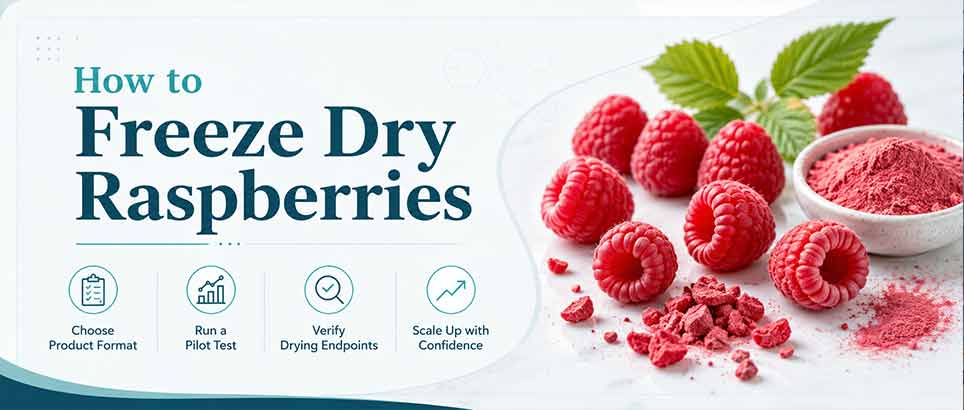
This guide explains how to freeze dry raspberries for a food-production project. It is not a home recipe or a guaranteed machine cycle. Its purpose is to help a processor define the finished format, run a useful pilot, set release checks and request equipment capacity from measured product data.
Technical guide reviewed July 28, 2026.
How to Freeze Dry Raspberries for Commercial Production
Start with the product decision, not a temperature copied from the internet. Whole berries, pieces and puree or powder feed have different geometry, handling losses and downstream uses. A useful commercial process therefore gives the operations team a decision sequence instead of pretending that every raspberry batch has one correct duration.
| Target format | What the pilot must prove | Typical downstream use |
|---|---|---|
| Whole berries | Appearance, breakage and acceptable internal dryness at the planned tray loading. | Snacks, cereal inclusions and premium decoration. |
| Pieces or broken fruit | Fines rate, loading consistency and a release specification that accepts the intended particle range. | Bakery, cereal and ingredient blends. |
| Puree-based sheet or powder route | Layer geometry, downstream milling behavior and moisture protection after milling. | Powders, fillings and formulated ingredients. |
For broader fruit-format decisions, see the commercial fruit freeze-drying guide. This page remains limited to raspberry process development rather than price, generic equipment selection or finished-product sales.
Commercial Raspberry Freeze-Drying Workflow
Do not copy a laboratory recipe as a factory setpoint. In one raspberry state-diagram experiment, fruit was frozen, dried at a specified shelf temperature and 20 Pa, then milled for powder analysis.[1] Those conditions describe that laboratory material and purpose; they do not validate a whole-berry production cycle, a commercial condenser duty or a shelf-life promise.
How Long Does It Take to Freeze Dry Raspberries?
There is no reliable universal commercial time. Format, berry size, initial water, tray loading, freezing history, allowable product temperature, heat transfer, pressure, vapor removal and endpoint specification can all change the result. The right production question is: which cycle reaches the stated endpoint at the repeatable pilot load?
A raspberry study used a laboratory freeze dryer for 48 hours under its own equipment conditions and final-moisture basis.[2] That is useful evidence that experimental outcomes depend on defined conditions, but it is not a production schedule. For cross-product planning only, use the freeze-drying time chart, then confirm raspberry capacity in a pilot.
What to Measure in a Pilot Test
This record makes a commercial discussion auditable. It also prevents a quotation from turning a fresh-fruit kilogram number into an unsupported daily-output promise. For trial planning, see the lab and pilot food freeze-dryer guide.
Packaging Is Part of the Raspberry Process
Do not treat drying as the final quality decision. A study of freeze-dried raspberry powder found that storage water activity and physical state were associated with anthocyanin loss over long-term storage.[3] That finding is specific to ground powder stored under the study conditions, so it does not set a universal water-activity target or shelf life for whole berries. It does support a practical rule: validate the chosen package, storage route and final product together.
Plan the packaging handoff before routine production: define the maximum exposure time before sealing, package barrier requirements, finished-product checks and the storage study needed for the intended market. The freeze-dried food packaging guide covers the broader packaging decision.
How to Select a Freeze Dryer for a Raspberry Project
Equipment selection comes after the pilot data. Match usable tray area to the tested loading rate, then verify that heating, vacuum and vapor capture can repeatedly handle the measured water load and production schedule. If vapor handling is the question, review the condenser and cold-trap guide. If the project is ready for a broader food-equipment comparison, continue to the commercial food freeze-dryer selection guide.
- Validated fresh load per usable tray area: use the tested loading basis rather than nominal tray area alone.
- Initial moisture or solids: record the measured water removed per batch.
- Target endpoint: define the test method used to verify acceptable drying.
- Peak vapor demand: confirm loaded condenser behavior rather than empty-machine performance.
- Production schedule: include loading, drying, unloading and defrost time.
- Monitoring: retain enough batch data to investigate a quality deviation.
How to Freeze Dry Raspberries: Commercial FAQ
Can whole raspberries be freeze-dried commercially?
Yes, but whole berries should be validated as their own product format. The pilot should include the intended loading, an internal-dryness check and an agreed breakage and appearance specification.
Do raspberries need to be frozen before freeze drying?
Yes. Freeze drying removes frozen water by sublimation under vacuum. For production, the key requirement is complete, repeatable freezing of the intended load before primary drying.
Can frozen raspberries be used for freeze drying?
Yes. A processor can develop a cycle using frozen raspberries provided that raw-material condition, loading, freezing history and final quality are controlled consistently. However, a pilot developed with frozen raw material should not automatically be treated as equivalent to a cycle developed from fresh raspberries.
Can freeze-dried raspberries be milled into powder?
Yes. Treat milling and moisture-protective packaging as downstream design steps. A whole-berry process and a puree-based powder route should not be assumed to share the same validated cycle.
How can a processor confirm the batch is dry?
Use the product’s defined release criteria, such as final moisture, internal dryness where relevant, visual quality and repeat-batch consistency. Do not release solely because a fixed timer ended.
Need a Raspberry Pilot-Test and Capacity Review?
After a processor understands how to freeze dry raspberries at pilot scale, the next step is to convert the tested load into commercial capacity. Send the data that makes an engineering response useful: target format, representative wet batch mass, initial moisture or solids, trial loading or layer depth, intended daily schedule, endpoint method and package format.
Good Freeze Dryer can return a pilot-test data checklist and a capacity or RFQ evidence review focused on water load, loading logic and the questions that should be settled before equipment selection.
Request a Raspberry Pilot-Test Data ReviewReferences
- Syamaladevi, R. M.; Sablani, S. S.; Tang, J.; Powers, J.; Swanson, B. G. State diagram and water adsorption isotherm of raspberry (Rubus idaeus). Journal of Food Engineering. 2009;91(3):460–467. DOI: 10.1016/j.jfoodeng.2008.09.025
- Stamenković, Z.; Pavkov, I.; Radojčin, M.; Tepić Horecki, A.; Kešelj, K.; Bursać Kovačević, D.; Putnik, P. Convective Drying of Fresh and Frozen Raspberries and Change of Their Physical and Nutritive Properties. Foods. 2019;8(7):251. DOI: 10.3390/foods8070251
- Syamaladevi, R. M.; Sablani, S. S.; Tang, J.; Powers, J.; Swanson, B. G. Stability of Anthocyanins in Frozen and Freeze-Dried Raspberries during Long-Term Storage: In Relation to Glass Transition. Journal of Food Science. 2011;76(6):E414–E421. DOI: 10.1111/j.1750-3841.2011.02249.x