Best Commercial Freeze Dryer for Food Production: How to Choose the Right Machine

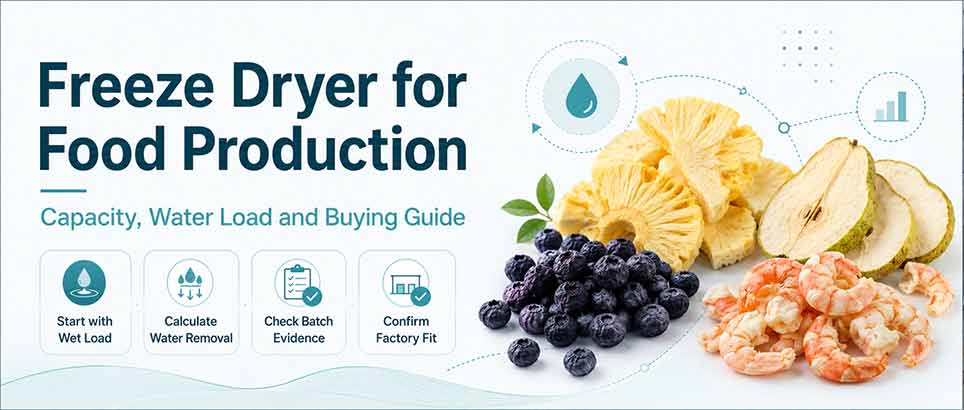
Commercial freeze dryer for food production with fruit, meat, pet food, and ready meal applications
Commercial freeze dryer for food production, designed for processing fruits, meat, pet food, and ready meals.
Table of contents Show

Choosing the best commercial freeze dryer is not only about price. For food businesses, the right machine must match the product, batch capacity, drying time, energy cost, and long-term production plan.

A small machine may help with product testing. However, it may not support stable commercial output. On the other hand, an oversized machine can increase investment, energy use, and factory space requirements.

Therefore, buyers should evaluate a commercial freeze dryer from a production point of view. This guide explains how food manufacturers can choose the right freeze dryer equipment for real business use.


What Is a Commercial Freeze Dryer?

A commercial freeze dryer is a freeze drying machine designed for business use. It removes moisture from frozen products under vacuum. During this process, ice turns directly into water vapor without becoming liquid water.

This method helps food manufacturers keep the product’s shape, color, flavor, and structure. As a result, freeze drying is widely used for fruits, vegetables, meat, seafood, pet food, ready meals, coffee, tea, and functional ingredients.

A commercial food freeze dryer is different from a home freeze dryer. It is also different from a small laboratory freeze dryer. It must support higher capacity, better stability, food-grade design, and repeatable production.

For this reason, food businesses should not choose a machine only by tray size. Instead, they should check real output, water removal capacity, vacuum stability, cold trap performance, and energy consumption.


Commercial Freeze Dryer vs Home and Industrial Freeze Dryer

Many buyers use the terms “commercial freeze dryer” and “industrial freeze dryer” in the same way. However, they are not always the same.

TypeBest ForMain Focus
Home freeze dryerFamily use and small batchesLow cost and simple operation
Laboratory freeze dryerTesting and researchPrecision and process control
Commercial freeze dryerFood brands, farms, and small factoriesCapacity, quality, and production cost
Industrial freeze dryerMedium and large food plantsHigh output, automation, and ROI

A commercial freeze dryer is often the bridge between small testing and industrial production. It is suitable for businesses that want to sell freeze-dried products, but do not yet need a very large plant.


What Products Can a Commercial Food Freeze Dryer Process?

A commercial food freeze dryer can process many types of food. However, each product needs a different drying strategy.


Freeze-Dried Fruits

Fruits such as strawberries, mangoes, bananas, apples, and blueberries are common freeze-dried products. They usually contain high moisture. Some fruits also contain high sugar, so temperature control is important.

For fruits, the product temperature must stay below its collapse temperature during primary drying. If the heating curve is too aggressive, the product may shrink, collapse, lose color, or develop poor texture.

Therefore, fruit processors should choose a commercial freeze dryer with stable shelf temperature and reliable vacuum control.

This is one reason why many commercial and industrial freeze dryers use hollow aluminum shelves as heating plates. In many systems, water, glycol, or silicone oil circulates inside the shelf. The fluid is heated by electric heaters, steam, or another heat source. Then, it transfers heat evenly to the shelf surface.

This design creates a thermal buffer. As a result, the shelf temperature changes more smoothly and remains more uniform across the drying area.

Anodized aluminum surfaces are also often used to improve radiation heat transfer and surface durability. Compared with small freeze dryers that use direct electric heating plates, fluid-circulated shelves are usually better for stable temperature control.

They are especially useful for sensitive products such as fruits, ready meals, and high-value food ingredients.


Freeze-Dried Meat and Seafood

Meat, seafood, and protein-based products require careful process control. These products may contain fat, fiber, dense tissue, and bones. Therefore, drying time can vary greatly.

For most food production projects, excess fat and bones should be removed before freeze drying. Fat can block the vapor pathways inside the food structure. This makes it harder for water vapor to escape during sublimation.

Bones also require a long drying time, but they add limited commercial value to the final product. As a result, removing fat and bones can improve drying efficiency, reduce energy use, and increase usable product yield.

For meat, seafood, and pet food production, buyers should focus on food safety, loading capacity, cold trap capacity, and batch consistency.


Freeze-Dried Pet Food

Freeze-dried pet food is a high-value market. Products may include chicken, beef, duck, fish, organs, or mixed formulas.

For pet food factories, the key issue is not only product quality. It is also daily output. A suitable commercial freeze drying machine should help reduce drying time, labor cost, and energy cost per batch.

In addition, pet food processors should pay attention to product thickness, loading density, and final moisture. These factors can affect drying time and product safety.


Freeze-Dried Ready Meals

Ready meals often contain rice, vegetables, meat, sauce, and seasoning. Because the structure is complex, drying must be uniform.

In this application, the freeze dryer should provide stable heat transfer and reliable vacuum performance. Otherwise, some parts may remain wet while other parts become over-dried.

Therefore, ready meal processors should choose equipment with stable shelf temperature, good vacuum control, and repeatable drying recipes.


Coffee, Tea, and Functional Ingredients

Freeze drying is also used for instant coffee, tea extracts, probiotics, enzymes, and other sensitive ingredients. These products often need to dry under strict temperature limits.

As a result, the key challenge is balancing drying efficiency and product quality. If the process is too slow, production cost will rise. However, if the heating process is too aggressive, aroma, activity, color, or structure may be damaged.

Therefore, buyers should choose a commercial freeze dryer with accurate shelf temperature control, stable vacuum performance, and repeatable drying recipes. This is especially important for coffee extracts, tea ingredients, probiotics, enzymes, and functional food materials.


How to Choose the Best Commercial Freeze Dryer

The best commercial freeze dryer is not the cheapest machine. It is the machine that fits the buyer’s product, production goal, workshop conditions, and cost target.

Below are the key points buyers should check before purchase.


1. Choose by Product Type and Sample Test Data

Most commercial freeze dryers are general-purpose machines. They are not designed for only one product unless the buyer requests a customized system. However, different foods behave differently during freeze drying.

For example, fruits may be sensitive to temperature and collapse. Meat and pet food may contain fat, fiber, or dense tissue. Ready meals may have complex structures and uneven moisture distribution.

Therefore, the same freeze dryer may perform differently with different products.

Before choosing a commercial freeze dryer, buyers should ask the manufacturer to run sample tests when possible. Sample testing can provide useful data, such as drying time, product temperature, loading density, final moisture, appearance, texture, and energy use.

With these test results, the manufacturer can help confirm the proper machine size, cold trap capacity, heating method, vacuum system, and loading design. This makes equipment selection more reliable than choosing only by tray area or brochure capacity.

Before requesting a quote, buyers should prepare basic product information:

  • Product name
  • Product shape and size
  • Initial moisture content
  • Target final moisture
  • Fresh material weight per batch
  • Expected dry product output
  • Special quality requirements

2. Choose by Real Batch Capacity

Many buyers compare machines by tray area. However, tray area alone does not show real capacity.

A better method is to calculate real production output. Buyers should consider:

  • Fresh material weight per batch
  • Water content of the product
  • Final moisture target
  • Drying time per batch
  • Number of batches per day
  • Working days per year

For example, two machines may have similar tray area. However, their real output can be different if the cold trap capacity, heating system, and vacuum system are not the same.

Therefore, a suitable commercial freeze dryer should be selected by real production output, not only by machine size.


3. Check the Drying Time

Drying time has a direct impact on profit. A shorter and stable drying cycle can increase output. However, faster drying is not always better.

If the product is heated too quickly, quality problems may appear. These problems may include shrinkage, cracking, poor color, uneven drying, or lower rehydration quality.

Drying time depends on several factors:

  • Product thickness
  • Loading density
  • Moisture content
  • Shelf temperature
  • Chamber pressure
  • Cold trap capacity
  • Vacuum stability

For commercial food production, the goal is balance. The machine should achieve stable product quality, reasonable drying time, and controlled energy cost.


4. Check the Cold Trap Capacity

The cold trap is one of the most important parts of a commercial freeze dryer. It captures water vapor from the product during sublimation.

If the cold trap is too small, the chamber pressure may become unstable. As a result, drying time can increase. In serious cases, the product may not dry evenly.

Buyers should ask the manufacturer these questions:

  • What is the maximum ice capacity?
  • What is the water removal capacity per hour?
  • Can the cold trap handle the expected batch load?
  • How long does defrosting take?
  • Is continuous or alternate defrosting available?

This is especially important for commercial and industrial production. Frequent defrosting can reduce daily output. In addition, poor vapor capture can increase drying time and energy cost.


5. Compare Energy Consumption

A low purchase price does not always mean a low production cost. For food factories, energy consumption can affect profit for many years.

Buyers should compare energy use by water removal, not only by installed power. In other words, they should ask how much energy is required to remove each kilogram of water from the product.

Refrigeration efficiency is especially important. It often depends on two key temperatures: the cold trap refrigeration temperature and the heat rejection temperature. When the condenser must reject heat at a higher temperature, the refrigeration system usually consumes more power.

The cold trap temperature should also be selected carefully. In many food freeze drying projects, the cold trap temperature does not need to be extremely low. A practical design is often to keep the cold trap about 8°C lower than the product’s eutectic point.

This is because the benefit of a lower cold trap temperature becomes smaller as the temperature decreases. However, the energy consumption of the refrigeration system increases clearly.

For example, apple can be used as a reference product. If its eutectic point is about -20°C, a cold trap temperature around -35°C is often sufficient for many production conditions.

Under the same condensing temperature, and using a two-stage screw refrigeration compressor as a reference, lowering the refrigeration temperature from -35°C to -40°C may increase energy consumption by about 10%. The theoretical drying speed may improve by about 12%.

However, if the temperature is reduced further, the energy penalty becomes more obvious.

Cold Trap Temperature ChangeEstimated Refrigeration System Energy IncreaseTheoretical Drying Speed Increase
-35°C to -40°CAbout 10%About 12%
-35°C to -45°CAbout 24%About 18%
-35°C to -50°CAbout 41%About 22%
-35°C to -55°CAbout 64%About 25%

However, buyers should understand one key point. The energy increase is real and measurable. The drying speed increase is only a theoretical estimate.

In actual production, the improvement is often much lower. This is because freeze-dried products have a limit on how fast water vapor can escape from the material. The real drying rate is also affected by product thickness, loading density, vapor flow resistance, chamber pressure, and cold trap design.

Therefore, a lower cold trap temperature is not always better. If product quality and production capacity are not affected, a higher cold trap temperature can often save more energy.

The condenser type should also be evaluated carefully. For commercial and industrial freeze dryers, water-cooled or evaporative condensers are often better choices than air-cooled condensers, especially in hot climates or summer production.

In summer, air-cooled systems may face much higher condensing temperatures. As a result, their refrigeration energy consumption can be much higher than water-cooled or evaporative systems.

In some high-temperature conditions, the difference may become close to double. In addition, air-cooled systems may carry a higher risk of high-temperature shutdown during hot afternoons.

Important energy factors include:

  • Cold trap refrigeration temperature
  • Condensing temperature
  • Condenser type
  • Heating method
  • Vacuum pump power
  • Drying cycle length
  • Defrosting time
  • Workshop temperature
  • Loading efficiency

Electric heating may be simple. However, steam heating may be more suitable for larger production if steam is available.

Likewise, air-cooled refrigeration may be easier to install. However, water-cooled or evaporative cooling can often provide better efficiency for continuous production.

For this reason, buyers should not compare commercial freeze dryers only by machine price. They should also compare long-term energy cost, cooling method, drying time, and system stability.


6. Evaluate Loading and Unloading Method

Loading and unloading can affect labor cost and daily output. Therefore, buyers should not ignore this part.

Small commercial machines may use manual tray loading. This is simple and low cost. However, it may become slow when production increases.

Larger systems may use:

  • Trolley loading
  • Rail-assisted loading
  • Overhead monorail loading
  • Conveyor loading

These systems can reduce labor intensity and shorten batch turnover time. As a result, the factory can improve production efficiency.

For growing food businesses, loading design should allow future expansion. Otherwise, the machine may become a bottleneck after sales volume increases.


7. Check the Control System and Automation

Commercial production requires repeatable results. Therefore, the control system must be stable and easy to use.

A good commercial freeze drying machine should support:

  • Shelf temperature control
  • Vacuum control
  • Recipe management
  • Alarm records
  • Process data recording
  • Remote monitoring if needed
  • Automatic defrosting if required

These functions help operators reduce mistakes. They also help managers track batch quality.


8. Check Manufacturer Support

A commercial freeze dryer is not a simple appliance. It is production equipment. Therefore, manufacturer support matters.

Before purchase, buyers should check whether the manufacturer can provide:

  • Product testing support
  • Capacity calculation
  • Water removal calculation
  • Energy use estimation
  • Cold trap matching
  • Workshop layout advice
  • Installation guidance
  • Operator training
  • Spare parts support
  • After-sales service

A reliable manufacturer should not only sell equipment. It should also help the buyer reduce selection risk.


Commercial Freeze Dryer Price: What Affects the Cost?

Many buyers search for “commercial freeze dryer for sale” because they want a clear price. However, the price can vary greatly.

The final cost depends on:

  • Chamber size
  • Tray area
  • Batch capacity
  • Cold trap capacity
  • Refrigeration system
  • Vacuum pump
  • Heating method
  • Control system
  • Stainless steel design
  • Loading system
  • Automation level
  • Installation requirements

A small commercial freeze dryer may require a lower initial investment. However, smaller machines usually have a higher cost per kilogram of output when the price is compared by production capacity.

This is because the refrigeration system, vacuum system, control system, chamber, and cold trap all require a basic investment. As capacity increases, these costs can be spread over more product output.

Therefore, buyers should compare not only the total machine price. They should also compare cost per batch, cost per kilogram, energy consumption, labor cost, and future expansion needs.

A larger system may cost more at the beginning. However, if production demand is stable, it may reduce the unit production cost and provide better long-term ROI.


New vs Used Commercial Freeze Dryer for Sale

Used equipment can be attractive because the initial price is lower. It may also be available faster than a new machine. However, buyers should be careful.

A used commercial freeze dryer may have hidden risks.

Common risks include aged refrigeration systems, weak cold trap capacity, vacuum leakage, outdated controls, unknown maintenance history, food sanitation concerns, limited spare parts, and no process support.

Freeze dryer components also have service life limits. Core parts such as refrigeration compressors, vacuum pumps, valves, sensors, and control systems may need repair or replacement after years of operation.

For example, a refrigeration compressor may need major maintenance after long-term use. If the machine is already old, the buyer may face major repair costs soon after purchase.

In some cases, used equipment is sold because the previous owner found performance problems or design defects. These problems may include high energy consumption, unstable vacuum, poor drying results, or low real capacity.

For new buyers, these risks are difficult to judge before purchase. The risk is even higher if the equipment is very old. The original manufacturer may no longer exist, and spare parts may be hard to find.

If the buyer does not know how to inspect or repair the machine, they may need to pay a high cost for professional service.

Therefore, a used commercial freeze dryer may be suitable for testing or short-term projects. However, for long-term food production, a new commercial food freeze dryer is often safer.

It can be selected based on product type, target capacity, energy conditions, and factory layout. It also provides better technical support after installation.


Commercial Freeze Dryer Buyer Checklist

Before contacting a manufacturer, buyers should prepare clear information. This can make the quotation more accurate.

Use this checklist:

  • What product will be freeze dried?
  • What is the fresh material weight per batch?
  • What is the initial moisture content?
  • What is the target final moisture?
  • What is the product size or thickness?
  • How many batches are required per day?
  • What is the target daily or yearly output?
  • Is electricity, steam, or both available?
  • What workshop space is available?
  • Is manual, trolley, or conveyor loading preferred?
  • Are there special food safety requirements?

This information helps the manufacturer recommend the right freeze dryer equipment. It also helps avoid overbuying or underbuying.


Why Work With a Commercial Freeze Dryer Manufacturer?

Working with a manufacturer can reduce project risk. This is because commercial freeze drying involves product behavior, heat transfer, vacuum control, refrigeration, and factory layout.

A professional manufacturer can help buyers evaluate:

  • Machine size
  • Batch capacity
  • Drying time
  • Cold trap capacity
  • Energy consumption
  • Loading method
  • Installation conditions
  • Future expansion

This support is important for food startups and growing factories. It helps them make a decision based on real production needs, not only brochure data.


FAQ About Commercial Freeze Dryers

What is the best commercial freeze dryer for food production?

The best commercial freeze dryer is the one that matches the product, capacity, drying time, energy cost, and long-term production plan. It should provide stable drying performance, enough cold trap capacity, and reliable manufacturer support.


How much does a commercial freeze dryer cost?

The cost depends on chamber size, tray area, batch capacity, cold trap, refrigeration system, vacuum system, heating method, material, and automation level. Therefore, buyers should request a quotation based on real production data.


What size commercial freeze dryer does a food business need?

The right size depends on fresh material weight, moisture content, target final moisture, drying time, daily output, and future expansion plan. Sample testing can also help confirm the proper equipment size and configuration.


Can a home freeze dryer be used for commercial food production?

A home freeze dryer may be used for small tests. However, it is not ideal for stable commercial food production. Commercial production needs better capacity, hygiene, process control, and continuous operation.


How long does commercial freeze drying take?

Drying time depends on product type, thickness, loading density, moisture content, shelf temperature, vacuum level, and cold trap capacity. A stable drying cycle is more important than simply chasing the shortest time.


Is a used commercial freeze dryer worth buying?

A used commercial freeze dryer may reduce initial investment. However, buyers should check the refrigeration system, vacuum performance, cold trap capacity, control system, sanitation condition, and spare parts availability before purchase.


Why is cold trap temperature important in a commercial freeze dryer?

Cold trap temperature affects vapor capture, refrigeration energy use, and drying efficiency. However, a lower cold trap temperature is not always better. If product quality and capacity are not affected, a higher cold trap temperature can often reduce energy consumption.


Why is refrigeration design important in a commercial freeze dryer?

Refrigeration design affects drying speed, energy consumption, cold trap performance, and system stability. In hot climates, water-cooled or evaporative cooling may offer better efficiency than air-cooled systems.


What information should buyers provide before requesting a quote?

Buyers should provide product type, fresh material weight per batch, moisture content, target final moisture, product size, target output, energy conditions, and workshop space. This helps the manufacturer recommend a suitable machine.


Conclusion

Choosing a commercial freeze dryer is a business decision. Buyers should not choose only by price, tray area, or appearance.

Instead, they should evaluate product type, sample test data, batch capacity, drying time, cold trap capacity, energy consumption, loading method, automation, and manufacturer support.

For food businesses, the right commercial food freeze dryer can improve product quality, reduce production cost, and support long-term growth.

Scroll to Top