
Freeze Dryer Condenser: Capacity, Temperature & Buyer Checks
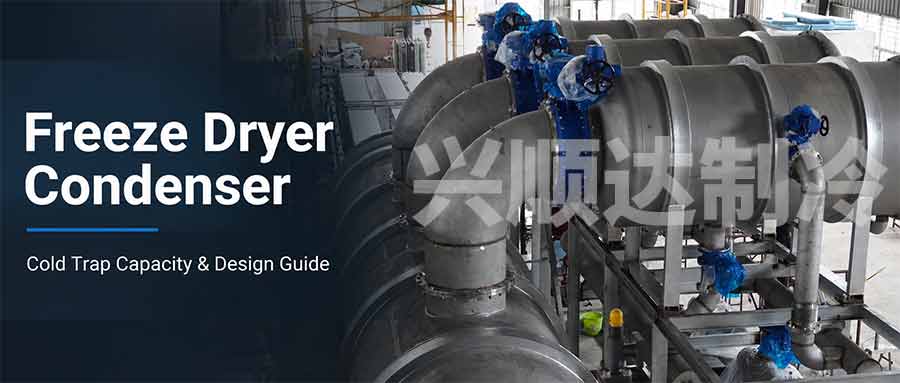
A freeze dryer condenser is not selected by its lowest no-load temperature or its ice-capacity label alone. For commercial food production, the relevant question is whether it can collect the batch water load, handle the highest expected vapor load, maintain temperature under that load, and return to service on the required production schedule.
This page covers the freeze-dryer cold trap (also called an ice condenser), which captures process vapor as ice. It is different from the refrigeration condenser that rejects heat from the refrigeration circuit. For the full process sequence, see how freeze drying works. For equipment-level evaluation of product load, condenser duty, loaded vacuum stability and factory fit, see how these factors interact in a vacuum freeze-drying system.
What to Compare in a Freeze Dryer Condenser
These five values describe different limits. Therefore, buyers should not substitute one for another.
| Value to request | What it answers | Evidence to ask for |
|---|---|---|
| Usable ice capacity | Can the condenser hold the water removed in one batch? | Rated capacity, allowed ice thickness or fill condition, and the stated batch basis. |
| Condensing rate | Can it accept vapor fast enough during the highest-load part of primary drying? | kg/h (or equivalent) with product/load, pressure, shelf-heat input and test duration. |
| Loaded condenser temperature | Does the cold surface stay cold while it is actually collecting vapor? | Temperature trend, probe locations and vapor-load basis—not only a no-load pull-down result. |
| Vapor path | Can vapor reach the condenser without an avoidable restriction? | Connection, valve and inlet geometry for the proposed chamber-condenser arrangement. |
| Defrost-to-ready time | What does the cold trap add to real batch turnaround? | Measured ice removal, drainage and next-ready time under a stated condition. |

How to Size a Freeze Dryer Condenser From Water Load
Start with a water balance, then confirm the peak vapor load separately. For a batch with wet mass Mw, initial moisture fraction Xi and target final moisture fraction Xf:
Dry solids = Mw × (1 − Xi)
Final product mass = dry solids ÷ (1 − Xf)
Water removed = wet mass − final product mass
Example: 100 kg of product at 80% initial moisture contains 20 kg of dry solids. At 2% final moisture, final mass is about 20.4 kg, so the batch removes about 79.6 kg of water. That calculation is a quotation input; it does not establish the required kg/h capture rate or the machine’s safety margin. For the wider throughput calculation, see the batch freeze dryer capacity guide.
Peak vapor generation changes during primary drying. A condenser can hold the total batch water yet still restrict the cycle if its capture rate, refrigeration duty or vapor path is inadequate at the peak. Food freeze-drying is also a high-energy process, so cycle and equipment decisions should be validated for the actual product rather than generalized from a nominal machine size.[2]
Temperature: Use the Loaded Value, Not a Colder Marketing Number
Condenser temperature is a process-matching question. The required level depends on the product, water or solvent system, target pressure, vapor load and refrigeration design. A low no-load temperature alone does not demonstrate that the condenser will maintain capture performance during primary drying.
Therefore, replace “What is your lowest condenser temperature?” with: “At the proposed vapor load, what surface temperature is maintained, where is it measured, and for how long?” If a project includes solvents or non-water vapors, they should be identified before the specification is prepared; a water-food comparison should not be applied directly to a solvent application.
Why Ice Distribution and Vapor Path Belong in the RFQ
Ice does not necessarily form uniformly across a condenser. A 2024 CFD study, validated against controlled experiments, examined how condenser temperature, sublimation rate and inert gas affect deposition behavior and system pressure.[1] The study does not supply a universal food-machine rating. Its useful purchasing implication is narrower: buyers should request the condenser layout and loaded test record rather than treating nominal volume as usable performance throughout the batch.

Also inspect the route from product chamber to cold surface. A restrictive connection, valve or inlet can become the practical limit before nominal condenser capacity is reached. The related freeze-dry vacuum chamber guide explains the chamber-side design checks; the vacuum-pump guide explains why pump selection does not replace vapor capture.

Internal or External Condenser?
Cold-Trap Fabrication Evidence


Neither layout is automatically better. An internal condenser can support a compact arrangement. An external condenser may offer more design freedom for vapor routing, service access, condenser volume and defrost handling. The layout should therefore be selected from the developed product load, chamber geometry, access requirements, transport constraints and production schedule.


For complete-system boundaries, this page owns condenser selection and verification. It links to the broader freeze dryer components guide, while overall machine sizing belongs on the food freeze-dryer design guide.
Freeze Dryer Condenser FAT: What to Put in the Acceptance Plan
Empty-chamber vacuum and no-load pull-down tests are useful checks, but they do not prove production capacity. The table below is intentionally limited to condenser-specific FAT evidence. For the complete machine-level FAT and SAT framework, see the food freeze dryer validation and acceptance testing guide.
| Acceptance item | Record in the FAT file |
|---|---|
| Test basis | Product or agreed simulant, starting condition, water load, target pressure, shelf/heat setting and duration. |
| Vapor handling | Condensing-rate basis and pressure/temperature trend through the stated load period. |
| Temperature | Probe locations and loaded condenser-temperature data, not only a controller setpoint. |
| Ice and flow path | Observed ice distribution or inspection record, plus condenser/inlet configuration. |
| Turnaround | Defrost, drainage and next-ready time; identify any manual steps. |

Request a Condenser and Water-Load Review
Send the product name, wet batch mass, initial and target moisture, loading thickness, target cycle, operating schedule and any supplier quotation. The engineering team can review the water balance and prepare a condenser-RFQ evidence list for the project. This review is intended for food-processing projects that need to compare a proposed machine before purchase.
Send Project Data for ReviewFreeze Dryer Condenser FAQ
Is a freeze dryer condenser the same as a cold trap?
Usually, yes. In this context, “freeze dryer condenser,” “cold trap” and “ice condenser” mean the cold surface or chamber that captures sublimated process vapor as ice. They are not the refrigeration condenser.
Is a −80°C condenser better than a −50°C condenser?
Not necessarily. A lower no-load temperature does not automatically mean higher food-production throughput. Buyers should compare condenser performance under the expected vapor load, including loaded temperature, condensing rate, refrigeration duty and vapor-path performance.
Can a larger vacuum pump compensate for an undersized condenser?
No. A vacuum pump supports pressure control and removal of non-condensable gases; it does not replace refrigeration capacity, condensing surface or vapor handling at the cold trap.
What information should a supplier receive before it sizes a condenser?
Provide wet batch mass, initial and final moisture, product form and loading thickness, proposed shelf area, target cycle, expected batches per day, available utilities, vapor composition and any competing quotation. The separate freeze dryer specifications guide lists the wider RFQ set.
Does defrost affect daily capacity?
Yes. Daily output depends on the whole batch turnaround, including ice removal, drainage, recovery and loading—not drying time alone. For operating guidance, see defrosting a freeze dryer between batches.
References
- Kamenik, B., Hriberšek, M., & Zadravec, M. Simulation of ice deposition in a freeze dryer condenser: A computational fluid dynamics study. Applied Thermal Engineering. 2024;247:123019. https://doi.org/10.1016/j.applthermaleng.2024.123019
- Duan, X., Yang, X., Ren, G., Pang, Y., Liu, L., & Liu, Y. Technical aspects in freeze-drying of foods. Drying Technology. 2016;34(11):1271–1285. https://doi.org/10.1080/07373937.2015.1099545
Technical Review
Zheng Wei works on food freeze-drying system selection, equipment specification, process matching and project engineering for commercial and industrial applications. This page distinguishes product-specific engineering inputs, internal engineering references and published research from general equipment claims so buyers can request comparable supplier evidence.