
For food manufacturers and product-development teams
Freeze Drying Avocado: How to Plan a Commercial Pilot and Scale-Up
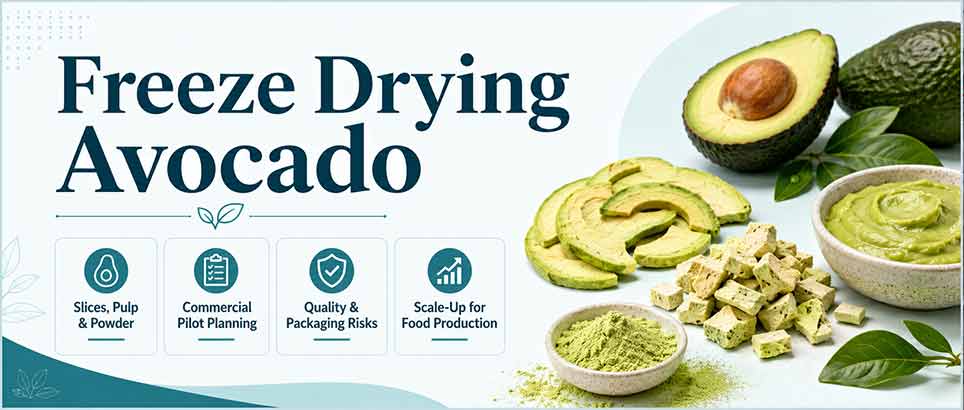
Freeze drying avocado can create slices, pulp-based ingredients or powder, but it is not a copy-and-paste fruit recipe. The commercial question is whether the chosen format can meet its color, texture, rehydration, yield and packaging requirements at a repeatable cycle time.
For broader process context, see the commercial fruit freeze-drying guide and the explanation of how freeze drying works. This page concentrates on the decisions that make avocado projects difficult to scale.
What Makes Avocado a Different Freeze-Drying Project?
Avocado’s finished-product risks are not limited to removing water. Teams must also control raw-material maturity, exposure after cutting, browning, texture, powder flow or slice breakage, and moisture and oxygen exposure after unloading.
In a laboratory study of Collinson avocado pulp, changing the initial freezing condition and lyophilization pressure changed drying behavior, browning and texture. The researchers compared 25 g samples frozen at −26 °C or −80 °C. They then dried the samples at 0.12, 0.37 or 1.07 mbar. These results support testing the variables; they are not a commercial recipe or universal setpoint.[1]
Slices or pieces
Best when visible whole-food appearance matters. Validate uniformity, breakage, center dryness and color.
Pulp or cake
Useful when the buyer will rehydrate or formulate the product. Define tray depth, unloading behavior and the target rehydration test.
Powder
Useful for dosing and formulated foods. Validate milling, flow, clumping, moisture pickup and performance in the intended application.
Commercial Freeze Drying Avocado Process
When freeze drying avocado for commercial production, the process should be written around repeatable preparation, loading and acceptance criteria. A practical pilot sequence is:
- Sort and select the raw material. Record variety, maturity and the condition accepted for processing.
- Wash, peel and remove the pit. Keep preparation time controlled so one batch is comparable with the next.
- Prepare slices, pieces or pulp. Record slice thickness or pulp depth and tray layout.
- Apply a validated pretreatment only when required. Compare it against the intended flavor, ingredient declaration and color specification.
- Freeze under defined conditions. Record the freezing method and the point at which product enters the drying stage.
- Run primary and secondary drying. Track product temperature, chamber pressure, condenser behavior and cycle time rather than relying on a fixed avocado recipe.
- Verify the endpoint and package promptly. Check final moisture, center dryness, sensory quality and the intended end-use test before release.
Before freeze drying avocado at a larger scale, repeat the selected pilot condition. A second comparable batch is more useful for equipment planning than a single successful run.
Build the Pilot Around Actual Use
Before selecting a cycle, document what a successful product looks like: appearance, permitted ingredients, target texture, rehydration method, pack format, target market and required shelf-life validation. A snack slice, a guacamole base and a powdered ingredient can use the same fruit but require different development choices.
| Decision | What to define before the pilot | Why it protects the project |
|---|---|---|
| Raw material | Variety, processing maturity and acceptable batch variation | Stops raw-material changes being mistaken for equipment performance. |
| Geometry | Slice thickness or pulp depth, plus tray layout | Creates a repeatable water-vapor path and loading condition. |
| Product protection | Whether a pretreatment is permitted and how it will be compared | Balances color and sensory goals against label and formulation requirements. |
| Acceptance | Final moisture, center dryness, sensory quality, rehydration and package test | Prevents a technically dry but commercially unusable product from being accepted. |
A Philippine patent for freeze-dried avocado cuts shows that pretreatment can be a genuine development variable. However, a patented process is not a universal formulation. Any treatment must be validated against the intended ingredient declaration, flavor and finished-product specification.[2]
What to Record During an Avocado Freeze-Drying Trial
Record data that can be repeated, compared and used to size equipment. Do not select a commercial freeze dryer from finished kilograms per day alone.
- Fresh input, usable tray area and loading expressed as kg/m²
- Slice thickness or pulp depth, tray arrangement and freezing condition
- Product temperature, chamber pressure, condenser behavior and total cycle time
- Dried output, water removed per batch, final-moisture method and endpoint decision
- Color, aroma, texture, breakage or flow, and the intended rehydration/end-use result
- Packaging configuration and the conditions used for stability validation
Run the most promising condition again. One good batch demonstrates feasibility; repeatable batches are the starting point for a scale-up discussion.
How to Translate Pilot Data into Equipment Requirements
Use a pilot baseline to calculate loading and water-removal load. Then review tray area, heat transfer, vacuum performance, condenser capacity, utilities, labor and intended batches per day as one system. The calculation below is a planning relationship, not an equipment guarantee.
Daily fresh throughput = fresh input per batch × repeatable batches per day.
Compare both values with measured water removed per batch and the repeatable cycle time before selecting a machine.
Read the freeze-dryer condenser guide alongside the freeze-drying time and scale-up guide. For pilot scope, use the food R&D and pilot-testing guide. For later-stage comparison, see the commercial food freeze-dryer selection guide.
Packaging and Storage: Validate the Product You Actually Made
Freeze-dried avocado should move from unloading to a validated package without unnecessary exposure. The relevant packaging decision depends on the actual format, final moisture, oxygen sensitivity and pack size. Distribution conditions and the target shelf life must also be considered.
A formulation containing carriers is not interchangeable with pure avocado powder. Likewise, a supplier’s shelf-life claim is not a substitute for product-specific validation. Use the freeze-dried food packaging guide and shelf-life guide to structure the test plan.
Common Failure Modes to Isolate in Trials
| Observed issue | Check first |
|---|---|
| Browning or weak flavor | Ripeness, time after cutting, pretreatment comparison, freezing delay and post-dry exposure. |
| Wet or soft center | Geometry, kg/m² loading, heat-transfer consistency and endpoint method. |
| Breakage or unsuitable texture | Finished format, freezing history, tray handling and target use. |
| Clumping or poor powder flow | Final moisture, milling, humidity exposure, formulation and package barrier. |
| Inconsistent batches | Raw-material specification, geometry, loading, freezing and written recipe controls. |
Change one or a small number of variables per comparison. Otherwise, a better batch will not show which intervention created the improvement.
FAQ
How long does avocado take to freeze dry?
There is no defensible universal cycle time. Format, thickness or depth, loading, freezing history, heat transfer, pressure, water-removal load and endpoint criteria all matter. Use repeatable pilot data for equipment sizing.
Can avocado pulp be freeze dried?
Yes. For commercial work, validate pulp depth, formulation, drying endpoint, unloading, rehydration or milling, and packaging as one linked process.
Can freeze-dried avocado be made into powder?
Yes. The dried material can be milled when the product specification allows it. However, powder flow, clumping, moisture pickup, formulation and packaging should be validated for the intended application.
What size freeze dryer is needed for avocado production?
Start with fresh input per batch, usable tray area, loading, water removed per batch, repeatable cycle time and daily throughput. A model name or finished-kilogram target alone is not enough.
Need an Avocado Pilot-Planning Review?
Send the intended format, fresh input per batch, approximate slice thickness or pulp depth, target market and required output per day. The engineering team can return a project-question checklist and discuss the pilot data needed to evaluate tray area, water-removal load and a scale-up path.
Discuss an Avocado Freeze-Drying Pilot
Technical Review
Zheng Wei — Freeze-Drying Systems Engineer
Zheng Wei works on food freeze-drying equipment selection, pilot-to-production scale-up and process evaluation for commercial food projects.
References
- Souza, D. S.; Marques, L. G.; Gomes, E. B.; Narain, N. Lyophilization of Avocado (Persea americana Mill.): Effect of Freezing and Lyophilization Pressure on Antioxidant Activity, Texture, and Browning of Pulp. Drying Technology. 2015;33(2):194–204. DOI: 10.1080/07373937.2014.943766.
- Azanza, M. P. V. et al. Process of Producing Debittered Freeze Dried Avocado (Persea americana) Cuts. Philippine Patent PH12016000401A1 / PH12016000401B1. Patent record.