
Freeze Dryer Mexico: Commercial & Industrial Food Buyer Guide
For a food manufacturer evaluating a freeze dryer Mexico project, the correct starting point is product format, wet load, water to remove, validated loading density, utilities and the required production schedule—not machine price alone. Therefore, this guide helps commercial and industrial buyers turn those inputs into a comparable specification and a stronger RFQ.
Who this is for: food factories, ingredient producers, contract manufacturers and investors evaluating imported freeze-drying equipment for a Mexican site. The page does not promise local installation, regulatory approval, a guaranteed cycle or a fixed quotation.
Is This Mexico Freeze-Dryer Guide Right for the Project?
For a Mexican food-production project, the central decision is how product requirements, site conditions and commercial scope translate into an equipment specification. Therefore, this guide focuses on industrial procurement rather than household machines, generic freeze-drying theory, fixed price lists or toll-processing services.
In Spanish-language results, the same equipment may be described as a liofilizador industrial. However, the terminology does not change the technical evidence required in an RFQ: product load, usable shelf area, condenser or cold-trap capacity, vacuum performance, utilities, testing and delivery scope.
For buyers still comparing general machine classes, the commercial food freeze-dryer capacity and water-load guide provides the broader selection framework; the sections below add Mexico-specific procurement, site and import-planning considerations.
Freeze Dryer Mexico RFQ: What Should a Food Producer Specify Before a Quote?
First, a useful quotation starts with process data. Without that basis, suppliers may quote nominal chamber or tray area that cannot be compared fairly with another supplier’s wet-load, cycle or installed-cost basis. Moreover, the same inputs help the engineering team identify which assumptions still require product testing.
| Input | Why it matters |
|---|---|
| Product, formulation and format | Fruit pieces, coffee extract, seafood, meat, pet treats and liquid ingredients create different heat-transfer and water-load conditions. |
| Initial moisture and total solids | Separates wet mass from the water that the condenser must capture; high-solid products can behave differently from dilute liquids. |
| Fresh raw material, kg/batch and kg/day | Defines the output basis and prevents a kg/batch listing from being compared with kg/day. |
| Piece size, slice thickness or fill depth | Changes drying resistance and makes a single time or kg/m² claim unreliable across products. |
| Target batches, operating days and expansion | Connects batch capacity with daily throughput, turnaround and the next production stage. |
| Final moisture, water activity and quality endpoint | Defines what “dry” means and how the batch will be released; final moisture alone may not describe texture, rehydration or shelf-life performance. |
| Packaging and post-drying transfer | Limits moisture pickup after unloading and affects downstream equipment and labor. |
| Factory location, utilities and access | Determines installation planning, heat rejection, drainage, delivery route, service clearance and local contractor scope. |
| Import and delivery responsibility | Clarifies whether the proposal is equipment-only, FOB/CIF, delivered, installed or commissioned at the Mexican site. |
In addition, the freeze-dryer specification checklist can support early configuration comparisons. Nevertheless, the RFQ should still state the buyer’s own test basis.
Commercial vs. Industrial Freeze Dryer for Mexico Projects
Equipment class should follow the production decision, not a marketing label. For example, a pilot unit may be correct while the product and cycle are still being established. A commercial unit may then suit repeatable smaller production, whereas an industrial system may be justified when water load, uptime, labor, utilities and batch consistency dominate the decision.
| Project stage | Primary objective | Evidence to request |
|---|---|---|
| R&D or pilot | Validate preparation, freezing, loading and endpoint | Product trial records, sensor method, final-moisture and rehydration checks |
| Commercial production | Repeatable batches for an established product line | Wet-load basis, cycle record, utilities, packaging and repeat-batch data |
| Industrial production | Higher daily throughput and factory-level operation | Water-load balance, condenser capacity, vacuum stability, FAT/SAT and service scope |
Accordingly, the lab and pilot freeze-dryer, commercial freeze-dryer and industrial freeze-dryer pages provide product-category references. Final selection, however, should be made from the product trial and stated project scope.
Food-scale literature explains why this distinction matters: as the dry layer grows, resistance to vapor flow increases, while heat-transfer conditions and equipment geometry affect product temperature and drying behavior during scale-up.[1]
Freeze Dryer Mexico Capacity: How to Size from Daily Production
First, usable shelf area is a useful calculation because it links prepared product to the dryer. However, it is not a finished-product guarantee. Therefore, shelf area should be paired with water load, condenser capacity, vacuum stability, drying time, endpoint and packaging turnaround.
For early screening of some solid-food projects, an internal engineering reference used in this guide is approximately 10–13 kg of fresh product per square metre. However, this is only a project-development range, not a literature-wide constant or guaranteed capacity. Plant-based food research likewise shows that product structure, sample size, composition and pre-treatment can materially change drying behavior and final quality.[2]
For example, a plant planning to process 500 kg of prepared fruit in one batch at a screening value of 10 kg/m² would require about 50 m² of usable shelf area. At 12.5 kg/m², the same calculation gives about 40 m². These are calculation examples only; the validated product trial controls the final loading value.
Calculate water load as well as shelf area
An early mass-balance estimate can be written as:
Next, the result becomes a planning input for condenser or cold-trap capacity, vacuum-pump selection and cycle review. Food-powder engineering literature identifies the condenser as the component that captures the vapor generated during primary drying. In addition, the same literature shows why scale-up changes heat and mass transfer.[1]
Cycle Time Should Be Treated as Tested Evidence
Finally, an internal preliminary-planning reference for some solid-food projects is a broad 8–15 hour food-cycle range. However, it must not be presented as a Mexico-wide or product-independent promise. Food freeze-drying research also shows that endpoint monitoring depends on process conditions, product/loading format and the selected measurement method.[3]
Accordingly, the food freeze-drying time guide can be used for related timing terminology, but it remains a starting framework rather than a substitute for product testing.
Which Foods Are Good Candidates for Freeze Drying in Mexico?
For a freeze dryer Mexico application review, freeze drying can be commercially attractive when a product benefits from low-temperature moisture removal, low bulk density, rapid rehydration or retention of shape and aroma. However, the correct dryer configuration still depends on the product and the intended release specification.
Fruit and vegetables
For fruit and vegetables, mango, pineapple, berries, banana, avocado and other products can be prepared as slices, pieces, powders or ingredients. Nevertheless, surface structure, sugar concentration, thickness and pre-freezing history can alter vapor escape and cycle development, so one product trial should not be copied to another.[2] The commercial fruit process guide and vegetable freeze-dryer guide provide application-specific detail.
Coffee, extracts and liquids
By contrast, liquid or concentrated products require controlled fill depth, freezing structure and vapor-release paths. High-solids systems may reduce the water that must be removed, but they can also change pore structure, resistance and rehydration. Therefore, the coffee freeze-dryer process guide treats this application separately.
Meat, seafood and pet food
Likewise, protein products need close control of hygiene, pretreatment, piece thickness, post-drying packaging and product-specific quality release. Importantly, freeze drying is a moisture-removal process, not a substitute for a validated cooking or pathogen-control step where one is required. Related application pages cover commercial meat processing, fish and seafood and pet food and treats.
From Raw Material to Packaged Product: Production Flow and Endpoint Control
- Receiving
- Washing / preparation
- Cutting or filling
- Pre-freezing
- Freeze drying
- Endpoint verification
- Packaging
- Storage
First, pre-freezing affects the ice structure that later becomes the pore network. In concentrated coffee and gum-arabic systems, freezing conditions changed microstructure and reconstitution behavior; however, those results were formulation-specific and should not be treated as universal food settings.[5]
Next, endpoint release should combine agreed pressure and temperature records with a product-specific moisture method and, where relevant, water activity, texture, color, rehydration or sensory checks. Therefore, a fixed recipe or stated number of hours does not by itself prove that every load has reached the same endpoint.[3]
Finally, in a freeze dryer Mexico production line, the dryer is only one part of the process. Because the time between unloading and final sealing affects moisture pickup, packaging should be planned with the dryer rather than after it is ordered. The freeze-dried food packaging guide and shelf-life validation guide cover that downstream control.
Freeze Dryer Mexico Installation: Utilities and Import Planning
First, the exact installation schedule depends on the selected model and site. Therefore, before a proposal is accepted, the buyer and appropriate local electrical, refrigeration, construction and compliance professionals should review:
- Electrical supply, connected load and protection
- Cooling-water or heat-rejection plan
- Drainage for defrost and cleaning
- Ventilation and machine-room temperature
- Vacuum-pump exhaust and service clearance
- Door, corridor, lifting and unloading dimensions
- Hygienic separation of raw and dried-product zones
- Pre-freezing, packaging and temporary-hold space
Clarify delivery, commissioning and service scope
In addition, the supplier should state whether the quotation includes unloading guidance, installation supervision, commissioning, operator training, remote support, on-site support, travel costs and start-up spares. This distinction matters because a machine price does not prove that the buyer has a complete service plan for a Mexican site.
The commercial freeze-dryer installation guide and food-facility planning guide provide additional layout and utility detail. Meanwhile, the supplier’s utility schedule should state assumptions, units, test conditions and buyer-supplied services.
In addition, the official SNICE NICO/LIGIE resource explains the NICO structure used with tariff fractions. However, the buyer’s Mexican customs broker should confirm the current classification, duties, documentation and non-tariff measures for the actual shipment. The Secretaría de Economía industry resources provide another official starting point.
Finally, food-plant requirements should be checked with the buyer’s compliance professionals using official COFEPRIS and SENASICA/COFEPRIS food-safety resources. These links provide regulatory context, but they do not replace a Mexico-specific legal or sanitary review.
Freeze Dryer Mexico Project Cost: What Should the Budget Include?
Equipment price is only one line in the project budget. Instead, a more useful comparison is the installed scope required to reach stable, released production.
| Cost group | Items to include or clarify |
|---|---|
| Core equipment | Chamber, shelves, control system, vacuum group, refrigeration, condenser and standard accessories |
| Upstream equipment | Preparation, slicing, filling, trays, racks and pre-freezing |
| Logistics and import | Freight, insurance, unloading, customs-broker work, duties or taxes where applicable and inland transport |
| Site work | Power distribution, cooling, drainage, ventilation, foundations or access modifications |
| Commissioning | Installation support, FAT/SAT, training, documentation and production start-up |
| Downstream equipment | Moisture-protective packaging, sealing, inert gas where applicable and finished-goods handling |
| Operating cost | Electricity, labor, packaging, cleaning, maintenance and critical spares |
Therefore, a buyer should separate FOB or equipment-only price from delivered and installed project cost. The freeze-dryer price guide explains general price drivers, while the Mexico RFQ should add local delivery, utilities and compliance scope.
Compare energy with a stated boundary
Installed electrical power is not the same as energy per product. Therefore, a buyer should request energy per batch and a normalized value such as kWh per kg of fresh product or kWh per kg of water removed, with the product, load, cycle, pre-freezing and included equipment stated. For context, a freeze-drying process-control review reports a literature-level reference around 0.4 kg of water per kWh for a vacuum freeze-drying process; however, that value is a general literature reference, not a model-specific or food-specific guarantee.[4]
Accordingly, the related freeze-dryer electricity-use guide can be used to structure the comparison.
Freeze Dryer Mexico Supplier Due Diligence: FAT, SAT and Acceptance
First, Factory Acceptance Testing (FAT) verifies agreed equipment and control functions at the manufacturer. Site Acceptance Testing (SAT), meanwhile, confirms installation and agreed functional performance at the Mexican site. Therefore, neither should be left as a general promise such as “high quality” or “fast drying.”
- Vacuum pull-down, leak and pressure-record method
- Shelf temperature range, control and uniformity
- Condenser temperature, ice load and water-capture test
- Refrigeration stability and heat-rejection conditions
- Alarm, interlock and emergency functions
- Batch data, sensor locations and control-record export
- Defrost, drainage, cleaning and access
- Documentation, critical spares and maintenance responsibility
In addition, where production performance is part of acceptance, the test plan should specify the product, wet load, thickness or fill depth, pre-freezing condition, final-moisture method, rehydration or texture checks, test duration and pass/fail rule. A loaded product test should therefore be separated from an empty-machine functional test.
Ten supplier questions that improve the comparison
- Can the supplier provide comparable food-project evidence with product and wet-load details?
- Is usable shelf area stated separately from chamber dimensions?
- What condenser capacity and maximum ice-load test support the proposed water load?
- What pressure, sensor and vacuum data are recorded under load?
- Which utilities, cooling, drainage and installation services are included?
- What is included in FAT, and what requires a loaded product test?
- Which work belongs to the supplier, local contractor and buyer?
- Which start-up spares and wear items are included?
- Is process-cycle development separate from equipment commissioning?
- Does the price comparison show equipment, logistics, site work, commissioning and operating assumptions separately?
For a broader technical bid review, the freeze-dryer manufacturer and supplier checklist and the food freeze-dryer validation guide provide additional due-diligence detail.
Mexico Project Experience: Why Application Data Matters
Most importantly, a freeze dryer Mexico buyer benefits from project-specific evidence rather than generic country claims. The engineering team has documented a customer visit connected with an aloe vera freeze-drying project in Mexico, where raw-material behavior, local installation conditions and production targets were part of the equipment discussion.
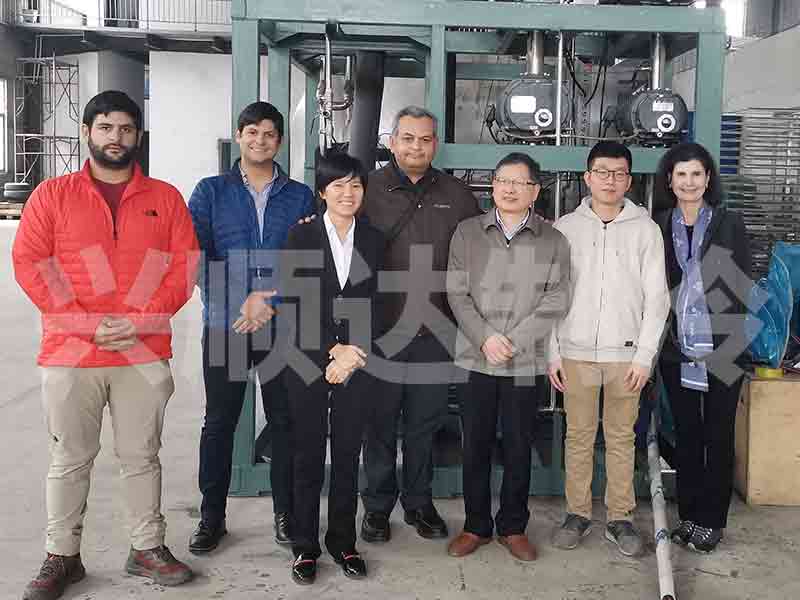
However, the image documents a project discussion rather than a claim of installed capacity, local service coverage, certification, customer result or a standard Mexico configuration. The correct configuration still depends on product, throughput, utilities, plant layout, delivery scope and acceptance criteria.
In addition, buyers can review the company’s engineering and manufacturing background before requesting a proposal.
Freeze Dryer Mexico RFQ Checklist for Food Manufacturers
Therefore, a short technical RFQ normally produces a better first proposal than a message asking only for “freeze dryer price.” For a freeze dryer Mexico project, the buyer should provide:
- Food product, formulation and physical format
- Initial moisture and total solids if known
- Fresh wet load per batch and per day
- Slice thickness, piece size or liquid fill depth
- Target final moisture, water activity or quality endpoint
- Expected batches per day/week and expansion plan
- Factory city/state and delivery access in Mexico
- Available electrical, cooling and drainage utilities
- Packaging format and time-to-seal requirement
- Desired installation or production-start window
Request a Preliminary Capacity Recommendation
For a freeze dryer Mexico quotation, a food manufacturer can submit the product format, expected wet load per batch/day, thickness or fill depth, final-moisture target, factory location and available utilities. The engineering team can then return a preliminary drying-area and water-load basis, an equipment-direction shortlist, a utility checklist and the missing questions for a technical quotation. However, product trials and agreed acceptance criteria remain necessary before a capacity or cycle is guaranteed.
Send Mexico Project RequirementsFrequently Asked Questions
What size freeze dryer does a Mexico food factory need?
A freeze dryer Mexico project should be sized from wet product per batch/day, validated loading kg/m², water to remove, batch duration, endpoint and required batches. Therefore, shelf area alone is not enough.
What is the difference between a commercial and industrial freeze dryer?
Commercial systems are generally selected for repeatable production at a smaller factory scale, whereas industrial systems are selected around higher water load, throughput, utilities, uptime, service and acceptance requirements. However, the boundary should be confirmed from the project data.
Is a liofilizador industrial the same as a freeze dryer?
Yes. Liofilizador is the common Spanish term. Nevertheless, a Mexico RFQ should still state product load, shelf area, condenser capacity, vacuum requirements, endpoint and utilities.
Can one freeze dryer process fruit, coffee, meat and pet food?
The same equipment platform may process different foods, but each product needs its own preparation, loading, cycle and release checks. In addition, hygiene, segregation, cleaning and any required kill step must be evaluated separately.
How much does a commercial freeze-drying project cost in Mexico?
For a freeze dryer Mexico project, there is no reliable single price without capacity and scope. Therefore, a buyer should compare equipment, freight, import work, site utilities, commissioning, packaging and operating assumptions rather than the machine quotation alone.
What utilities are required before installation?
Requirements normally include electrical capacity, heat rejection or cooling, drainage, ventilation, access and service space. However, exact values depend on the model and site and should be confirmed in the supplier’s utility schedule.
Can the machine be tested before shipment?
Yes. FAT can verify agreed equipment, controls, vacuum, temperature, condenser and alarms before shipment. In addition, a loaded production test should be specified separately when product performance is part of acceptance.
References and Official Resources
Mexico official starting points
- Secretaría de Economía, Gobierno de México. Industry and foreign-trade resources. Official resource.
- Servicio Nacional de Información de Comercio Exterior (SNICE). NICO / LIGIE tariff-classification resources. Official resource.
- Comisión Federal para la Protección contra Riesgos Sanitarios (COFEPRIS). Official health-risk regulatory portal. Official resource.
- SENASICA / COFEPRIS. Food-safety cooperation and preventive-practice information. Official resource.
Technical literature used in the article
- Ratti C. Freeze drying for food powder production. In: Bhandari B, Bansal N, Zhang M, Schuck P, editors. Handbook of Food Powders: Processes and Properties. Woodhead Publishing; 2013:57–84. DOI: 10.1533/9780857098672.1.57.
- Bhatta S, Stevanovic Janezic T, Ratti C. Freeze-Drying of Plant-Based Foods. Foods. 2020;9(1):87. DOI: 10.3390/foods9010087.
- Pisano R, Barresi AA, Fissore D. Innovation in Monitoring Food Freeze Drying. Drying Technology. 2011;29(16):1920–1931. DOI: 10.1080/07373937.2011.596299.
- Barresi AA, Pisano R. Process intensification and process control in freeze-drying. Proceedings of the 21st International Drying Symposium. 2018:9–16. DOI: 10.4995/ids2018.2018.7652.
- Malik N, Gouseti O, Bakalis S. Effect of freezing on microstructure and reconstitution of freeze-dried high solid hydrocolloid-based systems. Food Hydrocolloids. 2018;83:473–484. DOI: 10.1016/j.foodhyd.2018.05.008.
Evidence boundary: the cited studies support the scoped technical explanations near each claim. They do not establish a universal Mexico capacity, a fixed setpoint, a guaranteed cycle, a food-safety kill step, a price, a certification or an installed project result.
Zheng Wei
Zheng Wei works on food freeze-drying equipment selection, process evaluation, utility planning and scale-up for commercial and industrial projects. Technical articles are written to help food manufacturers translate product requirements into practical equipment and project decisions.