
Freeze Dryer Supplier Checklist for Food Projects
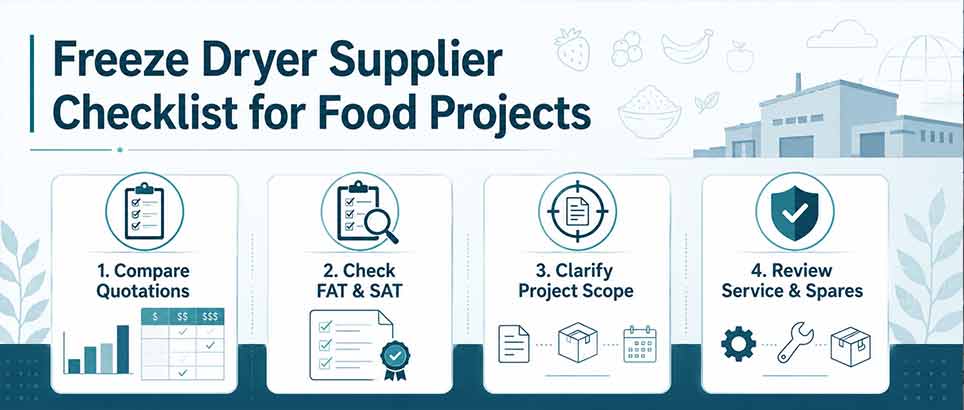
A food-project freeze dryer supplier should be compared by the evidence behind the proposal—not by tray area, a low headline price or an unqualified drying-time claim. This checklist helps procurement teams turn several quotations into one comparable technical and commercial decision.
Quick Answer
First, the buyer should give every shortlisted freeze dryer supplier the same product and factory brief. Each proposal should then state its capacity basis, included scope, acceptance tests, delivery boundary, documentation and service plan in writing. Finally, the buyer should compare those answers line by line rather than compare headline prices alone.
For machine type, capacity and water-removal sizing, the commercial food freeze dryer selection guide provides the appropriate starting point. This page is deliberately narrower: it evaluates the supplier and the proposal after the first sizing discussion.
1. Issue One Project Brief Before Requesting Quotations
A supplier cannot prepare a meaningful technical proposal from “a freeze dryer is required” alone. The required cycle and useful daily output depend on the product, geometry, water load, freezing conditions and agreed endpoint. In addition, a fixed recipe is not automatically repeatable when the product type, loading or cycle setup changes.[1] Therefore, every supplier should record the assumptions behind the recommendation.
Product Inputs
- Product form, photographs, cut size or fill depth
- Initial moisture or solids and target final moisture
- Daily wet-material target and expected batch pattern
- Texture, appearance, rehydration and packaging requirements
Factory Inputs
- Voltage, frequency, cooling method and heating utilities
- Room dimensions, door clearances, floor and drainage constraints
- Destination country and applicable safety or import requirements
- Required commissioning date, local labor and lifting plan
Why this matters: in food freeze-drying, dry-layer resistance, heat transfer and the vapor load handled by the condenser are product- and configuration-dependent.[2] Consequently, quoted tray area is useful context, but it is not a stand-alone production promise.
Engineering Review Note
In commercial food projects, quotations with similar tray area can still imply different daily output because suppliers may use different assumptions for wet loading, product thickness, defrost time and complete batch scheduling. Therefore, the buyer should require the capacity basis to appear in the final technical offer.
2. Identify Who Is Technically and Contractually Responsible
“Manufacturer,” “supplier” and “trading company” are descriptions, not quality grades. The practical question is who signs for design assumptions, manufacturing scope, factory testing, installation support and warranty. Therefore, one legal entity and one responsible contact should be assigned to each obligation.
| Question to Ask | Evidence to Request | Why It Protects the Buyer |
|---|---|---|
| Who designs, manufactures and signs the final technical offer? | Named legal entity, factory address, project contact and revision-controlled offer. | Prevents a handoff between sales, factory and installer after the order. |
| Who owns product trials and process assumptions? | Trial protocol or a stated limit on what has and has not been tested. | Separates a comparable case from an untested production guarantee. |
| Who performs installation, commissioning and training? | Responsibility matrix, site prerequisites and inclusions or exclusions. | Makes local work, travel and utilities visible before contracting. |
| Who supports spare parts and faults after handover? | Critical-spares list, manuals, troubleshooting route and warranty terms. | Allows the buyer to plan maintenance instead of relying on verbal assurances. |
Different freeze dryer manufacturers may use different scope definitions and capacity assumptions. As a result, the company name or factory photograph alone does not establish whether two proposals are technically equivalent.
3. Normalize the Proposal Before Comparing Price
Next, each shortlisted supplier should complete the same comparison sheet. If one proposal states “capacity” and another states “tray area,” they are not yet comparable. Capacity should identify the wet or dry basis, product, load, cycle basis and acceptance method.
Ratti describes how food freeze-drying performance depends on heat and mass transfer through the product and dried layer.[2] From a procurement perspective, a laboratory or pilot result should therefore be treated as scale-up evidence rather than an automatic industrial production guarantee.
| Comparison Field | What the Supplier Should State |
|---|---|
| Capacity basis | Product, wet-material load, loading thickness or density, estimated water removal, cycle basis and final-condition method. |
| System scope | Chamber, condenser, refrigeration, vacuum system, heating, controls, loading equipment, documentation and initial spare parts. |
| Utilities and site work | Electrical load, cooling or heating needs, drainage, foundation, ventilation, lifting and buyer-provided work. |
| Commercial boundary | Price basis, named delivery term and place, packing, insurance, customs assumptions, travel and local labor exclusions. The ICC Incoterms® 2020 guidance should be used when the delivery term is agreed. |
In addition, the proposed process pressure should be stated as absolute pressure. A low ultimate-vacuum figure should not replace the agreed vacuum-down test, leakage test or product-specific process evidence. The freeze dryer specifications guide explains the technical fields that should appear in a comparable quotation.
4. Ask for Evidence a Freeze Dryer Supplier Can Explain
Relevant evidence is stronger than a long image gallery. For example, a useful case record identifies the food form, configuration, loading basis, test condition and acceptance measure. A qualified freeze dryer supplier should also explain what the record does not prove for the proposed product.

- Comparable application evidence: product form, loading basis, cycle record and measured endpoint—not a universal time promise.
- Factory evidence: identifiable assembly, major-component records and functional test records for the quoted configuration.
- Control evidence: the variables, alarms and batch records that the proposed controls can retain.
- Documentation evidence: layout, utility schedule, component list, manuals, recommended spare parts and a final scope revision.


Red Flags
- A model is recommended without questions about product moisture, shape or daily wet load.
- One drying time is promised for fruit, meat, liquids and prepared meals.
- Ultimate vacuum is quoted without a stated test condition, leakage test or process record.
- Essential pumps, loading equipment, documents, travel or local installation appear only after negotiation.
- Evidence from a small or different application is described as proof of industrial output.
5. Agree FAT, SAT and Product Acceptance Before the Purchase Order
A factory acceptance test (FAT) verifies the agreed machine and documented functions before shipment. By contrast, a site acceptance test (SAT) verifies installation and operation at the buyer’s site. Neither test should be confused with a product-performance guarantee unless a separate trial protocol states the product, load, measurements, limits and repeatability criteria.
FAT: Machine and Documents
- Equipment identity, dimensions and agreed configuration
- Safety functions, alarms and emergency stops
- Vacuum, refrigeration, heating and control checks under stated conditions
- Recipe, trend and record functions
- Manuals, drawings, component and spare-parts documentation
SAT and Production Acceptance
- Site utilities and installation readiness
- System operation after connection and commissioning
- Agreed product, load and endpoint method
- Named witnesses, signatories and record owners
- Corrective action when a defined criterion is missed
For a detailed acceptance framework, the food freeze dryer FAT, SAT and validation guide provides a dedicated checklist. A quality-management certificate may support a review of the supplier’s management system; however, it does not prove that one machine meets the project capacity requirement. The buyer should refer to the applicable edition of ISO 9001 for the standard’s scope.
6. Make the Project Boundary Contractual
Before the order is released, the contract package should include the final technical offer, scope list, responsibility matrix, FAT protocol, delivery schedule, warranty terms, named delivery term and change-control procedure. Site preparation, lifting, utilities, commissioning travel and operator time are common omissions. Therefore, these items should be planned with the commercial freeze dryer installation requirements and the total project cost guide.
In addition, the final documents should identify the warranty start point, critical spare parts, troubleshooting route and service exclusions. The freeze dryer service and maintenance guide can support that lifecycle review.

7. Final Freeze Dryer Supplier Checklist
Finally, the procurement team can use the following table before approving the selected freeze dryer supplier. Any item marked “Needs clarification” should be resolved in the final technical or contract documents.
| Final Supplier Check | Pass | Needs Clarification |
|---|---|---|
| Product, moisture and loading assumptions are confirmed. | ||
| Wet-material capacity is stated per batch and per 24 hours. | ||
| The estimated water-removal basis is provided. | ||
| The full equipment scope and exclusions are listed. | ||
| FAT, SAT and product-acceptance criteria are distinguished. | ||
| Installation, utilities, travel and local responsibilities are assigned. | ||
| Comparable application evidence and its limitations are reviewed. | ||
| Warranty, critical spare parts and service routes are confirmed. | ||
| The named delivery term, place and excluded costs are recorded. | ||
| Important promises appear in the final signed documents. |
Request a Comparable Supplier-Evaluation Brief
Project owners can submit the product form, daily wet-material target, moisture or solids data, dimensions, factory utilities and destination. The engineering team can then return a project-based information checklist, a preliminary capacity and water-load discussion, and the questions needed to compare quotations.
Final equipment specifications, test commitments and commercial terms are confirmed only in the signed technical and contract documents issued for the selected configuration by Fuzhou Xing Shun Da Refrigeration Facility Project Co., Ltd.
Frequently Asked Questions
Can two freeze dryers with the same tray area have different output?
Yes. Product thickness, water load, heat transfer, vapor path, condenser capacity, loading method and cycle conditions can change useful throughput. Therefore, the stated assumptions and acceptance method should be compared instead of tray area alone.[2]
What is the most useful evidence from a supplier?
The most useful evidence is a clearly labelled record from a comparable application, together with a written explanation of the product, load, configuration, measured result and limitations. This record is more decision-useful than an unqualified claim that every product will achieve the same cycle time.
What should be included in a food freeze dryer RFQ?
A food freeze dryer RFQ should include product and capacity inputs, utility and site conditions, requested scope, required documents, FAT and SAT expectations, commercial boundaries and the named delivery term. The final checklist on this page can be attached to the RFQ.
Should the lowest-priced freeze dryer supplier be selected?
Not automatically. Instead, the buyer should compare equivalent capacity assumptions, equipment scope, acceptance tests, installation responsibility, spare parts and lifecycle risk. A lower machine price can produce a higher installed or operating cost.
References
- Pisano R, Barresi AA, Fissore D. Innovation in Monitoring Food Freeze Drying. Drying Technology. 2011;29(16):1920–1931. https://doi.org/10.1080/07373937.2011.596299
- Ratti C. Freeze drying for food powder production. In: Handbook of Food Powders. Woodhead Publishing; 2013. https://doi.org/10.1533/9780857098672.1.57