
How to Freeze Dry Vegetables for Commercial Production
Commercial vegetable freeze drying requires more than placing prepared vegetables on trays and starting a cycle. A reliable process connects raw-material selection, blanching decisions, cut size, loading density, complete freezing, controlled sublimation, endpoint verification, packaging, and production-scale calculations.
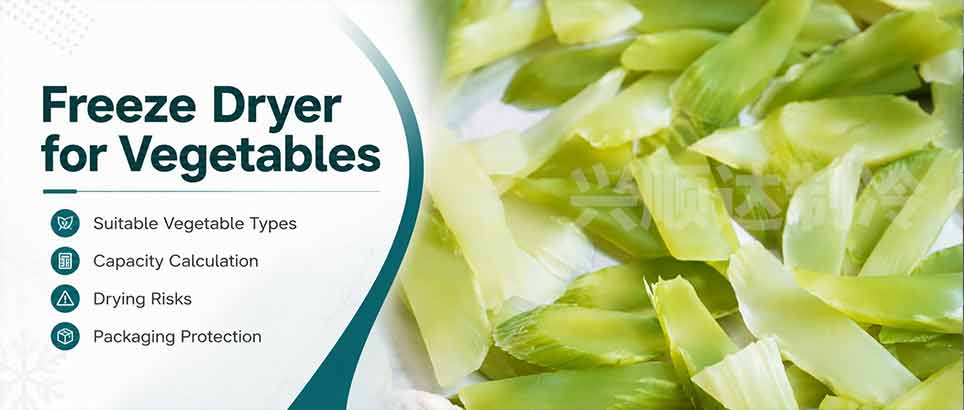
Quick Answer: How to Freeze Dry Vegetables
- Sort and wash vegetables using the plant’s approved raw-material and sanitation controls.
- Cut the product to a consistent thickness or piece size.
- Blanch or apply another pretreatment only when the vegetable and quality target require it.
- Load trays at a validated density with an even layer depth.
- Freeze the entire product load completely before vacuum drying.
- Run primary and secondary drying under a validated pressure and shelf-heating profile.
- Verify center dryness and final moisture, then package immediately in a suitable barrier system.
Commercial difference: the cycle is not complete merely because the machine stops. A production batch should meet a defined product specification across different trays and positions before release.
For a vegetable production project, review the carrot batch-test record and prepare the vegetable project checklist before requesting an equipment review.
Which Vegetables Are Suitable for Freeze Drying?
Many vegetables can be freeze dried, but they should not all use the same preparation method or drying recipe. Structure, initial moisture, sugar and starch content, surface area, enzyme activity, and the intended final use all change the process.
| Vegetable group | Examples | Main process concern | Typical commercial use |
|---|---|---|---|
| Root and stem vegetables | Carrot, radish, potato, lotus root, bamboo shoot | Wet centers in thick pieces and long vapor-removal paths | Dice, slices, soup ingredients, meal components |
| Peas, corn, and kernels | Green peas, sweet corn, edamame | Uneven freezing or drying between kernels | Instant meals, soup mixes, snack blends |
| Leafy and flower vegetables | Spinach, broccoli, cauliflower, spring onion | Color loss, collapse, and low bulk density | Powders, flakes, soup and seasoning ingredients |
| Aromatic vegetables | Onion, garlic, leek, scallion | Aroma retention, oxidation, and odor transfer | Seasonings, ready meals, ingredient supply |
| Mixed vegetable products | Soup packs, instant noodle vegetables, prepared meals | Different ingredients may reach the endpoint at different times | Convenience foods and complete meal systems |
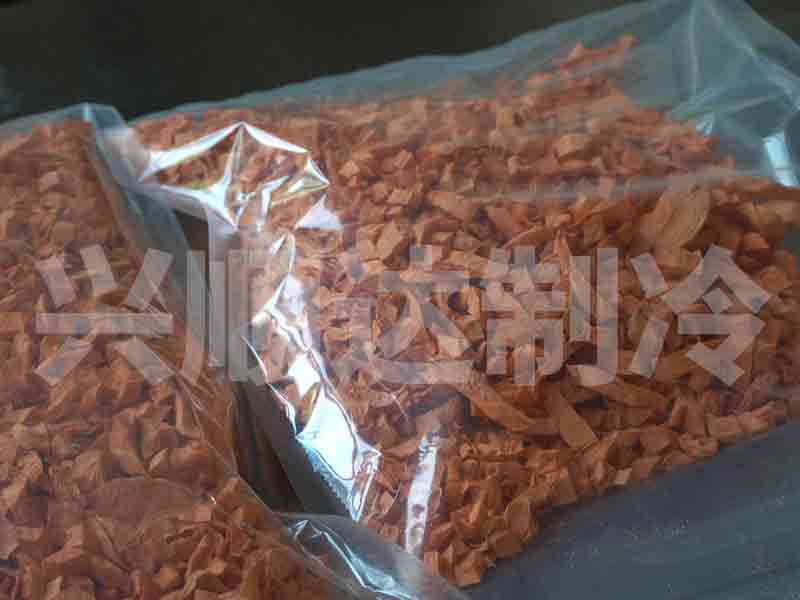
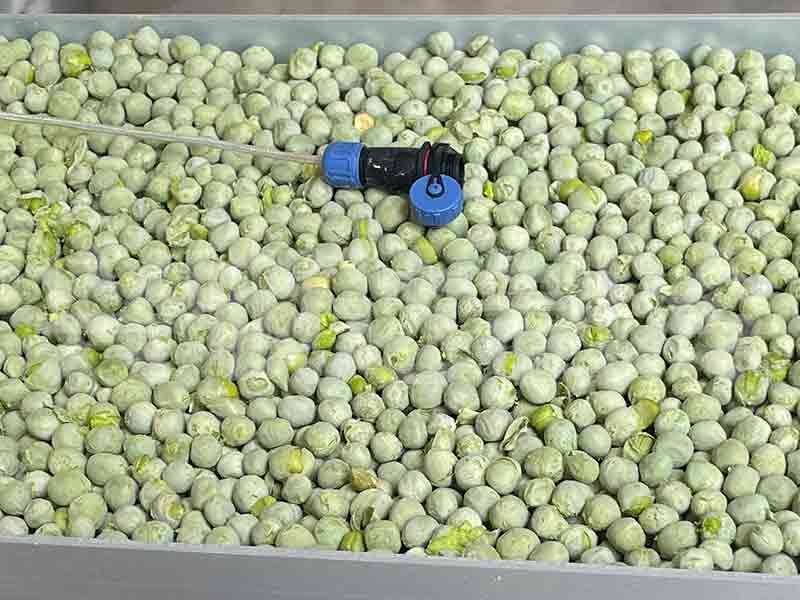
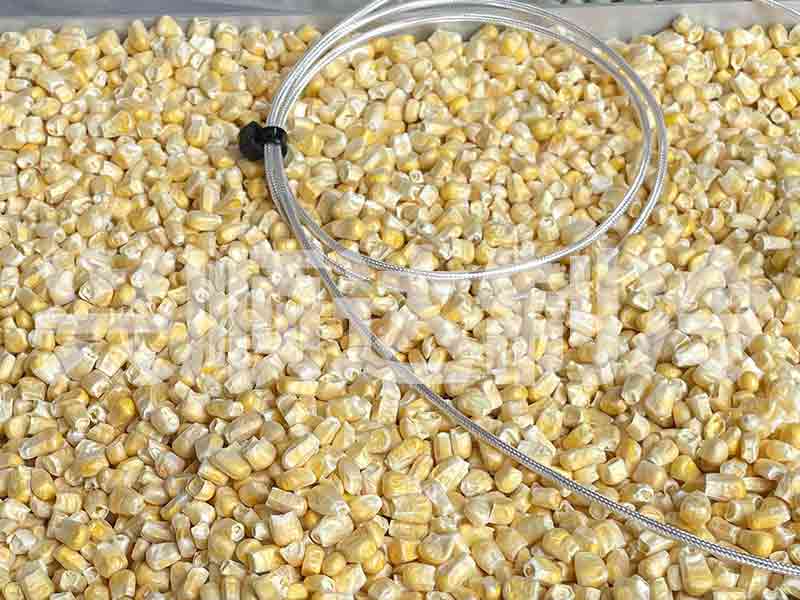
Mushrooms need their own thickness, pressure, and rehydration assessment. Projects centered on mushrooms should use the separate commercial mushroom freeze-drying guide rather than duplicating that process on this page.
Commercial Vegetable Freeze-Drying Process: Seven Steps
The following workflow provides a practical production framework. Exact settings should be established through pilot trials because the same vegetable can behave differently when maturity, variety, cut geometry, pretreatment, and loading change.
1. Sort, Wash, and Prepare the Raw Material
Processing begins with a consistent raw material. The production team should define acceptable maturity, size, damage, decay, and foreign-matter limits. Washing and sanitation must follow the factory’s food-safety program before cutting exposes additional product surfaces.
Surface water should be drained before tray loading. Uncontrolled free water increases the ice load without adding saleable product and can lengthen the batch.
2. Decide Whether Blanching Is Required
Blanching is not a universal setting that should be copied from one vegetable to another. It may be used to control enzyme activity, color, flavor, texture, and microbial load, but excessive time or temperature can soften the product and increase soluble-solid losses.
The National Center for Home Food Preservation notes that blanching time depends on vegetable type and size. A commercial project should therefore compare untreated and pretreated samples, then select the shortest validated treatment that meets the product target.
Practical decision rule: the engineering team should test blanching when the project has concerns about enzyme activity, green color, bitterness, storage changes, or rehydrated texture. The chosen pretreatment should be recorded as part of the production specification.
3. Control Cut Size and Thickness
Piece thickness changes the distance that water vapor must travel from the product center to the surface. Thick or irregular pieces increase the risk of a dry exterior with a moist center.
Many vegetable trials begin within a practical range of about 4–10 mm. An 8 mm slice or dice can be a useful first test for suitable vegetables, but it is not a universal standard. The correct size is the one that achieves the required appearance, texture, rehydration, and drying time without excessive trimming loss.
4. Set a Repeatable Tray Loading Density
Tray loading should be expressed as kilograms of wet material per square meter of shelf area, not only as kilograms per machine. For many commercial food trials, 10–13 kg/m² is a useful starting range. Actual loading must be validated for the specific vegetable and layer geometry.
Every tray should use the same net load and similar layer depth. Overfilled corners, mounds, overlapping slices, and mixed piece sizes create local resistance to vapor flow and reduce batch consistency.
5. Freeze the Product Completely
All product positions should be fully frozen before primary drying begins. Incomplete freezing can cause local melting, collapse, shrinkage, or a dense structure that rehydrates poorly. The freezing method should consider product thickness, tray spacing, freezer airflow, and the temperature difference between edge and center trays.
For the underlying process stages, see how freeze drying works. Detailed pressure and temperature relationships are covered separately in freeze-drying temperature and pressure.
6. Run Primary Drying Under Controlled Vacuum and Heat
During primary drying, ice sublimes and the vapor moves toward the cold trap. The shelf supplies controlled heat, but the product temperature must remain within the safe limit established by testing. Commercial food systems commonly operate in an absolute pressure range of approximately 26–100 Pa, although the validated setpoint depends on the product and equipment design.
The condenser must capture the expected water load without losing temperature or restricting vapor flow. A cold trap that is too small can extend the cycle even when the chamber has enough tray area. The role of this system is explained in the freeze dryer condenser guide.
7. Complete Secondary Drying and Verify the Endpoint
Secondary drying removes remaining bound moisture after most ice has disappeared. Many commercial vegetable products target approximately 1–2% final moisture, but the release limit must be defined by the product specification and shelf-life plan.
The production team should verify samples from different trays and positions. Useful checks include final moisture, center dryness, texture or brittleness where applicable, rehydration performance, and batch-to-batch consistency. Water activity can support shelf-life and microbiological assessment, but it should not replace direct endpoint checks for this process.
Release warning: a cycle-complete signal is not sufficient evidence that thick pieces are dry in the center. Without an inline moisture method, samples should be taken from different tray locations and broken, weighed, or tested according to the factory’s approved method.
Carrot Freeze-Drying Test: 14 h 11 min 48 s Batch Data
This carrot test provides a real batch reference for the process described above. Three trays with a total area of 0.30 m² were loaded with 4,913.22 g of prepared carrot, equal to 16.38 kg/m². The batch ran from 09:09:01 to 23:20:49, for a total freeze-drying time of 14 h 11 min 48 s.
| Batch metric | Measured result |
|---|---|
| Total tray area | 0.30 m² |
| Initial carrot weight | 4,913.22 g |
| Loading capacity | 16.38 kg/m² |
| Final freeze-dried product weight | 570.06 g |
| Product output | 1.90 kg/m² |
| Product yield | 11.6% |
| Final moisture content | 1.51% |
| Freeze-drying start / end | 09:09:01 / 23:20:49 |
| Total drying time | 14 h 11 min 48 s |
Tray Weights Before and After Freeze Drying
| Tray | Before freeze drying | After freeze drying |
|---|---|---|
| Tray 1 | 1,623.22 g | 178.99 g |
| Tray 2 | 1,655.80 g | 203.43 g |
| Tray 3 | 1,634.20 g | 187.64 g |
| Total | 4,913.22 g | 570.06 g |
Video Timeline
- 00:00 Sample Preparation
- 00:25 Pre-Freezing Completed
- 00:35 Pre-Drying Weighing
- 01:32 Freeze-Drying Started
- 01:53 Monitoring in Progress — 1000× Speed
- 02:48 Freeze-Drying Completed
- 03:06 Post-Drying Weighing
- 04:37 Moisture Content Test
- 04:50 Finished Product Showcase
How to use this data: this is one measured carrot batch, not a universal carrot recipe. It shows why loading density, cut geometry, freezing conditions, equipment performance, and endpoint verification should be validated together before commercial scale-up.
Eggplant Sticks Freeze-Drying Test: 12 h 15 min Batch Data
This eggplant sticks freeze-drying test provides a practical commercial vegetable processing reference. The batch used three trays with a total area of 0.30 m². A total of 2,575.66 g fresh eggplant sticks were loaded, equal to 8.59 kg/m² loading capacity. The freeze-drying cycle ran from 06:08:02 to 18:23:17, with a total drying time of 12 h 15 min 15 s.
| Batch metric | Measured result |
|---|---|
| Total tray area | 0.30 m² |
| Initial eggplant weight | 2,575.66 g |
| Loading capacity | 8.59 kg/m² |
| Final freeze-dried product weight | 144.59 g |
| Product output | 0.48 kg/m² |
| Product yield | 5.6% |
| Final moisture content | 1.89% |
| Total drying time | 12 h 15 min 15 s |
Video Timeline
- 00:00 Sample Preparation
- 00:18 Pre-Freezing Completed
- 00:23 Pre-Drying Weighing
- 01:05 Freeze-Drying Started
- 01:09 Monitoring in Progress — 1000× Speed
- 03:04 Freeze-Drying Completed
- 03:13 Post-Drying Weighing
- 04:25 Finished Product Showcase
- 04:47 Moisture Content Test
How Long Does It Take to Freeze Dry Vegetables?
Many commercial food cycles fall within approximately 8–15 hours, but there is no reliable universal time for all vegetables. Extract-rich, dense, thick, or heavily loaded products may require longer cycles.
Initial moisture, solids, fiber, starch, sugar, and cell structure influence drying resistance.
Thickness, blanching, layer depth, and prefreezing determine heat and mass transfer.
Shelf heating, vacuum stability, condenser capacity, and vapor path affect the real cycle.
A supplier should not promise daily output using a generic cycle copied from another vegetable. The better method is to test the proposed cut and loading, then confirm the result using the commercial freeze-drying time chart as a planning reference rather than a fixed recipe.
How to Calculate Commercial Vegetable Freeze-Dryer Capacity
Commercial capacity should be calculated from validated shelf loading, batch time, and water removal. Chamber volume or tray count alone does not predict output.
Shelf area × validated loading density = wet material per batch
Example: 20 m² × 12 kg/m² = 240 kg of wet vegetables per batch.
Dry solids = wet mass × (1 − initial moisture fraction)
Final product mass = dry solids ÷ (1 − target final moisture fraction)
Water removed = wet mass − final product mass
For 240 kg of vegetables at 88% initial moisture and 2% final moisture, the estimated final product is about 29.4 kg and the cold trap must manage about 210.6 kg of removed water.
The final model must also account for product freezing, loading and unloading, defrosting, cleaning, packaging speed, labor shifts, and planned maintenance. A nominal two-batch schedule is not realistic when these supporting steps cannot be completed within the available time.
Better quotation request: instead of asking for “a machine for 1 ton,” the buyer should state whether 1 ton means wet raw material per batch, wet raw material per day, or finished dry product per day.
Common Problems in Freeze-Dried Vegetable Production
| Observed problem | Likely cause | Practical corrective direction |
|---|---|---|
| Wet or leathery center | Pieces are too thick, loading is excessive, or the cycle ends too early. | Reduce thickness or loading, improve uniformity, and extend the validated drying stage. |
| Large differences between trays | Uneven tray load, airflow or freezing differences, sensor position, or heat-transfer imbalance. | Standardize tray weights and compare edge, center, top, and bottom positions during trials. |
| Color loss | Raw-material variation, unsuitable blanching, oxygen exposure, excessive heat, or light during storage. | Validate pretreatment, limit exposure before packaging, and use an appropriate oxygen and light barrier. |
| Collapse or shrinkage | Incomplete freezing, excessive product temperature, or an unsuitable pressure and heating profile. | Confirm complete freezing and reduce the early-stage heat load while maintaining vapor removal. |
| Cycle becomes longer over time | Condenser ice accumulation, vacuum leakage, pump condition, changing raw material, or higher loading. | Compare batch records, leak checks, pump maintenance, condenser performance, and actual tray weights. |
| Product softens after packaging | Incomplete drying, delayed packing, weak moisture barrier, seal defects, or humid handling conditions. | Verify endpoint, shorten open exposure, test seals, and validate the packaging barrier. |
Pilot Testing Before Commercial Scale-Up
A home or laboratory cycle cannot be scaled by multiplying tray count. Commercial scale-up requires measured relationships between loading density, water removal, drying time, product temperature, condenser load, and finished-product quality.
Fix the vegetable variety, maturity, pretreatment, cut geometry, and intended final use.
Compare practical kg/m² levels rather than assuming the maximum tray depth is acceptable.
Track pressure, shelf temperature, product temperature, drying time, and condenser behavior.
Measure final moisture and compare center dryness, texture, color, rehydration, and tray positions.
Convert the chosen wet load into expected water removal and finished product per batch.
Choose shelf area and system configuration from the required daily output and validated cycle.
Projects that still need recipe development should begin with a lab or pilot freeze dryer. Acceptance criteria and repeatability can then be formalized using the food freeze-dryer validation guide.
Choosing a Vegetable Freeze Dryer After the Process Is Defined
Equipment selection should follow process testing, not precede it. Once the buyer has validated loading, cycle time, water removal, and product quality, the required machine class becomes easier to calculate.
| Project stage | Typical model direction | Main purpose | Relevant page |
|---|---|---|---|
| Product development and pilot trials | SDG60 or SDG90 | Validate cut size, loading, recipe, packaging, and finished quality. | Lab and pilot systems |
| Small to medium commercial production | SDG350, SDG700, or SDG1100 | Produce vegetable snacks, soup ingredients, meal components, and regional supply volumes. | Commercial systems |
| Industrial continuous production planning | SDG1600, SDG3000, or SDG6000 | Support agricultural processors, export factories, and high daily wet-material demand. | Industrial systems |
The final evaluation should include refrigeration capacity, condenser water-capture rate, vacuum performance, shelf-heating uniformity, control records, utilities, installation space, service access, and spare parts. For a wider selection framework, use the commercial food freeze-dryer capacity and water-load guide.
Food Safety, Packaging, and Storage Controls
Freeze drying removes moisture but is not automatically a microbial kill step. Commercial producers still need an approved hazard-control plan, hygienic raw-material preparation, environmental controls, foreign-matter prevention, and packaging validation.
Final moisture, center dryness, and tray consistency should meet the written product specification before release.
Porous freeze-dried vegetables can absorb moisture rapidly. Transfer to packaging should be prompt and controlled.
Film, laminate, seal design, oxygen control, light protection, and pack size should match the shelf-life target.
The FDA’s technical guide on water activity in foods explains its role in microbial stability. For this vegetable process, water activity is best used as a supplementary product and shelf-life parameter rather than the sole drying endpoint.
Detailed film, sealing, oxygen, and moisture-barrier decisions are covered in the commercial freeze-dried food packaging guide.
Commercial Vegetable Freeze-Drying Project Checklist
A useful quotation begins with process data. Buyers should prepare the following information before requesting a model recommendation.
- Vegetable type, variety, and maturity
- Fresh, cooked, blanched, or otherwise pretreated
- Slice thickness, dice size, or product form
- Initial moisture or representative sample
- Target final moisture and rehydration requirement
- Retail snack, ingredient, soup, or meal application
- Required wet raw material per day
- Operating hours and batches per day
- Available power, cooling water, and steam
- Installation area and floor-loading limits
- Packaging format and packaging-line speed
- Required installation, training, and validation support
A related vegetable case is available in the 3 m² freeze-dried radish project. Installation planning should also be checked against the commercial freeze-dryer setup requirements.
Request a Commercial Vegetable Freeze-Drying Evaluation
The engineering team can estimate the required shelf area, wet load per batch, water removal, condenser demand, likely cycle range, and model direction when the project provides real product information.
- Vegetable type and pretreatment
- Cut size or thickness
- Daily wet raw-material target
- Target final product and packaging format
- Factory power, cooling water, steam, and available space
FAQ About How to Freeze Dry Vegetables
Do vegetables need to be blanched before freeze drying?
Some vegetables benefit from blanching because enzyme activity, color, flavor, texture, and storage behavior may otherwise change. The treatment should be selected by vegetable type, size, and final product requirements rather than applied as one universal rule.
How thick should vegetables be for freeze drying?
Many trials begin around 4–10 mm, with 8 mm serving as a practical first test for suitable slices or dice. The final specification should be based on center dryness, texture, rehydration, yield, and cycle time.
How long does it take to freeze dry vegetables?
Many commercial food cycles are approximately 8–15 hours. Initial moisture, thickness, tray loading, freezing, vacuum stability, shelf heating, and condenser load can make the actual cycle shorter or longer.
What final moisture should freeze-dried vegetables reach?
Many commercial vegetable products target roughly 1–2% final moisture, but the correct release limit depends on product specification, texture, packaging, and shelf-life validation. Samples should be checked across several tray locations.
Can different vegetables use the same drying cycle?
They can use the same equipment, but they should not automatically use the same recipe. Each vegetable and cut form needs validated loading, freezing, pressure, shelf heating, secondary drying, and endpoint criteria.
How much fresh vegetable can a commercial freeze dryer process per day?
Daily capacity equals validated wet load per batch multiplied by realistic batches per day. The calculation must include shelf area, kg/m² loading, cycle time, water removal, defrosting, loading, unloading, cleaning, and packaging constraints.
Technical Review by Zheng Wei
Zheng Wei is a freeze-drying systems engineer at Fuzhou Xing Shun Da Refrigeration Facility Project Co., Ltd. His work focuses on food freeze-dryer configuration, material testing, shelf-loading calculations, water-load assessment, vacuum and refrigeration systems, installation planning, and production scale-up.
Review scope: commercial vegetable process design, equipment sizing logic, drying endpoint control, and pilot-to-production transfer. Last technical review: August 14, 2026.
External Technical References
These non-competing sources support the article’s general blanching, food-safety, and water-activity context. The commercial loading, cycle, moisture, and equipment figures in this guide are engineering planning values that require product-specific validation.
- National Center for Home Food Preservation. Blanching Vegetables. University of Georgia.
- U.S. Food and Drug Administration. Water Activity (aw) in Foods.
- University of Minnesota Extension. Preserving Food at Home: Freeze-Drying.