
Food project procurement guide
Freeze Dryer Brazil: Commercial & Industrial Food Project Guide
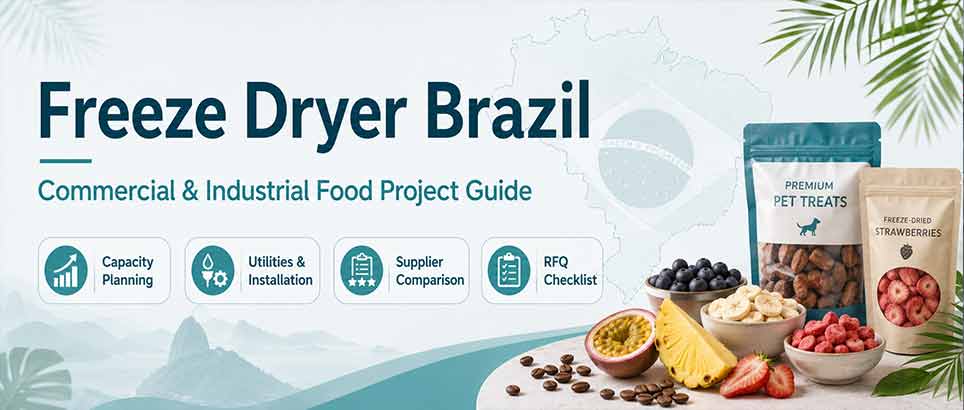
For a food company researching freeze dryer Brazil options, including the common search variant freeze dryer Brasil, the main decision is not simply where to find a machine. Therefore, the critical task is to match the equipment to the product, real water load, daily production target, factory utilities and acceptance criteria so that nominal batch capacity can translate into dependable production.
This guide is written for purchasing, engineering and production teams evaluating a freeze dryer in Brazil. In addition, searches for freeze dryer Brazil, freeze dryer Brasil, liofilizador Brasil and liofilizador industrial can reflect the same B2B need, but the engineering questions are the same: usable shelf area, product loading, water to remove, condenser performance, vacuum system, refrigeration, cycle assumptions, installation requirements and lifecycle support. Food freeze-drying literature also shows that product thickness, composition, freezing conditions and internal structure change drying resistance and final quality, so no single capacity number can replace a representative product test.[1] [2]
What type of freeze dryer does a food company in Brazil need?
The labels “laboratory,” “commercial” and “industrial” are useful only as a first filter. For example, two factories processing 300 kg of material per day may need different configurations if one handles concentrated liquid and the other processes sliced fruit. Therefore, equipment selection should account for usable shelf area, loading density, water to sublime, vapor path, cycle time and verified loaded performance.[2] [3]
| Project stage | Equipment class | Main objective | Question to answer |
|---|---|---|---|
| R&D / development | Lab or pilot | Define product preparation, loading and cycle | Is the product technically viable before commercial scale-up? |
| Small commercial production | Commercial | Produce saleable batches | How many kilograms must enter each batch and each day? |
| Growing food factory | Large commercial or industrial | Increase throughput with repeatable control | Would one larger system or two smaller lines provide better availability? |
| Large-scale plant | Industrial | Run multiple production batches with integrated handling | How will pre-freezing, loading, defrosting and packaging fit the production schedule? |
Companies still developing a process can compare a lab and pilot freeze dryer. Next, commercial production can be reviewed against the site’s commercial freeze dryer range, while high-throughput projects should be evaluated against industrial freeze dryer requirements. These product pages remain the owners of generic equipment-class intent; this Brazil page is limited to country-specific project procurement.
Which products make sense for commercial freeze-drying?
Freeze-drying can create commercial value when shape, aroma, rehydration, low bulk weight or product stability matter. However, it should not be presented as a guarantee that every nutrient or sensory attribute is completely preserved. Moreover, published food studies show that product structure and quality depend on raw material, formulation, freezing history and drying conditions.[1] [4] [5]
Tropical fruit and berries
Mango, pineapple, berries, dragon fruit and similar products require attention to maturity, sugar content, cut thickness and pre-freezing. In addition, high-moisture fruit can create a substantial condenser load. Therefore, product, layer thickness and endpoint should be tested together; results from one fruit should not automatically be transferred to another.[1] [4]
Preparation and process choices are covered in the commercial fruit freeze-drying guide.
Coffee and concentrated extracts
Liquids and concentrates need controlled bed depth, freezing and vapor release. For example, research on concentrated hydrocolloid and coffee systems shows that the freezing step can change pore structure and reconstitution, so a capacity figure developed for solid pieces should not be transferred automatically to extracts.[5]
Projects in this category can use the coffee freeze dryer guide for a deeper process discussion.
Meat, seafood and protein products
Piece geometry, fat content, thickness and food-safety controls affect preparation and cycle development. However, the freeze dryer does not replace raw-material controls, hygiene, validated lethality steps where required, packaging or the factory’s food-safety plan.
Protein applications can be reviewed in the commercial meat freeze dryer guide.
Pet food and pet treats
Pet treats can have a favorable value-to-weight ratio, but production scale still has to be based on the actual product mix and water removal. Therefore, different shapes and thicknesses should not be assumed to share the same validated cycle.
The dog food and pet treat freeze dryer guide covers this application in more detail.
In real production, drying time can change substantially with product, thickness, freezing, shelf temperature, pressure and endpoint. The approximately 8–15 hour range used on this site is a preliminary engineering reference for many food projects, not a guaranteed cycle for every product or machine. A purchasing team should treat the freeze-drying time chart as a starting point and confirm the final cycle with representative testing.[1] [4]
How to calculate freeze-dryer capacity
A common RFQ mistake is to state only that a factory needs to process “300 kg per day.” However, that does not show how much water must be removed, how many batches fit the daily schedule or how much usable shelf area is needed. Moreover, primary drying may also be constrained by product resistance and the equipment vapor path, so wet mass, shelf area and condenser duty should be treated as related but different variables.[2] [3]
1) raw material kg/day → 2) kg/batch → 3) initial moisture or solids → 4) water to remove → 5) tested loading per m² → 6) usable shelf area → 7) vapor load and effective condenser performance → 8) cycle duration and batches per day.
Example A: 100 kg of fruit per batch
Consider 100 kg of fruit at 85% initial moisture with a target near 2% final moisture. The raw material contains about 15 kg of dry solids. Therefore, at 2% final moisture, finished product mass would be approximately 15.3 kg, so the process would remove about 84.7 kg of water.
If a tested product can be loaded at approximately 10–13 kg/m², 100 kg of raw material would require roughly 7.7–10 m² of usable shelf area as an initial geometric estimate. However, the 10–13 kg/m² range is not a standard or universal recommendation; the design value should be replaced by product-specific loading, thickness, tray geometry, vapor path and thermal limits.
Example B: 300 kg per day
A 300 kg/day target can be met with one larger batch, multiple smaller batches or more than one unit. Therefore, the correct arrangement depends on the validated cycle, loading and unloading time, condenser defrost, cleaning and maintenance availability. A factory that relies on a single machine should also assess the production impact of planned or unplanned downtime.
Example C: 500 kg or more per batch
At this scale, the decision changes from “buying a machine” to designing a production system. As a result, pre-freezing, tray movement, access routes, floor loading, drainage, cooling water, electrical capacity, defrost and packaging can all become throughput constraints. Moreover, published scale-up studies also show that equipment geometry and heat/mass-transfer behavior differ between laboratory, pilot and production freeze dryers, which is why pilot data should be transferred with engineering review rather than simple multiplication.[3] [8]
Infrastructure for installing a freeze dryer in Brazil
Electrical and utility checks before purchase
Factory infrastructure should be confirmed before the purchase order. Brazil adopted 60 Hz for electrical distribution under Law No. 4,454 of November 6, 1964. Nevertheless, the actual site voltage, phases, available installed power, transformer requirement and connection scheme still need to be verified at the specific factory. Country alone is not a safe basis for the final electrical configuration.
| Infrastructure item | What to confirm before purchase | Why it matters |
|---|---|---|
| Electrical supply | Voltage, 60 Hz, phases, available power and cable distance | Reduces the risk of late transformer, panel or cable changes. |
| Cooling | Cooling-water temperature and flow, or the basis for an air-cooled arrangement | Refrigeration performance depends on the real design condition. |
| Space and access | Doors, corridors, ceiling height, chamber-door swing and maintenance clearance | Large systems may require lifting, staged assembly or access planning. |
| Floor | Allowable load, levelness and support locations | The main machine and auxiliary systems need a verified structural basis. |
| Drainage | Defrost water route, cleaning method, valves and drainage capacity | Defrost and drainage affect hygiene and batch turnaround. |
| Pre-freezing | Daily freezer capacity, temperature and material flow | A freeze dryer should not sit idle waiting for product if the production plan depends on separate pre-freezing. |
| Packaging | Time from unloading to sealing, room humidity and barrier material | Dry product can regain moisture quickly if exposed before packaging. |
Facility planning, defrost and food-safety context
In addition, defrost design should be evaluated together with drainage, valves and batch turnaround rather than by defrost time alone. The site’s commercial freeze dryer installation guide and food freeze-drying facility planning guide provide deeper checks for access, utilities and factory layout.
Moreover, equipment selection also has to fit the site’s food-safety system. Brazil’s Anvisa states that food manufacturers are primarily responsible for product quality and safety and should apply good manufacturing practices and process controls. The official guidance is available from Anvisa. As an international food-hygiene reference, the Codex General Principles of Food Hygiene, CXC 1-1969, provides a framework for good hygiene practices and HACCP.
Local supplier or imported equipment: how should a buyer compare them?
A local supplier may provide faster communication, easier service access or local parts support. By contrast, an international manufacturer may offer a different capacity range, configuration or purchase cost. Therefore, neither category is automatically better. Accordingly, a meaningful comparison uses the same product basis, batch load, cycle assumption, utilities, acceptance criteria and service scope for each quotation.
| Criterion | Questions for a local supplier | Questions for imported equipment |
|---|---|---|
| Technical fit | Are shelf area, product loading, condenser duty and cycle assumptions documented for the product? | Will the system be configured for the factory’s utilities and actual product? |
| Lead time | What is the realistic manufacturing and installation schedule? | What are the manufacturing, transport, customs and commissioning timelines? |
| Spare parts | Which critical items are kept locally? | Which critical parts should ship with the machine, and what are the replacement lead times? |
| FAT / testing | Which acceptance criteria are recorded before delivery? | Can the buyer review the FAT protocol, data and results before shipment? |
| Installation | Does the scope include utility checks, commissioning and training? | Who performs installation, startup and training in Brazil? |
| Total project cost | Does the quoted price include installation, parts and services? | Are freight, insurance, import-related costs, inland transport and commissioning separated? |
The comparison should use technical fit + total project cost + lifecycle support. For this reason, a purchasing team should avoid decisions based only on “price per kg of capacity,” because suppliers can define nominal capacity differently and equipment can be limited by product resistance, vapor-path conductance, refrigeration or condenser performance under load.[3] [6] [8]
8 freeze-dryer specifications that really matter
- Usable shelf area. The usable area should match product load, thickness and tray arrangement; nominal area is not automatically the same as practical loaded area.
- Loading per m². The approximately 10–13 kg/m² range used in this guide is a preliminary food-project reference, not a universal specification. Product testing has priority.
- Water balance and vapor load. A proposal should state the water expected to be removed per batch and the operating basis used to size the system.
- Effective condenser performance. Specifically, the buyer should review more than minimum cold-trap temperature. Ice capacity, ice distribution, capture area, vapor path, loaded behavior and defrost plan also matter.[6] [7] [10]
- Vacuum system. The review should include pump arrangement, evacuation test, maintenance requirements, pressure measurement and stability during sublimation.
- Shelf-temperature control. Uniformity and thermal response influence repeatability and product-temperature control.[1] [4]
- Refrigeration and utilities. Capacity should be reviewed under the agreed ambient and utility design conditions, not only at favorable factory-test conditions.
- PLC, alarms, batch records and loaded acceptance testing. In addition, process data support troubleshooting and recipe repeatability, while a loaded test checks whether core subsystems perform together under water-vapor load.[8] [9]
A technical team can use the freeze dryer specifications guide, freeze dryer components guide, condenser and cold-trap guide and monitoring, alarms and batch-record guide as detailed owner pages for those topics.
How to evaluate a freeze dryer manufacturer before paying a deposit
A sales page can show good photographs without proving process performance. For example, published qualification and troubleshooting work shows why empty or lightly loaded checks should not be treated as proof of full production behavior: heat-transfer, refrigeration and condenser limitations can become more visible under sublimation load.[8] [9] Before issuing a purchase order or deposit, the buyer should request evidence that can be reviewed technically.
- general arrangement drawing and overall dimensions;
- usable shelf area and recommended loading, with product and thickness basis;
- condenser capacity, operating temperature and loaded-performance basis;
- water balance, vapor-load basis and refrigeration configuration;
- vacuum-pump arrangement and pressure measurement;
- evacuation time and vacuum-test criteria;
- main-component list and selected brands;
- FAT, SAT and loaded performance-test protocol;
- critical spare-parts list and replacement lead times;
- installation, commissioning and training scope;
- technically comparable product tests or reference cases with stated conditions.
Published scale-up work supports treating equipment capacity as specific to geometry and operating conditions rather than transferring a pressure, sublimation rate or tray count from one dryer to another without review.[3] [8] Accordingly, projects that require formal acceptance can use the site’s food freeze dryer FAT, SAT and acceptance-testing guide. The freeze dryer manufacturer selection checklist remains the owner page for broader supplier due diligence.
Freeze Dryer Brazil project cost: what should the budget include?
There is no reliable single price for a freeze dryer Brazil project without defining scale, product, configuration and supply scope. However, an FOB machine price is not the installed cost of the production line. Moreover, product loading, process time, utilities, defrost strategy, controls, testing and support can all change the total project cost, so comparing only nominal kg/batch can hide material differences between quotations.
A project budget should separate at least:
- main freeze-drying equipment;
- selected auxiliary systems and accessories;
- export packing and freight;
- transport insurance;
- applicable import-related costs;
- inland transport to the factory;
- electrical, cooling-water, drainage and structural preparation;
- installation and commissioning;
- operator and maintenance training;
- critical spare parts for the agreed operating period.
Tax rates, customs classification and clearance costs should be confirmed with the professionals responsible for the specific Brazilian import at the time of purchase. Therefore, this guide intentionally avoids presenting one generic import-tax percentage as if it applied to every machine and transaction.
Price and total project cost are covered separately in the site’s freeze dryer price guide and industrial freeze dryer total-cost guide. Meanwhile, those pages remain the owners of generic price and cost intent.
Three project-sizing scenarios for Brazil
The examples below are illustrative sizing scenarios, not Brazilian customer case studies. Instead, their purpose is to show how a purchasing team can organize project data before requesting a technical proposal.
Scenario 1: tropical-fruit startup
- Target: 80–120 kg of fresh fruit per batch.
- Critical issue: slice thickness, sugar content and moisture vary among fruits.
- Approach: test two or three representative products and size around the most demanding water load or process constraint.
- Likely class: commercial.
Scenario 2: meat or pet-treat producer
- Target: daily production across multiple SKUs.
- Critical issue: thickness, fat, hygiene and product changeover.
- Approach: separate product families and confirm that cleaning, defrost and loading fit the daily schedule.
- Likely class: medium-to-large commercial.
Scenario 3: large ingredient, coffee or fruit processor
- Target: hundreds of kilograms per batch or multi-shift production.
- Critical issue: bottlenecks may move from the dryer to pre-freezing, material handling, defrost, utilities or packaging.
- Approach: design the project as a complete production system and include maintainability and availability in the capacity calculation.
- Likely class: industrial.
Preliminary sizing before quotation
A technical proposal becomes more useful when the engineering team receives real product and factory data. A buyer can submit the product, kg/day, approximate moisture or solids, format, target final moisture, available electrical supply, cooling conditions and planned production-start date for a preliminary configuration discussion.
Request a preliminary project reviewFreeze Dryer Brazil RFQ: information required for quotation
Before asking for the “best price,” a purchasing team can complete the briefing below. As a result, it reduces repeated clarification and makes competing quotations easier to compare on the same technical basis.
| Project data | Example | Why it affects the project |
|---|---|---|
| Product | Sliced mango / coffee concentrate / pet treat | Sets the test strategy and process constraints. |
| Raw material per day | 300 kg/day | Defines the required throughput. |
| Desired batch mass | 150 kg/batch | Helps define shelf area and number of units. |
| Initial moisture / solids | 80% moisture | Allows the water load to be estimated. |
| Format and thickness | 8 mm slices | Affects heat and mass transfer and product resistance. |
| Target final moisture | ≤2% | Defines the product endpoint and part of the cycle basis. |
| Electrical supply | Voltage, 60 Hz, phases, available power | Defines the electrical configuration. |
| Cooling condition | Available water temperature and flow | Affects refrigeration and condenser performance. |
| Factory location | City / state, Brazil | Needed for logistics and service planning. |
| Required startup date | Month / year | Defines manufacturing, shipping and installation schedule. |
| Representative sample / test | Product, format, pilot load and quality criteria | Provides a better basis for cycle and scale-up review. |
| Acceptance criteria | Final moisture, water activity where applicable, time, yield and records | Turns a marketing promise into a measurable acceptance condition. |
When some inputs are still unknown, a responsible supplier should identify them as assumptions and state which items must be confirmed by testing. Therefore, a strong proposal is traceable: it separates buyer-provided data, engineering assumptions and final acceptance criteria. In addition, product quality also needs to be part of the test; drying hours alone do not define a successful result.[1] [4]
Frequently asked questions about freeze dryers in Brazil
Where can a company buy a freeze dryer in Brazil?
A company can compare Brazilian suppliers and international manufacturers. Therefore, the decision should consider effective capacity, shelf area, condenser, vacuum and refrigeration design, FAT/SAT, spare parts, installation scope and lifecycle support in addition to purchase price.
How much does a freeze dryer cost in Brazil?
Cost depends on scale, configuration and scope. A project budget should separate equipment, transport, import-related costs where applicable, utilities, installation, commissioning, training and spare parts. Consequently, a price without a comparable capacity and technical basis is not enough for a reliable purchasing decision.
What is the difference between a commercial and industrial freeze dryer?
The practical differences are production scale, usable area, water load, auxiliary systems, automation and integration with the factory. The category name alone does not prove throughput.
What freeze-dryer capacity does a food factory need?
The calculation should start with raw material kg/day, moisture or solids, desired kg/batch and the validated cycle window. Next, those inputs are translated into usable shelf area, water to remove, vapor load, condenser duty and daily batch count. Finally, confirmation should use representative product and load conditions.[2] [8]
Why is cold-trap temperature alone not enough to compare machines?
Because loaded performance also depends on ice capacity, ice distribution, vapor-path conductance, sublimation load, refrigeration and defrost design. A colder quoted temperature does not by itself prove that the system will maintain adequate vapor capture during a full batch.[6] [7] [10]
Is separate pre-freezing required?
Many commercial food projects use separate pre-freezing to protect dryer throughput and simplify production scheduling. Therefore, the final arrangement depends on the machine design, product and validated process.
Can an imported freeze dryer operate on a Brazilian electrical supply?
The equipment can be configured for the approved project supply, but the supplier needs the actual factory data before manufacture. However, Brazil uses 60 Hz; voltage, phases and available power should still be confirmed at the site.
How should installation and commissioning be defined?
The commercial agreement should separate what the factory prepares from what the supplier delivers. Specifically, electrical power, cooling, drainage, access, base preparation, assembly, commissioning tests, training and acceptance criteria should be documented before shipment.
Which spare parts should ship with the machine?
The exact list depends on system architecture and the acceptable downtime. For example, wear items, seals, selected vacuum components, critical sensors and electrical/control parts should be reviewed according to failure impact and replacement lead time.
How long does a freeze-drying cycle take?
Cycle time changes with product, thickness, pre-freezing, shelf temperature, pressure and endpoint. The 8–15 hour range used in this guide is a preliminary reference for many food projects, not a guaranteed cycle. Therefore, the actual value should be confirmed with the intended product, loading and quality criteria.[1] [4]
Should a company test the product before buying the production machine?
For a new or high-value product, pilot testing can reduce uncertainty around loading, thickness, cycle time, finished appearance, water removal and rehydration. However, scale-up still needs engineering confirmation because a production dryer does not behave as a simple geometric multiple of a laboratory unit.[3] [5] [8]
Conclusion: a Freeze Dryer Brazil project should start with data
For a buyer researching freeze dryer Brazil options, the strongest purchasing decision does not begin with a model list. It begins with the product, daily target, water load, cycle basis, utilities, acceptance criteria and evidence of loaded performance. As a result, once those inputs are defined, a purchasing team can compare commercial and industrial freeze dryers, local and international suppliers, and different quotation scopes on the same technical basis.
The project documentation should also separate assumptions from measured or contracted results. Therefore, that reduces the risk of buying nominal capacity that does not convert into the required daily production and makes clear which figures are preliminary engineering estimates, which come from product trials and which are final acceptance requirements.
Next step for a technical quotation
A buyer can submit the product, kg/day, approximate initial moisture or solids, product format, target final moisture, available electrical supply, cooling conditions, representative test data where available and required startup date. Finally, the equipment proposal should be issued only after the technical assumptions and supply scope are confirmed.
Request a project configuration reviewReferences
Literature scope: food-science sources are used for food process and quality statements. Pharmaceutical freeze-drying sources are used only for transferable equipment, heat/mass-transfer, condenser and scale-up principles; they are not presented as food-specific product specifications.
- [1] Nowak D, Jakubczyk E. The Freeze-Drying of Foods—The Characteristic of the Process Course and the Effect of Its Parameters on the Physical Properties of Food Materials. Foods. 2020;9(10):1488; DOI 10.3390/foods9101488.
- [2] Ratti C. Freeze drying for food powder production. In: Handbook of Food Powders. Woodhead Publishing; 2013:57–84; DOI 10.1533/9780857098672.1.57.
- [3] Tchessalov S, Maglio V, Kazarin P, et al. Practical Advice on Scientific Design of Freeze-Drying Process: 2023 Update. Pharmaceutical Research. 2023;40:2433–2455; DOI 10.1007/s11095-023-03607-9.
- [4] Khalloufi S, Ratti C. Quality Deterioration of Freeze-dried Foods as Explained by their Glass Transition Temperature and Internal Structure. Journal of Food Science. 2003;68(3):892–903; DOI 10.1111/j.1365-2621.2003.tb08262.x.
- [5] Malik N, Gouseti O, Bakalis S. Effect of freezing on microstructure and reconstitution of freeze-dried high solid hydrocolloid-based systems. Food Hydrocolloids. 2018;83:473–484; DOI 10.1016/j.foodhyd.2018.05.008.
- [6] Ganguly A, Venkattraman A, Alexeenko AA. Simulations of Vapor/Ice Dynamics in a Freeze-Dryer Condenser. AIP Conference Proceedings. 2011;1333:254–259; DOI 10.1063/1.3562657.
- [7] Kamenik B, Hriberšek M, Zadravec M. Simulation of ice deposition in a freeze dryer condenser: A computational fluid dynamics study. Applied Thermal Engineering. 2024;247:123019; DOI 10.1016/j.applthermaleng.2024.123019.
- [8] Rambhatla S, Tchessalov S, Pikal MJ. Heat and mass transfer scale-up issues during freeze-drying, III: Control and characterization of dryer differences via operational qualification tests. AAPS PharmSciTech. 2006;7(2):E61–E70; DOI 10.1208/pt070239.
- [9] 过星. 冻干机制冷系统的典型问题及案例分析[J]. 机电信息, 2014(11):31–33; DOI 10.19514/j.cnki.cn32-1628/tm.2014.11.007.
- [10] 李筱泉. 真空冷冻干燥机凝结器的改进[J]. 龙岩学院学报, 2007, 25(6):87–88+92; DOI 10.16813/j.cnki.cn35-1286/g4.2007.06.029.
Official sources
- Agência Nacional de Vigilância Sanitária (Anvisa). Who is primarily responsible for food quality and safety? Official Brazilian food-safety guidance. Accessed August 2026.
- Presidência da República, Brazil. Law No. 4,454 of November 6, 1964. Establishes 60 Hz for electrical distribution in Brazil.
- FAO and WHO. General Principles of Food Hygiene. Codex Alimentarius Code of Practice, CXC 1-1969. Rome; 2023. Revisions through 2022; DOI 10.4060/cc6125en.
Technical author and reviewer
Zheng Wei is a freeze-drying engineer with experience in commercial and industrial food freeze-dryer selection, product-trial evaluation, capacity planning, process review, installation requirements and equipment configuration.
Equipment specifications, commercial proposals and final project documents are issued by Fuzhou Xing Shun Da Refrigeration Facility Project Co., Ltd. according to the confirmed product, utilities, selected configuration, test basis and contractual scope.