
Freeze Drying Cost Analysis for Food Production
Freeze drying cost analysis should not start with the purchase price alone. For food manufacturers, the real cost depends on water removal, freeze dryer electricity cost, steam use, drying time, labor, packaging, maintenance, and equipment efficiency.
This guide explains how to estimate freeze drying cost per batch, per kilogram of wet material, per kilogram of finished product, and per kilogram of water removed. It also shows why installed power is not enough for judging the real operating cost of an industrial freeze dryer.
This page is a cost analysis guide, not a price list or model catalog. If buyers want to compare purchase budget, they can read the industrial freeze dryer price guide. If they need equipment configuration after cost calculation, they can compare industrial freeze dryer models.
Operating-cost scope (TCO/OPEX): this page calculates production economics after equipment selection: cost per batch, cost per kilogram, electricity, steam, labor, packaging, maintenance, downtime, and utility assumptions. It does not compare equipment purchase prices. For CAPEX and capacity-based quotation ranges, use the industrial freeze dryer price guide.
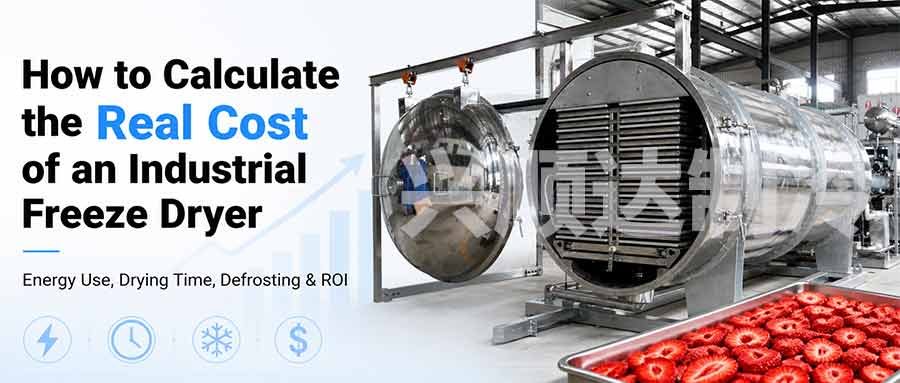
Quick Answer: What Determines Freeze Drying Cost?
Freeze drying cost depends mainly on how much water must be removed, how long the drying cycle takes, how much electricity and steam the system uses, and how efficiently the condenser, vacuum system and heating system work together.
For food production, buyers should calculate cost per batch, cost per kilogram of wet material, cost per kilogram of finished product, and cost per kilogram of water removed. This method is more useful than judging cost only by installed power or machine price.
What Does Freeze Drying Cost Include?
Freeze drying cost includes every expense required to remove water from frozen food under vacuum. A complete calculation should include both direct production cost and indirect production cost.
Direct Production Cost
Moisture Load
More water requires more energy, stronger condenser capacity, and longer drying time. Therefore, raw material moisture is the first cost driver.
Electricity and Steam
Industrial freeze drying uses electricity for refrigeration, vacuum, control, and auxiliary systems. Large systems may also use steam or a heat-transfer medium for shelf heating and defrosting.
Drying Cycle
Longer drying cycles reduce daily output. In addition, they increase energy duration, labor scheduling pressure, and equipment occupation time.
Indirect Production Cost
Labor and Operation
Loading, unloading, cleaning, tray handling, monitoring, and packaging affect the final cost per kilogram of freeze-dried food.
Maintenance
Vacuum pumps, seals, valves, sensors, refrigeration parts, and control systems need regular service. As a result, weak maintenance can increase downtime.
Downtime and Defrosting
Slow defrosting, difficult cleaning, or unstable equipment reduces daily production capacity. This hidden cost should be included before investment.
Why Freeze Drying Costs More Than Dehydration
Freeze drying usually costs more than hot-air dehydration because it uses freezing, vacuum, sublimation, refrigeration, vapor capture, and controlled heating. However, it can produce higher-value food with better shape, color, texture, and rehydration.
| Factor | Hot-Air Dehydration | Freeze Drying | Cost Impact |
|---|---|---|---|
| Water removal method | Evaporation by heat | Sublimation under vacuum | Freeze drying needs a more complex equipment system. |
| Temperature | Higher drying temperature | Low-temperature drying | Product quality is better protected, but the system cost is higher. |
| Product quality | More shrinkage and nutrient loss | Better color, shape, texture and rehydration | Higher selling price may offset higher production cost. |
| Equipment system | Heating and airflow | Freezing, vacuum, condenser and heating | More systems increase investment and maintenance cost. |
When the Higher Cost Is Worth It
High-Value Food Products
Freeze drying is suitable for fruit snacks, pet food, seafood ingredients, instant meals, herbs, tea extract, and products that need strong quality protection.
Better Product Positioning
Premium freeze-dried products can often sell at a higher price. Therefore, production cost should be compared with market value, not only drying energy.
Calculate Water Removal First
Water removal is the foundation of freeze drying cost analysis. Most fresh foods contain high moisture, so the amount of water removed decides the energy demand, condenser load, and drying time.
Basic Water Removal Formula
Water removed = wet material weight × initial moisture rate − final product weight × final moisture rateWhy This Number Matters
If two products have the same wet batch weight, the product with higher moisture usually costs more to dry. It also requires stronger vapor capture and longer machine operation.
Why Water Removal Is the Main Cost Driver
Same Weight, Different Cost
Two products with the same wet material weight may have very different freeze drying costs. For example, a product with higher initial moisture needs more vapor capture, more energy and often a longer drying cycle.
Data Needed Before Estimation
Buyers should send initial moisture and target final moisture before asking for an operating cost estimate. Without these values, the estimate can only be a rough reference.
Simple Example
| Item | Example Value | Cost Meaning |
|---|---|---|
| Wet material | 1,000 kg | This is the raw material loaded before freeze drying. |
| Initial moisture | 80% | The raw material contains about 800 kg of water. |
| Final moisture | 2% | The finished product still contains a small amount of water. |
| Main cost driver | Water to remove | The condenser, refrigeration, vacuum and heating systems must handle this load. |
Calculate Freeze Dryer Electricity Cost
Freeze dryer electricity cost is one of the most common concerns before equipment investment. However, food manufacturers should not calculate it only by installed power. Installed power shows the maximum electrical capacity, while real electricity cost depends on water removed, drying time, load level, machine design, and local electricity price.
Freeze Dryer Electricity Cost Formula
Freeze dryer electricity cost = water removed × kWh per kg of water removed × local electricity rateElectricity cost per kg finished product = electricity cost per batch ÷ finished product weightWhy Installed Power Is Not Enough
Different Load Stages
Freezing, primary drying, secondary drying, vapor condensation and defrosting have different load levels. The machine does not run at full installed power during the whole cycle.
Product-Specific Drying Time
Moisture content, sugar content, slice thickness and loading density can extend or shorten the drying cycle. As a result, electricity use per batch changes.
System Efficiency
Refrigeration design, condenser capacity, vacuum stability and heating control decide how efficiently the machine removes water.
Main Factors That Affect Electricity Cost
| Factor | Effect on Electricity Cost |
|---|---|
| Product moisture | Higher moisture means more water to remove. |
| Slice thickness | Thicker pieces slow internal moisture movement and extend drying time. |
| Loading density | Overloading blocks vapor flow and increases drying time. |
| Condenser capacity | A weak condenser slows vapor capture and raises operating time. |
| Vacuum stability | Unstable vacuum reduces sublimation efficiency. |
| Refrigeration efficiency | Inefficient refrigeration increases power use during vapor capture. |
| Drying curve | Poor process settings can waste energy or damage product quality. |
Add Steam and Heating Cost
Electricity alone does not show the full energy cost for industrial freeze drying. Large food freeze dryers may also use steam, hot water, or a heat-transfer medium for shelf heating and defrosting.
Heating During Drying
During drying, sublimation requires heat. In industrial food production, steam or a heat-transfer medium can provide stable shelf heating and reduce the load on electric heaters.
Defrosting Cost
Steam may also be used for defrosting large condensers. If defrosting is slow, downtime becomes another hidden cost.
Steam Cost Formula
Steam cost = kg steam used per batch × local steam priceQuestions to Ask
- How many kWh are used per kilogram of water removed?
- How many kilograms of steam are used per kilogram of water removed?
- Is steam used for shelf heating, defrosting, or both?
Estimate Drying Time Cost
Drying time affects the real cost because it decides how many batches the factory can finish each day. It also affects energy duration, labor scheduling, packaging flow, and equipment utilization.
Daily Output
A shorter drying cycle can increase daily output. Fixed costs are then spread over more product.
Energy Duration
Longer cycles keep refrigeration, vacuum, heating and control systems running for more hours. Therefore, each extra hour should be considered in cost analysis.
Production Scheduling
Long cycles can create waiting time between loading, unloading, cleaning and packaging. This reduces factory flexibility.
Factors That Extend Drying Time
| Factor | Why It Extends Drying | Cost Result |
|---|---|---|
| Thick material | Water inside the product needs more time to move out. | Energy use rises and daily capacity drops. |
| High sugar content | The product may collapse if temperature rises too fast. | The drying curve must be slower. |
| Weak condenser | Water vapor cannot be captured fast enough. | Vacuum becomes unstable and drying time increases. |
| Poor vacuum stability | Sublimation becomes less efficient. | The cycle becomes longer and final moisture becomes less stable. |
Freeze Drying Cost Calculation Framework
A practical cost analysis should calculate one drying cycle first. After that, the same batch cost can be converted into several useful production metrics.
| Cost Metric | Formula | Best Use |
|---|---|---|
| Cost per Batch | Total cost of one drying cycle | Production planning and batch profit calculation. |
| Cost per kg Wet Material | Total batch cost ÷ wet material weight | Raw material purchasing and factory capacity planning. |
| Cost per kg Finished Product | Total batch cost ÷ finished product weight | Sales pricing and margin calculation. |
| Cost per kg Water Removed | Total batch cost ÷ water removed | Equipment efficiency comparison. |
Freeze Drying Cost Formula for Food Production
The most practical method is to calculate one batch first. Then the result can be converted into cost per kilogram of wet material, finished product, and water removed.
Total cost = electricity + steam + labor + packaging + maintenance + defrosting downtime + depreciationWet-material cost per kg = total batch cost ÷ wet material weightFinished-product cost per kg = total batch cost ÷ finished product weightWater-removal cost per kg = total batch cost ÷ water removedWhich Cost Metric Should Be Used?
| Metric | Best Use | Why It Helps |
|---|---|---|
| Batch cost | Production planning | It shows the total expense for each drying cycle. |
| Wet-material cost per kg | Raw material purchasing | It helps compare fresh material input cost. |
| Finished-product cost per kg | Pricing and sales | It supports wholesale and retail price planning. |
| Water-removal cost per kg | Equipment comparison | It shows whether the drying system removes water efficiently. |
Operating Energy References from Production Data
Use project records and manufacturer planning references as evidence inputs, not as universal guarantees. Product moisture, loading, cycle time, condenser duty, utilities, and final-moisture targets can change the actual operating cost.
| Evidence | Production Context | Energy / Utility Reference | How to Use It |
|---|---|---|---|
| 200 m² shrimp project in India | About 2,320 kg raw shrimp per batch; about 8 hours drying; final moisture 1.68%. | About 1.02 kWh electricity + 1.41 kg steam per kg raw material. | Company-published project record. Use it as a comparable industrial reference, then replace the utility rates and product assumptions with the buyer’s own data. |
| Commercial electricity planning reference | Commercial-scale food production; actual value remains product dependent. | About 1.7 kWh electricity per kg wet material. | Manufacturer planning reference for preliminary electricity estimates. Confirm with product testing and batch records before investment. |
Example: Freeze Drying Cost Calculation for Strawberry Slices
The strawberry example is only a calculation template. Buyers should replace electricity price, steam price, water removed, labor cost, packaging cost and drying time with local factory data.
Example Input Data
| Input Item | Example Value | Meaning |
|---|---|---|
| Product | Strawberry slices | A high-moisture fruit product. |
| Target finished product | 100 kg freeze-dried sliced strawberries | The calculation is based on finished product output. |
| Estimated water removed | 870 kg water | This is the main basis for energy cost estimation. |
| Electricity price | 0.12 USD/kWh | This should be replaced with the local industrial electricity rate. |
| Steam price | Local steam price | Steam cost should be calculated separately for steam-heated systems. |
Reference Energy Consumption per kg of Water Removed
| Freeze Dryer Type | Energy Consumption per kg of Water Removed | How to Use This Data |
|---|---|---|
| Large steam-heated industrial freeze dryer | About 1.2 kWh electricity + 1.8 kg steam | Use electricity cost and local steam cost together. |
| Medium electric-heated freeze dryer | About 2 kWh electricity | Use local electricity price to calculate the main energy cost. |
Option 1: Large Steam-Heated Industrial Freeze Dryer
870 kg × 1.2 kWh/kg = 1,044 kWh870 kg × 1.8 kg/kg = 1,566 kg steam1,044 kWh × 0.12 USD/kWh = 125.28 USD125.28 USD + local steam costOption 2: Medium Electric-Heated Freeze Dryer
870 kg × 2 kWh/kg = 1,740 kWh1,740 kWh × 0.12 USD/kWh = 208.80 USDEnergy Cost per kg Finished Product
| Freeze Dryer Type | Calculation | Result | Note |
|---|---|---|---|
| Medium electric-heated freeze dryer | 208.80 USD ÷ 100 kg | 2.09 USD/kg finished product | Electricity cost only. |
| Large steam-heated industrial freeze dryer | 125.28 USD ÷ 100 kg | 1.25 USD/kg finished product | Steam cost still needs to be added. |
Energy Cost per kg Water Removed
| Freeze Dryer Type | Calculation | Result | Note |
|---|---|---|---|
| Medium electric-heated freeze dryer | 208.80 USD ÷ 870 kg | 0.24 USD/kg water removed | Electricity cost only. |
| Large steam-heated industrial freeze dryer | 125.28 USD ÷ 870 kg | 0.144 USD/kg water removed | Steam cost still needs to be added separately. |
How Equipment Design Affects Freeze Drying Cost
Equipment design has a direct impact on long-term freeze drying cost. Food manufacturers should not compare machines only by tray area or purchase price.
Condenser Capacity
A weak condenser slows vapor capture. As a result, drying time increases and the cost per batch becomes higher.
Read Condenser GuideVacuum Stability
Stable vacuum supports efficient sublimation. Poor vacuum matching, leakage, or weak pump configuration can extend drying time and increase power consumption.
Read How Industrial Freeze Dryers WorkHeating Uniformity
Uniform heat transfer helps products dry evenly. It also reduces the risk of over-drying some trays while other trays remain wet.
Refrigeration Efficiency
Refrigeration affects condenser stability and power use. Therefore, a well-designed refrigeration system can reduce long-term operating cost.


How to Reduce Freeze Drying Cost
Reducing freeze drying cost does not mean buying the cheapest machine. Instead, it means improving loading, drying speed, energy efficiency, product consistency, and production planning.
Optimize Slice Thickness
Proper thickness can shorten drying time. However, slices that are too thin may reduce yield, shape, or texture quality. The best thickness should be confirmed by product testing.
Control Loading Density
Good loading improves tray use. However, overloading blocks vapor movement and increases drying time, so loading density should balance capacity and drying efficiency.
Use Product Testing
Sample testing can confirm drying curve, final moisture, texture, color, and rehydration. This gives a more reliable cost basis than formula estimation alone.
Choose Enough Condenser Capacity
Strong vapor capture reduces drying bottlenecks. It also helps the machine finish batches more consistently.
Avoid Unnecessary Oversizing
Oversized equipment increases purchase cost and may run inefficiently at low load. The machine should match real production demand and factory utility supply.
Plan Defrosting and Cleaning
Faster defrosting and easier cleaning reduce downtime. They also help operators maintain a stable production rhythm.
Information Needed Before Freeze Drying Cost Estimation
A useful cost estimate must be based on real product data. The table below shows which values buyers should prepare before requesting a project-based cost analysis.
| Information | Why It Matters |
|---|---|
| Product type | Fruit, seafood, meat, herbs, soup and extracts need different drying curves. |
| Initial moisture | It determines how much water must be removed. |
| Target final moisture | It affects drying endpoint and storage stability. |
| Material thickness | Thickness strongly affects drying time. |
| Daily wet material capacity | It decides equipment scale and batch planning. |
| Local electricity and steam price | Local utility cost changes the real production cost. |

For a catalogue view across pilot, commercial, and industrial equipment, use the freeze dryer product range. Product selection should follow the operating-cost calculation rather than replace it.
What Information Should Buyers Send?
Before requesting a freeze drying cost analysis or equipment quotation, food manufacturers should prepare product, capacity, utility and factory information.
Product and Moisture Information
Production and Utility Information
From Cost Analysis to Equipment Selection
Freeze drying cost analysis helps the buyer decide whether the project is profitable. After that, the next step is to choose the right equipment configuration.
| Stage | Buyer Action | Recommended Resource |
|---|---|---|
| 1. Cost calculation | Calculate water removal, electricity, steam, labor, packaging and maintenance. | Use the cost formula |
| 2. Product validation | Test drying time, final moisture, texture, color and rehydration. | Pilot lab freeze dryer |
| 3. Equipment selection | Choose the suitable capacity and configuration. | Industrial freeze dryer models |
| 4. Selection guide | Confirm production scale, utility conditions and model selection logic. | Industrial food freeze dryer selection guide |
| 5. Budget review | Compare purchase budget, configuration scope and quotation logic. | Industrial freeze dryer price guide |
| 6. Supplier evaluation | Compare condenser, vacuum, refrigeration, materials, training and service. | Manufacturer guide |
| 7. Project verification | Review similar product cases and drying data. | Customer case studies |
Do Not Compare Freeze Drying Cost by Machine Price Only
During equipment selection, a lower purchase price does not always mean lower freeze drying cost. If drying time is longer, condenser capture is weaker, energy use is higher, or maintenance is harder, the long-term production cost can be much higher.
Ultimately, the best decision is to compare real cost per batch, cost per kilogram of finished product, and cost per kilogram of water removed.
FAQ About Freeze Drying Cost Analysis
These answers help food manufacturers estimate freeze drying cost before equipment selection and production planning.
Cost Calculation Basics
What is freeze drying cost analysis?
Freeze drying cost analysis is the process of calculating the real cost of freeze-drying food. It includes water removal, electricity, steam, drying time, labor, packaging, maintenance, downtime, and equipment efficiency.
How do food manufacturers calculate freeze dryer electricity cost?
They can calculate freeze dryer electricity cost by multiplying water removed, kWh per kilogram of water removed, and the local electricity rate. This method is more useful than using installed power alone.
Is freeze dryer electricity cost the same as total freeze drying cost?
No. Electricity is only one part of the cost. Industrial freeze drying may also include steam, labor, packaging, maintenance, defrosting downtime, depreciation and local utility cost.
Why should cost be calculated by water removed?
Water removal is the main load in freeze drying. Products with higher moisture usually require more vapor capture, more energy and longer drying time, even if the wet material weight is the same.
How do you calculate freeze drying cost per kilogram?
Add electricity, steam, labor, packaging, maintenance, downtime and depreciation for one batch. Then divide the total cost by wet material weight, finished product weight, or water removed.
Testing, Equipment and Cost Reduction
Why does freeze drying cost more than dehydration?
Freeze drying uses freezing, vacuum, sublimation, refrigeration, vapor capture, and controlled heating. Therefore, the equipment and energy systems are more complex than hot-air drying.
Does a cheaper freeze dryer reduce production cost?
Not always. A cheaper machine may have weaker condenser capacity, longer drying time, higher energy use, or more downtime. As a result, long-term cost may be higher.
Can freeze drying time be calculated by formula?
No. A formula can help estimate water removal and energy cost, but it cannot accurately predict drying time. Real drying time should be confirmed through sample testing, final moisture testing and process records.
Can a supplier give an accurate cost without product testing?
A supplier can provide a reference estimate, but accurate cost needs product data, moisture content, thickness, loading density, drying time and final moisture testing.
How can food factories reduce freeze drying cost?
Food factories can reduce cost by optimizing slice thickness, loading density, drying curves, condenser capacity, vacuum stability, defrosting time, and operator training.
Technical author and reviewer
Zheng Wei — Freeze-Drying Engineer, Fuzhou Xing Shun Da Refrigeration Facility Project Co., Ltd.
This guide is reviewed for water-removal calculations, freeze-dryer utility assumptions, operating-cost boundaries, and food-production engineering context. Buyers should replace example utility prices and process assumptions with their own factory data before making an investment decision.