
Freeze Dryer Components: 7 Systems Buyers Should Verify
Freeze dryer components should be evaluated as one integrated freeze-drying system, not as a list of isolated brand names or maximum specifications. For a commercial food project, the useful questions are: What job must each system perform under load, what evidence will prove it, and what maintenance or utility requirements follow?
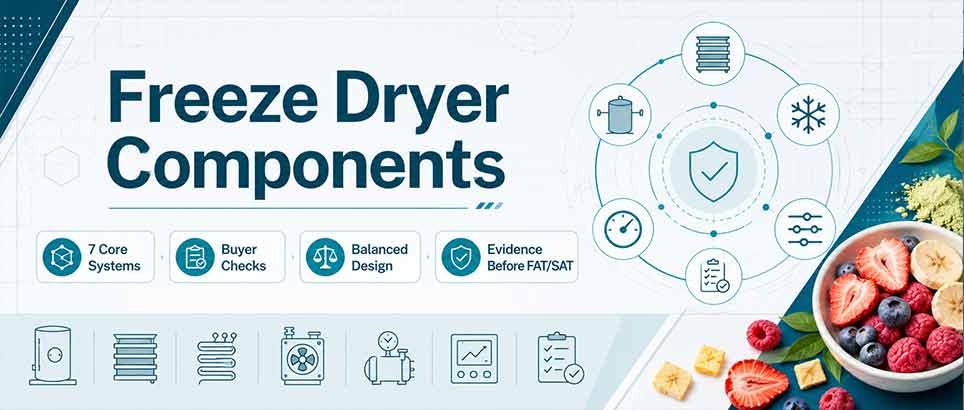
A buyer-facing freeze dryer can be grouped into seven systems: the chamber and vapor path; trays, shelves, and loading equipment; condenser and defrost system; vacuum system; refrigeration system; heating and thermal control; and sensors, PLC, HMI, and data records. The exact architecture varies by machine scale, so “seven” is a practical procurement framework rather than a universal engineering definition.
In This Freeze Dryer Component Guide
- Seven systems at a glance
- Why system balance matters
- What to verify for each system
- Component acceptance tests
- Quotation and supplier scope
- Project data to send
- Frequently asked questions
Freeze Dryer Components at a Glance
| Buyer-facing system | Main job | Evidence to request | Related guide |
|---|---|---|---|
| 1. Chamber, door, seals, and vapor path | Hold the product under controlled pressure and give vapor a low-resistance route to the condenser. | Material and weld specification, drainage and access details, leak-test method, and general arrangement drawing. | Vacuum chamber guide |
| 2. Trays, shelves, heating surfaces, and trolley | Support the planned load and transfer heat consistently across usable product area. | Usable area, tray dimensions, loading basis, temperature mapping, cleaning access, and trolley or rail details. | Tray and loading guide |
| 3. Condenser, defrost, and drainage | Capture the water vapor released during primary drying and clear the ice between batches. | Total usable ice capacity, peak capture evidence, loaded temperature behavior, defrost method, and turnaround time. | Condenser and cold-trap guide |
| 4. Vacuum pumps, piping, valves, and gauges | Remove non-condensable gases, evacuate the system, and maintain controllable chamber pressure. | Pump arrangement, chamber-side performance, pipe and valve sizes, leak rate, gauge type, and test conditions. | Vacuum-system guide |
| 5. Refrigeration and cooling utilities | Freeze or cool the product where applicable and remove heat from the condenser and thermal system. | Loaded pull-down or hold test, ambient design condition, cooling-water data, redundancy, refrigerant, and service access. | Specification checklist |
| 6. Shelf heating and thermal-fluid control | Supply controlled energy for sublimation without driving the product above its safe processing temperature. | Control range, ramp and hold functions, distribution test, over-temperature protection, and product-probe plan. | Temperature and pressure guide |
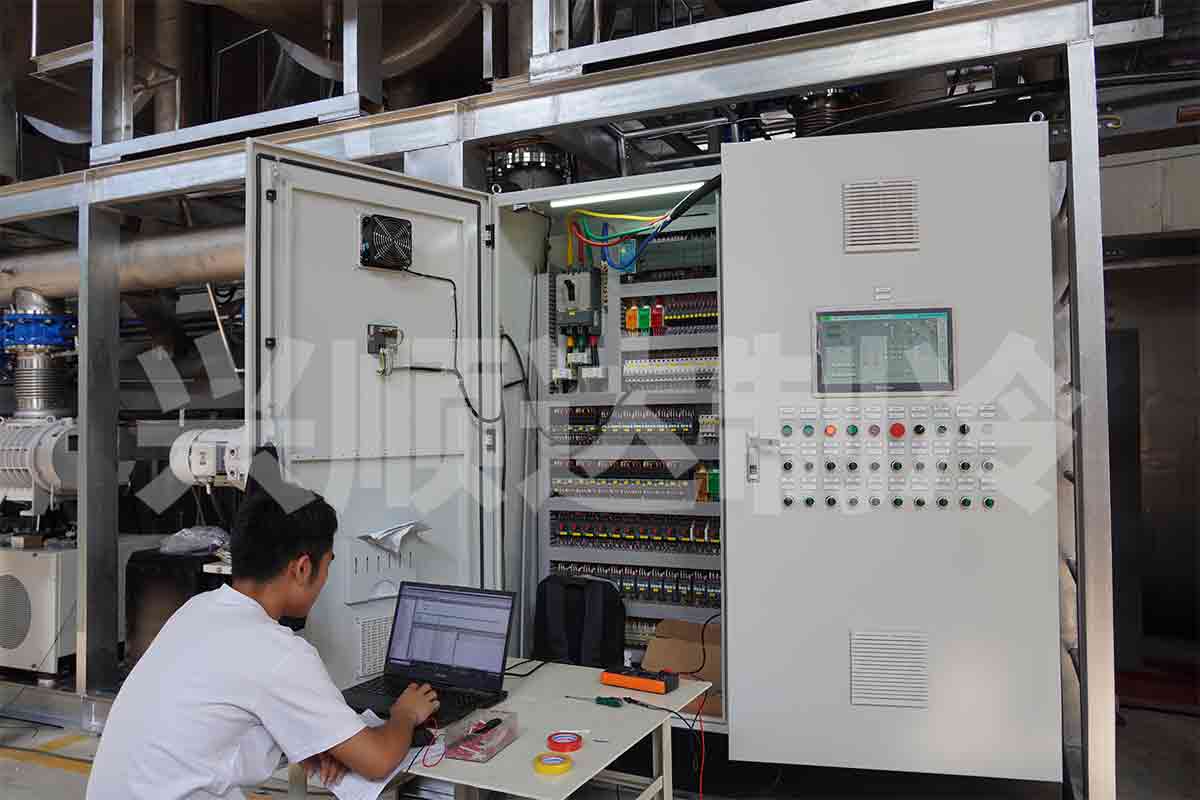
| 7. Sensors, PLC, HMI, alarms, and records | Coordinate the machine, show process conditions, protect the batch, and preserve evidence for review. | Instrument list, accuracy and calibration plan, recipe functions, alarm list, trend history, data export, and backups. | Monitoring and batch-record guide |
Why Component Balance Matters More Than the Largest Number
During primary drying, the heating system supplies energy, the product releases water vapor, the chamber and connecting duct carry that vapor, and the condenser captures it as ice. The vacuum system mainly removes non-condensable gases and helps control pressure; it should not be treated as a substitute for an adequately sized condenser.
Food-equipment literature describes the condenser as necessary for the large vapor quantity produced during primary drying and notes that scale, tray contact, radiation, and equipment geometry can change heat transfer and product temperature.[1] Equipment-capability research also shows that pressure control can be limited by the vapor path or condenser capacity; that research used pharmaceutical vial systems, so only the equipment-boundary principle—not its product settings—is applied here.[3]
For the process sequence, diagrams, and drying stages, use the separate guide to how freeze drying works. This page stays focused on component verification and quotation evidence.
Seven Freeze Dryer Systems and What Buyers Should Verify
1. Chamber, Door, Seals, and Vapor Path
The chamber is a pressure boundary, a product-loading space, and part of the vapor route. Buyers should inspect more than chamber diameter. Door sealing, internal obstructions, outlet geometry, drainage, trolley clearance, weld finish, and access for inspection or cleaning all affect operation.
- Request the chamber material and surface-finish specification.
- Define the leak or pressure-rise test, isolation time, and machine condition.
- Review the vapor outlet, connecting duct, valves, and condenser location together.
- Confirm drainage and access do not create difficult-to-clean product or water traps.

Food regulations vary by market, but the general principle is consistent: equipment should support sanitary operation and maintenance. The FDA food CGMP overview is one authoritative reference for plant equipment and sanitary operations; local requirements still control the project.
2. Trays, Shelves, Heating Surfaces, and Loading Equipment
Usable loading area is more valuable than a headline shelf-area number. Practical output also depends on product thickness, loading density, tray contact, spacing, heat-transfer method, and the slowest location in the batch. Published food-process analysis warns that lab and commercial equipment geometry can change product temperature and that tray contact and radiation can create batch heterogeneity.[1]
- Ask whether quoted area is gross, installed, or usable product area.
- Request the product, thickness, loading density, and cycle basis behind any kg-per-batch claim.
- Define temperature mapping across representative shelves or heating zones.
- Check tray material, drainage, edge design, handling method, and replacement availability.


3. Condenser, Defrost, and Drainage
The condenser must hold the batch water and capture vapor fast enough during the highest sublimation load. A minimum no-load temperature does not prove either requirement. Buyers should separate total usable ice capacity from peak capture performance and ask what happens as frost accumulates.
- Calculate approximate water removed from initial and target final moisture.
- Request loaded evidence for pressure control and condenser temperature during the peak vapor period.
- Confirm effective surface area, vapor route, defrost method, meltwater drainage, and between-batch time.
- For continuous schedules, ask whether the proposed defrost strategy supports the required batches per day.

Food-focused engineering literature identifies the condenser as the receiver for the large amount of vapor generated during primary drying.[1] The supplier should therefore connect condenser claims to the same product and load used for the capacity claim.
4. Vacuum Pumps, Piping, Valves, and Pressure Measurement
The pump label alone does not describe vacuum performance at the chamber. Effective pumping speed changes with pressure and can be reduced by narrow pipes, valves, leaks, wet surfaces, condenser overload, or pump condition.
- Separate empty-chamber evacuation time, ultimate pressure, and loaded operating pressure.
- Request pump curves, pump sequence, chamber-side pipe sizes, valve sizes, and leak-test criteria.
- Ask which gauge technology is used, where it is installed, and how it behaves in water-vapor service.
- Compare oil, seals, filters, cooling, exhaust, noise, service access, and critical spares.


Pressure is a measurement, not just an HMI number. NIST’s vacuum-gauge calibration guidance explains why uncertainty and traceability matter. For a supplier comparison, ask for the gauge type, range, accuracy, calibration evidence, and replacement plan.
5. Refrigeration and Cooling Utilities
Refrigeration may cool the condenser, the product shelves, or both, depending on the architecture. Compressor brand and motor power do not show how much cooling remains at the required low temperature and under the site’s actual ambient or cooling-water conditions.

- Define the product-freezing duty and condenser duty separately.
- Request loaded pull-down or hold tests rather than only an unloaded minimum temperature.
- Confirm ambient design temperature, cooling-water temperature and flow, power supply, refrigerant, and ventilation.
- For large production systems, review redundancy, isolation, service space, and local component support.


6. Shelf Heating and Product-Temperature Control
Sublimation requires energy, but the shelf setpoint is not the same as product temperature. Too little heat extends the cycle; too much heat can cause melting, shrinkage, or structural collapse in a product-specific way. A food review found that material composition, layer thickness, pressure, shelf temperature, and critical product behavior interact, so one recipe cannot be treated as universal.[2]
- Request the heating method, temperature range, ramp and hold capability, and protection logic.
- Define representative product-temperature probe locations for trials and loaded tests.
- Ask how uniformity is checked across the usable area and at more than one setpoint.
- Require the supplier to state whether a claim is based on empty shelves, a test load, or the buyer’s product.

7. Sensors, PLC, HMI, Alarms, and Batch Records
Controls make the mechanical systems repeatable and diagnosable. A production system should show the variables that operators need, protect the machine with interlocks, and preserve enough history to investigate a slow or failed batch.


- Request the instrument list, range, accuracy, location, calibration method, and spare strategy.
- Review recipe permissions, user levels, audit trail where required, alarm list, and interlocks.
- Confirm trend retention, data export, report format, time synchronization, software backups, and remote-support controls.
- Ask for a sample batch record and alarm history before approving the HMI description.


Need a Component-by-Component Quote Review?
Send the product data, wet batch, initial and target moisture, layer thickness, daily output, site utilities, and any supplier quotation already received. The engineering team can identify missing technical information and clarify which component-performance points should be verified before a model decision.
Minimum Evidence to Request Before FAT or SAT
For procurement, major component claims should be translated into written FAT or SAT conditions before equipment approval. The table below summarizes the minimum evidence buyers can request; detailed test procedures, numerical limits, and acceptance criteria should be defined separately for the selected machine, product, and project scope.
| Supplier claim | Evidence or acceptance test | Conditions that must be written down |
|---|---|---|
| Fast vacuum | Empty-chamber evacuation test plus loaded pressure-control evidence. | Starting and target pressure, chamber condition, condenser state, pumps operating, gauge type, ambient, and timing method. |
| Low leakage | Isolated pressure-rise or approved leak test. | Initial pressure, stabilization time, isolation period, temperature, permitted rise, and excluded volumes. |
| Powerful condenser | Total ice-load check and loaded peak-vapor test. | Water load, product or test material, shelf heat input, pressure, condenser temperature, duration, frost condition, and defrost state. |
| Uniform heating | Temperature-distribution mapping and representative loaded trial. | Probe quantity and position, setpoints, stabilization criteria, load, acceptance band, and data interval. |
| Advanced control | Recipe demonstration, alarm challenge, interlock check, trend export, and backup/restore review. | User roles, retained variables, data period, time stamp, file format, alarm acknowledgement, and recovery responsibility. |
| High daily output | Representative product trial or documented scale-up basis. | Product, preparation, thickness, wet load, initial/final moisture, drying endpoint, defrost, loading/unloading, and batches per day. |
Use the food freeze dryer FAT/SAT and validation guide for a complete acceptance plan and the freeze dryer specification guide to normalize competing quotation formats.
Separate Core Components, Utilities, Options, Spares, and Services
Two quotations can use the same machine name but include different boundaries. Before comparing price, require a scope table that separates the operating machine from factory utilities, optional production features, maintenance stock, and project services.
| Scope category | Examples to define | Buyer question |
|---|---|---|
| Core machine | Chamber, trays or shelves, condenser, refrigeration, vacuum, heating, valves, instruments, controls, defrost, and drainage supplied with the machine. | Is every item required for the quoted test included? |
| Factory utilities and interfaces | Power, transformer, cooling water, steam, compressed air, ventilation, drain, foundations, piping beyond the skid, and data connection. | Who supplies, installs, tests, and signs off each interface? |
| Optional production features | Pre-freezing, dual condenser, loading trolley, extra probes, remote monitoring, redundancy, and additional automation. | Which options are necessary for the required schedule rather than merely desirable? |
| Consumables and spare parts | Pump oil, filters, seals, sensors, valve kits, relays, fuses, contactors, belts, and model-specific service components. | What should be stocked for commissioning and the first two operating years? |
| Documents and services | Drawings, manuals, component list, software backups, FAT/SAT, commissioning, training, calibration records, troubleshooting support, and warranty boundary. | Which deliverables are included, in what language, and at what project milestone? |
The freeze dryer accessories and spare-parts guide explains the difference between installed components, optional accessories, consumables, and future replacements. Site engineers should also review the commercial freeze dryer setup requirements before the supplier scope is frozen.
Project Data to Send Before Requesting a Configuration
The supplier cannot balance freeze dryer components around a generic kilogram label. Prepare the following inputs before asking for a commercial or industrial configuration:
- Food product, formulation, and product form.
- Initial moisture or solids content.
- Target final moisture and test method.
- Slice thickness or liquid layer depth.
- Wet material per batch and per day.
- Expected batches and operating hours per day.
- Product preparation and pre-freezing plan.
- Available electrical supply and transformer limit.
- Cooling-water temperature, flow, and quality.
- Steam, compressed air, drainage, and ventilation.
- Installation ambient temperature and altitude.
- Room size, access route, floor loading, and service clearance.
- Cleaning, allergen, and product-changeover requirements.
- Data logging, user access, reporting, and integration needs.
- Local compliance, inspection, and documentation requirements.
Buyers who already know their production scale can compare commercial food freeze dryer models and industrial food freeze dryer models, then request a product-specific proposal.
Frequently Asked Questions About Freeze Dryer Components
What are the main components of a freeze dryer?
Most systems include a vacuum-tight chamber, product supports such as trays or shelves, a heat source, a condenser or cold trap, a vacuum system, refrigeration, and controls with temperature and pressure instruments. Large food systems may add trolleys, thermal-fluid units, cooling-water equipment, defrost modules, utilities, and production-line interfaces.
Is a freeze dryer condenser the same as a cold trap?
The terms are often used for the subsystem that captures water vapor as ice. Architecture and terminology vary, so compare its location, total usable ice capacity, peak capture behavior, loaded temperature, vapor path, defrost, and drainage instead of relying on the name.
Which component creates the vacuum?
The vacuum pump system evacuates the chamber and removes non-condensable gases. During normal freeze drying, most water vapor should be captured by the condenser. Chamber sealing, piping conductance, valves, gauge selection, condenser load, and pump condition all affect the pressure seen at the chamber.
Which freeze dryer component is most important?
No single component is most important for every project. The limiting system changes with the product, water load, layer thickness, heat-transfer arrangement, vapor path, condenser, vacuum control, utilities, and operating schedule. The best comparison identifies the weakest interface under the planned load.
Are spare parts included in freeze dryer components?
Installed pumps, valves, sensors, compressors, seals, and control hardware are components of the operating machine. Identical items supplied for future maintenance are spare parts. Quotations should separate installed scope, optional accessories, consumables, commissioning stock, and recommended long-term spares.
References
- Ratti C. Freeze drying for food powder production. In: Bhandari B, Bansal N, Zhang M, Schuck P, editors. Handbook of Food Powders: Processes and Properties. Woodhead Publishing; 2013. p. 57-84. https://doi.org/10.1533/9780857098672.1.57
- Nowak D, Jakubczyk E. The Freeze-Drying of Foods—The Characteristic of the Process Course and the Effect of Its Parameters on the Physical Properties of Food Materials. Foods. 2020;9(10):1488. https://doi.org/10.3390/foods9101488
- Tchessalov S, Maglio V, Kazarin P, Alexeenko A, Bhatnagar B, Sahni E, Shalaev E. Practical Advice on Scientific Design of Freeze-Drying Process: 2023 Update. Pharmaceutical Research. 2023;40:2433-2455. https://doi.org/10.1007/s11095-023-03607-9
Request a Configuration Based on Product and Water Load
Send the product, wet batch, moisture data, layer thickness, daily target, site utilities, installation country, and any supplier quotation already received. Good Freeze Dryer can use those inputs to discuss chamber area, condenser load, vacuum arrangement, heating control, utilities, and the acceptance evidence needed for the next decision.
Technical scope: This guide does not publish universal temperature, pressure, cycle-time, capacity, or energy thresholds. Final equipment selection should use representative product testing, site utilities, model-specific documents, and written acceptance conditions.
Equipment source context: This article is published on goodfreezedryer.com. Final equipment specifications and project proposals should be based on the documents issued by Fuzhou Xing Shun Da Refrigeration Facility Project Co., Ltd. for the selected configuration.
Last content review: July 19, 2026.