
Commercial and Industrial Food Production Guide
Freeze Dryer Australia: Commercial & Industrial Buying Guide
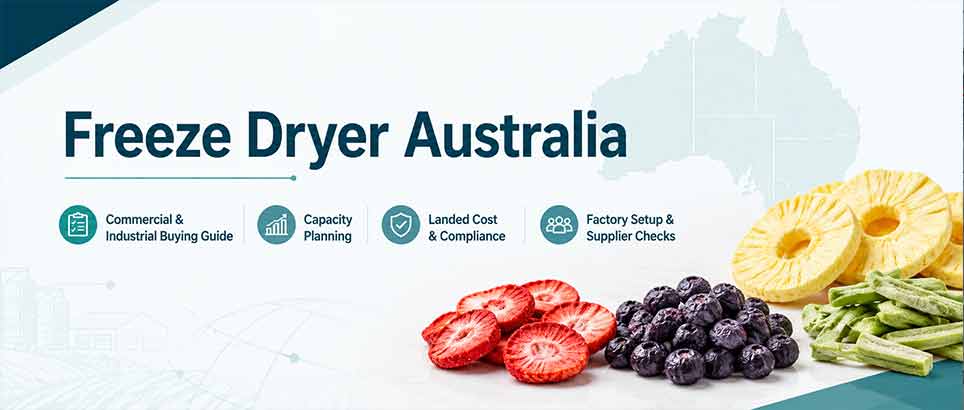
This freeze dryer Australia buying guide is written for food producers comparing pilot, commercial and industrial systems. The first decision should be daily wet-material input, product characteristics, cycle time and factory utilities, not tray count or purchase price alone. A suitable system must also arrive with the electrical, refrigeration, installation, testing and service documentation required for a practical Australian project.
Quick answer: which freeze dryer is suitable?
A laboratory or pilot unit is appropriate for formulation work and market samples. A commercial freeze dryer is generally the starting point for regular food production, while an industrial system is required when daily wet-material input reaches tonnes rather than hundreds of kilograms. The correct choice depends on wet feed per 24 hours, product thickness, loading density, drying time and the number of realistic batches.
Searches such as “freeze dryers Australia”, “buy freeze dryer Australia” and “freeze dryer for sale in Australia” often return a mixture of home, laboratory and factory equipment. Food manufacturers should separate these categories before comparing quotations because their production control, condenser capacity, vacuum performance, cleaning access and service requirements are not equivalent.
Australia buying path: local supply, imported equipment or contract drying?
Australian buyers are usually validating a product, scaling a proven line or comparing ownership with contract drying. The correct path depends on process certainty, production volume and the cost of errors.
| Buyer situation | Best next step | Risk to check |
|---|---|---|
| New product, uncertain demand | Lab/pilot testing or contract drying | Do not buy factory capacity before product thickness, yield, cycle time and packaging are known. |
| Regular food production under 1 tonne wet input/day | Commercial freeze dryer sizing | Confirm loading density, condenser load, cycle time and utilities from the product. |
| Multi-tonne daily input | Industrial project design | Pre-freezing, loading, cooling water, steam or electrical heating and packaging capacity can bottleneck the line. |
Home, laboratory, commercial or industrial freeze dryer?
Home freeze dryers
Home machines can support recipe trials and very small sales batches, but they are not a direct substitute for a commercial food system. Multiple small units add manual loading, defrosting, maintenance and record-keeping without providing reliable factory scale-up data.
Laboratory and pilot freeze dryers
Pilot equipment confirms product preparation, cycle time, final moisture and packaging before a larger investment. It should reproduce the heat-transfer method, condenser behaviour, vacuum range and process records of the planned production system. The SDG60 and SDG90 laboratory/pilot systems are intended for food R&D and pre-production testing.
Commercial freeze dryers
Commercial systems suit businesses requiring repeatable daily output. The commercial freeze dryer range covers approximately 340 kg to 1.36 tonnes of wet material per 24 hours and uses industrial refrigeration, dedicated vacuum, controlled shelf heating and process records.
Industrial freeze dryers
Industrial projects must coordinate preprocessing, freezing, tray handling, utilities, unloading and packaging. The industrial freeze dryer range covers approximately 1.2 to 8 tonnes of wet input per 24 hours, depending on the product and model.
How to size a freeze dryer for Australian production
Start with daily wet raw-material input
Capacity should begin with the mass entering the process, not final packaged output. The buyer should document wet input, initial solids or moisture, target final moisture, cut size, tray depth, cycle time and cleaning or defrost time.
Studies show that loading, layer thickness, freezing behaviour and composition affect drying time and quality. A quotation based only on tray count or empty chamber volume is therefore insufficient.[1][2]
For many sliced fruits, vegetables, meat and seafood products, practical loading often starts around 10-13 kg/m², with product thickness frequently between 4 and 10 mm. Products with different structures cannot be assigned the same loading. Whole berries, viscous meals and concentrated extracts may require different preparation, depth and drying time.
Convert the daily target into shelf area
Shelf area must use realistic loading and batch frequency. A “12-hour cycle” does not mean two daily batches because loading, vacuum pull-down, pressure release, unloading, defrosting and cleaning also take time.
The engineering margin should also account for seasonal raw-material variation. A high-sugar mango line, for example, may need a different product temperature limit and cycle from apple slices even when both products use the same tray area.
Why tray count alone is misleading
Machines with the same tray count can have different capacities. Tray dimensions, condenser and refrigeration duty, vacuum configuration, heating uniformity and sensors determine whether vapour is removed without collapse or melting.
A buyer should therefore compare freeze dryer specifications as a complete system. A low quotation may conceal a small condenser, slow vacuum pull-down, insufficient heat transfer or a control system that cannot provide usable batch records.
Capacity comparison for food production
| Equipment class | Models | Indicative wet input / 24 h | Typical use |
|---|---|---|---|
| Laboratory / pilot | SDG60, SDG90 | 60-80 kg; 90-120 kg | R&D, pilot sales, recipe and process development |
| Commercial | SDG350, SDG700, SDG1100 | 340-450 kg; 680-900 kg; 1.02-1.36 t | Fruit, vegetables, meals, meat, seafood and pet food |
| Industrial | SDG1600, SDG3000, SDG6000 | 1.2-2 t; 3-4 t; 6-8 t | Continuous factory schedules and multi-tonne daily input |
Capacity refers to wet raw material per 24 hours under typical assumptions, including approximately 15% solids. Actual capacity must be recalculated for the product, thickness, loading density, moisture load and cycle.
Get an Australia-ready freeze dryer sizing review
A project assessment should include the product, wet input per day, cut size or tray depth, target final moisture, Australian destination, available power and cooling-water conditions. The engineering team will use this information to identify a suitable model range, estimated shelf area, condenser load, utility checklist and questions to confirm before quotation.
Request an Australia Project Assessment Review Production CasesFreeze Dryer Australia Prices and Landed Project Cost
A meaningful freeze dryer price for Australia must separate the equipment quotation from the landed and commissioned project cost. The following ranges are manufacturer reference values before international freight, import charges, GST, local installation and building services.
| System category | Indicative equipment reference | Commonly excluded from the base price |
|---|---|---|
| Laboratory / pilot | Approximately RMB 280,000-310,000 (about US$39,000-43,000 before freight and local project costs, subject to the exchange rate at quotation) | Freight, import processing, local electrical work, commissioning |
| Commercial | Approximately US$75,000-193,000 | Cooling system, piping, unloading, inland delivery, installation and training |
| Industrial | Approximately US$235,000-542,000 | Steam system, cooling tower, factory works, rigging, commissioning and production integration |
Final pricing varies with chamber size, heating, condenser and vacuum configuration, controls, voltage, documentation, spares and service. Currency conversion should use the exchange rate at quotation.
What a comparable quotation should include
Australian Border Force explains that GST is generally payable on taxable importations and provides guidance on customs value, import declarations and processing charges. The buyer should obtain a project-specific calculation from an Australian customs broker rather than applying a simple percentage to the machine price. See the official ABF cost of importing goods guidance.
For deeper equipment-versus-project calculations, see the guides to commercial freeze dryer price and the real cost of an industrial freeze dryer.
Australian compliance and import checks
Who must verify the Australian import responsibilities?
| Topic | Why it matters | Who should confirm it |
|---|---|---|
| Customs value, duty, GST and declarations | Australian import cost is not just the machine price. | Australian customs broker/importer |
| EESS/RCM and Responsible Supplier status | Some in-scope electrical equipment responsibilities sit with an Australian or New Zealand responsible supplier. | Importer, compliance consultant, licensed electrical adviser |
| Refrigerant and EQPL | Equipment containing or designed to use controlled refrigerants may trigger licence checks. | Importer, refrigeration specialist, DCCEEW guidance |
| Food premises and equipment hygiene | The freeze dryer is part of the food business’s safety system, not a substitute for it. | Food-safety adviser and local regulator |
Electrical documentation, RCM and EESS
A CE mark should not be assumed to satisfy Australian electrical requirements. The importer or supplier should determine whether ACMA labelling rules or the Electrical Equipment Safety System apply to the complete machine or supplied components. Start with ACMA guidance and the EESS Responsible Supplier guidance.
Refrigerant and refrigeration-service checks
Refrigerant type, circuit charge and installation or service responsibilities should be confirmed before shipment. Importers should review DCCEEW guidance on equipment licences and refrigeration requirements.
Food-contact and cleanability review
A freeze dryer used for food production should be reviewed as part of the food business’s overall food-safety system. The buyer should check the FSANZ Food Safety Standards with the project’s food-safety adviser.
Freeze dryer assessment should cover tray material, chamber surfaces, door seals, condensate drainage, cleaning access, residue traps, cleaning-chemical compatibility and separation between food-contact and mechanical areas. The machine does not replace the factory’s hazard controls, validated cleaning procedures or upstream food-safety process.
Crating, biosecurity and import documentation
Machinery crates, timber packaging and used equipment can attract biosecurity attention. The importer should confirm packaging and cleanliness requirements before dispatch through the Australian Government’s biosecurity import guidance. Commercial invoices, packing lists, bills of lading, serial numbers and crate dimensions should match the shipment.
Site requirements before ordering
Electrical supply
The site review should confirm voltage, three-phase frequency, peak demand, motor starting loads, switchboard capacity, protection, cable routes and emergency isolation.
Cooling water and heat rejection
Cooling-tower capacity, inlet-water temperature, ambient conditions, pump reliability and water treatment affect refrigeration performance. The quotation should state the design ambient and cooling-water assumptions because air-cooled systems can lose capacity in hot conditions.
Floor loading, access and service space
Large freeze dryers should normally be installed at ground level. Before ordering, the buyer should check floor loading, drainage, door openings, unloading and rigging access, foundations, service clearances, pipe routes and component-removal paths.
Production-room flow
The layout should connect preprocessing, pre-freezing, loading, drying, unloading and barrier packaging without prolonged humidity exposure. See the commercial freeze dryer setup guide for utilities and installation responsibilities.
Match the freeze dryer to the product
Fruit and vegetables
Waxy skins, whole berries, high-sugar liquids and concentrated extracts can restrict moisture movement or increase collapse risk. Cut size, pretreatment, layer depth and loading should therefore be confirmed by trials rather than copied from another food.[3]
Producers can review the dedicated guides for a fruit freeze dryer machine and a commercial vegetable freeze dryer.
Meat, seafood and pet food
Meat and seafood require controlled raw-material handling because freeze drying is not a sterilisation step. Thickness, loading and cycle time should be verified against final moisture, centre dryness and sensory results. High-fat products also require oxygen- and moisture-barrier packaging.
Relevant process guides include freeze dryer for meat, commercial fish freeze drying and freeze dryer for dog food and treats.
Meals, dairy and extracts
Cooked meals and extracts require control of solids, tray depth, foaming and surface crust formation. Thin layers reduce resistance; concentrated extracts may need longer cycles. Coffee extracts may use pre-freezing nitrogen foaming, while low-solids products can sometimes be tray-frozen directly.
Product-specific information is available in the guides to freeze dryers for liquid and extract products, commercial milk freeze drying and coffee freeze dryer processing.
Final moisture, packaging and storage stability
Final moisture alone does not determine stability. Structure, hygroscopicity, oxygen exposure and barrier packaging also affect texture and quality loss.[2][5]
Comparable food-production data
These international reference cases show how product, area, loading and cycle interact. They are not Australian installations or guaranteed results for another product or site.
| Product and project | System | Loading | Drying time | Final moisture | Selection lesson |
|---|---|---|---|---|---|
| Pineapple, Indonesia | SDG700, 20 m² | 12.2 kg/m² | 12 h | 2.31% | Slice preparation and loading density support predictable fruit output. |
| Blueberries, Czech Republic | SDG1100, 30 m² | 12 kg/m² | 13 h | 1.97% | Skin pretreatment can be as important as chamber capacity. |
| Cooked fried rice, India | SDG350, 10 m² | 12.5 kg/m² | 6 h | 1.28% | Thin, porous cooked meals may dry faster than dense or sugary foods. |
| Pear slices, Oregon, USA | SDG3000, 100 m² | 12 kg/m² | 12 h | 2.21% | Large-area production still depends on uniform slicing and loading. |
| Shrimp, Kochi, India | SDG6000, 200 m² | 11.6 kg/m² | 8 h | 1.68% | High-throughput seafood projects require matched pre-freezing and packaging capacity. |
Operating cost and production economics
Installed power is not the same as electricity consumption
Installed power represents the connected or maximum design load, not continuous consumption. Actual batch energy depends on refrigeration loading, heating stages, vacuum operation, ambient conditions and auxiliary equipment.
Energy comparisons should define the boundary: kWh per batch, kWh per kilogram of wet input or water removed per kWh. Literature uses specific moisture extraction rate as a process metric, not a guaranteed model value.[4]
In the manufacturer’s documented commercial food projects, electricity consumption was approximately 1.67-1.80 kWh per kilogram of wet material, depending on the product, cycle and equipment configuration. In the documented SDG3000 pear project, energy use was approximately 1.1 kWh of electricity plus 1.5 kg of steam per kilogram of wet material. These are project records rather than universal guarantees. An Australian cost model should apply local electricity, steam, water and demand charges to the selected process.
Calculate cost per kilogram of saleable product
The business case should include:
- Raw material and preprocessing loss.
- Electricity, steam, cooling water and compressed air where used.
- Loading, unloading, cleaning and packaging labour.
- Moisture- and oxygen-barrier packaging.
- Vacuum-pump oil, seals, refrigeration service and planned maintenance.
- Depreciation, finance, rejected batches and realistic equipment utilisation.
Compare ownership with contract freeze drying
Contract processing can be appropriate during market validation, while ownership becomes more attractive when monthly volume, confidentiality, scheduling or freight costs justify the capital investment. The comparison should use annual processed volume and total delivered cost rather than the contractor’s price per tray. See commercial freeze-drying services versus buying a freeze dryer.
Request a landed-cost and production estimate
A useful estimate requires the product, wet input per day, thickness, initial moisture or solids, target final moisture, Australian destination, available power, cooling-water conditions and intended packaging method.
Get Capacity & Landed-Cost GuidanceHow to evaluate a freeze dryer supplier
Ask for product-specific test evidence
Empty-chamber vacuum and minimum condenser temperature do not prove loaded performance. A supplier should provide comparable data for thickness, loading, cycle, final moisture, centre dryness, batch consistency, sensory result and packaging.
Verify condenser and vacuum capability
The condenser must match the expected water load, while commercial drying commonly operates around 26-100 Pa. Vacuum should be measured with a suitable gauge; capacitance diaphragm gauges are more reliable in water vapour than low-cost thermal gauges.
Quotations should identify the pump group, pull-down time, loaded condenser temperature, ice capacity and defrost method. See the condenser and vacuum pump guides.
Define FAT, SAT and after-sales scope
FAT should verify the machine before shipment; SAT should confirm installation, utilities, safety and agreed performance. The contract should assign rigging, electrical, cooling-water, refrigeration, commissioning and trial-product responsibilities.
A credible delivery scope includes operation training, maintenance training, initial spare parts, remote diagnostics, first-batch production support and written batch records. The food freeze dryer validation guide provides a practical FAT and SAT framework.
What support can an overseas manufacturer provide in Australia?
The purchase order should define factory testing, English documentation, installation guidance, remote diagnostics, commissioning, training, first-batch support and spare parts. It should also identify work reserved for the Australian importer, licensed electrician, refrigeration specialist, rigging contractor and food-safety team. Remote support does not replace locally licensed work.
Australia freeze dryer procurement checklist
- Define the product, cut size, recipe and daily wet-material input.
- Confirm initial moisture or solids and target final moisture.
- Estimate loading density, shelf area and realistic batches per day.
- Compare complete system performance, not tray count alone.
- Request a line-item quotation with clear exclusions and Incoterms.
- Calculate freight, import processing, GST, inland transport and rigging.
- Confirm voltage, frequency, phase, peak demand and starting loads.
- Determine whether ACMA, RCM or EESS requirements apply.
- Record refrigerant type, circuit charges and import/service obligations.
- Review food-contact materials, drainage and cleanability.
- Confirm cooling-water temperature, flow, treatment and heat rejection.
- Check ground-floor space, floor loading, doors and maintenance access.
- Agree FAT and SAT criteria before the final payment schedule.
- Specify commissioning, operator training and first-batch support.
- Order critical spares and define remote-response procedures.
- Confirm packaging capacity so dry product is sealed without delay.
Frequently asked questions
How much does a commercial freeze dryer cost in Australia?
Commercial equipment reference prices are approximately US$75,000-193,000 before freight, import charges, GST, local transport, utilities, installation and commissioning. The correct comparison is the commissioned project cost for a defined capacity and product.
Can an overseas freeze dryer be imported into Australia?
Overseas equipment can be imported, but the Australian importer must confirm customs, biosecurity, electrical, refrigerant and local installation requirements. Documentation and responsibility should be settled before shipment rather than after the machine reaches port.
What size freeze dryer does a food business need?
Size should be calculated from daily wet input, loading density, shelf area and complete batch turnaround time. Final packaged output alone is insufficient because foods have different water loads and yields.
Is a home freeze dryer suitable for commercial production?
A home unit can support trials and very small batches. It is generally unsuitable as the primary platform for a factory that requires repeatable capacity, integrated utilities, production records, maintenance access and controlled scale-up.
How many batches can a commercial freeze dryer run per day?
The answer depends on the product. A nominal 8-15 hour drying period must be combined with loading, vacuum pull-down, pressure release, unloading, defrost and cleaning. The operating plan should use a complete batch turnaround time.
Does a commercial freeze dryer need cooling water?
Most commercial and industrial food systems require planned water-cooled or evaporative heat rejection. Flow and inlet temperature depend on the model, refrigeration load and local ambient conditions.
What should be tested during FAT and SAT?
FAT and SAT should cover vacuum, leaks, condenser and heating control, sensors, alarms, records, utilities and agreed loaded-product criteria. Final moisture, product-centre dryness, mass stability and batch consistency are more useful than an empty-chamber demonstration.
Plan an Australian freeze-drying project around the product, not the catalogue
The fastest route to a useful proposal is to provide the product, wet input per day, thickness or tray depth, target final moisture, site location, utilities and target production date. The engineering team can then recommend a pilot, commercial or industrial configuration and identify the information still required for an Australian landed-cost review.
Discuss an Australian Production Project Compare Equipment CategoriesOfficial Australian references
- Australian Communications and Media Authority – Follow the rules to supply a product.
- Electrical Equipment Safety System – Manufacturers and importers as Responsible Suppliers.
- Department of Climate Change, Energy, the Environment and Water – Equipment licences.
- DCCEEW – Refrigeration and air conditioning requirements.
- Food Standards Australia New Zealand – Food Safety Standards.
- Australian Border Force – Cost of importing goods.
- Department of Agriculture, Fisheries and Forestry – Import and biosecurity guidance.
Official requirements can change. The importer should verify the current rules for the final machine configuration and shipment.
Scientific references
- Liu Y, Zhang Z, Hu L. High efficient freeze-drying technology in food industry. Critical Reviews in Food Science and Nutrition. 2022;62(12):3370-3388. https://doi.org/10.1080/10408398.2020.1865261
- Dorota Nowak, Ewa Jakubczyk. The Freeze-Drying of Foods-The Characteristic of the Process Course and the Effect of Its Parameters on the Physical Properties of Food Materials. Foods. 2020;9(10):1488. https://doi.org/10.3390/foods9101488
- Sagar Bhatta, Tatjana Stevanovic Janezic, Cristina Ratti. Freeze-Drying of Plant-Based Foods. Foods. 2020;9(1):87. https://doi.org/10.3390/foods9010087
- Antonello A. Barresi, Roberto Pisano. Process intensification and process control in freeze-drying. 21st International Drying Symposium. 2018. https://doi.org/10.4995/ids2018.2018.7652
- S. Khalloufi, C. Ratti. Quality Deterioration of Freeze-dried Foods as Explained by their Glass Transition Temperature and Internal Structure. Journal of Food Science. 2003;68(3):892-903. https://doi.org/10.1111/j.1365-2621.2003.tb08262.x

About the author
Zheng Wei is the Founder and Freeze-Drying System Engineer at Fuzhou Xing Shun Da Refrigeration Facility Project Co., Ltd. He participates in food freeze-drying trials, equipment selection, vacuum and refrigeration configuration, installation guidance and process optimisation for fruit, vegetables, prepared meals, meat, seafood and plant products.