
Commercial Freeze Dryer Price: Cost, Capacity, and Quote Factors for Food Businesses
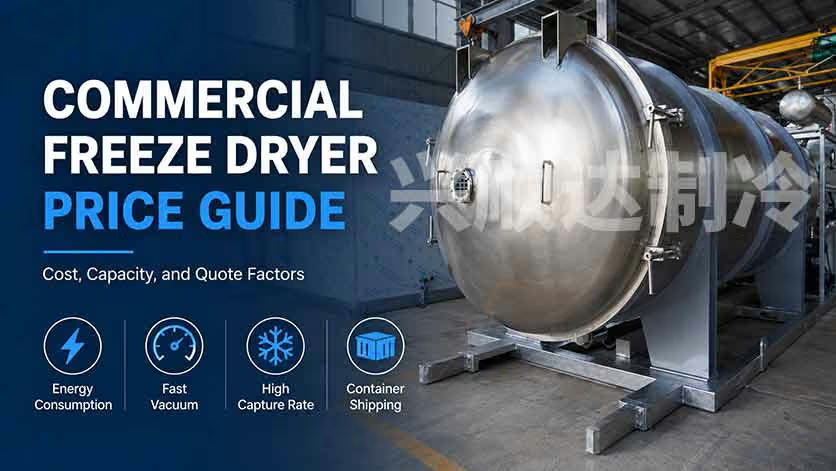
The commercial freeze dryer price should not be judged by machine size or tray area alone. Instead, food businesses should compare daily wet material capacity, drying stability, energy use, and the real cost of each kilogram of finished product.
A production-ready commercial food freeze dryer is a complete system. It combines refrigeration, vacuum, cold trap, heating, control, stainless steel structure, factory testing, and technical support. Therefore, the purchase price should always be evaluated together with output, drying time, and service capability.
In this guide, wet material capacity refers to typical food materials with about 15% solid content and 85% moisture content. However, if a product has higher moisture, different density, more sugar, more oil, or larger thickness, the actual batch load and drying time may change.
Article positioning: This page focuses on commercial freeze dryer price, budget range, quotation scope, and price-related buying risks. For model specifications, see the commercial freeze dryer product page. For operating cost calculation, see the freeze drying cost analysis.
Commercial Freeze Dryer Price Range
Commercial food freeze dryers such as SDG350 to SDG1100 generally require an estimated project budget of about USD 80,000 to USD 210,000. Meanwhile, larger industrial freeze dryers such as SDG1500 to SDG6000 generally require an estimated project budget of about USD 250,000 to USD 575,000.
These ranges are for reference only. In practice, the final commercial freeze dryer cost depends on capacity, refrigeration design, cold trap area, vacuum system, heating method, cooling method, automation level, stainless steel usage, multi-cold-trap design, shipping scope, and project requirements.
| Equipment Category | Estimated Project Budget | Best Fit | Main Buying Logic |
|---|---|---|---|
| SDG350–SDG1100 Commercial Freeze Dryer | About USD 80,000–210,000 | Food companies moving from testing to stable commercial production | Compare wet material capacity, drying time, energy use, and support |
| SDG1500–SDG6000 Industrial Freeze Dryer | About USD 250,000–575,000 | Larger food factories with higher daily output | Compare factory layout, utilities, long-term unit cost, and production scale |
A small low-cost machine may look attractive at first. However, if it cannot support stable daily production, the buyer may lose capacity, labor, energy, and delivery time. Therefore, the better comparison is not “which machine is cheaper,” but “which system gives lower cost per kilogram under real production conditions.”
Commercial Freeze Dryer Capacity Comparison
For commercial food production, price should be evaluated by wet material capacity first. In addition, buyers should check vacuum-down speed, cold trap capture rate, energy use, defrosting method, and shipping method.
| Model | Wet Material Capacity / 24h | Average Energy Use | Vacuum-Down Time | Cold Trap Capture Rate | Defrosting and Shipping |
|---|---|---|---|---|---|
| SDG350 | 340–450 kg | About 1.7 kWh/kg fresh raw material | <18 min to 133 Pa | >2 kg/m²·h | Hot water defrosting; container sea freight |
| SDG700 | 680–900 kg | About 1.7 kWh/kg fresh raw material | <18 min to 133 Pa | >2 kg/m²·h | Hot water defrosting; container sea freight |
| SDG1100 | 1.02–1.36 tons | About 1.7 kWh/kg fresh raw material | <18 min to 133 Pa | >2 kg/m²·h | Hot water defrosting; container sea freight |
Customers usually choose SDG350, SDG700, or SDG1100 according to order demand, daily output target, product type, and production plan. As a result, a larger model is not always the better choice. The correct model should match current production demand and near-term expansion.


What Is Included in the Price?
A commercial freeze dryer price should not be understood as only the drying chamber price. Instead, buyers should review the complete supply scope before comparing quotations.
Standard Supply Scope
For SDG350 to SDG1100 commercial food freeze dryer projects, the estimated project budget usually includes these items:
- Equipment body
- Vacuum system
- Refrigeration system
- Control system
- Factory testing
- Spare parts
- Packaging
- Cooling tower or water-cooling system
Items That Need Confirmation
However, different projects may require different shipping terms, site installation, local utilities, voltage design, cooling water layout, automation level, and factory preparation. Therefore, buyers should confirm the final scope of supply before placing an order.
What Affects Commercial Freeze Dryer Price?
Wet Material Capacity
Wet material capacity means the fresh raw material before freeze drying. It is not the final dried product weight. In general, higher real loading capacity requires stronger refrigeration, vacuum, cold trap, and heating systems.
Cold Trap Area and Capture Rate
The cold trap captures water vapor during freeze drying. If the cold trap area is too small, the machine may not capture vapor fast enough. As a result, vacuum stability drops and the drying cycle becomes longer. Therefore, larger cold trap area can increase the price but protect production efficiency.
Refrigeration System
The refrigeration system affects freezing, vapor capture, energy use, and stability. Moreover, stronger refrigeration, water-cooling, evaporative cooling, or multi-cold-trap design may be necessary for high-moisture products, hot climates, or continuous production.


Vacuum System
The vacuum system creates the low-pressure environment needed for sublimation. Although weak pump configuration may reduce the purchase price, it can slow vacuum-down speed and extend drying time. For SDG350, SDG700, and SDG1100, the vacuum-down time to 133 Pa is less than 18 minutes under normal operating conditions.

Chamber Material and Stainless Steel Usage
A commercial food freeze dryer works through repeated freezing, vacuum drying, vapor capture, and defrosting. Therefore, more stainless steel in the chamber, frame, cold trap, and structural parts improves corrosion resistance and long-term reliability.
Automation and Remote Monitoring
Higher automation, recipe storage, alarm records, production data, and remote monitoring can increase the price. However, these functions help reduce operator mistakes and support repeatable food production.

Why Buyers Should Not Compare Tray Area Only
Many buyers compare commercial freeze dryer price by tray area. However, tray area does not show real production performance.
What Buyers Should Compare Instead
A correct comparison should include wet material capacity, moisture content, drying time, water removal load, cold trap capture rate, vacuum-down speed, heating uniformity, energy use, defrosting method, training, and after-sales support.
Why Drying Time Changes the Real Cost
Example: If one machine completes a batch in about 12 hours and another machine needs 24–36 hours for the same product, the second machine may produce only one-third to one-half of the daily output. Therefore, a lower purchase price does not always mean lower production cost.
Real Project Data: Capacity, Drying Time, and Energy Use
Real production data helps buyers connect commercial freeze dryer cost with output, drying time, final moisture, and energy use. In addition, it shows why price comparison should be based on product data, not equipment appearance. More cases are available on the customer success story page.
Commercial Project Examples
| Project | Model | Drying Area | Batch Load | Drying Time | Final Moisture | Energy Use |
|---|---|---|---|---|---|---|
| India freeze-dried fried rice | SDG350 | 10 m² | 125 kg | 6 h | 1.28% | 1.67 kWh/kg raw material |
| Indonesia freeze-dried pineapple slices | SDG700 | 20 m² | 244 kg | 12 h | 2.31% | 1.73 kWh/kg raw material |
| Thailand freeze-dried durian | SDG1100 | 30 m² | 390 kg | 13 h | 2.09% | 1.73 kWh/kg raw material |
| Czech Republic freeze-dried blueberries | SDG1100 | 30 m² | 360 kg | 13 h | 1.97% | 1.80 kWh/kg raw material |
| Mongolia freeze-dried meat chunks | SDG350 | 10 m² | 121 kg | 12 h | 1.49% | 1.77 kWh/kg raw material |
| China freeze-dried apple slices | SDG700 | 20 m² | 254 kg | 12 h | 1.97% | 1.82 kWh/kg raw material |
What These Cases Show
These cases show that drying time and energy use depend on product moisture, thickness, pretreatment, loading density, and drying curve. Therefore, buyers should connect price with real production results.
Industrial Reference
An SDG6000 shrimp project with 200 m² drying area processed 2,320 kg per batch in 8 hours, with 1.68% final moisture. Its energy use was about 1.1 kWh electricity plus 1.5 kg steam per kg of raw material. This type of project belongs to industrial-scale production rather than standard commercial production.
Why Cheap Commercial Freeze Dryers May Cost More
A cheap commercial freeze dryer may reduce initial investment. However, it can create hidden costs if the system is not designed for real food production.
Common Low-Price Design Problems
| Low-Price Design Problem | Likely Production Consequence |
|---|---|
| Small cold trap area | Drying time may extend from about 12 hours to 24–36 hours. |
| Insufficient vapor capture speed | Vacuum becomes less stable, daily output drops, and energy use increases. |
| Weak vacuum pump configuration | Vacuum-down time may exceed 30 minutes to 133 Pa, causing frozen products to soften or melt before stable drying. |
| Carbon steel or aluminum alloy cold trap | Repeated freezing and defrosting may cause corrosion and possible refrigerant leakage. |
| Thin drying chamber plates | The chamber may deform or leak under long-term vacuum operation. |
| No on-site training | The first production batches may fail or show unstable final moisture. |
| No product-specific process support | The buyer may spend more time on trial and error before stable production. |
| Equipment needs heavy modification after arrival | The project cost rises because of extra installation, repair, or utility adjustment. |
Why the Lowest Quotation Can Be Risky
For food businesses, the lowest quotation is not always the lowest total cost. Instead, a reliable commercial freeze dryer should reduce risk in daily production, protect output, and shorten the startup process.
What a Reliable Supplier Should Provide
A commercial freeze dryer is part of a production process. Therefore, buyers need the correct model, correct process parameters, correct installation, and trained operators.
Support Before Shipment
- Sample testing before final model selection
- Equipment selection based on order demand and daily output
- Production parameter confirmation
- Factory testing before shipment
Support During Startup
- Installation guidance
- On-site training
- Support during the first production batches
- Remote engineering support after startup
- After-sales response within 24 hours
As a result, buyers can reduce startup mistakes, stabilize product moisture, shorten the learning curve, and enter commercial production faster.
Food Safety and Compliance Considerations
Commercial freeze drying is part of food production. Therefore, buyers should evaluate not only equipment price, but also sanitation, raw material handling, pretreatment, packaging, storage, and local compliance requirements.
In addition, buyers selling into regulated markets should check applicable food safety rules before commercial production. The U.S. FDA Food Safety Modernization Act focuses on preventing food safety problems through hazard analysis and preventive controls.
Useful External References
Need a Commercial Freeze Dryer Quote?
Share the product type, target daily capacity, moisture level, slice thickness, and factory conditions. Then, the engineering team can recommend a suitable commercial or industrial freeze dryer based on real production demand.
FAQ About Commercial Freeze Dryer Price
How much does a commercial freeze dryer cost?
A production-ready commercial food freeze dryer such as SDG350 to SDG1100 generally requires an estimated project budget of about USD 80,000 to USD 210,000. However, the final price depends on capacity, configuration, utilities, cooling method, automation level, and project requirements.
How much does an industrial freeze dryer cost?
Larger industrial freeze dryers such as SDG1500 to SDG6000 generally require an estimated project budget of about USD 250,000 to USD 575,000. Therefore, they are more suitable for higher daily output and larger factory-scale production.
What is included in the commercial freeze dryer price?
For SDG350 to SDG1100 commercial food freeze dryer projects, the estimated budget usually includes the equipment body, vacuum system, refrigeration system, control system, factory testing, spare parts, packaging, and cooling tower or water-cooling system.
Why are commercial freeze dryers expensive?
Commercial freeze dryers combine refrigeration, vacuum, heating, cold trap, control, stainless steel fabrication, testing, and process support. Therefore, a production-ready system costs more than a small testing machine.
Why should buyers avoid comparing tray area only?
Tray area does not show real production capacity. Instead, buyers should compare wet material capacity, moisture content, drying time, water removal load, cold trap capture rate, vacuum stability, energy use, and service support.
Why can a cheap commercial freeze dryer become more expensive later?
A cheap machine may have a small cold trap, weak vacuum system, thin chamber plates, poor material selection, or limited training. As a result, it can extend drying time, reduce output, increase maintenance, and delay stable production.
Why is vacuum-down speed important?
Vacuum-down speed affects whether frozen products can enter stable drying conditions quickly. If the machine takes more than 30 minutes to reach 133 Pa, frozen products may soften or melt before stable drying begins.
How can food businesses reduce freeze drying cost?
Food businesses can reduce cost by choosing the correct machine size, confirming product data before purchase, improving pretreatment, controlling thickness, optimizing loading density, reducing downtime, and comparing cost per kilogram instead of purchase price alone.
Conclusion
The commercial freeze dryer price should be evaluated through production data, not only through the quotation number. For food businesses, the real value depends on wet material capacity, drying time, cold trap performance, energy use, vacuum stability, material quality, service support, and long-term production cost.
However, a lower-priced machine may look attractive at first. If it causes long drying cycles, unstable vacuum, corrosion risk, product failure, or delayed startup, the total cost can become much higher.
Therefore, buyers planning freeze-dried fruit, seafood, pet food, ready meals, herbs, mushrooms, meat products, or food ingredients should review the commercial freeze dryer models, study real customer case data, or contact the engineering team for a project-based recommendation.
Internal positioning note: This article targets “commercial freeze dryer price” and “commercial freeze dryer cost.” It should link to the commercial product page for model details, the cost analysis article for operating cost calculation, and the case study page for proof. This helps reduce keyword overlap with existing pages.