
Food Processing Fundamentals
What Is Freeze Drying? A Food Processing Fundamentals Guide
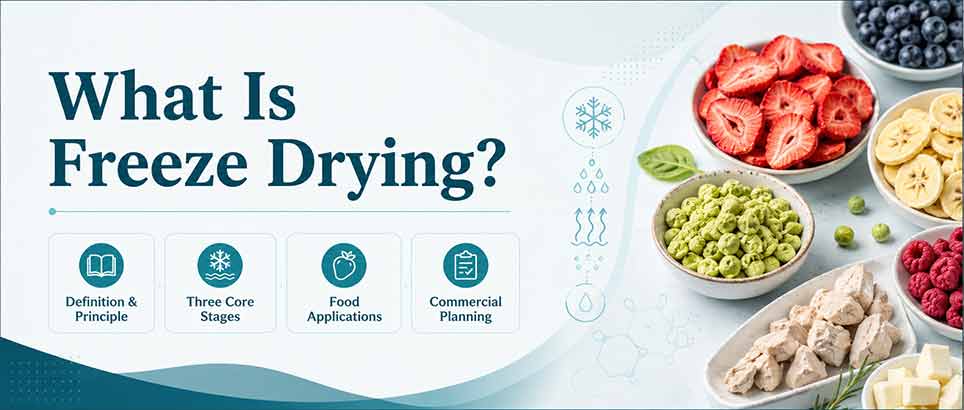
What is freeze drying? Freeze drying, also called lyophilization, is a low-temperature dehydration method. The product is frozen first; pressure is then reduced and controlled heat is supplied so ice leaves as water vapor through sublimation instead of melting first.[1]
For a food producer, that definition is only the beginning. Product composition, freezing history, piece or layer thickness, loading, final moisture target and packaging all affect whether the method is technically and commercially suitable.
What Is Freeze Drying?
A practical freeze drying definition for food processors is a dehydration process in which water is removed from a product that has first been frozen. The important distinction is how the water leaves: the main drying step begins with solid ice under reduced pressure rather than liquid water evaporating from a warm product.
The scientific term lyophilization describes the same general process. This freeze drying method is commonly discussed in food production, while “lyophilization” is frequently used in research, biotechnology and pharmaceutical processing.
This page explains freeze drying as a food-preservation and food-processing method. Readers looking for chamber components, the condenser, vacuum pump and water-vapor route should use the separate freeze dryer diagram and working principle guide.
The Freeze Drying Principle: Why Sublimation Matters
The central freeze drying principle is sublimation: ice changes directly into vapor without first passing through the normal liquid-water stage. To support that change, the product must be frozen, pressure must be reduced, energy must reach the ice and the released water vapor must be removed from the product environment.[1]
“Low temperature” does not mean “no heat.” Sublimation requires energy. The practical challenge is to supply enough controlled heat for water removal without allowing the product to melt, shrink or lose the desired structure. The acceptable operating window depends on the actual food rather than one universal temperature or pressure.
The Freeze Drying Process in Three Core Stages
The freeze drying process is commonly organized into freezing, primary drying and secondary drying. The stages are connected: freezing creates the ice structure that later becomes the pathway for water vapor, while the two drying stages remove different forms of water.[1]

Freezing
Water in the food is converted to ice. The product form, freezing history and ice-crystal structure can influence the later drying path and finished texture.
Primary Drying
Under reduced pressure, controlled heat supports sublimation. Much of the frozen water leaves the product as vapor during this stage.
Secondary Drying
After visible ice is removed, further controlled drying reduces part of the residual water associated with the food matrix.
The full factory workflow contains more than these three scientific stages. Preparation, loading, pre-freezing arrangements, unloading and moisture-protective packaging belong to production-system planning and are covered in the industrial freeze drying equipment guide.

What Happens to Food During Freeze Drying?
When ice sublimes, it can leave pores in the dried food. That porous structure often supports rapid rehydration and can help retain the product’s form. The outcome is not automatic: the raw material, pretreatment, freezing behavior, thickness, loading and drying conditions all influence structure, color, texture and rehydration.[1]
| Common assumption | More accurate interpretation | Where to investigate further |
|---|---|---|
| “Freeze drying preserves every nutrient.” | Low-temperature processing can reduce some heat-related damage, but retention varies by compound, product, process and storage. | Nutrient-retention guide |
| “A dry product is automatically safe.” | Freeze drying removes water but should not be treated as a validated pathogen kill step. Microorganisms may survive.[3] | Food-safety guide |
| “Freeze-dried food has a fixed shelf life.” | Final stability also depends on moisture pickup, oxygen, package barrier, seal quality and storage conditions.[1] | Shelf-life guide |
| “One recipe works for every food.” | Composition, product dimensions, loading and endpoint requirements change heat and mass transfer. | Cycle-time guide |
Why Is Freeze Drying Used in Food Production?
Food businesses generally evaluate freeze drying when product structure, rehydration, low-temperature processing, weight reduction or premium positioning may justify a more complex batch process. Typical commercial interest includes fruit and vegetable ingredients, seafood and meat products, dairy ingredients, coffee or tea extracts, prepared foods and selected pet-food products.
This page does not attempt to own every food application. The broader food-industry freeze drying applications guide explains product categories, feasibility questions and the path from sample to equipment in greater detail.
How Is It Different from Freezing or Conventional Dehydration?
| Question | Freeze Drying | Freezing | Conventional Dehydration |
|---|---|---|---|
| Is water removed? | Yes, from a frozen product. | No; water remains as ice. | Yes, mainly through evaporation. |
| What is the main preservation condition? | Low moisture plus suitable packaging. | A maintained cold chain. | Low moisture plus suitable packaging. |
| Where is the full comparison? | See freeze-dried vs frozen food and freeze dried vs dehydrated food. | ||
How Can a Food Producer Screen Product Suitability?
“Can it be freeze dried?” and “Can it be freeze dried consistently and economically at commercial scale?” are different questions. A useful first screen looks beyond the food name. For a category-by-category overview, see what foods can be freeze dried; this section focuses only on commercial suitability screening.
Water, sugar, fat, salt and solids affect freezing behavior, structure and the amount of removable water.
Slice thickness, particle size or liquid depth changes the distance that heat and water vapor must travel.
Appearance, texture, aroma, rehydration and final moisture determine what the process must achieve.
Product price, yield, throughput, packaging, labor and utilities determine whether the added process is justified.
What Are the Main Limitations of Freeze Drying?
Freeze drying is not automatically the best preservation method for every food. A credible evaluation should include its limitations:
- Higher equipment and operating complexity: low-temperature, vacuum and water-vapor removal functions must work together.
- Longer batch cycles: drying time can become an important cost driver, especially for thick products or heavy loading.[1]
- Product-specific development: settings cannot be transferred safely from one food to every other food.
- Packaging dependence: a dry, porous product may rapidly absorb moisture if barrier and sealing performance are inadequate.
- Scale-up risk: sample results do not become factory capacity until loading, endpoint, turnaround and batch uniformity are defined.
For a fuller commercial comparison, review the advantages and disadvantages of freeze drying.
From Understanding the Method to Planning Commercial Production
A general definition cannot determine machine capacity. Research on food freeze-drying monitoring shows why endpoint assessment should be based on observed process behavior rather than a fixed headline cycle time.[2] Product, geometry, loading and equipment conditions must still be evaluated for the actual project.
Before requesting a preliminary equipment assessment, define:
- product and formulation or pretreatment;
- initial moisture or solids;
- piece thickness, particle size or liquid layer depth;
- wet kilograms per batch and target daily output;
- target final moisture, drying endpoint criteria and finished-product quality requirements;
- appearance, texture and rehydration requirements;
- packaging objective and available factory utilities.
These inputs allow a supplier to discuss the required pilot evidence, approximate water-removal load, tray-area range and equipment class. Detailed specification and acceptance questions belong in the freeze dryer specifications checklist.
For additional project context, readers can review representative customer success stories and food freeze-drying applications before submitting product and capacity data.
Frequently Asked Questions
Is freeze drying the same as lyophilization?
Yes. The terms describe the same general dehydration method. “Freeze drying” is common in food production, while “lyophilization” is widely used in scientific and pharmaceutical contexts.
Is freeze drying the same as dehydration?
Freeze drying is a form of dehydration because it removes water. Its distinguishing feature is that the product is frozen first and much of the water is removed through sublimation under reduced pressure.
Does freeze drying kill bacteria?
It should not be treated as a guaranteed kill step. Food safety still requires suitable raw-material controls, hygienic processing, any necessary validated lethality step, finished-product specifications and safe rehydration or preparation instructions.[3]
How long does the freeze drying process take?
There is no universal time. Composition, dimensions, loading, freezing history, equipment and endpoint requirements all matter. Use representative product trials rather than applying another food’s cycle.
Can every food be freeze dried?
Many foods can be tested, but technical feasibility does not guarantee commercial feasibility. Product quality, drying time, yield, packaging, operating cost and market value must be considered together.
About the Technical Perspective
Good Freeze Dryer’s published engineering experience includes food freeze-dryer design, refrigeration and vacuum-system planning, equipment production, installation guidance and product testing. The company profile provides additional manufacturing and engineering context.
This guide combines that equipment perspective with scope-limited literature evidence. It does not present one temperature, pressure, cycle time, nutrient-retention rate, shelf life or equipment capacity as universal. Final process and equipment decisions should be based on representative product data and project-specific verification.
References
- Nowak D, Jakubczyk E. The Freeze-Drying of Foods—The Characteristic of the Process Course and the Effect of Its Parameters on the Physical Properties of Food Materials. Foods. 2020;9(10):1488. https://doi.org/10.3390/foods9101488
- Pisano R, Barresi AA, Fissore D. Innovation in Monitoring Food Freeze Drying. Drying Technology. 2011;29(16):1920–1931. https://doi.org/10.1080/07373937.2011.596299
- Utah State University Extension. Can I Freeze-Dry That? A Practical Guide to Safe and Effective Freeze-Drying. 23 January 2026. Food-safety guidance; not a journal paper. Source page.