
Does Freeze Drying Food Remove Nutrients? A Manufacturer’s Guide
Does freeze drying food remove nutrients? Freeze drying mainly removes water. Because most water leaves while the product remains frozen, the method usually limits thermal damage compared with hot-air drying. However, the exact result depends on the food, pretreatment, product temperature, cycle time, unloading, packaging, and storage.
Quick answer: Freeze drying does not deliberately extract protein, minerals, fiber, fat, or vitamins. Nevertheless, sensitive compounds can change during preparation, drying, air exposure, and storage. Therefore, a food manufacturer should validate the exact product instead of repeating a universal claim such as “97% nutrient retention.”
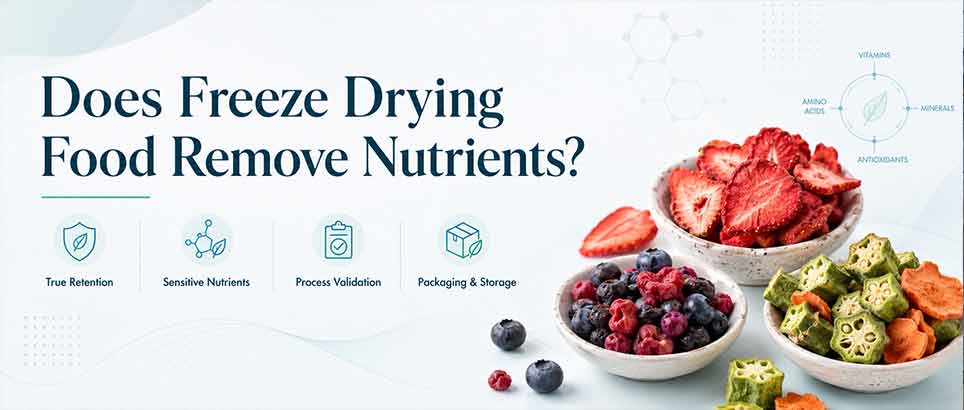
Does Freeze Drying Food Remove Nutrients?
Freeze drying removes frozen water through sublimation. Ice changes directly into vapor under vacuum, while controlled heat supplies the required energy. As a result, the process does not intentionally carry protein, minerals, fiber, fat, or vitamins out of the chamber with the water vapor.
However, nutrient retention is not automatic. Washing, peeling, cutting, soaking, blanching, cooking, or delayed freezing can change the food before drying begins. Later, excessive product temperature, an unnecessarily long cycle, humid unloading conditions, oxygen exposure, or unsuitable packaging can cause further losses.
For that reason, a food factory should combine process records with representative laboratory samples. The practical objective is to verify the prepared raw material, the dried product, and—when a shelf-life claim matters—the packaged product after storage.
For the physical process, see how food freeze drying works. Nutrition retention should also be separated from food safety; the related guide explains whether freeze drying kills bacteria and viruses.
Engineering distinction: Vacuum lowers gas-phase oxygen around the food and may remove part of the dissolved gases. However, it does not guarantee an oxygen-free product or protect the food after unloading. Consequently, pretreatment, chamber-opening procedures, and packaging can be as important as the freeze-drying recipe.
Nutrient Concentration Is Not the Same as True Retention
A freeze-dried food often contains more nutrients per 100 g than the fresh food because most water has been removed. This concentration is useful for formulation and nutrition labeling. However, it does not prove that every nutrient remained unchanged.
Water Removal Changes the Comparison Basis
For example, 100 kg of fresh fruit may produce only 12 kg of dried product. Therefore, 100 g of the finished food represents much more original fruit solids than 100 g of the fresh material.
Use a Batch-Level Mass Balance
The USDA true-retention method combines nutrient concentration with product weight before and after processing. Although the USDA table was developed mainly for food preparation and cooking, the same mass-balance principle is useful for freeze-dried food evaluation.[1]
True retention (%) = [(nutrient per g after drying × product mass after drying) ÷ (nutrient per g before drying × product mass before drying)] × 100
Hypothetical Calculation
Suppose a 100 kg fruit batch contains 20 mg of vitamin C per 100 g. The full batch contains 20,000 mg. After freeze drying, the product weighs 12 kg and contains 150 mg per 100 g. Therefore, the dried batch contains 18,000 mg in total, which equals 90% true retention.
In this example, the concentration increased from 20 to 150 mg per 100 g, yet total retention was not 100%. Consequently, any commercial report should state the analytical basis, batch yield, and sampling conditions.
Which Nutrients Are Most Likely to Be Retained?
No general table can predict the exact result for every formula. Nevertheless, nutrient groups face different risks. The following guide helps manufacturers decide what to test.
| Nutrient or Quality Factor | General Behavior | Main Risks | Useful Tests |
|---|---|---|---|
| Minerals | Minerals generally remain in the food solids because they do not evaporate with ice. | Peeling, trimming, soaking, blanching water, dripping, or discarded liquid. | Calcium, iron, potassium, sodium, or product-specific minerals. |
| Protein | Total protein normally remains, although functionality can change. | Cooking, pH, oxidation, freezing stress, and storage. | Total protein, amino-acid profile, solubility, or functional tests. |
| Fat | Fat remains and becomes more concentrated per unit weight. | Oxygen, light, warm storage, and weak oxygen barriers. | Total fat, peroxide value, anisidine value, and sensory stability. |
| Vitamin C | Low-temperature drying can protect it better than many hot processes, but losses vary. | Cutting, oxygen, holding time, product temperature, cycle duration, and storage. | Ascorbic acid before drying, after drying, and during shelf-life testing. |
| B Vitamins | Retention depends on the specific vitamin and full preparation route. | Water contact, blanching, cooking, oxygen, light, and heat. | Targeted analysis for the vitamins relevant to the product claim. |
| Polyphenols and Anthocyanins | Freeze drying often performs well, but the result varies by food and process. | Enzymes, oxygen, light, pretreatment, temperature, and storage. | Total phenolics, individual anthocyanins, color, and antioxidant assays. |
| Fiber | Total fiber generally remains in the dried solids. | Peeling, sieving, juice separation, and formulation changes. | Total dietary fiber and soluble or insoluble fractions when relevant. |
Scientific reviews generally report that freeze drying can protect plant-food structure and bioactive compounds better than conventional high-temperature drying. However, food matrix, preparation, process temperature, and storage still influence the result.[2][3]
What Published Food Studies Show
Published results explain why a manufacturer should not copy one retention percentage across unrelated foods. Even when the same drying method is used, the product, pretreatment, freezing route, thickness, temperature, and analytical basis can change the measured outcome.
| Food or Study | Reported Result | Commercial Interpretation |
|---|---|---|
| Banana, kiwifruit, blueberry, and grape | Under the tested conditions, vitamin C retention was 88.47% for banana, 96.67% for kiwifruit, 78.11% for blueberry, and 22.67% for grape.[4] | The result depended strongly on the fruit. Therefore, one universal percentage would be misleading. |
| Apple slices with ultrasound and vacuum freezing | The tested treatment reduced drying time from 16.00 h to 11.83 h, increased rehydration by 62.16%, and reached 83.90% vitamin C retention.[5] | Pretreatment can affect both cycle efficiency and quality. It must be assessed for the target product rather than selected only for speed. |
| Freeze-dried apple chips | Different color-protection treatments produced vitamin C values from 9.56 to 17.06 mg/100 g. Rehydration, brightness, and sensory scores also changed.[6] | A pretreatment may improve appearance while changing a sensitive nutrient. The factory must define which quality attributes have priority. |
| Pineapple slices | An optimized thesis process used 6 mm slices, a 1 °C/min cooling rate, 15 °C sublimation for 12 h, and 36 °C desorption for 2 h. The reported final moisture was 3.02%, with a 336.5% rehydration ratio.[7] | Meaningful scale-up data include thickness, temperature, time, moisture, and rehydration—not tray count alone. |
| Sea-buckthorn powder | A study comparing 20 °C and 60 °C sublimation programs found clear differences in color, aroma, antioxidant-related indicators, and active-compound profiles.[8] | Higher drying temperature may shorten a cycle, but it can also change the quality profile. Product temperature should follow the quality target. |
Planning a Nutrition-Sensitive Freeze-Drying Project?
A useful pilot plan starts with the food, pretreatment, wet load, thickness, target moisture, package, and the nutrient or quality indicator that must be checked. The engineering team can review these inputs before equipment capacity is selected.
Where Nutrient Loss Actually Occurs
1. Raw Material and Delay
Variety, maturity, transport, and storage determine the starting nutrient level. Therefore, a good drying cycle cannot restore quality already lost before processing.
2. Washing, Peeling, and Cutting
Peeling can remove nutrient-rich tissue. In addition, small pieces expose more surface area to oxygen, while long washing or soaking can move water-soluble compounds into discarded water.
3. Blanching, Cooking, and Formulation
Blanching can control enzymes and color, but time, temperature, and water contact matter. Likewise, cooked meals already contain the effects of boiling, frying, or other preparation before freeze drying begins.
4. Freezing and Primary Drying
Freezing rate changes ice structure, while thickness affects vapor resistance. Excess heat can cause local collapse; by contrast, insufficient heat may extend exposure without improving the product.
5. Secondary Drying
Secondary drying removes part of the remaining bound water. However, higher product temperature and extra hours should be justified by an endpoint and quality target.
6. Unloading, Packaging, and Storage
Freeze-dried food is porous and absorbs moisture quickly. Oxygen, light, heat, and package leakage can also reduce vitamins, pigments, aroma, and fat stability after a successful cycle.
Fruit projects can review the commercial fruit freeze dryer guide. Vegetable projects should also consider blanching and cutting in the vegetable freeze-drying guide.
Freeze Drying vs Hot-Air Drying, Canning, and Freezing
The best method depends on food safety, product quality, selling price, distribution, and production cost. Nutrient retention is important, but it should not be the only decision factor.
| Method | Typical Exposure | Product Structure | Commercial Consideration |
|---|---|---|---|
| Freeze Drying | Low product temperature during most water removal. | Light, porous, and generally easy to rehydrate. | Suitable for premium foods where quality can justify higher capital and energy costs. |
| Hot-Air Drying | Moderate or high heat for a longer period. | More shrinkage and a denser or chewier texture. | Lower-cost option when texture and thermal changes are acceptable. |
| Canning | Validated heat processing for shelf stability and safety. | Usually softer because the food remains in liquid or sauce. | Strong fit for commercially sterile foods and established distribution systems. |
| Conventional Freezing | Low-temperature storage without water removal. | Ice crystals can affect texture after thawing. | Requires a continuous cold chain. |
For a broader comparison of texture, rehydration, cost, and market positioning, read dehydrator vs freeze dryer for food production.
How Food Manufacturers Should Validate Nutrient Retention
A defensible claim requires a defined product, controlled process, representative samples, and a suitable analytical method. A machine specification alone cannot prove retention.
- Define the intended claim. Identify the specific vitamin, mineral, protein, pigment, antioxidant, or other measurable indicator. Broad wording such as “retains nutrients” is difficult to defend without a defined basis.
- Establish the prepared-material baseline. Sample the same batch that will enter the freeze dryer. Record variety, maturity, pretreatment, batch weight, and sampling time.
- Record process and yield data. Document wet load, solids, thickness, tray area, freezing conditions, chamber pressure, product temperature, cycle time, final weight, and handling loss.
- Collect representative dried samples. Sample more than one tray or shelf position when needed, and seal samples promptly to prevent moisture or oxygen exposure.
- Use a competent laboratory. Select an appropriate validated method. For label or sales claims, an accredited third-party laboratory is generally more defensible than an informal in-house test.
- Calculate true retention. Combine concentration with before-and-after mass. In addition, state whether the reported result uses wet basis, dry basis, or a serving basis.
- Repeat after scale-up and storage. A pilot result does not automatically represent commercial production. Recheck the claim when recipe, loading, machine size, packaging, or shelf-life conditions change.
Labeling warning: Nutrition-content and health-related claims are regulated in many markets. In the United States, manufacturers should review the FDA overview of label claims and obtain suitable regulatory advice before printing a claim.[9]
Early projects can use a lab or pilot freeze dryer to establish loading, temperature, time, moisture, yield, texture, and sampling procedures before full-scale investment.
Manufacturer experience: In the engineering team’s pilot workflow, the process record normally includes prepared wet load, load per square meter, product thickness, product temperature, vacuum, drying time, final weight, moisture, and rehydration or texture observations. These records support scale-up and laboratory sampling. However, they do not replace a qualified nutrition analysis when a nutrient claim is planned.
Process Controls That Help Protect Product Quality
The equipment cannot create nutrients. However, a stable process can reduce avoidable damage and produce repeatable samples for verification.
- Shorten the delay between preparation and freezing.
- Standardize variety, maturity, cutting size, and pretreatment.
- Keep product thickness and loading density consistent.
- Measure product temperature, not only shelf temperature.
- Match heat input and vacuum to vapor-removal capacity.
- Confirm the endpoint instead of adding unverified hours.
- Limit air and humidity exposure during unloading.
- Use packaging matched to moisture, oxygen, light, fat, and crushing risks.
- Consider nitrogen flushing for justified oxygen-sensitive products.
- Retain batch records for comparison after scale-up.
Final Moisture Is Not the Only Quality Indicator
A low moisture result does not automatically prove nutritional stability. Depending on the food, the verification plan may also include water activity, oxygen level, color, texture, rehydration, aroma, peroxide value, microbiology, and targeted nutrients.
Storage can change the result after drying. Therefore, manufacturers should also review the freeze-dried food shelf-life and packaging guide.
What Equipment Buyers Should Ask Before Purchasing
A buyer planning to market nutrition, color, aroma, or rehydration benefits should evaluate more than tray count and chamber size.
Process Evidence
- Has the supplier tested a similar food or formulation?
- Are loading density, thickness, cycle time, and final moisture documented?
- Can product-temperature and pressure records be exported?
- How is the drying endpoint confirmed?
Scale-Up Support
- Can the pilot process transfer to the proposed production system?
- Is condenser performance matched to the water load?
- Are installation, training, trial production, and remote support included?
- Will the supplier help define the first commercial verification batch?
Equipment selection should begin with prepared wet load, water removal, shelf area, loading density, cycle time, utilities, and product goals. The commercial food freeze dryer selection guide connects these factors to model size. In addition, buyers can review production case studies for actual products, capacities, drying times, and final moisture results.
Request a Freeze-Drying Process Evaluation
Food manufacturers can receive a more useful recommendation by providing the product name, formulation, pretreatment, prepared wet load, initial moisture, thickness, target final moisture, packaging plan, and the nutrient or quality indicators that require validation.
The engineering team can then assess whether pilot testing, a commercial unit, or an industrial system is the appropriate next step. Any formal nutrient claim should still be confirmed by a qualified laboratory.
Frequently Asked Questions
Does freeze drying destroy vitamin C?
Freeze drying can reduce thermal damage compared with many high-temperature methods. However, it does not guarantee complete vitamin C retention. Cutting, oxygen, delay before freezing, product temperature, cycle duration, packaging, and storage can all affect the result.
Are freeze-dried foods as nutritious as fresh foods?
They can retain many nutrients and may show higher values per 100 g because water has been removed. Nevertheless, concentration is not the same as total retention. A valid comparison should consider batch mass, serving size, processing, and storage.
Do freeze-dried vegetables retain nutrients?
Freeze-dried vegetables can retain many nutrients, but preparation matters. Peeling, cutting, washing, and blanching may create changes before drying begins. Therefore, manufacturers should compare the prepared raw vegetable with the finished product from the same batch.
Does storage reduce nutrients after freeze drying?
Yes. Oxygen, light, moisture pickup, warm storage, and package leakage can change vitamins, pigments, fat stability, aroma, and texture. Shelf-life testing should use the intended package and realistic distribution conditions.
Can a manufacturer claim that freeze drying retains 97% of nutrients?
A fixed percentage should not be used without evidence for the specific food, nutrient, process, analytical method, yield, package, and storage period. A narrower laboratory-supported statement is more credible than one universal number.
Conclusion: Verify the Product, Not Only the Drying Method
So, does freeze drying food remove nutrients? It mainly removes water and often protects heat-sensitive quality better than high-temperature drying. However, the final result depends on the entire production chain—from raw-material handling and pretreatment to drying, unloading, packaging, and storage.
For commercial decisions, the most reliable approach is to define the target quality, run a representative pilot test, record the process, measure yield, use an appropriate laboratory, and repeat verification after scale-up. This produces stronger evidence for product development, equipment selection, and responsible marketing.
References
- USDA Table of Nutrient Retention Factors, Release 6. Mass-balance method for true nutrient retention.
- Freeze-Drying of Plant-Based Foods. Foods, 2020.
- Effect of Preservation Steps and Storage on Vitamin C. Foods, 2021.
- Zhao F., Li S., Zhang X., et al. Study on Vacuum Freeze-Drying Characteristics of Common Berries and Fruits (常见浆果的真空冷冻干燥特性研究). Modern Food Science and Technology, 2014. DOI: 10.13982/j.mfst.1673-9078.2014.04.039.
- Zhou D., Wang H., Sun Y., et al. Effects of Pretreatment and Freezing Methods on Vacuum Freeze-Drying Efficiency and Quality of Apple Slices (不同前处理和冻结方式对苹果片真空冷冻干燥效率及干制品品质的影响). Modern Food Science and Technology, 2016. DOI: 10.13982/j.mfst.1673-9078.2016.12.034.
- Tang S., Ma D., Liu J., et al. Comparison of Three Pretreatments on the Quality of Freeze-Dried Apple Slices (三种不同预处理的冻干苹果片品质比较). Modern Food Science and Technology, 2021. DOI: 10.13982/j.mfst.1673-9078.2021.7.1212.
- Chen J. Study and Optimization of Vacuum Freeze-Drying Process for Pineapple Slices (菠萝切片真空冷冻干燥工艺研究及优化). Master's thesis, Tianjin University of Commerce, 2022. CNKI dissertation record: 1022600912.
- Fang G., Li X., Wang Y., et al. Comparative Study on the Quality of Sea-Buckthorn Powder Freeze-Dried by Two Processes (两种不同工艺冷冻干燥沙棘粉品质对比研究). Journal of Nuclear Agricultural Sciences, 2023. DOI: 10.11869/j.issn.1000-8551.2023.11.2214.
- FDA: Label Claims for Conventional Foods and Dietary Supplements.
This article provides general engineering and product-development information. Food safety, labeling, and nutrition claims must be evaluated for the specific product and target market.