
Freeze Dried vs Frozen Food: Which Production Model Fits?
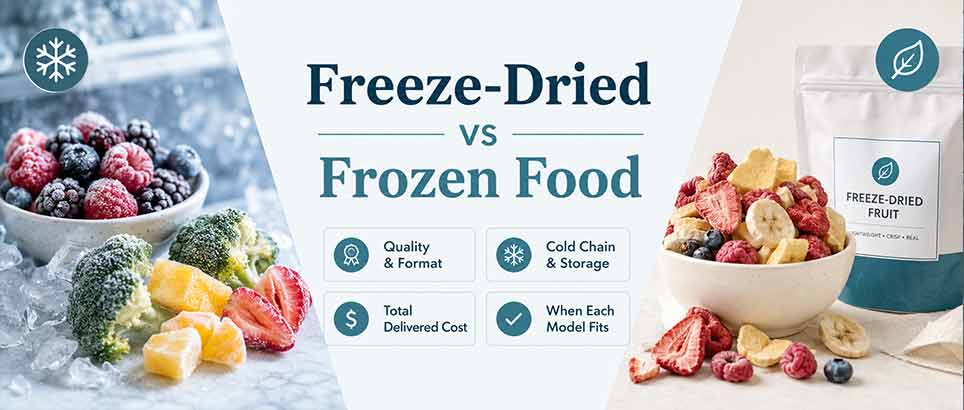
Freeze dried vs frozen food is not a contest with one universal winner. It is a choice between two production and distribution systems: keep water in the product and maintain a cold chain, or remove most removable water through freeze drying and protect the dry product with validated packaging.
This guide helps commercial teams decide which format deserves further testing. It does not use generic “25-year shelf life” or “retains all nutrients” claims because shelf life, quality, and economics depend on the product, process, package, and route to market.
Freeze Dried vs Frozen Food: Quick Decision
| Decision factor | Frozen model | Freeze-dried model | What to verify |
|---|---|---|---|
| Finished format | High-moisture product used frozen or after thawing | Dry, porous product eaten crisp or rehydrated | Target eating experience and customer use |
| Distribution | Continuous frozen storage and transport | Dry distribution may be possible after validation | Route, ambient conditions, package barrier, seal integrity |
| Processing | Freezing plus frozen handling | Freezing, vacuum, controlled heat input, vapor capture, and drying endpoint control | Cycle time, wet load, water removed, utilities |
| Quality risk | Ice-crystal damage, thaw drip, temperature fluctuation | Collapse, overdrying or underdrying, oxidation, moisture pickup, breakage | Product-specific sensory and analytical tests |
| Cost structure | Usually lower process complexity; recurring cold-chain cost | Higher process and packaging cost; possible logistics savings | Total delivered cost, not machine electricity alone |
| Best commercial fit | High-volume, price-sensitive products in established cold chains | Higher-value products where dry format changes margin or market access | Selling price, annual demand, channel, loss rate |
The comparison is intentionally conditional. The same fruit, meal, or ingredient can be commercially successful in either format when it serves a different use case.
What Changes When Food Is Frozen or Freeze-Dried?
Frozen food keeps its water and its cold-chain obligation
Freezing converts part of the water in food into ice but leaves the product as a high-moisture food. Freezing slows deterioration; it is not sterilization. The product still needs an appropriate frozen storage and handling plan. FDA and USDA guidance also separates food safety from quality loss during frozen storage: FDA food-storage guidance and USDA freezing guidance.
Freeze drying uses freezing as the first stage, then removes ice
Freeze drying normally includes freezing, primary drying, and secondary drying. Under reduced pressure, ice sublimes and leaves a porous structure; later drying removes part of the remaining bound water. The product temperature, pressure, layer thickness, formulation, and endpoint must be controlled because too little heat prolongs the cycle, while excessive product temperature can damage or collapse the structure.[1]
For a process-level explanation, see How Does Freeze Drying Work?. The important commercial distinction is that a freeze dryer produces a new dry format; it is not simply a freezer with a vacuum pump.
Quality, Texture, Rehydration, and Nutrients
Define the target quality before choosing the process
Frozen foods are usually judged after thawing or cooking. Freeze-dried foods may be judged as a crisp snack, a dry inclusion, a powder, or a rehydrated product. Those formats need different specifications. A useful pilot protocol can include color, shape, breakage, aroma, texture, rehydration time, solids loss, final moisture, and a product-specific nutrient or bioactive marker.
Freezing conditions affect the later freeze-dried structure
In concentrated coffee and gum arabic systems, researchers found that solids concentration, aeration, and the freezing profile changed the ice-crystal voids, pore structure, and reconstitution behavior of the final freeze-dried material.[2] The result is not a universal instruction to freeze faster or slower. It shows why the supplier should test the actual formulation: the pre-freezing step can alter drying resistance and the way the product dissolves or rehydrates.
One study on chokecherries compared frozen and freeze-dried samples using several antioxidant-related measurements. Frozen samples retained more of some measured compounds; another measure showed no significant difference, and the antioxidant assays did not produce one consistent ranking.[3] This is a single-fruit study, not proof for every food. The practical lesson is to define the nutrient or quality marker that matters for your product and test it, rather than claim that either method “preserves more nutrients” in all cases.
If nutrition is central to the sales claim, also review Does Freeze Drying Food Remove Nutrients? and obtain product-specific laboratory results before publishing a percentage claim.
Shelf Life, Packaging, and Food Safety
Frozen products require a controlled frozen chain
Codex guidance for quick-frozen foods generally uses −18 °C or colder as the product-temperature reference through the cold chain, subject to applicable legislation and permitted tolerances. See the Codex code of practice for quick-frozen foods. The business model must therefore account for freezer storage, loading, transport, distribution, retail or food-service handling, and contingency plans for temperature excursions.
Freeze drying does not create a validated shelf life by itself
A dry product can still absorb moisture, oxidize, lose aroma, change texture, or fail at the package seal. Final moisture is not the only control variable; water activity, product composition, glass-state stability, oxygen exposure, package barrier, and storage temperature can all matter.[1]
Commercial production should define the formulation, validated drying endpoints, packaging materials, sealing process, and shelf-life or stability study. Good Freeze Dryer does not use water activity as the primary equipment drying endpoint. Production acceptance focuses on final moisture, center dryness, mass stability, sensory quality, rehydration, and batch consistency. Where required by the product category or local regulations, the food manufacturer or process authority may separately include water-activity testing as part of finished-product safety validation. University of Minnesota Extension similarly notes that commercial freeze-dried products may need process-authority review, final water-activity evaluation, packaging review, and challenge or stability studies: commercial freeze-drying process guidance.
Use Food Freeze Dryer Validation, Freeze-Dried Food Packaging, and Freeze-Dried Food Shelf Life as the next-step technical pages. Do not copy a shelf-life number from another product.
Cold Chain, Shipping Weight, and Market Access
Frozen distribution
Usually needs frozen warehousing, temperature-controlled loading, refrigerated transport, and suitable storage at the destination. It can be efficient where those assets already exist and utilization is high.
Freeze-dried distribution
May use dry distribution after the product and package are validated. The product carries less water, but may require stronger moisture and oxygen barriers plus protection from crushing.
Do not estimate freight savings with a generic “90% lighter” claim. Build a mass balance from the actual wet feed, solids content, target final moisture, finished pack weight, carton volume, and pallet configuration. Weight savings can be large for high-moisture products, but low bulk density may limit how much volume is saved.
Freeze drying is more likely to change the business case when the route is long, frozen logistics are unreliable or expensive, the ingredient has high value per kilogram of dry solids, or a dry format opens e-commerce, export, travel, institutional, or instant-food channels. Frozen production can remain superior for short routes, high-volume local sales, low-margin foods, and products valued for their thawed sensory quality.
Compare Total Delivered Cost, Not One Electricity Bill
Freeze drying is typically a longer, more energy- and equipment-intensive operation than freezing alone, and cycle time is a major cost driver.[1] Frozen products, however, carry recurring storage and refrigerated-distribution costs. A fair comparison puts both systems at the same annual saleable output and customer destination.
| Model input | Frozen case | Freeze-dried case |
|---|---|---|
| Saleable output | kg frozen product/year | kg dry product/year and equivalent wet feed |
| Factory cost | freezing, handling, freezer room | pre-freezing, cycle time, vacuum/refrigeration, loading, cleaning |
| Packaging | frozen-food protection and case pack | moisture/oxygen barrier, seal control, physical protection |
| Distribution | frozen storage and reefer freight | validated dry storage and standard freight where permitted |
| Loss and risk | temperature excursion, freezer burn, thaw loss | under-drying, oxidation, seal failure, moisture pickup, breakage |
| Revenue | frozen format price and channel | dry format price, new channel, freight benefit |
For equipment-side inputs, use How to Calculate the Real Cost of an Industrial Freeze Dryer. The decision should be made on contribution margin and risk at realistic utilization, not on maximum nameplate capacity.
Which Products Fit Each Model?
Frozen is often the stronger choice when
- customers expect a juicy, frozen, thawed, or cooked product;
- the factory and route already have reliable frozen capacity;
- volume is high and the dry format cannot command enough margin;
- the sales radius is short and refrigerated freight is predictable;
- removing water adds little functional or channel value; or
- product-specific testing shows better sensory acceptance after freezing.
Freeze drying deserves a pilot when
- the product benefits from a crisp or rapidly rehydratable structure;
- lower shipped water weight has measurable value;
- dry distribution can unlock a new route or market;
- the product has enough margin to absorb processing and barrier packaging;
- a visible premium ingredient must retain shape or piece identity; or
- the customer has defined a quality specification that freeze drying can meet.
Freeze Dried vs Frozen Fruit: When Does Each Format Work Better?
The main difference between frozen and freeze dried fruit is not simply shelf life; it is the finished product format and the distribution system required to deliver it. Frozen fruit fits smoothies, bakery, sauces, and food-service applications where thawing or further processing is expected. Freeze dried vs frozen fruit therefore becomes a commercial channel decision as much as a preservation decision.
Freeze-dried fruit can fit snacks, cereals, inclusions, instant products, and export packs where low water content and a crisp structure are valuable. Frozen fruit can remain the stronger choice where customers want a high-moisture product and a reliable cold chain already exists. The better business is determined by the channel and product specification, not by the preservation method alone.
Minimum Pilot Data Before Equipment Selection
- Product and formulation: ingredient list, sugar, salt, fat, binders, and any pre-treatment.
- Feed condition: initial moisture or solids, particle size, slice or layer thickness, and temperature at loading.
- Production target: wet feed per batch/day, required saleable dry output, shifts, and operating days.
- Quality target: eating format, color, structure, rehydration, final moisture, center dryness, mass stability, and any claim-related marker.
- Pilot result: actual loaded mass, water removed, cycle time, endpoint evidence, defects, sensory result, and cleaning observations.
- Package and shelf-life plan: barrier specification, seal method, physical protection, storage conditions, and validation schedule.
- Factory constraints: electrical service, cooling water or refrigeration, drainage, room conditions, loading flow, sanitation, maintenance, and labor.
Still Evaluating Whether Freeze Drying Fits the Product?
Use pilot testing before selecting production capacity. A pilot cycle can confirm product behavior, loading density, cycle time, final moisture, sensory quality, rehydration, packaging needs, and the data required for scale-up.
Review Pilot Testing OptionsWhen Does Buying a Commercial Freeze Dryer Make Sense?
Buying becomes easier to justify after the market, product, and pilot evidence align. The product should have a defined buyer and price; the dry format should create a measurable benefit; expected demand should support acceptable equipment utilization; and the factory should be able to run, clean, maintain, and package the product consistently.
If those conditions are not yet proven, use pilot production or contract processing to reduce risk. If they are proven, move to capacity and utility comparison using Best Commercial Freeze Dryer for Food Production.
Frequently Asked Questions
Is freeze-dried food better than frozen food?
No universal answer exists. Freeze-dried food may be lighter, crisp, and easy to rehydrate; frozen food may better fit a fresh-like cooked or thawed format at lower process complexity. Choose against a written product and distribution specification.
Does freeze-dried food need refrigeration?
Many validated freeze-dried foods can use dry storage, but the process name alone is not proof. Confirm the drying endpoint, final moisture, package barrier, seal integrity, and stability under the intended storage conditions. Where required by the product category or local regulations, water-activity testing may be added separately as part of finished-product safety validation.
Which has a longer shelf life?
Both can support extended storage through different control systems. Frozen foods depend on continuous low temperature; freeze-dried foods depend on successful drying, packaging, and storage. Use product-specific shelf-life validation rather than a category-wide number.
Is freeze drying always more expensive?
Its factory process is usually more complex and costly than freezing alone, but the final decision depends on packaging, storage, freight, losses, selling price, and market access. Compare annual delivered cost and contribution margin.
What should a supplier test before quoting capacity?
At minimum: the actual formulation, wet load, solids, layer thickness, loading pattern, cycle time, water removed, endpoint, product defects, target output, packaging plan, and factory utilities.
Conclusion: Choose the Product and Route Before the Machine
The freeze dried vs frozen decision starts with the format customers will buy and the distribution system the business can operate. Frozen is often the efficient choice for high-volume products moving through a dependable cold chain. Freeze drying becomes compelling when the dry format changes freight, channel access, convenience, rehydration, or selling price enough to cover the added process and package cost.
Define the quality target, build both cost cases, run the product through a pilot cycle, and validate the finished package. Equipment selection should be the result of those decisions—not the first decision.
Request a Preliminary Freeze-Drying Capacity Review
Provide the product, initial moisture or solids, slice or layer thickness, wet feed per batch or day, target final condition, required output, operating schedule, destination market, and available utilities. We will use those inputs to identify the likely test scope and whether pilot, commercial, or industrial capacity is the realistic next step.
Send Project DataReferences
- Nowak D, Jakubczyk E. The Freeze-Drying of Foods—The Characteristic of the Process Course and the Effect of Its Parameters on the Physical Properties of Food Materials. Foods. 2020;9(10):1488. https://doi.org/10.3390/foods9101488
- Malik N, Gouseti O, Bakalis S. Effect of freezing on microstructure and reconstitution of freeze-dried high solid hydrocolloid-based systems. Food Hydrocolloids. 2018;83:473–484. https://doi.org/10.1016/j.foodhyd.2018.05.008
- Téllez-Pérez C, Cardador-Martínez A, Tejada-Ortigoza V, Soria-Mejía MC, Balderas-León I, Alonzo-Macías M. Antioxidant Content of Frozen, Convective Air-Dried, Freeze-Dried, and Swell-Dried Chokecherries (Prunus virginiana L.). Molecules. 2020;25(5):1190. https://doi.org/10.3390/molecules25051190