
Commercial ground-beef process development
Freeze Drying Ground Beef for Commercial Production: Process, Fat Control & Scale-Up
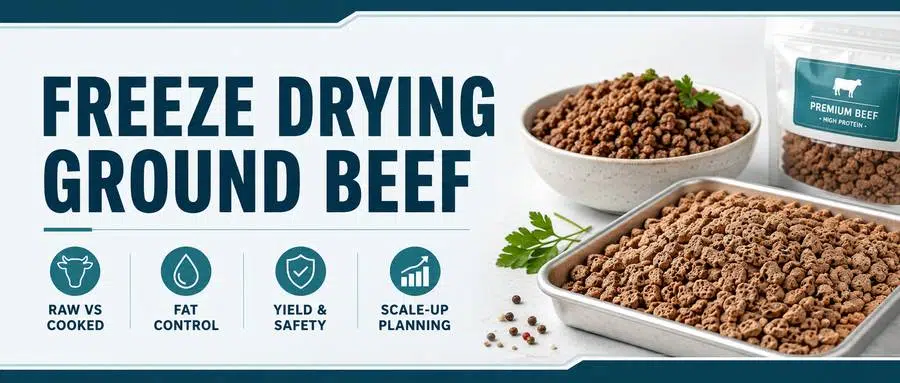
Freeze drying ground beef is a process-development decision before it is an equipment-selection decision. Therefore, a repeatable commercial product needs a fixed raw or cooked specification, controlled fat level, consistent crumb or layer geometry, documented tray loading, a verified endpoint, suitable packaging and a food-safety plan that does not treat freeze drying as a kill step. In addition, this guide is for meat processors, prepared-meal manufacturers, ingredient producers and food R&D teams.
Can Ground Beef Be Freeze Dried Commercially?
Yes. Processors can develop both raw and cooked ground beef as freeze-dried products. However, the two routes require different process controls. Moreover, grinding changes the contamination-control problem, while fat level, cooking loss, particle distribution, intended use and packaging change the drying and storage basis.
In addition, processors comparing several meat categories should use the site’s commercial meat freeze-drying guide. However, this article stays narrower: ground-beef formulation, fat control, crumb geometry, cooked-versus-raw routing, yield, rehydration and the process data needed to size commercial equipment.
| Ground-beef format | Commercial development fit | First control to define |
|---|---|---|
| Lean cooked ground beef | Often a controllable pilot route | Cook yield, draining, crumb size, oxidation and end use |
| Raw ground beef | Possible with a defined downstream use | Raw-meat controls, segregation, label and validated cooking or other control |
| Higher-fat ground beef | Requires careful validation | Retained fat, wet cores, oxygen exposure and sensory stability |
| Seasoned or sauced ground beef | Formulation-specific | Salt, sugar, oil, sauce solids, freezing behavior and rehydration |
Raw vs. Cooked Ground Beef: Which Route Is Better?
First, the processor should choose the route from the finished product and its validated food-safety system. Processors can often standardize cooked and drained ground beef more easily for meal components and ingredients because they can fix the cook step, fat loss, cooling condition and crumb distribution before freeze drying. Processors can also freeze dry raw ground beef. However, the finished appearance does not prove that the process eliminated pathogens.
Cooked ground beef
For a cooked route, the processor should define the cook step required for the destination market, draining, cooling time, post-cook handling and maximum time before loading. For U.S. consumer food-safety guidance, USDA FSIS lists 160°F (71.1°C) for ground meats. However, that number is not a substitute for the establishment’s applicable lethality validation, HACCP plan or regulatory review.[2][3]
Raw ground beef
By contrast, a raw route needs receiving, grinding, temperature, sanitation, cross-contamination and intended-use controls. Therefore, if the finished product is not ready-to-eat, its label and customer instructions must preserve the required downstream cooking or other validated control. Raw and cooked materials should not share an uncontrolled handling path.
Why Fat Content, Water Activity and Oxygen Matter
However, freeze drying removes frozen water by sublimation; it does not remove most of the fat already present in ground beef. Therefore, the project team should define the incoming lean-to-fat specification, cooking yield and retained fat after draining before it quotes a cycle or capacity.
Moreover, ground-beef storage needs more than a low-moisture result. For example, Sun et al. evaluated 15% fat ground-beef patties freeze-dried to different water-activity endpoints and stored at 25°C or 49°C. Lipid oxidation and protein solubility changed with water activity and storage temperature under the study conditions. Therefore, a processor should validate water activity, oxidation and product functionality for the actual formulation and package rather than adopt one universal target.[1]
In addition, FDA guidance describes water activity as a factor in food stability and notes that processors must reach the selected condition during drying and maintain it during storage. Therefore, for a fatty ground-beef product, the quality plan should connect the endpoint measurement to oxygen barrier, seal integrity, storage temperature, pack size and shelf-life testing.[4]
Consequently, commercial development should record:
- incoming lean-to-fat specification and supplier lot;
- raw or cooked status, cook yield and rendered-fat loss;
- crumb distribution, maximum layer depth and kg/m² loading;
- finished moisture and water activity where relevant;
- oxygen and moisture barrier, seal integrity and storage condition;
- sensory, oxidation, rehydration and shelf-life acceptance criteria.
Freeze Drying Ground Beef: Commercial Process
Therefore, a useful process record contains variables that the engineering team can transfer from a pilot trial to a larger machine. For example, “one tray of hamburger” is not a scalable specification; product condition, layer geometry, kilograms per square metre, water load and endpoint are.
Define the finished product
First, record raw or cooked status, lean-to-fat ratio, seasoning, intended use, target final moisture, package format, rehydration expectation and required wet-material output. Then, keep this specification fixed while comparing cycles.
Cook, drain and cool when developing a cooked route
Second, apply the validated cook step for the target market, then record draining method, cooling condition and time to loading. As a result, the goal is a repeatable pre-drying condition, not only the removal of visible grease.
Standardize crumb size and layer depth
Third, break large clumps and define the practical particle distribution. For example, dense masses can create a dry surface with a wet centre. Record the maximum clump size and loaded layer depth so a change in geometry is not mistaken for a change in machine performance.
Measure wet loading in kg/m²
Next, weigh the actual wet mass and divide it by usable shelf area. In addition, record layer depth, spacing and overlap so pilot data remains comparable when tray dimensions change. Therefore, do not copy a fruit, sliced-meat or meat-chunk loading value into ground beef without validation.
Freeze completely before primary drying
Next, the product centre must reach a fully frozen condition before the main vacuum-drying stage. Shelf heat, product temperature, chamber pressure, dry-layer resistance and condenser performance interact during primary drying. The site’s guides to how freeze drying works and freeze-drying temperature and pressure explain the general mechanism.
Verify the endpoint and repeatability
Finally, check representative samples from different trays, including the thickest or densest areas. For example, qualification can include moisture, water activity where relevant, mass stability, visual structure, texture, rehydration and tray-to-tray consistency.
How Long Does Ground Beef Take to Freeze Dry?
Therefore, there is no responsible single drying-time answer for commercial freeze drying ground beef. For example, cycle time changes with raw or cooked status, fat level, particle size, layer depth, kg/m² loading, initial water, shelf-temperature program, chamber pressure, condenser performance and the required endpoint.
Household guides and generic time charts can provide useful orientation. However, engineers should not copy those hours into an industrial capacity calculation. A commercial time basis should come from a controlled pilot with the same formulation and loading logic. The broader freeze-drying time chart provides context; it does not replace a ground-beef validation run.
Ground Beef Yield: Separate Cooking Loss from Drying Loss
Therefore, processors should measure yield from freeze drying ground beef instead of borrowing a generic online ratio. For example, cooked ground beef may lose water and rendered fat before it enters the freeze dryer; the drying stage then removes additional water while most remaining solids stay in the product.
However, one percentage is not enough for equipment selection. A useful mass balance separates the losses:
| Measurement | Why it matters | Trial value |
|---|---|---|
| Incoming raw ground beef | Procurement and total mass balance | ___ kg |
| After cooking | Cooking water and fat loss | ___ kg |
| After draining and cooling | Repeatable pre-drying condition | ___ kg |
| Loaded into freeze dryer | Actual batch load and kg/m² | ___ kg |
| Freeze-dried output | Dry product yield and packaging demand | ___ kg |
In addition, water removed from the chamber is not automatically equal to raw-to-dry weight loss because cooking, draining and handling losses occur before loading. A plant specifying only “500 kg of beef per day” gives less useful information than a plant that can state the actual product condition entering the freeze dryer.
Food Safety: Freeze Drying Is Not a Kill Step
Because grinding distributes surface contamination through the product, ground beef needs a deliberate food-safety plan. For example, USDA FSIS states that appearance cannot reveal harmful bacteria and advises cooking ground beef to a safe minimum internal temperature of 160°F (71.1°C) for the referenced U.S. guidance.[2]
Moreover, a commercial process still needs the appropriate combination of raw-material controls, sanitation, validated lethality where applicable, post-cook protection, microbiological verification where required, packaging controls and traceability. The FSIS raw-ground-beef HACCP model is a category example, not a substitute for a product-specific hazard analysis or destination-market requirements.[3]
For example, for a broader explanation of this boundary, see Does Freeze Drying Kill Bacteria and Viruses? Dryness, crisp texture or a low final weight is not proof of pathogen elimination.
Packaging and Storage: Protect the Validated Endpoint
After drying, ground beef can regain moisture from ambient air. Moreover, retained fat makes oxygen exposure important for flavor and storage performance. Therefore, processors should use prompt handling, a suitable barrier and a verified seal to maintain the product condition achieved at the dryer.[1][4]
In addition, the package specification may include moisture-barrier performance, oxygen-barrier performance, oxygen control where appropriate, seal integrity, pack size, storage temperature and real-time or accelerated shelf-life evidence. For this reason, processors should not adopt a generic “10-year shelf life” claim without product, package and storage validation.
Furthermore, the site’s freeze-dried food packaging guide covers barrier and production-line considerations, while the freeze-dried food shelf-life guide explains why storage testing is stronger than a generic online claim.
How Should Freeze-Dried Ground Beef Be Rehydrated and Evaluated?
For commercial development, rehydration is a product-quality test rather than a single recipe instruction. Therefore, the R&D team should use a fixed method. The R&D team should define a fixed water-to-product ratio, water temperature, contact time and final cooking or serving condition, then compare texture, flavor release, clumping, water uptake and cooking loss between trials.
Therefore, the acceptance test should reflect the finished application. A ground-beef ingredient for soup may tolerate a different texture from one intended for tacos, pasta sauce, rice meals or a ready-to-eat formulation. The R&D record should therefore compare rehydration time, water uptake, clumping, texture and flavor under a fixed test method. Therefore, the R&D team should qualify the drying cycle against end-use performance as well as moisture.
From Pilot Batch to Commercial Ground Beef Production
After pilot validation, commercial scale-up for freeze drying ground beef converts process data into required shelf area and water-removal capacity. Moreover, each input must come from the actual product, not from the word “beef” alone.
In addition, the engineering review should confirm utilities, room conditions, loading and unloading workflow, packaging timing, sanitation strategy, condenser margin and realistic operating hours. As a result, sizing a machine from nameplate shelf area alone can produce the wrong result. The selected machine may be too small when the process requires a thinner ground-beef layer, or unnecessarily large when pilot data supports a higher practical loading density.
Ground Beef vs. Meat Chunks: Why Capacity Cannot Be Copied
For example, the site includes a real Mongolia meat project in which an SDG350 with 10 m² of drying area processed approximately 121 kg of 10 mm meat chunks per batch at a loading density of 12.1 kg/m². That project recorded a 12-hour drying cycle and 1.49% final moisture. However, these are first-party production data for meat chunks—not guaranteed ground-beef parameters.
However, ground beef differs in particle geometry, contact between particles, layer density, fat distribution and exposed surface area. Therefore, the project team should run a ground-beef pilot and record kg/m², layer depth, cycle, endpoint, water removal and rehydration results before quoting capacity.
View the 10 m² freeze-dried meat case study and its production data.
How to Size a Freeze Dryer for Ground Beef Production
Therefore, a buyer can shorten the engineering review by providing process information before requesting a model recommendation. For example, the minimum useful project brief includes:
- raw or cooked ground beef and the intended final use;
- lean-to-fat specification, seasoning and formulation;
- target kg per batch and kg per day;
- crumb, layer-depth and maximum-thickness specification;
- initial moisture or a representative product sample;
- target final moisture, water activity and quality criteria;
- package format, storage condition and intended shelf life;
- electrical, cooling-water, steam and room utilities as applicable;
- planned operating hours, batches per day, defrost and changeover window.
First, R&D teams can review the lab and pilot freeze dryer before fixing a production process. Next, smaller food plants can compare the commercial freeze-dryer range; larger projects can review the industrial freeze-dryer range. Buyers still deciding between capacity classes can start with the commercial food freeze-dryer selection guide.
In addition, if the processor plans to mill the product into a protein ingredient or use it in a comminuted formulation, the freeze-dried protein production guide covers the separate powder and downstream-functionality decisions.
Common Ground Beef Freeze-Drying Problems
| Observed problem | Likely development area | Practical check |
|---|---|---|
| Greasy finished product | Fat specification or draining | Record incoming fat, cook yield and retained fat; do not assume drying removes fat. |
| Wet internal clumps | Aggregation or excessive layer depth | Standardize crumb distribution and inspect the densest loaded zones. |
| Uneven tray results | Non-uniform loading | Compare kg/m², layer depth and product-temperature history across trays. |
| Long cycle | Water load, geometry or conservative heat input | Review initial water, loaded mass, product temperature, shelf program and condenser behavior. |
| Poor rehydration | Product or cycle mismatch | Use a fixed rehydration test and compare texture by intended application. |
| Oxidized or stale flavor | Residual fat plus oxygen exposure | Review formulation, oxygen barrier, headspace control and storage validation. |
| Moisture pickup after drying | Slow unloading or weak barrier | Reduce exposure time and verify package seal and barrier performance. |
| Lower output than expected | Capacity based on tray count | Recalculate from validated kg/m², usable area, water removal, cycle and batches/day. |
Frequently Asked Questions
Process and Food-Safety Questions
How to freeze dry ground beef commercially?
First, define raw or cooked status, formulation and fat level; then standardize cooking, draining, crumb size and layer depth. Next, record kg/m², freeze completely and validate the endpoint. Finally, qualify rehydration, packaging and the food-safety system before scale-up.
Can raw ground beef be freeze dried?
Yes, but the product needs a food-safety plan appropriate to its intended use and destination market. Do not assume that freeze drying provides the microbial kill step. Instead, raw product may require downstream cooking or another validated control.
Is it better to freeze dry raw or cooked ground beef?
Neither format is universally better. Processors can often standardize cooked and drained ground beef more easily for meal and ingredient development. In contrast, raw ground beef requires stricter raw-meat controls and a clearly defined downstream use.
How long does ground beef take to freeze dry?
However, commercial time is product-specific. Fat level, raw or cooked status, crumb size, layer depth, kg/m² loading, water load, shelf-temperature program, pressure, condenser behavior and the required endpoint all affect cycle duration.
Does freeze drying ground beef kill bacteria?
Therefore, processors should not present freeze drying as a pathogen kill step. A commercial product needs the applicable sanitation, cooking or other validated lethality controls, HACCP or equivalent food-safety system, packaging controls and market-specific regulatory review.
Capacity and Packaging Questions
How much ground beef can a commercial freeze dryer process?
Therefore, engineers should calculate capacity from validated kg/m² loading, usable shelf area, water removal per batch, cycle time, defrost and changeover time, and practical batches per day. Likewise, engineers should not automatically reuse sliced-meat or meat-chunk data for ground beef.
How should freeze-dried ground beef be packaged?
Finally, the package should maintain the validated moisture condition and protect the product from oxygen and environmental exposure at the level required by the product’s fat content, intended shelf life and distribution conditions. Seal integrity and storage testing remain part of the commercial specification.
Plan a Commercial Ground Beef Freeze-Drying Trial
Therefore, a processor requesting a technical review should provide the ground-beef format, fat specification, raw or cooked status, formulation, kg/batch, kg/day, planned layer, target endpoint, package format, storage goal and available utilities. Those inputs allow the engineering team to define pilot requirements, sizing assumptions and the appropriate commercial or industrial equipment range.
Therefore, the engineering team should confirm each model recommendation and production figure against the actual product and agreed test basis rather than treat it as a universal ground-beef capacity.
References
- Sun, Q., Senecal, A., Chinachoti, P., & Faustman, C. (2002). Effect of Water Activity on Lipid Oxidation and Protein Solubility in Freeze-dried Beef during Storage. Journal of Food Science, 67(7), 2512–2516. DOI: 10.1111/j.1365-2621.2002.tb08768.x.
- USDA Food Safety and Inspection Service. Ground Beef and Food Safety.
- USDA Food Safety and Inspection Service. HACCP Model for Raw Ground Beef (Raw Non-Intact), Guideline ID FSIS-GD-2021-0003.
- U.S. Food and Drug Administration. Water Activity (aw) in Foods.

Technical author and reviewer
Zheng Wei is a freeze-drying engineer with experience in commercial and industrial food freeze-dryer selection, product-trial evaluation, process review, capacity planning and scale-up.
Equipment specifications, commercial proposals and final project documents are issued by Fuzhou Xing Shun Da Refrigeration Facility Project Co., Ltd. according to the confirmed product, utilities, selected configuration, test basis and contractual scope. Company background is available on the About Us page.