
Commercial chicken freeze-drying guide
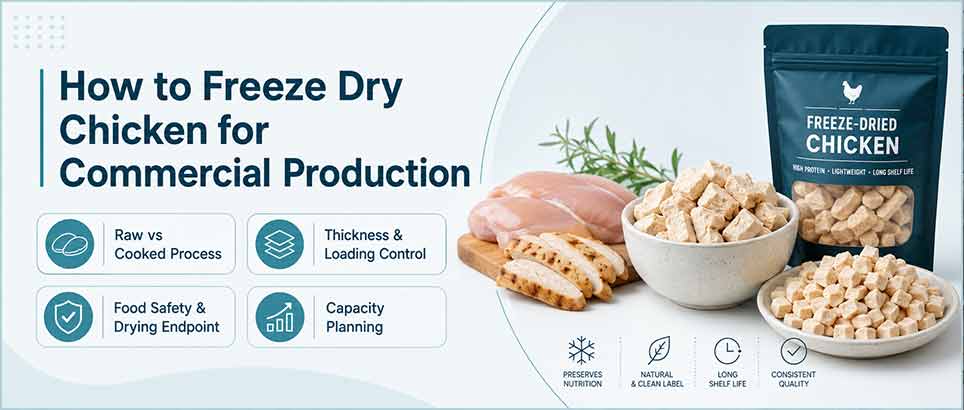
How to Freeze Dry Chicken for Commercial Production
How do you freeze dry chicken commercially? Start with a validated product definition, not a generic machine recipe. Raw or cooked status, piece dimensions, tray loading, freezing, drying endpoint, packaging and the food-safety plan all change the process.
For plants that want to freeze dry chicken consistently, this guide explains commercial chicken freeze drying, pilot scale-up and equipment sizing. It is not a household recipe, and it does not publish a universal pressure, temperature or cycle-time guarantee.
1. Define the Chicken Product Before the Freeze Dryer
“Chicken” is not a sufficient process specification. For example, diced cooked breast for instant meals, shredded chicken for an ingredient blend, raw chicken for further processing and a single-ingredient pet treat have different safety, geometry, fat and packaging boundaries.
| Product format | Commercial use | First validation question |
|---|---|---|
| Cooked breast cubes | Meal component, soup, sauce or ingredient | Can the centre dry and rehydrate consistently without excessive breakage? |
| Shredded cooked chicken | Ingredient blend or prepared meal | Can bed depth and tray distribution be controlled from batch to batch? |
| Raw chicken ingredient | Product that receives another validated control later | What hazard analysis, segregation, labeling and downstream control apply? |
| Seasoned or sauced chicken | Formulated meal or snack component | How do salt, sugar, oil and free liquid change water load and texture? |
| Chicken dog treat | Pet-food or treat SKU | Which pet-food safety, label and shelf-life requirements apply? |
Before a pilot, record the intended market, final use, raw or cooked status, formulation, maximum dimensions, target texture, final-moisture specification and package format. For example, a buyer comparing chicken with beef, seafood or other meat applications can use the site’s commercial meat freeze-drying guide for the broader equipment context.
2. Raw vs Cooked Chicken: Make the Safety Decision First
The choice between raw and cooked chicken affects handling, texture, water distribution, intended use and the required food-safety controls. Therefore, it should be settled before the drying cycle is compared.
| Decision factor | Raw chicken | Cooked chicken |
|---|---|---|
| Typical process position | Ingredient requiring further cooking or another validated control | Prepared ingredient or meal component, where the final use permits it |
| Primary control | Raw-poultry handling, segregation, intended use and downstream control | Validated cooking where applicable, rapid cooling and post-cook hygiene |
| Process development | Validate the exact raw formulation, dimensions and final instructions | Fix cooking, cooling, cutting, draining and loading before drying trials |
| Release question | What control makes the product safe for its stated destination? | What moisture, texture, rehydration and microbiological criteria release the batch? |
In addition, Utah State University Extension’s 2026 peer-reviewed fact sheet, Can I Freeze-Dry That?, states that freeze-drying can preserve foodborne bacteria and advises that meats should be cooked before freeze-drying or after rehydration. Commercial release criteria still require a product-specific safety plan.
3. Standardize Chicken Preparation Before Drying
Variable incoming material can make a validated cycle look unreliable. Therefore, the plant should control preparation as carefully as shelf temperature and chamber pressure.
Fix the cut and formulation
Record the chicken part, deboning status, skin and visible-fat specification, seasoning, cooking condition and maximum dimensions. “Chicken cube” should include a measurable size tolerance.
Control cooking and cooling where applicable
Define the validated heat treatment, cooling time and hygienic transfer before the drying trial. Freeze drying must not compensate for an undefined cooking process.
Drain free liquid consistently
Surface water, sauce and marinade change the effective water load. Use a repeatable draining or dewatering step when the formulation requires it.
Load representative product
Use the planned commercial piece size and distribution. A hand-selected tray of unusually thin pieces can understate the real drying challenge.
4. How Do You Freeze Dry Chicken? Control Thickness, Freezing and Loading
Thickness controls the distance that water vapor must travel from the product centre to the surface. In addition, loading density, overlap and layer depth determine how much vapor the chamber must handle. A dry surface can therefore coexist with a wet centre when geometry is uncontrolled.
| Control | What it changes | Commercial record |
|---|---|---|
| Maximum piece thickness | Drying resistance, endpoint risk, rehydration and texture | Nominal size plus tolerance; sample the thickest pieces |
| Freezing history | Ice structure, pore structure, colour and rehydration behavior | Freezing method, product-core condition and time to frozen centre |
| Tray loading | Heat and mass transfer, water load and cycle length | Wet kg, usable shelf area, kg/m², layer depth and spacing |
| Fat, skin and formulation | Water distribution, texture, oxidation risk and package demand | Recipe, fat range, skin level, free liquid and intended use |
A separate study of cooked diced chicken white meat found that freeze-drying produced a more porous structure and better rehydration than the air-drying treatments tested; the authors linked rehydration mainly to porosity and chemical change. For a manufacturer, the useful lesson is to measure rehydration and texture under the intended end use instead of promising that every chicken format will behave alike.[2]
For scale-up, use kg/m² rather than “kg per tray” alone. Because tray dimensions differ between machines, kg/m², layer depth and piece-size tolerance provide a more transferable basis for comparing a pilot result with a proposed commercial chamber.
5. Commercial Chicken Freeze-Drying Cycle and Endpoint
Freeze drying chicken is not controlled by vacuum alone. Instead, shelf heat, product temperature, chamber pressure, condenser performance and the resistance of the growing dry layer interact throughout the batch.
Freezing
Freeze the product centre completely before primary drying. Record the freezing method and product-core condition because freezing history can change the pore structure, colour and rehydration response.
Primary drying
Under vacuum, ice sublimes while controlled shelf heat supplies the energy for phase change. The cycle must keep the product within its validated temperature and vapor-flow limits while the condenser captures the sublimed water.
Secondary drying
After most visible ice is removed, secondary drying reduces more tightly bound moisture. Its duration should follow the product specification and measured endpoint, not an arbitrary “extra dry” time.
How to verify the endpoint
Therefore, a low moisture result alone may not qualify a chicken product that must rehydrate with an acceptable bite. Farkas and Singh found that freeze-dried cooked chicken had a more porous structure and better rehydration than the air-dried treatments they tested.[2] For the physical process, see the guides to how industrial freeze drying works and freeze-drying temperature and pressure.
6. How Long Does Chicken Take to Freeze Dry?
There is no defensible universal answer. When manufacturers freeze dry chicken, drying time changes with maximum thickness, initial moisture, raw or cooked status, fat and formulation, kg/m² loading, spacing, freezing condition, shelf-energy input, chamber pressure, condenser water load and final endpoint.
Recorded 2023 chicken freeze-drying test: 11 h 58 min 04 s
The manufacturer conducted this chicken freeze-drying experiment in 2023 and recorded the complete process from preparation through final moisture measurement. The test footage was later published on YouTube on . This batch used 0.30 m² of total tray area and 4,263.09 g of chicken before drying, equal to a loading density of 14.21 kg/m². After freeze drying, the total product weight was 1,046.08 g, equal to 3.49 kg/m² of product output and a 24.5% product yield. Final measured moisture content was 0.14%.
Chicken freeze-drying experiment conducted in 2023, showing sample preparation, pre-freezing, weighing, monitored drying at 1000× speed, final weighing and moisture-content testing. Video published on YouTube on August 13, 2026.
| Recorded batch metric | Result |
|---|---|
| Experiment year | 2023 |
| Video publication date | |
| Total tray area | 0.30 m² |
| Initial chicken weight | 4,263.09 g |
| Loading capacity | 14.21 kg/m² |
| Final freeze-dried product weight | 1,046.08 g |
| Product output | 3.49 kg/m² |
| Product yield | 24.5% |
| Final moisture content | 0.14% |
| Freeze-drying start time | 08:10:36 |
| Freeze-drying end time | 20:08:40 |
| Total drying time | 11 h 58 min 04 s |
| Tray | Before freeze drying | After freeze drying |
|---|---|---|
| Tray 1 — 0.10 m² | 1,418.51 g | 346.51 g |
| Tray 2 — 0.10 m² | 1,435.75 g | 353.33 g |
| Tray 3 — 0.10 m² | 1,408.83 g | 346.24 g |
| Total | 4,263.09 g | 1,046.08 g |
The direct broiler study also reached different quality outcomes when thickness, freezing rate, drying phase and pressure changed. That is why a commercial plan should report a complete cycle record rather than quote “chicken takes X hours.” The site’s commercial freeze-drying time chart provides broader comparison context.
7. Food Safety: Freeze Drying Chicken Is Not a Kill Step
Freeze drying lowers available water and can limit microbial growth when the finished product remains dry and protected. However, it does not automatically eliminate pathogens that entered with raw poultry. Therefore, a dry-looking product is not proof of microbiological safety.
| Control point | Commercial question |
|---|---|
| Incoming chicken | What supplier, temperature, lot, microbiological and handling controls apply? |
| Cooking, if used | What validated lethality step applies to the product and destination market? |
| Raw/cooked segregation | How will the plant prevent cross-contamination during transfer and loading? |
| Post-process handling | How will the dried product be protected during unloading, inspection and packaging? |
| Release specification | Which moisture, water-activity, microbiological, texture and labeling criteria apply? |
For U.S. projects, start with USDA FSIS HACCP guidance and its guideline for controlling Salmonella in raw poultry. Outside the United States, the plant must use the competent authority and customer requirements for the destination market. The site’s separate article explains why freeze drying should not be treated as sterilization.
8. Package Freeze-Dried Chicken Quickly and Validate the Barrier
Once the chamber is opened, dry chicken can pick up ambient moisture. Therefore, packaging is part of the process, not a cosmetic step after drying.
Wilkinson and colleagues measured lipid oxidation in fresh and freeze-dried beef and chicken using TBARS and fluorescence methods. Antioxidant effects in the freeze-dried meats varied with the analytical method and storage period.[3] As a result, oxidation stability should be verified for the actual chicken formulation instead of inferred from a generic shelf-life claim.
For film selection, oxygen and moisture control, sealing checks and storage planning, use the dedicated commercial freeze-dried food packaging guide.
9. Pilot Testing Before Commercial Scale-Up
A reliable chicken line is scaled from measured product data, not by multiplying a household recipe or copying a beef cycle. Before a plant tries to freeze dry chicken at production scale, the pilot should test the variables that control product quality and production economics.
| Record | Why it matters |
|---|---|
| Product and formulation | Connects the result to raw/cooked status, fat, seasoning, skin and intended use. |
| Maximum dimensions and tolerance | Defines the longest vapor path and the difficult pieces that may control the endpoint. |
| Wet load, usable shelf area and kg/m² | Creates a transferable basis for water load and equipment comparison. |
| Freezing and cycle records | Shows product temperature, pressure, stage duration, condenser behavior and turnaround. |
| Endpoint and product quality | Combines moisture, water activity where relevant, texture, rehydration, appearance and batch variation. |
| Packaging and storage trial | Tests moisture pickup, oxygen exposure, seal integrity and shelf-life assumptions. |
Where practical, change one meaningful variable at a time. Otherwise, if piece size, formulation, loading and cycle all change together, the trial may produce a dry product without showing why it succeeded or failed. For a separate R&D route, see the lab and pilot freeze-dryer guide and the food freeze-dryer validation guide.
10. Calculate Commercial Chicken Freeze-Dryer Capacity
“How many trays?” is not enough. To freeze dry chicken at a defined daily output, the capacity basis should connect the wet-chicken target to validated loading, water removal and a realistic batch rhythm.
| Calculation | Use |
|---|---|
| Required usable shelf area = wet kg per batch ÷ validated loading density (kg/m²) | Converts a tested chicken load into a first shelf-area estimate. |
| Dry solids = wet batch × (1 − initial moisture fraction) | Separates product solids from removable water. |
| Estimated final weight = dry solids ÷ (1 − target final-moisture fraction) | Creates an initial mass balance, not a release result. |
| Estimated water removed = wet batch − estimated final weight | Checks whether condenser, refrigeration, vacuum and defrost planning match the batch. |
| Practical daily output = validated kg/batch × realistic batches/day | Includes loading, unloading, defrost, sanitation, inspection and changeover. |
A plant targeting 500 kg/day should first determine its validated kg/m² and complete cycle. A 10-hour loaded cycle and a 16-hour loaded cycle lead to different equipment requirements even when the wet target is identical. For the broader buyer methodology, link to the commercial food freeze-dryer capacity guide.
11. Choose the Equipment Class After the Process Basis Is Defined
The chicken product and pilot evidence should determine the equipment class. In other words, equipment selection should follow product validation rather than replace it.
| Project stage | Main purpose | Selection priority |
|---|---|---|
| Lab or pilot | Develop product specification and cycle basis | Flexible control, representative trays, data logging and manageable trial changes |
| Early commercial | Produce saleable batches while building repeatability | Usable shelf area, condenser load, turnaround, cleaning and utilities |
| Established factory | Meet a defined wet kg/day target | Validated batch output, uptime, sanitation, loading method and production integration |
| Industrial line | Run high-volume multi-batch production | Water removal, refrigeration, vacuum capacity, defrost, layout and acceptance testing |
Use the site’s commercial freeze-dryer range and industrial freeze-dryer range after the process basis is ready. General meat and equipment comparison remains owned by the commercial meat guide; this page owns the chicken-specific process question.
12. Data to Prepare Before Requesting Chicken Equipment Sizing
Finally, a useful quotation starts with process data. Send the following information before asking for a capacity recommendation:
- Chicken part, product format and intended use.
- Raw, cooked or otherwise treated status.
- Maximum piece dimensions, layer depth and size tolerance.
- Wet chicken target in kg/day and planned operating hours.
- Available pilot loading in kg/m², initial moisture and target final moisture, if known.
- Packaging format, storage objective and shelf-life target.
- Factory voltage, utilities, drainage, space and destination country.
Send Chicken Production Data for a Capacity Review
The buyer provides the product format, photos or sample description, raw/cooked status, dimensions, wet kg/day, loading basis, endpoint target, package and utilities. The engineering team can return a preliminary water-removal basis, missing-data checklist, pilot questions and equipment-range assumptions for discussion. It is not a guaranteed production cycle or a substitute for a signed project specification.
Request a Capacity Review See Real Meat Project Data13. FAQ About Freeze Drying Chicken
Can raw chicken be freeze dried?
Technically, raw chicken can enter a freeze-drying process, but freeze drying is not a pathogen kill step. A commercial raw-chicken product needs a product-specific hazard analysis, raw-poultry controls, intended-use instructions and a validated downstream control where required.
Is it better to freeze dry raw or cooked chicken?
There is no universal answer. Cooked chicken is often easier to standardize for a first prepared-food pilot because cooking, cooling, dimensions and texture can be fixed before drying. Raw chicken may fit a product that receives another validated control later. The intended use and food-safety plan should decide.
Can a plant freeze dry chicken breast?
Yes. A plant can freeze dry chicken breast, but the breast must be tested at its intended cut, thickness, loading, freezing condition, endpoint and package. Direct broiler research identifies thickness as a critical process variable, so a chicken-breast result should not be transferred to a different format without a trial.[1]
How long does chicken take to freeze dry?
For a plant planning to freeze dry chicken, commercial drying time depends on thickness, formulation, kg/m² loading, freezing, shelf-energy input, pressure, condenser load, endpoint and changeover. The linked 10 m² meat project reached its stated result in about 12 hours, but that is project-specific evidence, not a guaranteed chicken cycle.
Does freeze drying chicken kill Salmonella?
No. Freeze drying should not be treated as a Salmonella kill step. Use the validated cooking or other control required by the product and destination market, then protect the product from post-process contamination.
How much chicken can a commercial freeze dryer process per batch?
To freeze dry chicken at a defensible batch capacity, start with usable shelf area multiplied by the validated chicken loading density in kg/m². Then confirm water removal, cycle time, defrost, changeover and release criteria. A project reference cannot replace product-specific loading data.
Does chicken skin or fat change the process?
Yes. Skin, fat and formulations can change water distribution, drying behavior, texture, oxidation risk and package requirements. Fix the specification before pilot testing and validate the storage barrier for the exact SKU.
Conclusion: Build a Repeatable Chicken Process Before Scaling Equipment
The central question is not simply whether a plant can freeze dry chicken. A commercial project must define the product, preparation, maximum thickness, loading per square metre, drying endpoint and food-safety controls before and after drying.
Once a pilot batch establishes those parameters, the plant can convert real kg/m² loading, water removal, cycle time and batches/day into a defensible equipment requirement. That sequence gives buyers a stronger basis for supplier comparison than tray count, a household time range or a nominal machine rating.
References
- Babić J, Cantalejo MJ, Arroqui C. The effects of freeze-drying process parameters on Broiler chicken breast meat. LWT – Food Science and Technology. 2009;42(8):1325–1334. https://doi.org/10.1016/j.lwt.2009.03.020
- Farkas BE, Singh RP. Physical Properties of Air-Dried and Freeze-Dried Chicken White Meat. Journal of Food Science. 1991;56(3):611–615. https://doi.org/10.1111/j.1365-2621.1991.tb05341.x
- Wilkinson AL, Sun Q, Senecal A, Faustman C. Antioxidant Effects on TBARS and Fluorescence Measurements in Freeze-Dried Meats. Journal of Food Science. 2001;66(1):20–24. https://doi.org/10.1111/j.1365-2621.2001.tb15604.x
Operational references
- U.S. Department of Agriculture, Food Safety and Inspection Service (FSIS). HACCP Guidance.
- U.S. Department of Agriculture, Food Safety and Inspection Service (FSIS). FSIS Guideline for Controlling Salmonella in Raw Poultry. Guideline ID FSIS-GD-2021-0005.
- U.S. Department of Agriculture, Food Safety and Inspection Service (FSIS). Safe Minimum Internal Temperature Chart
- Utah State University Extension. Can I Freeze-Dry That? A Practical Guide to Safe and Effective Freeze-Drying. January 23, 2026.
- Fuzhou Xing Shun Da Refrigeration Facility Project Co., Ltd. Freeze-Dried Meat Case Study: 10 m² Freeze Dryer in Mongolia. 2024 project data; project-specific and not a chicken recipe.
Technical author and reviewer
Zheng Wei is a freeze-drying engineer with experience in commercial and industrial food freeze-dryer selection, product-trial evaluation, process development, capacity planning and scale-up review.
Equipment specifications, commercial proposals and final project documents are issued by Fuzhou Xing Shun Da Refrigeration Facility Project Co., Ltd. according to the confirmed product, utilities, selected configuration, test basis and contractual scope. Factory, engineering-team and manufacturing information is available on the manufacturer profile and About Us page.