
How to Freeze Dry Bananas for Commercial Production
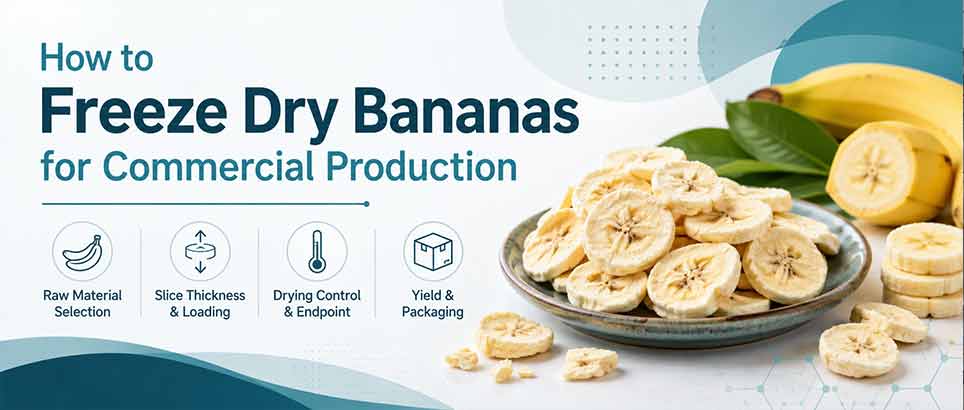
How to freeze dry bananas commercially depends on product format, maturity, slice geometry, tray loading, freezing, vacuum stability, shelf heat, endpoint testing, and packaging. A repeatable process must control those variables together.
This guide is written for food processors planning banana slices, banana chips, puree, or powder. It answers the process question behind the search term and connects it to the information a supplier needs for a defensible freeze-dryer estimate. It is not a home recipe and it does not present one laboratory cycle as a universal commercial setting. For the broader fruit-process hub, see how to freeze dry fruit.
Quick Answer: How to Freeze Dry Bananas Commercially
For processors asking how to freeze dry bananas at production scale, a commercial process normally follows this sequence:
- Grade the fruit for consistent maturity, variety, damage, and edible yield.
- Peel and cut the product to a controlled thickness or depth.
- Test the browning-control method required by the product specification and local label rules.
- Load trays evenly, record wet product in kg/m2, and avoid heavy overlap.
- Freeze the product completely before primary drying.
- Apply controlled shelf heat and vacuum while keeping product temperature within the validated process window.
- Continue secondary drying until final moisture and quality acceptance criteria are met.
- Protect the dried product from humid air, then package and record the batch.
The important commercial controls are raw-material consistency, geometry, loading, water removed per batch, product temperature, chamber pressure, endpoint evidence, and packaging delay. A machine quote that lists only tray count does not answer all of those questions.
What Controls Banana Freeze Drying?
Banana is a high-sugar fruit whose firmness and stickiness change as it ripens. That affects slicing, tray handling, heat transfer, drying resistance, breakage, and the texture of the finished product. The same machine can therefore produce different results when the raw material or product format changes.
| Control | What it changes | What the production record should capture |
|---|---|---|
| Raw material | Firmness, soluble solids, color, edible yield, and sticking risk | Variety, maturity range, supplier lot, damage, and prepared mass |
| Geometry | Drying path, breakage, cycle time, and endpoint uniformity | Slice thickness or puree depth and thickness checks |
| Loading | Water load, heat transfer, vapor load, and slowest-drying location | Wet kg per tray and kg/m2, including tray map |
| Endpoint | Crispness, residual moisture, storage stability, and release decision | Product temperature trend, final moisture, texture, and batch comparison |
For a broad explanation of sublimation and the three process stages, see how freeze drying works in food production. The banana page remains responsible for the product-specific decisions below.
Step 1: Select Bananas for Batch Consistency
A stable process begins before the freeze dryer. The incoming specification should define an acceptable ripeness range instead of relying only on visual judgment. Whole-fruit purchasing and prepared edible input should also be separated because peel and trimming losses affect both yield and machine sizing.
| Incoming check | Why it matters | Practical control |
|---|---|---|
| Ripeness | Changes firmness, sweetness, stickiness, flavor, and cutting behavior | Define an accepted maturity range and reject obvious outliers |
| Physical damage | Bruised or leaking tissue can discolor and soften faster | Remove damaged fruit before peeling and record the loss |
| Size and variety | Changes edible yield and the geometry produced by the slicer | Record supplier and variety; standardize the cutting method |
| Soluble solids | Can help explain maturity and batch-to-batch variation | Use degrees Brix as a development data point when useful |
USDA FoodData Central is useful for reference composition data, but the processor’s own incoming measurements should control the yield model. Cultivar, maturity, trimming, and preparation can change the water and solids balance.
Step 2: How to Freeze Dry Bananas with Consistent Slice Thickness
Uniform geometry is one of the fastest ways to reduce batch variation. For preliminary trials, 5-8 mm is retained as a practical engineering pilot window for banana slices. Thinner slices may dry faster but can break more easily; thicker pieces preserve shape but increase the distance that vapor must travel.
Recommended pilot matrix
- Compare 5 mm, 6-7 mm, and 8 mm groups rather than mixed thicknesses.
- Measure drying time, endpoint uniformity, color, crispness, sticking, and breakage.
- Record finished mass per tray and the percentage of off-spec or broken pieces.
- Choose the thickness that meets product quality and economics, then place it in the SOP.
A banana study by Bera, Chakraborty, and Bhattacharya used small cylindrical Cavendish samples 10-20 mm thick with liquid-nitrogen freezing and infrared-assisted drying. Its response-surface result selected 10 mm and 5 hours within that laboratory design, while measuring moisture, final product temperature, and rehydration together.[1] The result is useful for designing a pilot matrix, but it is not a commercial slice recipe: the sample size, geometry, freezing route, IR heating, loading, and equipment were different.
Step 3: Control Browning Before Freeze Drying Bananas
Banana browning should be treated as a product-quality control point. The right method depends on flavor, label, customer specification, and local food regulations, so no single pretreatment should be presented as mandatory.
- Time: minimize the delay between peeling, slicing, and freezing.
- Temperature: keep prepared fruit cool when the process and hygiene plan allow.
- Pretreatment: compare an untreated control with legally permitted antioxidant or acidification treatments when color retention is commercially important.
- Acceptance: score color together with flavor, texture, ingredient declaration, and finished-product stability.
Therefore, the target is not simply the lightest sample. The selected control must fit the product’s label and remain stable after drying, packaging, and distribution.
Step 4: Load Trays and Freeze Completely
Commercial capacity should be expressed as kg of wet product per square meter of effective shelf area. Tray count alone does not describe the thermal and water load placed on the machine.
For early capacity planning, 10-13 kg/m2 of wet food is retained as an engineering range for this equipment platform. Banana slices should be spread evenly without heavy overlap. The validated loading may be lower or distributed differently when the fruit is very ripe, sticky, thick, or prepared as puree.
Ratti’s food-powder chapter specifically discusses freeze-drying scale-up issues, large-scale techniques, and technological challenges.[4] More detailed heat- and mass-transfer guidance from Tchessalov et al. shows why product temperature, sublimation time, pressure control, and equipment constraints must be considered together.[5] Because that second source is primarily pharmaceutical, this article uses it only for general engineering principles, not as a banana or food setpoint.
Freeze the coldest and warmest product locations completely before primary drying. The required freezing strategy depends on thickness, tray load, freezer configuration, and whether freezing occurs inside or outside the dryer. A pilot record should state the freezing method and confirm the frozen condition instead of assuming that a fixed pre-freeze time is transferable.
Step 5: Control Primary and Secondary Drying for Bananas
Primary drying removes ice by sublimation
After freezing, chamber pressure is reduced and shelf heat is supplied in a controlled manner. The process must supply enough energy for sublimation without allowing local melting, collapse, scorching, or unacceptable quality loss. Product temperature, vapor load, condenser condition, and pressure should be read together.
For the supplier’s commercial food freeze-dryer platform, 26-100 Pa is retained as a controlled vacuum planning window. It is not a fixed banana setpoint. The validated value must be matched to product temperature, shelf program, load, condenser performance, and the machine’s actual pressure-control behavior. The site’s freeze-drying temperature and pressure guide covers the general relationship.
Secondary drying reduces residual moisture
After most ice has been removed, the process shifts toward residual bound moisture and the finished-product specification. 1-2% final moisture is retained as a starting engineering specification for crisp banana slices, subject to the processor’s texture, water activity, packaging, shelf-life, and regulatory requirements. It should not be treated as a universal release limit.
How Long Does It Take to Freeze Dry Bananas?
In practice, there is no single correct commercial banana cycle. For initial commercial planning, 8-15 hours is retained as an engineering range for many food products on this equipment platform, but the production cycle must be validated against the actual banana product and load.
The main variables are:
- slice thickness, shape, and overlap;
- maturity, solids, and initial water content;
- wet kg/m2 loading and total water load;
- freezing rate and uniformity;
- shelf-temperature program and product temperature;
- chamber-pressure stability and vapor flow;
- condenser capacity and ice accumulation;
- final moisture, water activity, and texture requirements.
Taskin’s 2025 study of vacuum freeze-dried banana reported a 480-minute process and 3.967 kWh energy consumption under its own experimental conditions.[2] Bera et al. reported a 5-hour optimum only for a small, IR-assisted, LN2-frozen cylindrical sample within a response-surface experiment.[1] Both results are useful order-of-magnitude references and pilot-design prompts; neither is a commercial cycle guarantee.
For cross-product planning, see the site’s commercial freeze-drying time chart. The banana page should keep the final decision tied to banana geometry, loading, endpoint evidence, and the actual dryer.
How to confirm the endpoint
A batch should not be released because the surface looks dry. The slowest-drying locations determine whether the batch is complete.
- Track product-temperature behavior at representative tray and shelf locations.
- Review chamber-pressure and vapor-load behavior near the end of the cycle.
- Test final moisture against a defined acceptance limit and method.
- Check texture, color, and moisture uniformity across trays.
- Compare the run with prior batch records and document any extra-dry time.
The site’s guide to freeze-dryer monitoring, alarms, and batch records explains how to turn a machine stop into repeatable process evidence.
Freeze-Dried Banana Slices versus Banana Powder
Slices and powder can support different businesses, but they should not share one undifferentiated process specification.
| Factor | Banana slices or chips | Banana powder |
|---|---|---|
| Main use | Snack pieces, cereal inclusions, retail packs | Bakery, beverage, flavor, nutrition, and ingredient applications |
| Critical quality | Shape, color, crispness, and low breakage | Aroma, particle size, flow, wettability, and low moisture pickup |
| Post-drying step | Inspection and moisture-barrier packaging | Milling, sieving, dust control, and powder packaging |
| Handling risk | Breakage and moisture pickup | Dust, caking, agglomeration, and rapid moisture absorption |
A Food Chemistry comparison reported meaningful differences in volatile aroma composition among banana powder made by vacuum belt drying, freeze drying, and air drying.[3] The commercial implication is that the drying method belongs in the product specification; the buyer should not compare only final moisture or equipment price.
Fresh Banana to Freeze-Dried Banana Yield
Yield should be calculated from peeled edible banana entering the dryer, not whole purchased fruit, unless peel and trimming losses are included separately.
Illustrative 100 kg example
If a planning worksheet uses 74.9% water as an illustration, 100 kg of peeled edible banana contains approximately 25.1 kg of dry solids. This value should be replaced by the processor’s own incoming analysis; USDA FoodData Central[6] is a reference source, not a substitute for lot-specific measurements.
At a 2% finished-moisture assumption:
The theoretical result is therefore about 25.6 kg of freeze-dried banana from 100 kg of prepared banana. Actual factory yield will be lower when broken pieces, sampling, sticking, trimming, off-spec product, and packaging losses are counted.
How to Size a Freeze Dryer for Banana Production
Equipment selection should start with prepared wet product per day, validated kg/m2 loading, water removed per batch, and the number of production batches available. A supplier that quotes only tray count or a nominal kilogram figure leaves the main process assumptions unresolved.
Example: 500 kg of peeled banana per day
Using the 10-13 kg/m2 planning reference and one main drying batch per day:
500 kg / 10 kg/m2 = 50 m2
The first planning estimate is roughly 39-50 m2 of effective shelf area. Pilot data can move the requirement up or down.
Example: 2,000 kg of peeled banana per day
2,000 kg / 10 kg/m2 = 200 m2
This points toward an industrial planning range of 154-200 m2 of effective shelf area on a one-main-batch-per-day basis. These calculations are examples, not a machine promise.
Final selection should also check:
- water removed per batch and condenser duty;
- loaded-cycle time, operating hours, defrost, and changeover;
- freezing method and pre-freezer capacity;
- loading/unloading, labor, and product handling;
- electrical, cooling-water, and other utility availability;
- future production growth and product mix.
For broader equipment decisions, see the site’s commercial freeze-dryer selection framework and commercial fruit freeze-dryer guide.
Planning a Banana Freeze-Drying Line?
The engineering team can review a preliminary banana project when the processor supplies prepared input in kg/day, product format, slice thickness or puree depth, target final moisture, operating hours, factory location, and available utilities. Those inputs support a first estimate of shelf area, water-removal demand, condenser duty, and batch schedule before a quotation is prepared.
Send Banana Production RequirementsCommon Banana Freeze-Drying Problems
| Problem | Likely causes to investigate | First checks |
|---|---|---|
| Dark or brown slices | Long pre-freeze exposure, maturity variation, or unsuitable browning control | Preparation time, raw-material range, pretreatment trial, and package delay |
| Soft center | Incomplete drying, thick pieces, or excessive local loading | Slice thickness, tray distribution, endpoint moisture, and product temperature |
| Sticky product | Very ripe/high-solids fruit, residual moisture, or humid post-drying handling | Ripeness, final moisture, room humidity, and time to seal |
| Uneven dryness | Mixed thickness, overlap, uneven shelf load, or scale-up non-uniformity | Slicer setting, tray map, shelf position, and loaded-cycle data |
| Cycle runs too long | Excessive thickness or water load, weak vacuum, or condenser limitation | kg/m2, pressure trend, product temperature, and condenser ice load |
| High breakage | Very thin slices, brittle endpoint, or rough unloading and packing | Geometry, endpoint window, handling method, and pack format |
Package Freeze-Dried Bananas Quickly and Protect Food Safety
Freeze-dried fruit and powder can absorb moisture after the chamber is opened. The packaging plan should therefore control the delay between unloading and sealing, the packaging-room humidity, seal integrity, and the barrier performance required by the target shelf life.
Commercial packaging validation should evaluate:
- water-vapor barrier performance;
- oxygen exposure and oxidation risk;
- seal strength and leak integrity;
- room humidity and time before sealing;
- transport temperature and storage conditions;
- finished-product moisture, water activity, texture, and shelf-life evidence.
The site’s guides to freeze-dried food packaging and freeze-dried food shelf life cover the downstream decisions in more detail.
Freeze Drying versus Dehydrating Bananas
Both technologies remove water, but they create different products and economics. Hot-air dehydration usually exposes the product to higher temperatures and can produce a denser, chewier banana. Freeze drying removes ice under vacuum and is selected when a processor values a light porous structure, rapid rehydration, low residual moisture, and a different sensory profile.
A processor choosing between the two should compare product specification, selling price, energy and utility cost, throughput, packaging, and target market. The more expensive method is not automatically the better business choice. See the site’s dehydrator versus freeze-dryer comparison.
What Information Should a Banana Processor Send the Supplier?
A useful quotation starts with process data. Therefore, the processor should prepare:
- product format: slices, halves, puree, or powder feedstock;
- prepared wet input in kg/day and expected batches per day;
- slice thickness or product depth;
- target final moisture, water activity, texture, and appearance;
- raw-material maturity and variety range;
- packaging format and time allowed before sealing;
- factory location, ambient conditions, and production hours;
- power supply, cooling water, and installation constraints;
- future capacity and product-mix requirements.
The supplier’s preliminary response should state the assumptions behind shelf area, water removal, condenser load, batch schedule, utilities, and pilot validation. That makes the quotation easier to compare with competing offers.
Frequently Asked Questions
How do you freeze dry bananas commercially?
Commercial processors grade the fruit, control maturity and geometry, manage browning, load trays at a defined wet kg/m2, freeze completely, run controlled primary and secondary drying, verify the endpoint, and package the product promptly.
How thick should bananas be for freeze drying?
The engineering planning reference uses 5-8 mm for pilot trials. The final thickness should be chosen from measured drying time, endpoint uniformity, breakage, color, crispness, and product economics. It is not a universal recipe.
How long does it take to freeze dry bananas?
The engineering planning range is 8-15 hours for initial commercial discussion on this equipment platform. Actual time depends on thickness, maturity, loading, freezing, shelf heat, pressure stability, condenser performance, and final moisture. A loaded pilot cycle is required before production timing is promised.
Can freeze-dried bananas be made into powder?
Yes. The powder route adds milling, particle-size, dust, flow, caking, moisture-pickup, and packaging controls. Powder and slice products should have separate acceptance criteria.
Why do freeze-dried bananas become sticky?
Common causes include very ripe/high-solids fruit, incomplete drying, high final moisture, or moisture pickup after unloading. The investigation should start with maturity, endpoint data, room humidity, and packaging delay.
How much freeze-dried banana comes from 100 kg of fresh banana?
On a peeled edible-product basis, the illustrative 74.9% water and 2% final-moisture calculation gives about 25.6 kg of theoretical finished product from 100 kg of prepared banana. Actual factory yield must include peel, trimming, breakage, sampling, and off-spec losses.
What size freeze dryer is needed for commercial banana production?
The machine should be sized from prepared kg/day, validated kg/m2 loading, water removed per batch, cycle time, operating hours, condenser capacity, freezing method, and utilities. The 500 kg/day planning example corresponds to roughly 39-50 m2 of effective shelf area for a one-main-batch-per-day planning basis.
How to Freeze Dry Bananas Reliably at Commercial Scale
Knowing how to freeze dry bananas reliably means controlling a process rather than copying one temperature or one number of hours. A repeatable commercial process is built around consistent raw material, controlled geometry, known wet loading, stable freezing and vacuum behavior, verified final moisture, and packaging that protects the dried product.
For scale-up, the most useful numbers are prepared wet input per day, water removed per batch, validated cycle time, effective shelf area, condenser margin, and the product acceptance test. Those values create a defensible equipment brief and a process that can be repeated after the first successful trial.
Request a Preliminary Banana Freeze-Dryer Capacity Check
A processor can send product format, prepared kg/day, slice thickness, target final moisture, operating hours, factory location, and available utilities. The engineering team can then review the planning assumptions for shelf area, water removal, condenser duty, and commercial or industrial capacity.
Discuss the Banana ProjectReferences and External Technical Sources
- Bera M, Chakraborty R, Bhattacharya P. Optimization of Intensification of Freeze-Drying Rate of Banana: Combined Applications of IR Radiation and Cryogenic Freezing. Separation Science and Technology. 2013;48(2):346-358. https://doi.org/10.1080/01496395.2012.688785
- Taskin O. Study on the vacuum freeze-drying of banana and impact on powder properties. Case Studies in Thermal Engineering. 2025;67:105844. https://doi.org/10.1016/j.csite.2025.105844
- Wang J, Li YZ, Chen RR, Bao JY, Yang GM. Comparison of volatiles of banana powder dehydrated by vacuum belt drying, freeze-drying and air-drying. Food Chemistry. 2007;104(4):1516-1521. https://doi.org/10.1016/j.foodchem.2007.02.029
- Ratti C. Freeze drying for food powder production. In: Handbook of Food Powders. 2013. https://doi.org/10.1533/9780857098672.1.57
- Tchessalov S, Maglio V, Kazarin P, Alexeenko A, Bhatnagar B, Sahni E, Shalaev E. Practical Advice on Scientific Design of Freeze-Drying Process: 2023 Update. Pharmaceutical Research. 2023. https://doi.org/10.1007/s11095-023-03607-9
- U.S. Department of Agriculture, Agricultural Research Service. FoodData Central. USDA FoodData Central.
- U.S. Food and Drug Administration. Current Good Manufacturing Practices (CGMPs) for Food and Dietary Supplements. FDA CGMP / 21 CFR Part 117 resource.
Paper-derived claims are scoped to the cited study, sample, and equipment conditions. The company engineering figures in this article remain planning references and require product-specific validation.