
Lab Freeze Dryer for Food R&D: Pilot Testing Before Scale-Up
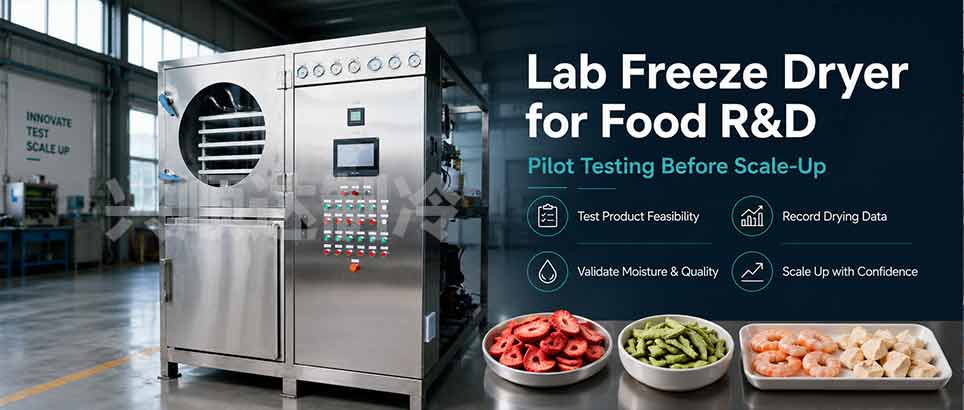
A lab freeze dryer for food helps a factory test recipes, drying cycles, texture, moisture targets, water activity, and production cost before investing in a larger commercial or industrial freeze dryer. The best pilot test does not only prove that a product can be dried. It creates the process data needed to choose the right equipment size.
Quick Answer
A lab freeze dryer is suitable for small food samples, formula screening, and early product development. A pilot freeze dryer is better when a food company needs repeatable batch data for scale-up. Before buying commercial equipment, the factory should record tray loading, product thickness, drying time, chamber pressure, shelf temperature, condenser load, final moisture, water activity, rehydration, and energy use.
What Is a Lab Freeze Dryer?
A lab freeze dryer is a small freeze-drying system that removes frozen water from a product under vacuum. In food product development, it is used to test whether fruit, vegetables, meat, seafood, cooked meals, candy, herbs, pet food, or other formulas can reach the required texture, color, final moisture, water activity, and rehydration performance.
For business buyers, the value is not only making attractive samples. The real value is decision data. A useful lab or pilot system should help the factory understand how the product behaves under controlled shelf temperature, vacuum pressure, condenser temperature, tray loading, product thickness, and drying time.
This article focuses on food factory R&D and pilot scale freeze drying. It is not written for pharmaceutical vial lyophilization, home hobby use, or medical laboratory sample preservation.
Engineering Basis for This Guide
Food freeze-drying studies repeatedly show that drying rate and final quality are affected by product thickness, freezing method, heat transfer, mass transfer, chamber pressure, cold trap performance, shelf temperature, and the shift from primary drying to secondary drying. In addition, freeze-drying scale-up literature notes that lab cycles cannot simply be copied to larger systems without checking conditions such as shelf temperature, chamber pressure, and product behavior. For this reason, a pilot test should record more than appearance. It should create a repeatable drying curve and enough data to estimate commercial shelf area, condenser load, drying time, and product quality risk. Read a technical reference on freeze-drying process development and scale-up.
Who Needs a Lab or Pilot Freeze Dryer?
A food company should consider a lab freeze dryer or pilot freeze dryer when the product formula is not fully validated, when a new SKU has uncertain drying behavior, or when the company plans to buy a larger commercial freeze dryer but still needs reliable test data before final capacity planning.
Food Startups
Startups can test product shape, taste, crispness, packaging direction, and sales samples before committing to a full production line.
Existing Food Factories
Factories can verify new products, compare cutting thicknesses, test pretreatments, and estimate drying cost before adding capacity.
Engineering Teams
Engineering teams can collect vacuum, temperature, condenser, loading, moisture, and energy records for future scale-up.
In practical terms, pilot testing is most useful when the buyer asks: Can this product be freeze dried profitably and repeatably at a commercial scale? A sample that looks good once is not enough. The process must be measurable, repeatable, and suitable for equipment sizing.
Lab Freeze Dryer vs Pilot Freeze Dryer vs Commercial Freeze Dryer
Different equipment levels answer different business questions. A buyer should not compare only chamber size or price. The better question is what decision the equipment must support.
At the early R&D stage, a lab scale freeze dryer is useful for formula screening and first drying trials. However, when the buyer needs repeatable scale-up data, a pilot freeze dryer gives stronger support for commercial equipment planning.
| Equipment Type | Main Purpose | Best For | Scale-Up Limitation |
|---|---|---|---|
| Home freeze dryer | Small personal batches | Hobby users and simple taste trials | Limited data recording, light tray loads, and different vacuum/condenser behavior |
| Lab freeze dryer | Initial sample tests and formula screening | R&D teams testing product feasibility | May not reflect commercial loading density if the test is too small |
| Pilot freeze dryer | Process development and scale-up verification | Food companies preparing for production investment | Useful for data, but not intended for high daily output |
| Commercial freeze dryer | Small to medium food production | Factories with confirmed product process and demand | Risky if purchased before formula, loading, and drying cycle are confirmed |
| Industrial freeze dryer | Large-scale food production | Factories with mature products and high daily output | Requires process data, facility planning, utilities, and installation preparation |
For most food businesses, the safest path is sample testing first, pilot verification second, and then commercial or industrial model selection. This sequence helps prevent overbuying, underbuying, or choosing a system with insufficient cold trap or vacuum performance.
Need Help Choosing Lab, Pilot, or Commercial Capacity?
Share the product type, target daily wet material capacity, cutting thickness, moisture target, packaging plan, and photos of the material. The engineering team can help judge whether a lab/pilot test is needed or whether the project can move directly to commercial equipment selection.
Why Home Freeze Dryer Test Data Often Cannot Scale
Home freeze dryer results can be useful for an early taste test, but they often cannot support commercial equipment selection. Industrial food production depends on loading density, product thickness, heat transfer, cold trap capacity, vacuum stability, and repeatable batch records.
A small tray sample may dry quickly because the load is light. When the same product is loaded more heavily in a commercial chamber, drying behavior can change. Thick products may stay wet inside, high-sugar products may collapse or become sticky, mixed meals may dry unevenly, and high-fat products may need additional quality checks.
Many home systems also do not provide complete process records. Without shelf temperature, product temperature, chamber pressure, cold trap trend, and drying time, the test cannot reliably support a larger investment.
Engineering Note
If the goal is commercial production, the test system should imitate the future process as closely as possible. That includes tray loading, product thickness, vacuum control, heating method, condenser performance, and data recording. Otherwise, the factory may make a purchasing decision based on misleading sample results.
Key Specifications to Check Before Buying a Lab Freeze Dryer
A lab freeze dryer for food product development should be judged by process reliability, not only by chamber volume. The following specifications have the greatest impact on test quality and future scale-up.
Shelf Area and Tray Loading
Shelf area determines how much material can be tested per batch. More importantly, tray loading affects drying time. Record material weight per tray, loading density, slice thickness, and final dry yield.
Condenser Capacity
The condenser, also called the cold trap, captures water vapor during sublimation. If it is undersized, drying becomes slower and chamber pressure may become unstable.
Vacuum Pump and Pressure Stability
Vacuum performance affects product structure and drying speed. The key is not only ultimate vacuum, but stable pressure under real moisture load.
Shelf Heating and Temperature Control
Controlled heating provides energy for sublimation. Too little heat extends cycle time; too much heat can cause shrinkage, meltback, collapse, or poor appearance.
Data Recording
The system should record vacuum pressure, cold trap temperature, shelf temperature, drying time, and process alarms so the team can compare test batches.
Cleaning and Food Contact Design
For food projects, chamber, tray, drainage, and cleaning design matter. Product testing should also consider sanitation, cross-contamination, and packaging plans.
Related Technical Reading
For process conditions, read the guide on freeze drying temperature and pressure. For cost planning after testing, review how to calculate the real cost of an industrial freeze dryer.
Pilot Freeze Dryer Test Record Template
A pilot test should produce engineering data, not only good-looking samples. Use a consistent record format for every batch so the factory can compare recipes, thicknesses, loading levels, and drying cycles.
| Record Item | What to Record | Why It Matters for Scale-Up |
|---|---|---|
| Product identity | Product name, recipe, supplier, batch number, pretreatment | Prevents comparing different products as if they were the same test |
| Cutting and loading | Thickness, piece size, tray area, wet kg per tray, wet kg per square meter | Loading density is one of the main drivers of drying time |
| Freezing condition | Freezing temperature, freezing time, product core state before drying | Poor freezing can cause texture damage, meltback, or inconsistent drying |
| Drying curve | Shelf temperature, product temperature if available, chamber pressure, cold trap temperature | Creates the process curve needed for repeatable production |
| Water removal | Wet weight, final dry weight, yield, estimated water removed | Supports condenser sizing and batch capacity calculation |
| End-point quality | Final moisture, water activity, color, shape, crispness, rehydration, taste | Confirms whether the product meets shelf-life and market requirements |
| Production estimate | Total cycle time, labor notes, energy use, packaging result | Helps estimate commercial cost per kg and daily output |
For food safety and shelf-stable product planning, moisture content alone may not be enough. Buyers should also understand water activity and local food safety requirements. The U.S. FDA explains how water activity affects microbial growth in foods, and U.S. food facilities should also consider current good manufacturing practice and preventive controls requirements under 21 CFR Part 117.
External references: FDA: Water Activity in Foods and eCFR: 21 CFR Part 117.
Recommended Pilot Testing Workflow
The workflow below keeps the test useful for both product development and equipment selection.
What Food Products Should Be Tested First?
The first pilot test should focus on the products with the highest business value or the highest technical uncertainty. A simple apple slice and a seasoned cooked meal do not behave the same way. Each food category needs a different test focus.
| Food Category | What to Test | Why It Matters | Useful Internal Reference |
|---|---|---|---|
| Fruit | Slice thickness, color, crispness, sugar behavior, final moisture | High-sugar products may need careful heating to avoid collapse or stickiness | Fruit freeze dryer machine guide |
| Vegetables | Cutting size, blanching, structure retention, rehydration | Vegetable structure and pretreatment strongly affect texture and drying time | Freeze dryer for vegetables |
| Meat and seafood | Thickness, protein texture, fat content, final moisture, odor control | Protein products need stable process control and food safety validation | Freeze dryer for meat |
| Cooked meals | Recipe, salt, oil, sauce content, rehydration speed | Mixed formulas may dry unevenly if the recipe is not optimized | Best meals to freeze dry |
| Candy | Expansion rate, heating curve, whether freezing is needed, appearance | Some candy uses vacuum and controlled heating more than traditional ice sublimation | Freeze dryer for candy |
| Pet food | Shape integrity, nutrient retention, fat stability, batch repeatability | Pet food buyers often require stable appearance, nutrition, and production cost | What foods can be freeze dried |
How Pilot Test Results Help Choose Commercial or Industrial Models
Once the product process becomes stable, pilot data can support equipment sizing. The buyer can estimate how much shelf area is needed, how many batches are required per day, and whether the project should use a lab/pilot, commercial, or industrial freeze dryer.
1. Estimate Shelf Area
Required shelf area equals target wet kg per batch divided by tested loading kg per square meter. If the pilot test used an unrealistically light load, the commercial estimate will be too optimistic.
2. Estimate Batch Cycle
Use the validated drying cycle, not a catalog average. High-sugar fruit, thick meat, cooked rice, and sauces can require very different drying times.
3. Check Condenser Load
Estimated water removed per batch should be matched with condenser capacity, ice capture rate, and defrost plan. Weak condenser capacity can slow the whole process.
4. Check Factory Utilities
Before moving to commercial equipment, confirm power, cooling water or air cooling conditions, floor space, drainage, packaging, and cleaning workflow.
| Project Stage | Best Equipment Direction | Selection Logic |
|---|---|---|
| Formula not confirmed | Lab freeze dryer | Use for feasibility, recipe screening, early texture testing, and first drying curve |
| Product feasible but scale-up unclear | Pilot freeze dryer | Use realistic loading and data recording to support model selection |
| Product confirmed and demand is moderate | Commercial freeze dryer | Use when daily output, cycle time, and product quality targets are clear |
| Product mature and daily output is high | Industrial freeze dryer | Use when the factory has mature process data, utility planning, and production layout |
For example, if a pilot test shows that a product needs a 12-hour drying cycle at a specific loading density, the engineering team can calculate daily wet material capacity more realistically. This is more reliable than choosing a model from a general catalog number without product data.
Real Project Data Makes Pilot Testing More Useful
Experienced equipment selection should be based on real food behavior. Different foods require different cycles, pretreatments, and loading strategies. Project records from freeze-dried fruit, rice, meat, and seafood show that final moisture, drying time, and texture can vary significantly by product.
Useful references include freeze-dried blueberries, freeze-dried pineapple, freeze-dried rice, freeze-dried meat, and freeze-dried shrimp. These case studies help buyers understand why one universal drying cycle cannot fit every food product.
Common Mistakes When Choosing a Lab Freeze Dryer
The wrong pilot system can create false confidence. Before purchasing, buyers should avoid the following mistakes.
Only Comparing Price
A low initial price may hide weak condenser capacity, slow vacuum pull-down, limited controls, or poor service support.
Ignoring Data Recording
Without batch records, the factory cannot compare tests or build a scale-up basis for commercial equipment.
Testing Too Lightly
A thin sample layer may dry well, but it may not represent real production loading density.
Skipping Moisture and Water Activity Tests
Appearance alone is not enough. The product must meet moisture, water activity, texture, and storage targets.
Buying Large Equipment Too Early
If the formula is not stable, a large system can magnify process problems and increase wasted batches.
Using One Product to Judge All Products
Fruit, vegetables, cooked meals, candy, seafood, and pet food each need different process validation.
When Can a Factory Skip Lab Testing?
Lab testing is not always required. A factory may move directly to commercial equipment when the product is mature, the formula is stable, the target capacity is clear, and similar project data is available. Even then, first-batch commissioning and process adjustment are still important.
However, when a product has high sugar, high oil, dense structure, mixed ingredients, seasoning, or uncertain rehydration requirements, pilot testing is usually safer. In those cases, a small investment in testing can prevent a much larger mistake in equipment sizing.
Test the Product Before Buying a Large Freeze Dryer
A food factory does not need to guess its freeze dryer size. By testing the product first, the buyer can estimate drying time, loading density, energy use, final moisture, water activity, condenser load, and suitable model range with more confidence.
Send the product type, expected daily wet material capacity, cutting thickness, moisture target, and photos of the material. The engineering team can suggest whether a lab freeze dryer, pilot freeze dryer, commercial freeze dryer, or industrial freeze dryer is the best next step.
FAQ About Lab Freeze Dryers for Food Development
What is the difference between a lab freeze dryer and a pilot freeze dryer?
A lab freeze dryer is mainly used for early sample testing and formula screening. A pilot freeze dryer is more suitable for process development, batch records, and scale-up decisions before commercial production.
Can lab freeze dryer data be used for commercial production planning?
Yes, but only when the system records useful process data and the test conditions are close to future production. Tray loading, product thickness, vacuum pressure, shelf temperature, cold trap performance, drying time, final moisture, and water activity should be recorded.
Is a home freeze dryer suitable for food factory testing?
A home freeze dryer can help with simple samples, but it usually cannot provide enough data for commercial equipment selection. Food factories need repeatable loading, process records, and scale-up logic.
What food products should be tested before buying a large freeze dryer?
Products with high value or high technical uncertainty should be tested first. Examples include high-sugar fruit, seasoned meals, meat, seafood, pet food, candy, herbal slices, and mixed-ingredient recipes.
How many pilot test batches are needed?
One successful batch is rarely enough. Most projects need several test batches to compare thickness, loading density, temperature programs, final moisture, texture, and rehydration. The exact number depends on product complexity.
When should a buyer choose a commercial freeze dryer instead of a pilot system?
A commercial freeze dryer is suitable when the product process is already confirmed, the target daily capacity is clear, and the factory is ready for regular production. If the process is still uncertain, pilot testing is safer.

About the Author
Zheng Wei, Founder & Freeze-Drying System Engineer, participates in freeze-drying projects across the site, including product testing, equipment selection, vacuum system configuration, refrigeration planning, installation guidance, and drying process optimization. His work covers fruit, vegetables, cooked meals, seafood, meat, herbs, and other food applications.
This article is written from an engineering selection perspective. Food factories should also validate their own product safety, labeling, packaging, and shelf-life requirements according to local regulations and laboratory test results.