
Freeze Dryer for Candy: How Food Businesses Choose the Right Machine
A freeze dryer for candy should be selected by candy formula, process route, expansion behavior, usable tray area, vacuum stability, drying time, and packaging requirements. Candy is a special category: some products follow true freeze drying, while others mainly use the freeze dryer’s vacuum and controlled heating environment for low-pressure drying or puffing.
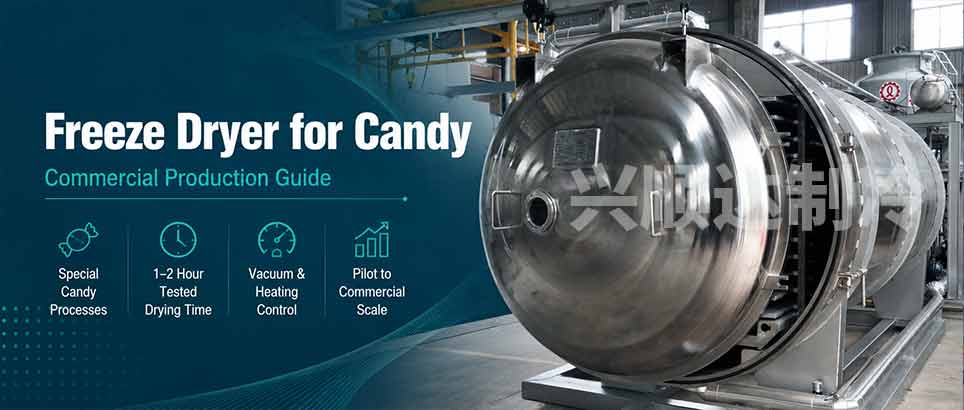
What Is a Freeze Dryer for Candy?
A freeze dryer for candy is a vacuum processing system used to create light, expanded, crispy candy products. In many food projects, freeze drying means freezing the product and removing ice by sublimation. However, candy production is more complex. Some candies are processed in a freeze dryer without a traditional freezing step because the main change is liquid water vaporization, vacuum expansion, or low-pressure drying.
Therefore, a commercial buyer should not assume that all freeze-dried candy follows the same route as fruit, meat, soup, or liquid products. Candy formulas contain sugar, gelatin, starch, acids, colorants, coatings, and sometimes fat-based ingredients. These ingredients affect melting, cracking, expansion, sticking, final texture, and shelf stability.
Buyer takeaway: a candy freeze dryer machine should not be chosen only by tray quantity, chamber size, or low purchase price. The buyer should first confirm the correct process route for the actual candy formula.
Freeze Dryer vs Dehydrator for Candy
A dehydrator uses hot air and airflow. For many candies, this can cause melting, deformation, surface hardening, or a chewy texture. A freeze dryer works under vacuum and uses controlled heating. As a result, it can support puffing, crisping, or true freeze drying when the formula is suitable.
For a general process explanation, readers can review how freeze drying works. For broader food applications, see the freeze-dried food suitability guide.
Two Candy Process Routes: True Freeze Drying vs Vacuum Puff Drying
Candy is an extremely special category in freeze dryer projects. Some products need to follow the traditional frozen-to-vapor route. However, other products mainly use the freeze dryer’s vacuum and heating environment, even though the market may still call the finished product freeze-dried candy.
The product is frozen first. Then ice changes into vapor under vacuum. This route is suitable for products that need real sublimation drying, such as prepared chocolate formulas.
Some candies do not need freezing first. They mainly use vacuum, controlled heat, and internal moisture movement to expand and dry.
The same equipment may process different candies, but the recipe, temperature curve, loading density, and drying time must change.
Important engineering note: some marshmallow formulas may develop surface cracks if they are frozen before drying. In that case, preheating the machine and using a suitable vacuum drying route can create a cleaner appearance. Chocolate is different. It usually needs water addition, remelting, molding, freezing, and then drying; otherwise, a standard candy cycle may fail.
Tested Candy Drying Results
Recorded engineering tests show that selected candy formulas can dry much faster than many fruit, meat, or liquid products. The marshmallow result below was recorded after equipment preheating, while the gummy candy video records an exact drying stage of 1 h 58 min 23 sec. These results are reference data from specific tested formulas, not universal guarantees. Each customer should verify results with their own candy samples. The actual result depends on formula, size, loading density, tray spacing, vacuum performance, heating curve, and whether the product follows true freeze drying or vacuum puff drying.
| Candy Type | Tested Drying Time After Preheating | Process Note |
|---|---|---|
| Marshmallow | 55 min 33 sec after preheating | Tested at 2.81 kg/m² loading density. The machine was preheated before the recorded drying stage; some formulas do not need freezing first. |
| Gummy candy | 1 h 58 min 23 sec | Recorded from 10:44:36 to 12:42:59. Gummies need controlled spacing because they can expand and become porous during processing. |
| Hard candy | About 1.5 hours | Expansion and final texture depend strongly on formulation, size, spacing, and heating curve. |
How to use this data: these tested times help buyers understand the potential production advantage of candy projects. Nevertheless, each factory should test its own candy formula before calculating daily output or selecting a commercial freeze dryer for candy.
Watch the Marshmallow Freeze-Drying Test
This video documents the marshmallow engineering test referenced above. The batch used 843.66 g of marshmallows across 0.30 m² of tray area, equal to a loading density of 2.81 kg/m². The freeze dryer was preheated and brought to the required operating condition before the recorded drying stage began. Under those tested conditions, the recorded freeze-drying stage ran from 12:22:38 to 13:18:11, for a total of 55 min 33 sec.
Recorded test stages: 00:00 sample preparation; 00:11 pre-drying weighing and freeze-drying start; 00:25 monitoring in progress at 1000× speed; 00:45 freeze-drying completed. Important: the 55 min 33 sec result is the recorded drying stage after equipment preheating, not the total processing time from a cold machine start.
Watch the Gummy Candy Freeze-Drying Test
This video documents the gummy candy test referenced above, including sample preparation, freeze-drying startup, continuous process monitoring, and drying completion. The recorded drying stage started at 10:44:36 and ended at 12:42:59, giving an exact total drying time of 1 h 58 min 23 sec. The on-screen result is rounded to approximately 1 h 59 min.
Recorded test stages: 00:00 sample preparation; 00:59 freeze-drying started; 01:07 monitoring in progress at 1000× speed; 01:16 freeze-drying completed. Important: the exact recorded drying time is 1 h 58 min 23 sec; the video graphic rounds this to approximately 1 h 59 min.
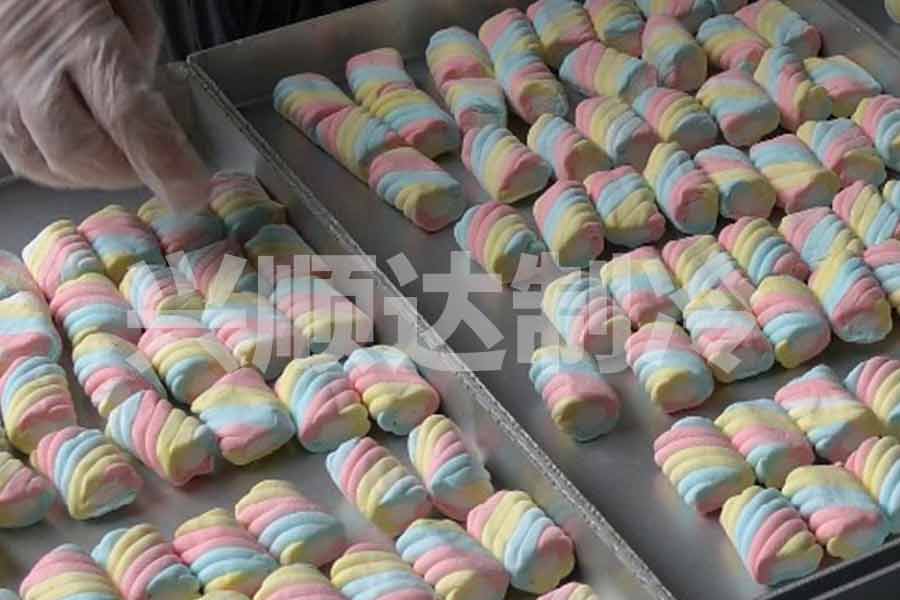
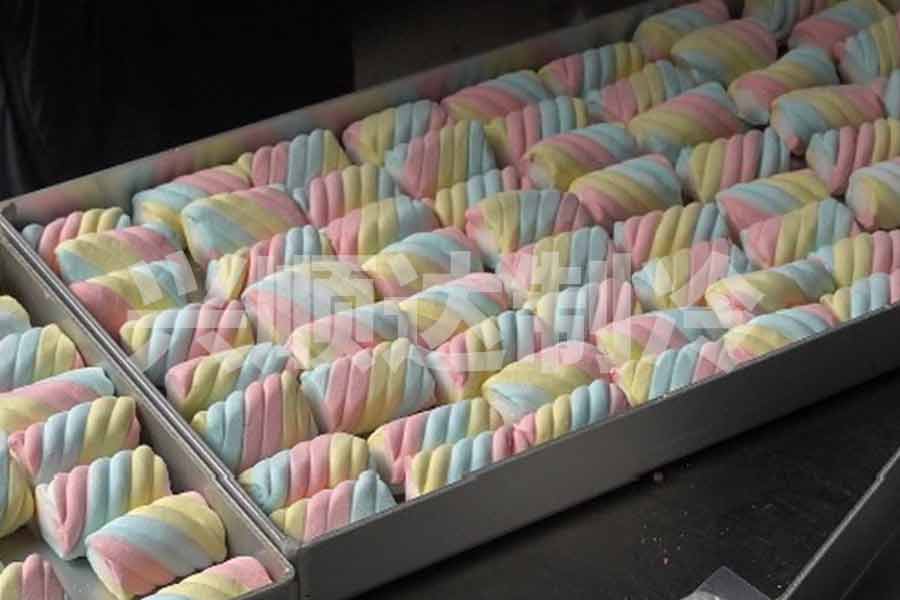
Marshmallow Before and After Processing
These photos show marshmallows loaded on trays before processing and the expanded marshmallow texture after processing. They are useful for explaining spacing, expansion, and appearance control.
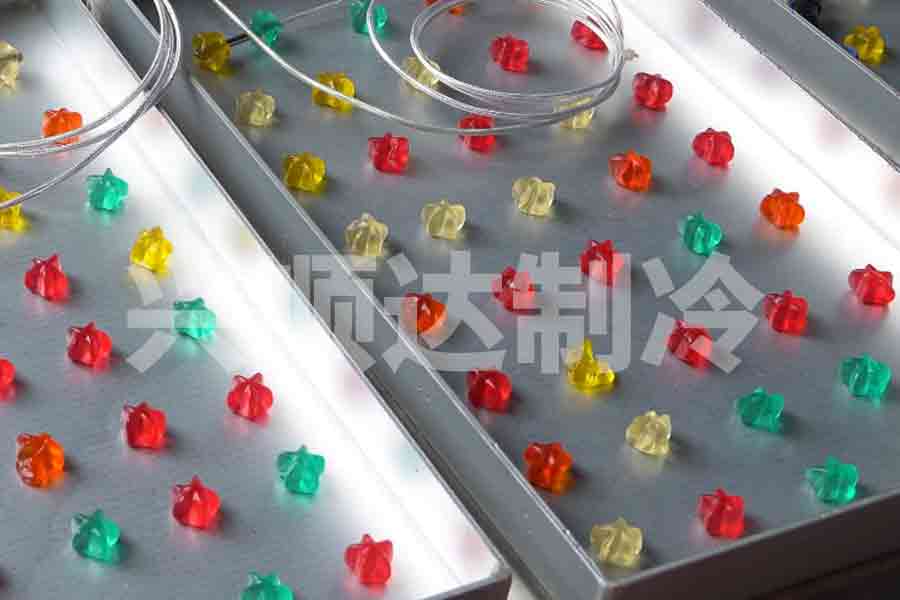
Gummy Candy Before and After Processing
Gummy candy can expand into a porous, crunchy structure. Proper spacing helps reduce sticking and supports more consistent final texture.
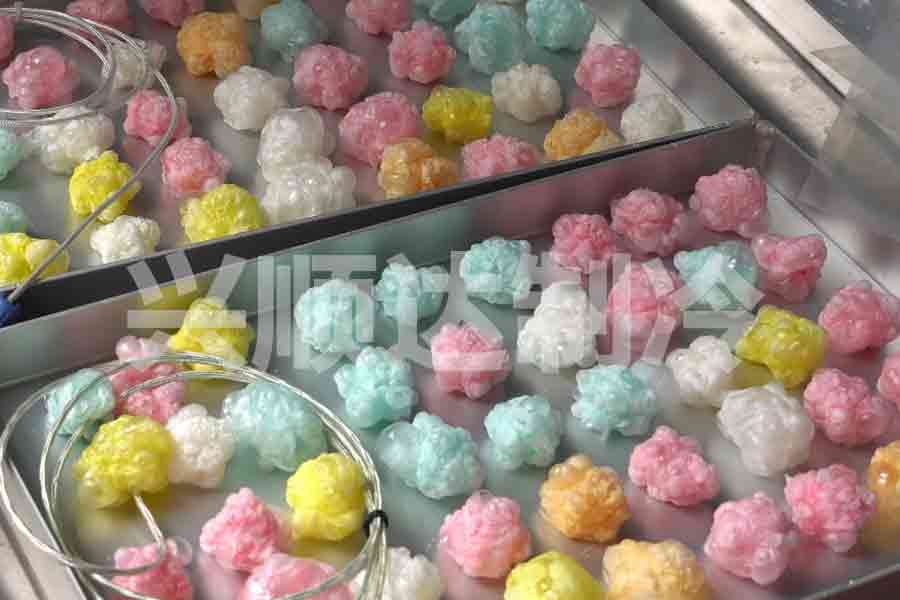
Hard Candy Before and After Processing
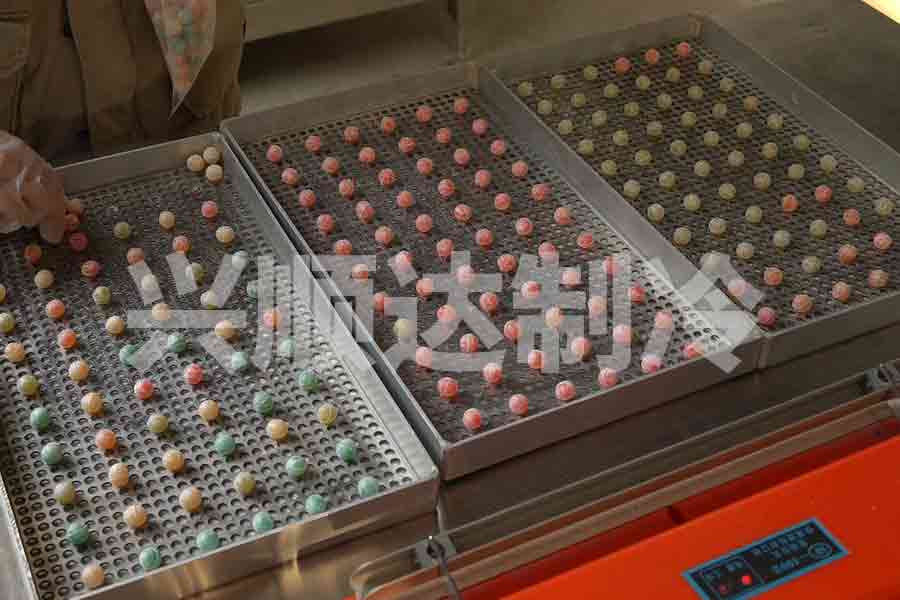
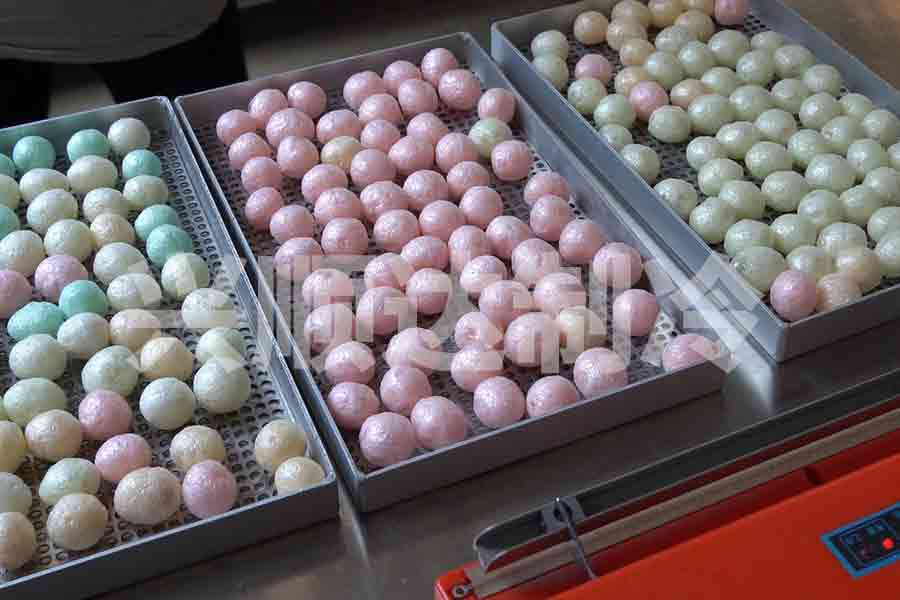
Hard candy can change from small dense pieces into larger porous pieces when the formula and process curve are suitable. This is why batch loading should consider expansion volume, not only starting weight.
Which Candies Work Best for Freeze Dryer Processing?
Many candies can be tested, but not every candy is suitable for profitable commercial production. The best candidates usually have a formula that supports expansion, controlled moisture movement, and a stable final texture.
Gummies often expand and become crunchy. However, formula, size, gelatin structure, and sugar content strongly affect the result.
Marshmallows can dry quickly after preheating, but some formulas should not be frozen because surface cracks may appear.
Some hard candies can puff or become brittle. Still, product testing is needed because coatings and ingredients can limit expansion.
Caramel and Filled Candy Need Careful Testing
Some caramel-based or filled candies can create attractive textures. However, they are more sensitive to heating and vacuum conditions. If the center softens too early, the product may deform, stick to trays, or lose a clean bite. Therefore, these products should go through pilot testing before a large freeze dry machine for candy is selected.
Which Candies Are Risky or Difficult?
Commercial buyers should identify difficult candies before they invest in equipment. A product that looks successful in a small online video may not produce stable results at factory scale.
| Candy Type | Common Risk | Recommended Action |
|---|---|---|
| Chocolate or high-fat candy | Softening, melting, poor puffing, surface bloom, or oily residue. | Do not run it like normal gummy candy. Add water, remelt, mold, freeze, and then dry in a controlled process. |
| Very sticky candy | Pieces stick to trays or attach to each other during expansion. | Use proper spacing, suitable liners, preheating, and lower loading density. |
| Large pieces | Uneven drying, hard centers, or long cycle time. | Cut pieces, control height, and record drying time by piece size. |
| Mixed candy batches | Different products finish at different times or need different process routes. | Separate recipes by candy type, size, formula, and route. |
Important: high sugar does not automatically mean easy processing. The decisive factors are formula, internal moisture movement, softening temperature, vacuum stability, heat input, expansion space, and packaging moisture control.
Key Machine Requirements for Candy Production
A commercial candy project needs stable control. The machine should support recipe development, fast batch repetition, and cleanable food production. In addition, the supplier should understand that candy cycles may differ from traditional food freeze-drying cycles.
Stable Vacuum System
Vacuum stability affects puffing, drying speed, and product appearance. For candy, vacuum pull-down and control matter because many formulas soften easily. Buyers can also review the vacuum pump for freeze dryer guide before comparing quotations.
Accurate Shelf Heating Control
Candy is sensitive to heat input. Too much heat can cause melting or deformation, while too little heat slows drying. Therefore, recipe control should allow operators to adjust the heating curve by candy type.
Suitable Condenser and Chamber Design
The condenser must match the actual moisture load. However, for some candy products, expansion volume and shelf spacing may limit capacity more than water load. Buyers can review the freeze dryer condenser guide for a broader explanation of condenser selection.
Food-Grade Contact Surfaces and Easy Cleaning
Sticky sugar residue makes cleaning important. Stainless steel contact surfaces, removable trays, smooth chamber design, and accessible corners help reduce sanitation risk and labor time.
Control System and Recipe Storage
Recipe storage helps operators repeat successful batches. Data records should include candy type, process route, loading density, preheating condition, shelf temperature, chamber pressure, drying time, final texture, and packaging response.
How to Calculate Batch Capacity for Freeze-Dried Candy
For candy, capacity should not be calculated from wet weight alone. The buyer must consider expansion volume, spacing, product height, route selection, drying time, packaging speed, and how many batches can be completed per day.
Capacity Factors to Confirm
- Candy formula: marshmallow, gummy candy, hard candy, and chocolate behave differently.
- Piece size: larger pieces may need more spacing and different drying time.
- Loading density: the practical kg per square meter depends on expansion and sticking risk.
- Usable tray area: buyers should confirm real loadable area, not only chamber dimensions.
- Drying cycle: include preheating, loading, vacuum drying or true freeze drying, unloading, and cleaning.
- Target output: daily output should be calculated from batches per day and acceptable utilization.
- Packaging speed: crispy candy can soften quickly in humid air, so packaging capacity must match dryer output.
Simple Capacity Logic
If one candy expands heavily, the operator should reduce loading density and leave more spacing. If another candy needs true freezing and sublimation, the total cycle may become longer. As a result, two candies with the same starting weight may require different machine sizes.
Practical recommendation: ask the supplier to calculate capacity using candy type, tray area, loading density, estimated expansion, tested drying time, target final texture, and packaging plan. A brochure capacity alone is not enough for commercial candy production.
Small Commercial vs Commercial Candy Freeze Dryer
The best model depends on the business stage. A startup testing online demand should not buy the same system as a contract manufacturer supplying supermarkets. Instead, the buyer should match equipment scale to order volume, production schedule, and factory utilities. For buyers comparing freeze dryers for candy, the key is tested output per batch rather than the largest advertised tray area. A freeze dryer machine for candy should be selected from real product behavior, not only from chamber size.
| Production Stage | Suitable Equipment Direction | Best Use Case |
|---|---|---|
| Product development | Pilot or small commercial freeze dryer | Formula screening, texture comparison, market samples, and test data collection. |
| Early commercial sales | Small commercial or commercial freeze dryer | Online sales, local retail, small wholesale orders, and private-label trials. |
| Stable commercial production | Commercial freeze dryer | Regular batch output, multiple candy SKUs, recipe storage, and repeatable quality. |
| Large factory output | Industrial freeze dryer system | Contract manufacturing, large snack brands, and multi-shift production planning. |
For pilot and small trial production, review SDG60 and SDG90 pilot lab freeze dryers. For regular food business production, compare SDG350, SDG700, and SDG1100 commercial freeze dryers. If daily demand is much higher, review the industrial freeze dryer series.
Common Candy Freeze Dryer Problems and Solutions
Most candy processing failures come from route mismatch, formula limitation, poor loading, unsuitable freezing, unstable vacuum performance, or inadequate packaging. The following problems should be checked during pilot testing.
Marshmallow Surface Cracks
Some marshmallow formulas crack if they are frozen before drying. In this case, the operator should test a non-freezing vacuum drying route after machine preheating and compare the surface appearance.
Candy Melts During Drying
Melting can happen when shelf temperature rises too fast, vacuum pull-down is too slow, or the formula softens easily. To reduce risk, operators should adjust the heating curve, tray loading, and vacuum control.
Candy Does Not Puff
Some formulas do not expand well. High-fat coatings, dense centers, or low internal moisture can limit puffing. Therefore, the buyer should test several candy formulas before using one machine quote as the final investment basis.
Candy Becomes Sticky After Packaging
Processed candy absorbs moisture quickly. If final drying is incomplete or the packaging room is humid, the product can lose crispness. Better final drying, fast transfer, moisture-barrier packaging, and suitable desiccants can help protect texture.
Batch Results Are Inconsistent
Inconsistent results often come from mixed candy types, uneven loading, changed recipes, or unstable vacuum. The solution is to standardize product size, loading density, process route, and batch records.
Packaging and Shelf-Life Control
Drying is only one part of the project. After unloading, processed candy should be packed quickly because the porous structure can absorb moisture from the air. If the packaging step is slow, the product may become soft before it reaches customers.
Recommended Packaging Considerations
- Use moisture-barrier packaging suitable for crispy snacks.
- Control humidity in the packaging area.
- Confirm sealing strength and package leak resistance.
- Use desiccant when the product and market requirements justify it.
- Run storage tests for texture, color, flavor, and package stability.
- Keep batch codes and production records for traceability.
Food businesses should also follow applicable food safety rules in their target market. For the United States, the 21 CFR Part 117 current good manufacturing practice and preventive controls rule is a useful regulatory reference. In addition, FDA has published guidance related to low-moisture ready-to-eat human foods, which is relevant when factories design sanitation and corrective-action programs for low-moisture products.
How to Test Candy Before Buying a Large Freeze Dryer
For a serious food business, testing is the safest way to reduce investment risk. A supplier should not recommend a large machine only from a product name. Instead, the engineering team should evaluate actual candy samples and record process data.
Data to Collect During Testing
Candy type, formula notes, coating, piece size, starting weight, and loading density.
Route selection, preheating, freezing condition if used, vacuum pull-down, shelf temperature, chamber pressure, and drying time.
Expansion, texture, final moisture, stickiness, breakage rate, color, flavor, and packaging response.
How Test Results Support Model Selection
After the test, the supplier can estimate tray loading, cycle time, batches per day, and daily output. This makes the quotation more reliable. It also helps the buyer compare small commercial, commercial, and industrial options with less guesswork.
For general food production sizing, the food freeze dryer selection guide provides broader capacity logic. For regular factory output, readers can also compare the commercial freeze dryers capacity guide. For electricity planning, see how much electricity a freeze dryer uses.
Useful Resources for Candy Freeze Dryer Projects
The following pages can help buyers compare the candy project with other food freeze-drying applications:
- Food freeze dryer selection guide for capacity, product type, and process planning.
- Commercial freeze dryers for food production for small and medium factory planning.
- Commercial freeze dryer models for SDG350, SDG700, and SDG1100 comparison.
- Pilot lab freeze dryers for sample testing and scale-up preparation.
- Customer success stories for real food freeze-drying project references.
- Contact the engineering team to discuss candy testing and model selection.
Request a Candy Freeze-Drying Test or Equipment Quote
Choosing a freeze dryer for candy production should start with product testing, not only machine size. Share the candy type, target daily output, package size, available power, cooling condition, and factory space. The engineering team can evaluate the correct process route, estimate batch capacity, and recommend a suitable freeze dryer model for commercial candy production.