
Best Meals to Freeze Dry for Food Businesses
The best meals to freeze dry are not only the meals that taste good after rehydration. For a food business, the right product must also dry evenly, scale well, control moisture, keep good texture, and support a stable production cost.
Many online guides focus on home freeze-drying recipes. However, commercial freeze-dried meals need a different standard. A meal that works in a small home machine may not work in a commercial freeze dryer with hundreds of kilograms per batch.
Therefore, this guide explains the best meals to freeze dry for food businesses, the meals that create production risks, and the key tests a company should run before scaling up.
What Makes a Meal Suitable for Freeze Drying?
A suitable freeze-dried meal should have good water distribution, controlled thickness, moderate fat content, and stable texture after rehydration. These factors help the product dry evenly and recover well when consumers add water.
During freeze drying, frozen water leaves the food as vapor under vacuum. Therefore, the meal structure must allow water vapor to escape. If the food is too thick, too oily, too sticky, or too dense, drying time becomes longer.
Key Commercial Evaluation Points
For commercial production, food companies should judge a meal by measurable processing results. In addition, they should connect the test result with the target retail format.
- Drying uniformity: The product should dry from surface to center without wet spots.
- Rehydration quality: The meal should recover good flavor, texture, and shape after hot water is added.
- Batch stability: The product should perform consistently across different trays and batches.
- Packaging stability: The final product should maintain quality in moisture-proof packaging.
- Production cost: Drying time, energy use, and loading capacity must support a reasonable unit cost.
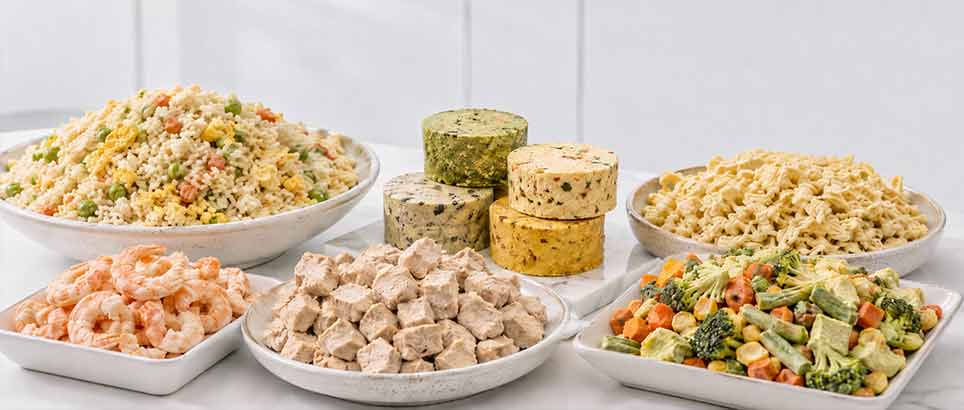
Because of these requirements, the best meals to freeze dry are usually rice meals, soup blocks, pasta meals, meat toppings, seafood toppings, and vegetable-based ready meals.
Best Meals to Freeze Dry for Commercial Production
Commercial freeze-dried meal production should start with products that combine clear demand with stable processing behavior. As a result, the following categories often work better than complex, oily, or very dense meals.
1. Rice-Based Meals
Rice-based meals are one of the best choices for commercial freeze-dried food production. They are easy to portion, easy to rehydrate, and suitable for instant meals, emergency food, camping food, and convenience food packs.
Common examples include fried rice, curry rice, rice with vegetables, rice with chicken, rice with beef, and rice with seafood toppings. Moreover, rice grains help water vapor move through the product during drying.
Rice-based meals also have strong market evidence. For example, well-known outdoor and emergency food brands sell chicken rice, beef rice, and mixed rice entrées. Their product lines show why rice remains one of the most commercially viable bases for freeze-dried ready meals.
However, the recipe still needs control. Too much oil can reduce drying efficiency. Also, too much sauce can make the meal sticky and dense.
Commercial Testing Tips for Rice Meals
For better results, food businesses should test the cooking level of the rice, the oil ratio, the sauce amount, and the loading thickness. Even a small recipe change can affect drying time and rehydration quality.
A useful reference is this freeze-dried fried rice production case. The case shows how cooked fried rice can be processed with controlled batch loading and final moisture.
2. Concentrated Soup Blocks and Instant Soup Meals
Soup blocks are also strong candidates for freeze-dried meal production. They work well for instant soup, camping meals, airline meals, military food, and emergency food.
Common products include vegetable soup blocks, mushroom soup ingredients, tremella soup, meat and vegetable soup, and instant noodle soup packs.
However, soup products often contain more water than rice or pasta meals. Therefore, manufacturers often concentrate soups before freeze drying. By increasing solids and reducing excess water, they can shorten drying cycles, lower operating costs, and improve throughput.
How to Improve Soup Block Drying
For commercial production, companies should test the concentration level, thickness, solid content, pre-freezing condition, and rehydration time. The goal is not only to make the soup dry. The final block should also dissolve or rehydrate quickly when consumers add hot water.
Goodfreezedryer.com has a related freeze-dried instant soup block case. This case shows how a soup product can move from testing to scaled production.
3. Pasta and Noodle Meals
Pasta and noodle meals can become good freeze-dried products when the formula is properly designed. They are suitable for ready meals, outdoor meals, instant food packs, and meal kits.
Common examples include pasta with light sauce, macaroni meals, noodle toppings, noodle and vegetable mixes, and meat sauce pasta with controlled fat content.
The main risk is texture. If pasta or noodles are overcooked before freeze drying, they may become too soft after rehydration. In addition, a thick sauce may slow drying and create uneven moisture.
When to Dry Ingredients Separately
Food businesses should test noodles, sauce, vegetables, and meat pieces separately before combining them into one meal. This approach helps the factory identify the ingredient that controls drying time.
If different ingredients require very different drying parameters, the factory can freeze dry them separately. Then, it can blend them during final packaging to improve quality and production efficiency.
4. Meat and Seafood Meal Components
Meat and seafood components have high commercial value. They often appear in instant noodles, rice meals, soup packs, pet food, and premium ready meals.
Common products include cooked chicken cubes, beef pieces, shrimp toppings, fish pieces, and meat and vegetable mixes. These products can create excellent texture after rehydration.
However, they need careful control. Large pieces dry slowly. Therefore, manufacturers often trim excess fat and remove bones before freeze drying. This step can improve drying efficiency and product consistency.
Key Controls for Protein Ingredients
High-fat meat can reduce shelf stability. Meanwhile, bones add weight without contributing to the edible portion and may complicate processing. Seafood also requires strict hygiene control before, during, and after freeze drying.
Food businesses should validate cutting size, cooking method, loading density, final moisture, and water activity. They should also check whether the product keeps good bite and flavor after rehydration.
For example, this freeze-dried shrimp for instant noodle toppings case shows how shrimp can be processed as a high-value ingredient for instant food production.
5. Vegetable-Based Meals
Vegetable-based meals are often easier to freeze dry than high-fat mixed meals. Vegetables usually keep good color, shape, and porous structure after freeze drying.
Common examples include mixed vegetable rice, vegetable curry, mushroom meal ingredients, soup vegetable packs, and vegetable-based meal mixes.
Vegetables can add color, nutrition, and visual appeal to ready meals. However, each vegetable behaves differently. Mushrooms, carrots, peas, leafy vegetables, and onions may need different cutting sizes and pre-treatment steps.
Packaging Notes for Vegetables
Carrots can fade when they stay exposed to light for a long time. Therefore, freeze-dried carrot products usually need light-blocking packaging. This package choice helps protect appearance during storage.
For factories, the best method is to test each ingredient first. After that, the company can combine tested ingredients into a complete meal formula.
Meals That Are Difficult to Freeze Dry
Not every meal is suitable for commercial freeze drying. Some products can dry, but they may not scale well or may create quality problems.
High-Fat and High-Sugar Products
Difficult meals often include very high-fat meals, butter-heavy sauces, peanut butter products, nut butter products, honey, jam, syrup-rich products, and thick sauces with high sugar content.
The main issue is simple: freeze drying removes water, not oil. Excess fat can block or restrict the pathways through which water vapor escapes. As a result, high-fat meals may dry more slowly, feel greasy, and lose quality faster during storage.
Dense or Bone-In Meals
Large bone-in meat pieces and dense mashed meals also create problems. They increase product thickness, slow vapor movement, and make final moisture harder to control.
For this reason, commercial food producers should not only ask whether a meal can be freeze dried. Instead, they should ask whether it can be freeze dried consistently at scale.
Food Safety and Moisture Control
Freeze drying can help produce shelf-stable foods by reducing moisture. However, food businesses should not treat freeze drying as a sterilization step.
The U.S. FDA explains that water activity is an important factor in food safety and stability. Food companies can use water activity testing to evaluate whether a low-moisture food has reached a stable range. More details are available in the FDA guide on water activity in foods.
Packaging Still Matters
The University of Minnesota Extension also notes that freeze-dried foods need proper moisture-proof packaging. It also explains that freeze drying does not kill all illness-causing microorganisms. Food businesses can review its guide on freeze-drying and food safety.
Therefore, final moisture alone is not enough. A food business should also test water activity, packaging tightness, oxygen control, and storage stability.
How Food Businesses Should Test Freeze-Dried Meals Before Scaling Up
Before buying a large freeze dryer, a food company should test the meal formula in a pilot or commercial-scale trial. This step reduces risk and helps the factory choose the right equipment size.
Core Process Tests
A proper freeze-dried meal test should check ingredient cutting size, tray loading thickness, loading weight per square meter, freezing condition, drying time, final moisture, and water activity.
Quality and Market Tests
The same test should also check rehydration time, texture after rehydration, color retention, shape retention, packaging stability, and batch repeatability.
A product may look successful in one small test. However, it may still fail during commercial production if the factory increases loading too much or changes the recipe.
Supplier Support Matters
For this reason, food businesses should work with a freeze dryer supplier that can support sample testing, process adjustment, and equipment selection. This support is especially important for ready meals, soup blocks, meat products, seafood, and high-value convenience foods.
Commercial vs Industrial Freeze Dryer for Freeze-Dried Meals
The right freeze dryer depends on the production goal. Therefore, a company should match the machine scale with the product type, batch target, factory space, and energy supply.
Lab Pilot Freeze Dryer
A food business can use a lab pilot freeze dryer for recipe development and small-batch testing.
Commercial Freeze Dryer
A commercial freeze dryer works well for small to medium production, market test batches, and early-stage ready meal products.
Industrial Freeze Dryer
An industrial freeze dryer supports larger factories that need stable output and lower unit production cost.
Full Product Range
Companies that are not sure which scale to choose can review the full food freeze dryer product range.
Real Freeze-Dried Meal Production Cases
Commercial freeze-dried meals should be judged by real production data, not only by recipe ideas. Therefore, case data can help buyers understand product feasibility before they invest in equipment.
| Product | Application | Model | Batch Load | Drying Time | Final Moisture |
|---|---|---|---|---|---|
| Cooked fried rice | Instant meal | SDG350 | 125 kg/batch | 6 h | 1.28% |
| Instant tremella soup | Soup block | SDG700 | 600 kg/batch | 20 h | 1.94% |
| Shrimp | Instant noodle topping | SDG6000 | 2,320 kg/batch | 8 h | 1.68% |
| White mushroom slices | Soup ingredient | SDG3000 | 1,200 kg/batch | 11.5 h | 2.09% |
What These Cases Show
These cases show why the best meals to freeze dry should be selected by both market demand and process performance. A good product should dry efficiently, rehydrate well, and support repeatable production.
More production examples are available in the customer success story library.
FAQ About the Best Meals to Freeze Dry
What are the best meals to freeze dry?
The best meals to freeze dry include rice meals, soup blocks, pasta meals, noodle toppings, meat pieces, seafood toppings, and vegetable-based ready meals. These products usually rehydrate well and can be suitable for commercial food production.
Can cooked rice meals be freeze dried?
Yes. Cooked rice meals can be freeze dried if the oil level, sauce amount, and tray loading thickness are controlled. Fried rice, curry rice, and rice with vegetables are common options for instant meal production.
Are soups good for freeze drying?
Yes. Soups can be freeze dried into blocks or ingredient packs. However, soup products need testing because water content, solid-liquid ratio, and thickness can strongly affect drying time and rehydration.
Can pasta meals be freeze dried?
Yes. Pasta meals can be freeze dried, but the pasta should not be overcooked. The sauce should also stay controlled so the meal does not become too sticky or dense during drying.
Why are high-fat meals difficult to freeze dry?
High-fat meals are difficult because freeze drying removes water, not oil. Excess fat can block vapor pathways, increase drying time, reduce shelf stability, and affect texture during storage.
Does freeze drying make meals shelf stable?
Freeze drying can support shelf stability by reducing moisture and water activity. However, the product still needs correct sanitation, final moisture control, water activity testing, and moisture-proof packaging.
Does freeze drying kill bacteria?
Freeze drying is not a sterilization process. Food businesses should control raw material quality, cooking, sanitation, packaging, and storage conditions.
What should a food business test before buying a freeze dryer?
A food business should test loading thickness, drying time, final moisture, water activity, rehydration quality, texture, color, packaging stability, and batch repeatability.
What size freeze dryer is suitable for freeze-dried meals?
Small companies can start with a pilot or commercial freeze dryer. Larger factories should consider an industrial freeze dryer when they need stable output, higher batch capacity, and lower unit cost.
Can one freeze dryer process rice, soup, meat, and vegetables?
Yes. One freeze dryer can process different foods. However, each product needs its own drying recipe because rice, soup, meat, seafood, and vegetables have different drying times and loading limits.
Final Recommendation
The best meals to freeze dry for a food business are products that combine market demand with reliable processing. Rice meals, soup blocks, pasta meals, seafood toppings, meat ingredients, and vegetable-based meals are strong options.
However, food companies should not choose a product only because it looks popular. Instead, they should test the formula, drying time, final moisture, water activity, rehydration quality, and packaging stability before scaling up.
Need to Evaluate a Freeze-Dried Meal Project?
Goodfreezedryer.com supports food businesses with freeze-dried meal testing, process evaluation, and freeze dryer selection for pilot, commercial, and industrial production.
Share the product type, batch target, ingredient list, and expected output. Then the team can help evaluate the right freeze dryer scale and process direction.
Request a Project Evaluation