
Vacuum Freeze Drying Equipment for Food Production
Vacuum freeze drying equipment should be selected as a balanced production system, not by tray count, chamber size, or the lowest advertised temperature alone. A defensible selection connects the prepared product, removable water, complete batch rhythm, condenser duty, loaded vacuum stability, factory utilities, and acceptance evidence.
This guide is for food processors evaluating a vacuum freeze dryer for fruit, vegetables, seafood, meat, pet food, prepared meals, coffee, tea, or food ingredients. It focuses on system fit and evidence. Detailed component design, specifications, FAT/SAT, installation, price, and manufacturer due diligence remain on their dedicated pages.
Evidence basis: identified first-party food-production records and authoritative university and government resources. Evidence reviewed .

Equipment sizing should begin with the food project.
Food processors can submit the product, prepared wet kilograms per day, initial moisture or solids, piece size, target final moisture, operating schedule, and site utilities. The engineering team can then prepare a preliminary sizing basis and identify which tests are still required.
What Is Vacuum Freeze Drying Equipment?
A vacuum freeze dryer processes a frozen product under reduced pressure while controlled heat supplies the energy required for ice to change directly into vapor. Depending on the system design, freezing may take place in an external freezer or inside the drying chamber. The vapor then freezes on a colder condenser, while secondary drying removes part of the remaining sorbed water. Utah State University Extension and the University of Minnesota describe the same core principle of freezing followed by sublimation under vacuum.[1][2]
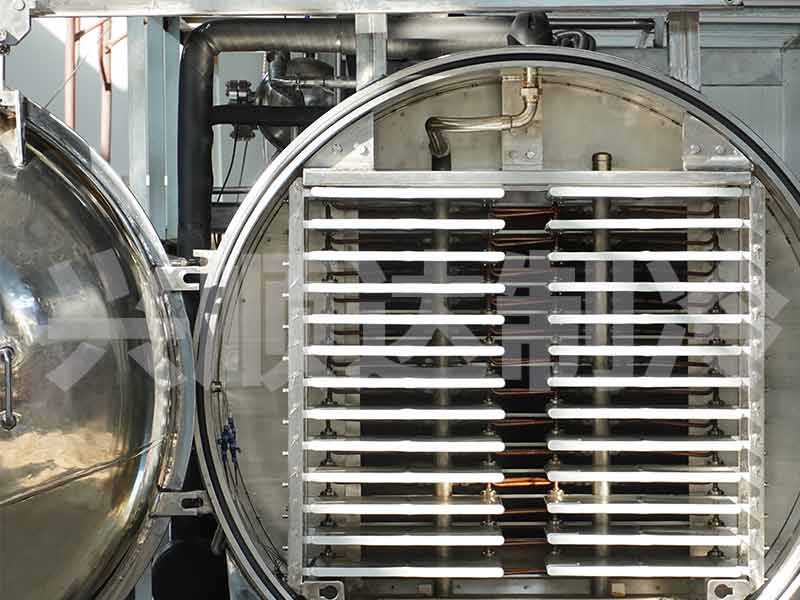
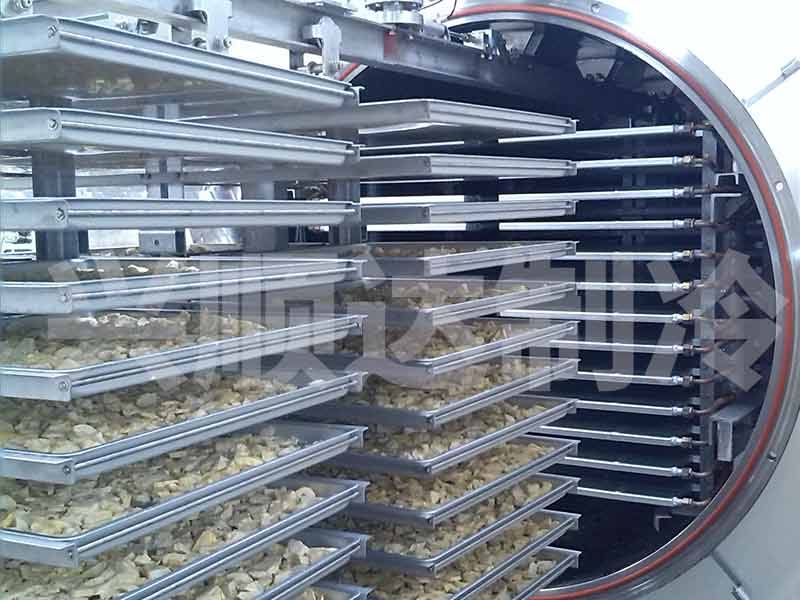
For food production, the equipment is more than a vacuum chamber. It normally includes product loading, shelves or heating plates, condenser, refrigeration, vacuum pumps, instruments, valves, controls, batch records, defrosting, safety protection, and utility connections.
This page evaluates whether those functions form a balanced and testable system. The freeze-drying working-principle guide explains the process stages, while the freeze dryer components guide examines individual systems in greater detail.

Start with Product, Water Load, and Complete Batches
The correct sizing basis is the material that enters the dryer after washing, peeling, cutting, cooking, draining, mixing, or other preparation. Finished dry weight alone cannot establish capacity.
Define the Prepared Product
The project brief should state the food, recipe, physical form, piece dimensions, layer depth, initial moisture or solids, target final moisture, and quality attributes that must be protected. Pineapple slices, blueberries, cooked rice, shrimp, meat pieces, and liquid extracts do not create the same heat- and mass-transfer conditions.
Use Complete Batch Time
Daily output includes loading, drying, endpoint confirmation, unloading, defrosting, drainage, cleaning, and restart. Therefore, a 12-hour drying phase does not automatically prove two complete batches every 24 hours.
Preliminary wet-load calculation
Prepared wet load per batch = required prepared wet load per day ÷ complete batches per dayWater balance should be checked before tray area. For example, 100 kg of prepared food at 80% moisture contains 20 kg of dry solids. At a target final moisture of 3% wet basis, the final product mass is approximately 20.62 kg, so about 79.38 kg of water must be removed.
Dry solids = 100 × (1 − 0.80) = 20 kgFinal product mass = 20 ÷ (1 − 0.03) = 20.62 kgApproximate water removed = 100 − 20.62 = 79.38 kgThe condenser requires usable ice capacity above the calculated amount after an engineering allowance. In addition, the refrigeration system, collecting surface, and vapor path must handle the peak vapor rate during primary drying. Tray area remains useful, but it does not prove wet kilograms per batch without a tested loading density and accepted endpoint.
System-Fit Checks for a Vacuum Freeze Dryer
The purpose of this review is not to repeat a complete component specification. Instead, buyers should confirm that the main systems are matched to the stated product and water load.

| System | Main Responsibility | Minimum Buyer Check |
|---|---|---|
| Chamber and loading | Holds the product under vacuum and supports batch movement | Usable area, loading density, sealing, trolley route, cleaning and service access |
| Heating | Supplies controlled sublimation and secondary-drying energy | Temperature uniformity, control method, product sensors, and utility basis |
| Condenser | Captures sublimated water as ice | Usable ice capacity, collecting area, loaded temperature, vapor path, and defrost |
| Vacuum system | Removes non-condensable gas and controls chamber pressure | Pump configuration, gauge type, measurement location, loaded stability, and maintenance |
| Refrigeration | Supports condenser duty and, where applicable, product freezing | Cooling basis, ambient assumptions, heat rejection, and service access |
| Controls and records | Runs the recipe and preserves batch evidence | Temperature, pressure, condenser status, alarms, stage time, and exportable records |
| Defrost and maintenance | Restores condenser capacity and supports uptime | Defrost duration, drainage, residual ice, component access, and production interruption |

Detailed subsystem evaluation belongs in the components guide. Buyers preparing a technical data sheet should also use the separate freeze dryer specifications guide.


How to Verify a Vacuum Freeze Dryer Capacity Claim
A brochure throughput figure is useful only when its assumptions are visible. Before approving capacity, the buyer should request five connected forms of evidence:
- Product definition: food type, recipe, pretreatment, piece size, layer depth, and initial moisture or solids.
- Loading and water basis: usable area, kg/m², prepared wet kilograms, calculated water removed, and condenser basis.
- Complete cycle: freezing basis, drying stages, endpoint confirmation, unloading, defrosting, cleaning, and restart.
- Loaded records: representative product temperature, chamber pressure, condenser status, heating stages, alarms, and time.
- Accepted result: final moisture, center dryness, batch consistency, appearance, texture, and rehydration where relevant.
When no comparable batch exists, the correct next step is a representative pilot test or a documented test plan. Detailed FAT and SAT evidence should be defined through the food freeze dryer validation guide, not assumed from a brochure.
Capacity should be proved under a defined load.
A preliminary review can identify the water balance, comparable project, test requirement, utilities, and missing assumptions before a final model is selected.
Commercial vs Industrial Vacuum Freeze Drying Equipment
The commercial-versus-industrial decision should follow verified batch load, complete batch rhythm, utilities, labor plan, and expansion requirements. Model names alone do not define the correct scale.
| Decision Point | Commercial System | Industrial System |
|---|---|---|
| Typical project stage | Validated product entering stable small- or medium-scale production | Established product requiring high wet-load capacity or multi-shift production |
| Material handling | Smaller trolley and simpler batch movement | Larger chamber, heavier trolleys, planned loading routes, and factory integration |
| Utilities | Often electric or compact thermal-fluid arrangements | May require larger electrical service, cooling water, steam, and greater heat rejection |
| Engineering scope | Site check, utility confirmation, installation, and operator training | Layout, access, foundations, utilities, installation sequence, and acceptance planning |
| Main risk | Buying before the product and batch basis are validated | Scaling brochure capacity without confirming water load, vapor handling, and turnaround |
Food processors ready to compare models can review the commercial freeze dryer range or the industrial freeze dryer range. The product pages show model information; final selection still requires product and site evidence.
Real Food Production Evidence
The following first-party records connect product type, prepared batch load, drying area, cycle time, pressure range, final moisture, and reported energy use. They are project-specific references rather than universal ratings.
Cooked Fried Rice
A 10 m² system processed approximately 125 kg per batch in a recorded 6-hour drying cycle.
- Loading density: 12.5 kg/m²
- Vacuum range: 26–89 Pa
- Final moisture: 1.28%
- Reported energy use: 1.67 kWh/kg fresh material
Pineapple Slices
A 20 m² system processed approximately 244 kg per batch in a recorded 12-hour drying cycle.
- Loading density: 12.2 kg/m²
- Vacuum range: 26–92 Pa
- Final moisture: 2.31%
- Reported energy use: 1.73 kWh/kg fresh material
Perforated Blueberries
A 30 m² system processed approximately 360 kg per batch in a recorded 13-hour drying cycle.
- Loading density: 12 kg/m²
- Vacuum range: 26–90 Pa
- Final moisture: 1.97%
- Reported energy use: 1.8 kWh/kg fresh material
Evidence boundary: these values describe identified products, preparation methods, equipment, and operating conditions. Another product requires representative testing or a justified scale-up review.
Factory Fit, Price Factors, and Quotation Boundary
Equipment performance depends on the site that supports it. Before contract approval, the buyer and supplier should confirm footprint, service clearance, access route, floor capacity, material flow, voltage, cooling water, steam where required, drainage, ambient conditions, heat rejection, installation sequence, training, and acceptance responsibility.
Quotation boundary: freight, insurance, pre-freezing, utilities, lifting, installation, travel, accommodation, commissioning, training, spare parts, tests, and warranty support should be explicitly included or excluded. Two quotations with the same tray area may therefore describe very different supplied systems.
The detailed site checklist is available in the commercial freeze dryer installation guide. Cost-focused buyers should use the dedicated freeze dryer price guide, while supplier due diligence belongs in the vacuum freeze dryer manufacturer guide.
Five Common Buying Mistakes
- Comparing tray count instead of a defined product load. Trays differ in dimensions, spacing, layer depth, and usable area.
- Using the unloaded minimum condenser temperature as capacity proof. It does not show performance after frost accumulates under a real load.
- Using ultimate vacuum as the main performance metric. An empty-chamber reading does not prove stable pressure during sublimation.
- Ignoring turnaround. Defrosting, drainage, cleaning, loading, and unloading can materially change daily output.
- Skipping representative testing. High-sugar fruit, skin-covered berries, fatty foods, mixed meals, liquids, and thick pieces may require different preparation and cycle control.
Information Required for a Useful RFQ
Product and Quality Brief
- Product name, recipe, and photographs
- Prepared wet kilograms per day
- Initial moisture or solids
- Piece dimensions, layer depth, and pretreatment
- Target final moisture and quality criteria
- Existing pilot data and packaging plan
Factory and Commercial Brief
- Operating days and complete batches per day
- Voltage, cooling water, steam, drainage, and ambient conditions
- Available space, access route, and loading method
- Destination, schedule, and requested Incoterm
- Required testing, installation, training, and spare parts
- Acceptance criteria and quotation exclusions
Food-Safety and Compliance Boundary
Freeze drying removes water but should not be presented as a validated sterilization step. Raw-material controls, hygienic design, sanitation, validated pretreatment where required, environmental controls, packaging, storage, and the facility food-safety plan remain separate responsibilities.
For the United States, covered food facilities may need to meet Current Good Manufacturing Practice and hazard-analysis and risk-based preventive-control requirements under 21 CFR Part 117. The applicable obligations depend on the product, facility, market, and exemptions, so the food business should confirm its own regulatory scope with the relevant authority or qualified adviser.[3]
The separate article Does Freeze Drying Kill Bacteria? explains why drying performance and microbial control should not be treated as the same validation question.
FAQ About Vacuum Freeze Drying Equipment
Is vacuum freeze drying equipment the same as a freeze dryer?
Usually, yes. The longer term emphasizes the complete food-production system, including product handling, heating, condenser, refrigeration, vacuum, controls, defrosting, and utilities.
How should a food factory calculate freeze dryer capacity?
The calculation should begin with prepared wet kilograms per day, complete batches per day, initial moisture or solids, target final moisture, product dimensions, tested loading density, removable water, turnaround, and representative cycle evidence.
Is tray area the capacity of a vacuum freeze dryer?
No. Tray area is one loading input. Actual capacity also depends on product geometry, loading density, water load, vapor handling, heating, pressure control, cycle duration, defrosting, and the required product result.
Why is condenser capacity important?
Sublimated water must move from the product and freeze on the condenser. An undersized or poorly matched condenser can restrict vapor capture, disturb pressure control, and lengthen the cycle.
Does a lower vacuum always make freeze drying faster?
No. Pressure, heat transfer, product temperature, vapor-path conductance, and condenser load must be considered together. One low vacuum value cannot prove a fast or acceptable loaded cycle.
Can one vacuum freeze dryer process different foods?
One system can process different foods within its verified operating range. However, each product may need different preparation, layer depth, loading density, temperature control, drying time, and endpoint acceptance.
What should a buyer request before approving a quotation?
The buyer should request the product and loading assumptions, water balance, comparable batch or test plan, loaded-cycle evidence, utility schedule, supplied scope, exclusions, installation plan, training, acceptance criteria, and service terms.

About the Author
Zheng Wei is a freeze-drying system engineer at Fuzhou Xing Shun Da Refrigeration Facility Project Co., Ltd. His work includes food-product testing, equipment sizing, vacuum and refrigeration configuration, manufacturing review, installation guidance, operator training, and scale-up for fruit, vegetables, cooked foods, seafood, meat, and food ingredients.
Readers can review the manufacturer and engineering background and the identified food-production case library.
The project values on this page are first-party engineering references. They require validation against the prospective buyer’s product and factory before final sizing.
Authoritative References
- Utah State University Extension. Freeze Drying. Process explanation based on sublimation. Accessed July 31, 2026.
- University of Minnesota Extension. Preserving Food at Home: Freeze-Drying. General food-preservation explanation. Accessed July 31, 2026.
- U.S. Food and Drug Administration. FSMA Final Rule for Preventive Controls for Human Food. Regulatory overview for covered U.S. facilities. Accessed July 31, 2026.
DOI note: the cited sources are university extension and government webpages rather than journal papers, so no DOI applies.
Prepare a Defensible Vacuum Freeze Drying Equipment Specification
Food processors can send the product, prepared wet load, moisture or solids, piece dimensions, target final moisture, operating schedule, and factory utilities. The engineering team can return a preliminary sizing basis, key assumptions, missing information, and the evidence required before a final model decision.