
How to Use a Freeze Dryer for Commercial Food Production
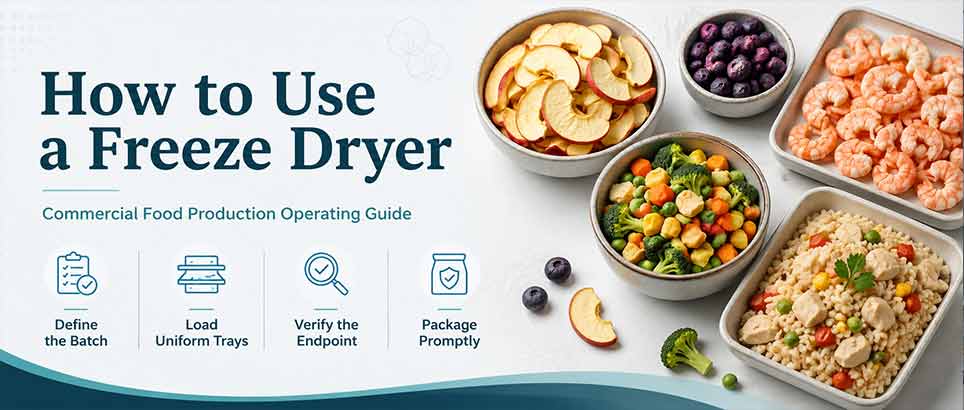
This guide explains how to use a freeze dryer as a repeatable food-production process, not as a household appliance. It covers batch definition, preparation, loading, freezing, vacuum drying, endpoint release, packaging, cleaning, and records.
Technical review date: June 30, 2026. The equipment manual, site safety rules, food-safety plan, and product-specific validated process always take priority.
Quick answer: To learn how to use a freeze dryer consistently, treat each run as a controlled batch. Define the product specification, inspect the machine, prepare and load consistent trays, freeze the product completely, run the validated vacuum-and-heating recipe, monitor trends, verify the endpoint, unload and package promptly, defrost and clean, then approve the batch record. Do not copy one food’s pressure, temperature, thickness, or drying time into another product.
Before Operating a Commercial Freeze Dryer
A food-production team should begin operation only after the freeze dryer has been installed, commissioned, leak-tested, and released for food use. The separate commercial freeze dryer setup guide covers site, foundation, utility, drainage, and access planning.
Only trained personnel should operate the system. Never bypass safety interlocks, force a chamber door under vacuum, or improvise a valve sequence. This operating guide can help a food factory develop its own equipment- and product-specific SOP, but it is not a substitute for an approved site procedure. Food facilities should connect freeze drying with sanitation, preventive maintenance, hazard analysis, packaging control, and batch release. FDA current good manufacturing practices address plant equipment, sanitary operations, facility sanitation, and production and process controls.[4]
No universal recipe: Product composition, sugar, fat, salt, particle size, cut geometry, freezing history, loading density, equipment design, and final quality target can all change the correct cycle. The values below are scoped examples, not default setpoints.
1Define the Product and Release Specification
Write the batch target before loading the machine. An operator cannot judge whether a cycle is correct if the factory has not defined what “finished” means.
For a new food, use a lab or pilot freeze-drying test to establish the first recipe and scale-up record before committing a full commercial batch.
2Complete a Documented Pre-Start Inspection
A short written inspection is more reliable than operator memory. Confirm the following before trays enter the chamber:
- Chamber and drain: clean, dry, empty, and free of residual ice.
- Door and seals: clean, correctly seated, and free from visible damage.
- Vacuum system: pump oil or dry-pump condition acceptable; valves, hoses, and connections ready. The freeze dryer vacuum pump oil guide covers oil condition and maintenance.
- Refrigeration and condenser: cooling utilities available, condenser at the required start condition, and alarms clear.
- Heating and sensors: recipe limits loaded; product probes, pressure sensor, shelf control, and data logging active.
- Downstream readiness: packaging room, bags or containers, seal checks, labels, and batch paperwork prepared.
Record the empty-chamber pump-down time periodically. A slower result under the same test conditions can indicate a seal, valve, pump, contamination, or maintenance problem; it is a condition trend, not proof of a single fault.
For equipment acceptance, the supplier and buyer should agree on the test method instead of comparing brochure numbers obtained under different conditions. China’s official standards platform lists JB/T 10285-2017 as the current food vacuum freeze-drying equipment standard.[7]
3Prepare and Load Uniform Trays
Wash, trim, cook, blanch, drain, slice, dice, puree, or portion the food according to its approved process. Keep thickness, piece size, liquid depth, and loading density consistent across trays. Avoid deep piles, blocked vapor paths, and mixed geometries that leave wet centres beside overdried edges.
Cut geometry should be tested rather than assumed. The batch record should preserve thickness, piece shape, liquid depth, and pretreatment so the factory can compare drying time, texture, rehydration, and yield across trials.
Record loading density
Calculate wet loading as wet material mass ÷ usable tray area and record it in kg/m². If the material settles, foams, drips, or has mixed components, also record layer depth and portion arrangement. The commercial freeze dryer tray guide explains tray area, sizing, and loading calculations.

4Freeze the Product Completely
Confirm that representative product locations—including the slowest centre—have reached the validated frozen condition before vacuum drying begins. Surface frost or a cold chamber reading does not prove that the full load is frozen.
Starting vacuum too early can cause melting, foaming, splashing, collapse, or a sudden vapour load. Freezing rate also changes ice-crystal structure and the vapour path that remains after sublimation. A food freeze-drying review connects freezing, primary drying, and secondary drying conditions with the final structure and physical properties of the food.[3]
For the mechanism behind freezing and sublimation, use the dedicated how freeze drying works guide. This page stays focused on operating decisions.

5Run the Validated Vacuum-and-Heating Recipe
After the load is frozen and the condenser is ready, start the approved automatic sequence. The machine manual controls valve logic and safety interlocks. The recipe controls product limits, chamber pressure, heating stages, and transition criteria.
Do not choose pressure in isolation. Lower pressure can support mass transfer, while gas conduction and heat transfer also change with pressure. Product temperature, chamber pressure, shelf or heating-medium temperature, condenser condition, and vapour load must be reviewed together.
Scoped production example: A factory study of diced garlic reported that increasing chamber pressure from 100 to 130 Pa reduced the tested cycle from 23 to 22 hours and cut vacuum-pump electricity by 13.5%, while the reported appearance and final moisture remained consistent.[1] The 130 Pa result is product- and equipment-specific and should not be treated as a general setpoint.
The detailed setpoint discussion belongs on the freeze-drying temperature and pressure guide.
6Monitor Trends, Not Just the Timer
Compare the live batch with an approved baseline for the same product and loading pattern. Investigate deviations instead of repeatedly resetting alarms.
| Trend | Normal review | Reason to investigate |
|---|---|---|
| Product temperature | Representative probes rise in the expected sequence and remain within the product limit. | Early, rapid, or uneven rise; one location remains far behind the rest. |
| Chamber pressure | Pressure reaches and holds the validated operating band. | Slow pump-down, repeated instability, or a rise without a planned recipe change. |
| Condenser temperature | The condenser remains within its operating condition as ice accumulates. | Persistent warming, refrigeration alarm, or declining vapour-capture performance. |
| Heating output | Heat input follows the recipe and product response. | Continuous maximum output without expected temperature or drying progress. |
| Time and events | The stage duration remains reasonably close to the approved range. | Unexplained extension, utility interruption, manual override, or missing event record. |
Use pressure instruments for the job they actually perform
An absolute capacitance diaphragm gauge provides a gas-type-independent pressure signal. For example, INFICON describes its CDG020D as a gas-independent absolute sensor and specifies accuracy options of 0.5% or 1% of reading.[6] Thermal-conductivity gauges can add useful process trend information, but their readings respond to gas composition. Treat each sensor as a defined measurement tool, not an interchangeable number on the screen.
7Verify the Drying Endpoint Before Release
A preset time is not a release test. Raw-material maturity, solids, thickness, loading, freezing history, leakage, condenser performance, and heat transfer can all move the endpoint. The commercial freeze-drying time chart provides product-specific time ranges and the factors that change them.
Commercial endpoint verification should combine compatible indicators rather than relying on cycle time alone:
- Product-temperature trend: representative locations approach the validated end condition.
- Pressure behaviour: pressure remains stable under defined conditions.
- Pressure-rise test, if the machine is designed for it: use the validated isolation time and acceptance limit; do not improvise valve closure.
- Representative product check: the slowest centre has the required structure and no frozen or wet core.
- Mass trend: repeated sample or in-process mass shows no meaningful further loss under the approved method.
- Moisture and water activity: results meet the product-and-package release specification.
Moisture content and water activity are related but not interchangeable. FDA explains that water activity reflects available water and should be brought to a suitable level at the end of drying and maintained during storage.[5] Set the acceptance value for the actual food, package, and shelf-life plan rather than applying one generic “1–2% moisture” rule.
8Unload and Package Without a Humidity Delay
Return the chamber to atmospheric pressure through the approved venting sequence. Confirm a safe opening condition, unload with clean handling practices, and move the product directly to the prepared packaging area.
- Use a package with the required moisture, oxygen, light, puncture, and seal barriers.
- Control the time and room conditions between door opening and sealing.
- Select vacuum, nitrogen flushing, oxygen absorbers, or desiccants from the food and package risk assessment.
- Verify seal integrity and attach the batch identity for traceability.
Why post-drying control matters: In a study of freeze-dried lemon slices, storage temperature had the largest tested effect on colour change, followed by oxygen and then light. The authors recommended light-protective, deoxygenated packaging and low-temperature storage for colour retention.[2] Package selection still needs product-specific validation.
Use the commercial freeze-dried food packaging guide for barrier selection and line planning.
9Defrost, Clean, and Inspect the System
Use the supplied defrost method and drain all meltwater before the next production release. Residual condenser ice reduces available ice capacity and makes one batch different from the next.
Clean trays, racks, chamber surfaces, drains, tools, and transfer equipment under the facility’s sanitation procedure. Confirm that chemicals and methods are compatible with product-contact materials. Inspect the door seal, pump condition, drains, sensors, abnormal noise, vibration, and any alarm that occurred during the cycle.
10Complete and Approve the Batch Record
A useful record allows the factory to distinguish raw-material variation from an equipment or operating problem. Save:
- Product identity, formulation or lot, pretreatment, dimensions, and initial moisture or solids.
- Wet load, tray count, kg/m², recipe name and version, and probe locations.
- Freezing condition; product, pressure, condenser, and heating trends; stage times; and alarms.
- Endpoint method, final moisture, water activity when required, yield, rejected trays, and packaging observations.
- Manual changes, utility interruptions, cleaning release, maintenance findings, operator, reviewer, and approval status.
Keep the record format stable enough to compare batches. Change a validated recipe through the factory’s approval process, not through undocumented screen edits.
Why One Freeze Dryer Recipe Cannot Fit Every Food
The following figures are first-party project records, not independent comparative trials. They show why operators should save product geometry, load, time, and endpoint data together.
| Project record | Recorded result | Operating lesson |
|---|---|---|
| Cooked fried rice, India | 12.5 kg/m²; 125 kg batch; 6 h; 1.28% final moisture. | A prepared meal needs its real formulation, oil, starch, and mixed ingredients tested together. |
| Apple slices, China | 8 mm; 12.7 kg/m²; 254 kg batch; 12 h; 1.97% final moisture. | Slice-thickness selection must balance texture, drying time, and output. |
| Blueberries, Czech Republic | Perforated fruit; 12 kg/m²; 360 kg batch; 13 h; 1.97% final moisture. | An intact skin can become a mass-transfer barrier, so pretreatment may control the whole cycle. |
Commercial Freeze Dryer Operator Checklist
References, Standards, and Technical Sources
- 刘业凤, 周国梁, 李续. 真空冷冻干燥蒜丁实际生产的能耗研究[J]. 农业工程学报, 2014, 30(10): 242–247. DOI: 10.3969/j.issn.1002-6819.2014.10.030.
- 邓其海, 侯小桢, 丁心, 等. 包装形式和贮藏条件对柠檬冻干片在贮藏过程中色泽变化的影响[J]. 安徽农业科学, 2016, 44(33): 77–79. DOI: 10.13989/j.cnki.0517-6611.2016.33.025.
- Nowak D, Jakubczyk E. The Freeze-Drying of Foods—The Characteristic of the Process Course and the Effect of Its Parameters on the Physical Properties of Food Materials. Foods. 2020;9(10):1488. DOI: 10.3390/foods9101488.
- U.S. Food and Drug Administration. Current Good Manufacturing Practices for Food and Dietary Supplements.
- U.S. Food and Drug Administration. Water Activity (aw) in Foods.
- INFICON. Porter CDG020D Capacitance Diaphragm Gauge specifications.
- 全国标准信息公共服务平台. JB/T 10285-2017 食品真空冷冻干燥设备(现行).

Reviewed by Zheng Wei
Founder & Freeze-Drying System Engineer
Fuzhou Xing Shun Da Refrigeration Facility Project Co., Ltd.
Zheng Wei participates in food freeze-drying trials, equipment selection, vacuum-system configuration, refrigeration planning, installation guidance, and cycle optimization for fruit, vegetables, prepared foods, seafood, meat, dairy, egg, herbs, and extracts.
Scope note: This article provides general engineering guidance. The equipment manual, site safety rules, food-safety plan, and product-specific validated process remain the controlling documents.