
Freeze Dry Vacuum Chamber: 7 Checks for Food Manufacturers
A freeze dry vacuum chamber is not just a metal box that reaches low pressure. For food manufacturers, it must hold vacuum, fit real trays, move vapor to the condenser, stay cleanable, and pass measurable acceptance tests before production.
Quick Answer: Ask for Evidence, Not Chamber Volume Alone
Before buying a freeze dry vacuum chamber for food production, ask the supplier for usable shelf area, tray drawings, chamber reinforcement details, door sealing design, pump-down data, pressure-rise leak-test results, vapor path layout, condenser matching, cleaning access, and sensor information.
The chamber should be evaluated as part of a complete freeze-drying system. A large shell volume does not prove capacity if the tray layout wastes space, the vapor path is narrow, the condenser is undersized, or the chamber cannot be cleaned after sticky or protein-rich foods.
Procurement rule: A larger vacuum pump cannot correct a leaking door seal, a restricted vapor path, weak chamber reinforcement, poor pressure measurement, or an undersized condenser. Ask for test data before comparing prices.
What a Freeze Dry Vacuum Chamber Must Do
Hold Stable Low Pressure
The shell, door, gaskets, welds, valves, and pipe connections must limit leakage and withstand repeated pressure cycles.
Move Vapor Efficiently
Water vapor must travel from the product to the condenser through a path with enough conductance. Long chambers and narrow ducts can create pressure differences.
Support Real Food Loading
Tray fit, layer thickness, tray flatness, product spacing, and loading density all affect drying consistency and usable production capacity.
The vacuum pump removes non-condensable gases and helps establish low pressure. The condenser captures most water vapor as ice. For the full process, see how freeze drying works. For the pressure-temperature relationship, see the guide to freeze-drying temperature and pressure.

Chamber Volume Is Not the Same as Production Capacity
Some quotations highlight chamber volume because it is easy to compare. Food manufacturers should compare usable shelf area and tray loading instead.
A practical first calculation is: usable shelf area = tray length x tray width x number of trays. Then check whether the tray spacing, product layer thickness, vapor release rate, heating control, and condenser capacity can support the batch time promised by the supplier.
| Capacity Claim | What to Check | Why It Matters |
|---|---|---|
| Large chamber volume | Usable shelf area, tray count, tray dimensions, and loading height | Empty space does not dry food unless it can hold trays and maintain vapor flow. |
| High wet-load capacity | Product water content, layer thickness, condenser ice capacity, and batch time | Wet load depends on how much water must be frozen, sublimated, and captured. |
| Fast drying cycle | Heating control, chamber pressure, vapor conductance, and endpoint control | Fast cycles are only useful if final moisture, texture, color, and safety targets are met. |

7 Checks for a Freeze Dry Vacuum Chamber
Vacuum Chamber Construction Evidence


1. Usable Chamber Area and Tray Fit
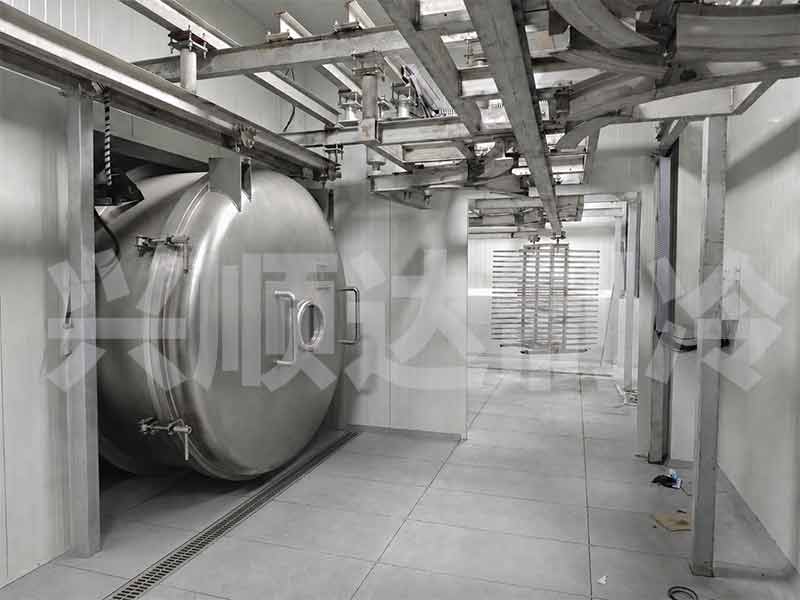
Compare the usable chamber space, tray size, tray count, loading height, shelf spacing, and cart or rack handling method. Ask for a dimensioned chamber and tray drawing, not only a chamber-volume figure.

2. Chamber Reinforcement Under External Pressure
A vacuum chamber is loaded by atmospheric pressure from the outside. Medium and large equipment usually needs reinforcement ribs or a structural frame in addition to suitable wall thickness. Ask how the supplier confirms shell deformation and sealing condition after repeated vacuum cycles.
3. Door, Gasket, and Locking Design
The door should close evenly, protect the gasket from damage, and allow practical inspection and replacement. Ask how operators check contamination, wear, compression marks, and damage on the sealing surface.
4. Leak-Test Method and Result
Do not accept a statement such as “the chamber holds vacuum” without a method. Request the test configuration, chamber volume, starting pressure, isolation time, ending pressure, calculated pressure-rise rate, repeat count, and acceptance limit.
5. Absolute-Pressure Measurement
Ask the supplier to state pressure in an absolute unit such as Pa or mbar. A gauge reading near -0.1 MPa is not precise enough for freeze-drying evaluation. Also confirm the sensor type, range, location, calibration method, and whether the value is empty-chamber ultimate pressure or operating pressure during drying.
6. Vapor Path and Condenser Connection
The chamber outlet, valve, connecting duct, and condenser entrance must carry the vapor released during peak sublimation. Shorter and wider paths usually reduce conductance losses. In a long chamber, outlet position can affect pressure distribution. Review this together with condenser capacity and ice distribution.
7. Hygienic Construction and Cleaning Access
Review internal corners, weld finishing, drainage, removable parts, access around shelves, gasket grooves, and cleaning procedures for sticky fruit, protein-rich food, soups, and powders. FDA equipment rules emphasize corrosion resistance, cleanability, and suitability for intended use. See 21 CFR 117.40 Equipment and Utensils.


Supplier Evidence: What to Request and What It Proves
| Request | What It Helps Verify | Red Flag |
|---|---|---|
| Dimensioned chamber and tray drawings | Usable chamber space, tray fit, loading access, vapor clearance, and maintenance space | Only gross chamber volume is shown. |
| Door, gasket, and locking details | Sealing reliability, gasket replacement, operator inspection, and service access | The supplier only says the chamber “holds vacuum.” |
| Pump-down and pressure-rise leak tests | System evacuation performance and static sealing condition | No method, units, chamber volume, isolation time, or acceptance limit is provided. |
| Vapor path and condenser connection layout | Whether vapor can move smoothly from product trays to the condenser | The condenser is described separately without showing the connection path. |
| Cleaning and maintenance procedure | Downtime, sanitation effort, gasket care, residue control, and routine inspection | Cleaning is described as “easy” without a written procedure. |
| Sensor list and calibration method | Pressure reliability, operation records, alarm logic, and data traceability | Pressure is shown only as -0.1 MPa without absolute units or sensor details. |
For the vacuum-pump side of the system, use the separate freeze dryer vacuum pump guide. Keeping the chamber, condenser, and pump evaluations separate makes supplier comparisons clearer.
Vacuum Test Data Sheet for Buyer Review
Ask each supplier to fill in the same test data. This makes quotations easier to compare and reduces the risk of buying a chamber that looks good in a brochure but performs poorly during production.
| Test Item | Supplier Should State | Buyer Comment |
|---|---|---|
| Chamber volume and usable shelf area | Gross chamber volume, tray size, tray count, and usable shelf area | Use shelf area and product loading to compare real capacity. |
| Empty pump-down test | Starting pressure, target pressure, pump-down time, pump model, and valve status | This shows evacuation performance, not final food drying capacity. |
| Pressure-rise leak test | Starting pressure, ending pressure, isolation time, chamber temperature, and calculated rate | This helps separate chamber leakage from pump performance. |
| Pressure sensor information | Sensor type, range, unit, location, calibration date, and display resolution | Absolute pressure in Pa or mbar is more useful than a rough vacuum gauge reading. |
| Condenser matching | Ice capacity, condenser surface area, lowest temperature, defrost method, and connection size | The condenser must capture vapor before it overloads the pump or raises chamber pressure. |
Get a Product-to-Chamber Review
Send your product name, daily wet load, tray size, layer thickness, target final moisture, preferred batch time, and available utilities. The engineering team can review chamber arrangement, tray fit, condenser load, vacuum configuration, cleaning access, and a basic factory acceptance plan.
A Practical Chamber Acceptance Test Plan
Separate chamber acceptance into document review, visual inspection, empty-system vacuum testing, basic operating review, and cleaning review. These checks help confirm whether the chamber is practical before production use.
- Document review: Confirm chamber drawings, tray drawings, material information, instrument list, vacuum test method, and agreed acceptance criteria.
- Visual inspection: Inspect the door, gasket, internal finish, reinforcement ribs, sensors, valves, drainage, shelf access, and service space.
- Empty-system vacuum test: Record pump-down time, ultimate pressure, pressure-rise leakage, sensor agreement, and chamber sealing condition.
- Basic operating review: Check whether chamber pressure, condenser temperature, vacuum recovery, and operator access remain stable during normal operating conditions.
- Cleaning review: Check whether operators can clean the chamber, gasket area, drain points, shelves, tray carts, and difficult internal corners after a realistic food batch.
Food-safety responsibilities extend beyond the chamber. Covered facilities should integrate equipment cleaning and contamination control into their food-safety system. See the FDA overview of FSMA Preventive Controls for Human Food.
Food-Specific Risks the Chamber Review Should Address
| Product Type | Chamber Review Priority | Related Project |
|---|---|---|
| Sticky or acidic fruit | Cleaning access, tray material, drainage, gasket protection, and high water load | Freeze-dried figs |
| Meat and seafood | Residue control, odor carryover, sanitation, and cleaning consistency | Freeze-dried shrimp |
| Soup and liquid ingredients | Tray depth, spill control, peak vapor load, and cleaning time | Freeze-dried soup |
| Powders and extracts | Dust handling, cross-contamination control, filter protection, and recovery method | Instant tea powder |
Supplier Red Flags
Be careful when a proposal:
- Lists only chamber volume, without tray dimensions or usable shelf area.
- Shows only “-0.1 MPa” as the vacuum value, without absolute pressure in Pa or mbar.
- Does not provide a pressure-rise leak-test method or result.
- Uses a large pump to compensate for weak chamber sealing or a restricted vapor path.
- Describes the condenser, vacuum pump, and chamber separately without a system layout.
- Claims easy cleaning without showing gasket access, drainage, removable parts, or sanitation steps.
Engineering Perspective Behind This Guide
This guide is based on chamber design, vacuum testing, condenser matching, tray loading, cleaning access, and food project acceptance questions commonly reviewed before commercial and industrial freeze dryer delivery.
In food freeze-drying projects, brochure volume alone rarely gives enough information for equipment selection. Chamber leakage affects pressure control, condenser design affects vapor capture, usable shelf area affects batch capacity, and pressure-rise methods can help separate leakage from pump performance. These details matter before a buyer commits to a production system.
FAQ About Industrial Freeze Dryer Chambers
What pressure should a freeze dryer chamber reach?
There is no single pressure that proves suitability for every food. Ask for the absolute-pressure range used during operation, the empty pump-down result, the pressure-rise leak-test result, and the sensor type. These values must be interpreted together with product condition and condenser performance.
Can a larger vacuum pump fix a leaking chamber?
No. It may temporarily mask a small leak, but it does not correct the seal, gasket, weld, valve, or connection causing the problem. It can also increase energy use without solving the real chamber sealing issue.
Is chamber volume the same as production capacity?
No. Production capacity depends on usable shelf area, tray loading, product water content, layer thickness, heat transfer, condenser capacity, vapor flow, and stable vacuum performance.
Why does condenser matching matter for the chamber?
The condenser captures the water vapor released from the product. If vapor cannot move smoothly from the chamber to the condenser, or if the condenser cannot capture the vapor load, chamber pressure can rise and drying can become slower or uneven.
Request a Freeze Dry Vacuum Chamber Evaluation
Share the product, wet load, tray dimensions, layer thickness, target endpoint, batch-time goal, factory utilities, and destination market. The engineering team can review the chamber together with the tray layout, condenser, vacuum system, controls, cleaning access, and factory acceptance plan.
Conclusion
A strong freeze dry vacuum chamber proposal should be measurable. Compare usable shelf area, tray fit, vessel reinforcement, door sealing, pressure measurement, vacuum testing, vapor conductance, condenser connection, and cleanability. This gives food manufacturers a clearer basis for supplier selection and reduces the risk of buying capacity that exists only on a brochure.