
Freeze Dryer for Ice Cream: Test, Size and Select Equipment
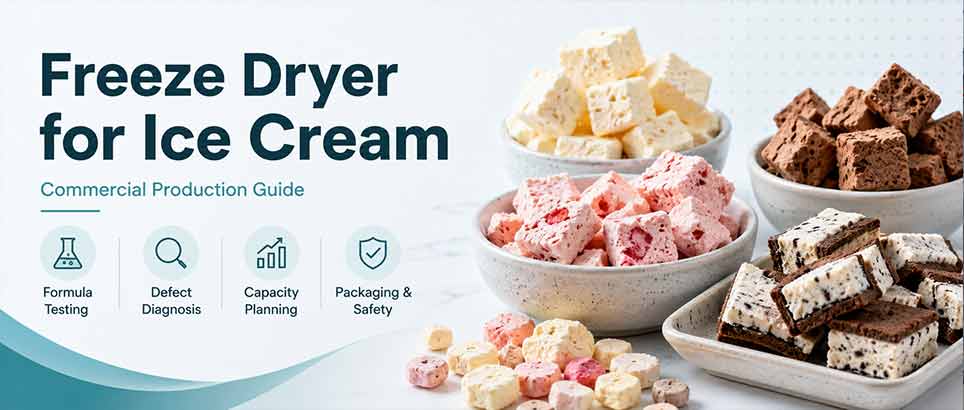
A freeze dryer for ice cream should be selected from a representative product test—not from tray count or a generic internet cycle. The useful inputs are formula, piece geometry, measured tray loading, water removed per batch, complete turnaround and saleable output.
This guide is for food manufacturers and frozen-dessert brands planning pilot, commercial or industrial production. For manufacturers, selecting a freeze dryer for ice cream requires product-specific test data. The guide explains what to test, how to diagnose common defects and which data a supplier needs before recommending equipment.
What Is Freeze-Dried Ice Cream?
Freeze-dried ice cream is a frozen dessert from which water is removed mainly by sublimation under vacuum. The dried structure usually becomes porous, crisp and lightweight. It is commonly sold as small bites, slices, bars, sandwich pieces, coated products or inclusions for snack and bakery applications.
The finished product should not be treated as ordinary ice cream without water. Its eating quality depends on the structure left by the original ice crystals, air cells, fat network, milk proteins, sugars and stabilizers. The same flavor can therefore produce different results when its formula, hardening history or shape changes.
Bites, molded pieces, thin bars, sandwich sections, yogurt bites, plant-based frozen desserts and inclusions for cereal or confectionery.
A factory must control formulation, hardening, transfer time, loading, batch records, allergen management, packaging speed and repeatability.
Why Ice Cream Formulation Matters
Ice cream is a multiphase food made from ice crystals, air cells, fat structures and an unfrozen serum phase. Their interaction depends on formulation and manufacturing history, so a flavor name alone cannot predict freeze-drying behavior.[1]
Fat, protein and emulsification
Fat and proteins help support the air-cell and continuous-phase structure. However, a high-fat product is not automatically unsuitable, and a low-fat product is not automatically easier. Compare formula variants by surface oil, fracture, shrinkage and sensory result instead of screening on fat percentage alone.
Sugar and the freeze-concentrated phase
Sugars depress freezing behavior and concentrate in the unfrozen phase. If a sugar-rich region becomes too mobile during drying, it can deform or remain sticky. Research on frozen sugar systems shows why product-specific thermal behavior matters, but it does not provide a universal ice cream temperature.[3]
Stabilizers and emulsifiers
Stabilizers and emulsifiers alter viscosity, water mobility and structural support. Tests on lactose/protein model systems also show that composition changes moisture sorption and crystallization behavior.[2] The practical lesson is to test the actual formula, not to copy another product’s stabilizer dose.
Overrun, shape and inclusions
Overrun changes piece density, wet load per square meter and breakage risk. Coatings, caramel, fruit preparations and cookies can create separate drying zones. Therefore, commercial trials should use the final piece size, coating thickness and inclusion distribution.
Is the Ice Cream Suitable for Freeze Drying?
A suitability review should connect formulation data with a physical product test. The following information is more useful than a generic flavor description.
| Product factor | Why it matters | What the test should record |
|---|---|---|
| Total solids and moisture | Determine finished yield and water-removal load. | Wet weight, dry yield, final moisture and batch mass balance. |
| Fat and emulsification | Influence structure, surface oil and handling strength. | Surface condition, fracture, mouthfeel and storage behavior. |
| Sugar and syrups | Change freezing behavior, softness and collapse risk. | Hardening condition, stickiness and center dryness. |
| Stabilizer system | Affects pore structure and shape retention. | Uniformity, shrinkage, hardness and batch consistency. |
| Overrun | Changes piece density, shelf loading and breakage. | Piece weight, volume, loading per square meter and damage rate. |
| Shape and maximum thickness | Control vapor path length and center drying. | Dimensions, weight distribution and largest-piece center condition. |
| Coatings and inclusions | May create slow-drying or heat-sensitive regions. | Layer separation, residual soft spots, oil migration and flavor retention. |
Commercial Ice Cream Freeze-Drying Process
For food manufacturers, freeze drying ice cream successfully depends on formulation, hardening, piece geometry, measured tray loading and controlled heat input.
Define the finished product
Set the target texture, dimensions, appearance, pack weight, breakage limit and shelf-life study. Without a finished-product specification, a trial cannot define a useful endpoint.
Form and harden consistent pieces
Control piece weight and thickness, then harden the product before loading. Record the hardening and transfer history. A controlled study on concentrated coffee—not ice cream—showed that freezing conditions changed pore structure and drying kinetics; this supports measuring the real product rather than copying a cycle.[4]
Load trays by measured mass and usable area
Record usable tray area, piece spacing, product height, piece count and wet mass per square meter. Do not copy fruit or meat loading values into an ice cream project.
Control product temperature, pressure and shelf heat
The system must remove vapor while keeping the product within its validated structural limit. In sugar-rich amorphous materials, excessive product temperature can promote softening or collapse.[3] Adjust the recipe from product response and endpoint data, not elapsed time alone.
Verify the endpoint
Check the center of the largest representative pieces, final moisture, mass stability, texture, fracture, surface condition and batch consistency. A dry-looking surface is not enough.
Unload and package as one operation
Plan inspection, weighing and sealing around the batch discharge window. The food freeze dryer selection guide explains the broader production sequence.
Pilot Testing Before Equipment Purchase
A representative trial should precede a commercial purchase when the formula or final format is unvalidated. Pilot testing a freeze dryer for ice cream provides the loading, water-removal and cycle data needed for scale-up. Pilot results should be transferred using measured product loading, water removal and equipment-specific heat and mass transfer rather than assuming identical cycle performance.[5]
- Formula category and approximate total solids
- Fat, sugar, stabilizer, coating and inclusion type
- Piece dimensions, unit weight and overrun
- Starting temperature and hardening method
- Usable tray area and wet load per square meter
- Product, shelf, pressure and condenser trends
- Drying, unloading, defrosting and cleaning time
- Largest-piece endpoint result
- Final moisture and largest-piece center condition
- Saleable yield and mass stability
- Texture, flavor, shrinkage and surface condition
- Breakage after packaging and handling
- Water removed per batch
- Required shelf area and condenser duty
- Full turnaround and practical batches per day
- Wet input and saleable output per day
Request an Ice Cream Freeze-Drying Test
Send the formula category, product photographs, maximum piece dimensions, unit weight, target daily output and planned pack format. The engineering team can use these inputs to define a test-data checklist and the basis for model sizing.
Common Freeze-Dried Ice Cream Problems
| Observed problem | Possible causes | What to check next |
|---|---|---|
| Powdery or extremely fragile pieces | Weak formula structure, excessive aeration, partial melting before freezing, thin geometry or rough handling. | Compare piece density, hardening history, formula variants and packaging drop height. |
| Large cavities or distorted shape | Original air-cell structure, softening under vacuum, rapid heat input or syrup-rich zones. | Review product temperature, shelf program, overrun and inclusion distribution. |
| Oily or greasy surface | Fat migration, emulsion damage, excessive local temperature or high-fat coating. | Test the base and coating separately, then review temperature history and emulsification. |
| Sticky surface or loss of crispness | Incomplete drying, high-sugar region, slow packaging, humid handling area or poor moisture barrier. | Check the largest-piece center, packaging delay, seal integrity and storage test. |
| Dry outside but soft in the center | Excess thickness, inconsistent piece size, high loading, short cycle or insufficient vapor-handling capacity. | Cut the largest pieces, compare load density and examine pressure and condenser performance. |
| High breakage in the pack | Fragile geometry, weak matrix, excessive free volume or aggressive conveying and filling. | Change piece shape, pack count, cushioning, drop height and sealing-line speed. |
How to Calculate Ice Cream Freeze Dryer Capacity
Calculate capacity from mass balance and complete production time. Tray count or chamber volume alone can mislead because product thickness, dry-layer resistance and equipment heat transfer affect the cycle.[5]
Illustrative mass balance
If a tested product contains 38% total solids and the batch loads 200 kg, theoretical dry solids are 76 kg and approximately 124 kg of water must be removed. This is an arithmetic example, not an ice cream specification. Actual saleable yield also reflects residual moisture, samples, crumbs, rejected pieces and packaging loss.
Include turnaround and packaging
Practical batches per day include hardening, loading, vacuum establishment, drying, endpoint confirmation, unloading, defrosting, cleaning and restart. Also confirm that inspection and packaging can handle a full batch without long exposure to room humidity. See the freeze-dried food packaging guide.
Key Requirements for an Ice Cream Freeze Dryer
Vacuum performance under vapor load
The relevant question is not only the ultimate vacuum rating. The system should reach the required pressure promptly, remain stable while water vapor is released and provide reliable measurement. The guide to choosing a vacuum pump for a freeze dryer explains pump-group sizing and pressure measurement in food applications.
Condenser capture capacity
The cold trap should be sized from the amount of water removed per batch, expected vapor-release rate and the production schedule. A very low temperature does not compensate for inadequate capture area, poor heat rejection or insufficient capacity between defrosts.
Controlled shelf heating
Ice cream may contain heat-sensitive, sugar-rich and fat-rich regions. A programmable, staged heating system is therefore more useful than a single aggressive setpoint. Product temperature and pressure trends should be recorded with each recipe.
Tray geometry and usable area
Tray dimensions, shelf spacing and product height determine how many pieces can actually be loaded. The calculation should use usable area after allowing for spacing and handling—not the nominal chamber footprint.
Batch records and repeatable control
The control system should record pressure, condenser temperature, product or probe temperature, shelf stages, alarms and batch identification. Repeatable records help distinguish a formulation problem from an equipment or operating problem.
Cleanability and allergen control
Food-contact surfaces, trays, chamber access and drainage should support an established cleaning procedure. Dairy products also require careful control of milk allergen cross-contact when the same line processes non-dairy foods.
How to Choose a Freeze Dryer for Ice Cream
The correct freeze dryer for ice cream should follow the validated product load and required output. Published capacities below refer to general wet food capacity per 24 hours and are not guaranteed ice cream output. Product-specific capacity must be corrected by test loading, solids content, cycle and packaging yield.
Buyers moving beyond pilot scale can compare the commercial freeze dryer models and industrial freeze dryer models. Site utilities, rigging, cooling, drainage and maintenance access should also be reviewed through the commercial freeze dryer installation guide.
Packaging, Storage and Food Safety
Validate moisture protection and shelf life
Low-moisture lactose/protein systems can change as they absorb water, while water plasticization can reduce structural stability.[2][3] Choose the moisture barrier, oxygen barrier, seal and pack protection from the real formula, storage conditions and breakage target. Do not copy a shelf-life claim from another product.
Control milk and other allergens
For products sold in the United States, the FDA identifies milk among the nine major food allergens and requires controls for labeling and allergen cross-contact. Cookies, nuts, egg, soy or sesame can add further obligations.
Do not treat freeze drying as a kill step
The University of Minnesota Extension states that freeze drying does not inactivate illness-causing microorganisms. Commercial producers still need applicable raw-material controls, pasteurization or another validated treatment, sanitation, environmental controls and post-drying protection.
Is Freeze-Dried Ice Cream a Good Business?
Freeze-dried ice cream may support premium snack positioning and ambient distribution, but only after the product, package, safety and shelf life are validated. Build the business case from four measured groups:
Base mix, hardening, labor, energy, cleaning, quality control, packaging and rejected product.
Saleable yield, full turnaround, utilization, changeover, packaging speed and breakage.
Pack weight, channel margin, shipping volume, promotion, repeat purchase and price tolerance.
Other validated products that can use the dryer when ice cream demand is seasonal or uncertain.
Use the freeze-drying business guide for the wider investment model. This page remains the topic owner for ice cream formulation, testing and equipment fit.
Information Needed for an Equipment Recommendation
A more accurate recommendation can be prepared when the inquiry includes:
- Ice cream or frozen-dessert category
- Approximate fat, sugar, total solids and stabilizer system
- Coating, filling and major inclusion type
- Product shape, maximum thickness and unit weight
- Target wet input and finished output per day
- Operating hours, planned batches and pack size
- Existing hardening or pre-freezing equipment
- Available power, cooling water and steam
- Ground-floor installation space, access and drainage
- Destination market and whether product testing is required
Frequently Asked Questions
Can any ice cream be freeze-dried?
No. Many products can be tested, but fat, sugar, stabilizers, overrun, coatings and piece geometry can produce very different texture and drying behavior. A representative trial is the safest basis for commercial production.
Why does freeze-dried ice cream become powdery?
Possible causes include weak structural support, high aeration, partial melting before hardening, very thin pieces or rough handling. Formula, hardening history and packaging should be reviewed together.
How long does ice cream take to freeze dry?
There is no universal time. Formula, piece size, loading, pressure, shelf heat, condenser performance and endpoint all affect the cycle. Testing should define the time for the specific saleable product.
Does ice cream need to be pre-frozen?
The product should enter the drying process fully hardened and should not be allowed to soften during forming or loading. Whether hardening occurs in a separate freezer or as part of the project design depends on the production layout.
Does freeze-dried ice cream need refrigeration?
A storage claim should follow product, package and shelf-life verification. The dried product may be suitable for ambient distribution when its safety, moisture protection and quality remain controlled under the intended conditions.
What size freeze dryer for ice cream is required?
Size the model from measured wet loading, solids content, water removed per batch, practical turnaround, saleable yield and target daily output—not tray count alone.
Request an Ice Cream Test and Model Recommendation
Send the product format, approximate solids, largest-piece dimensions, target wet input or finished output, available utilities and planned package. The engineering team can use this information to define the test scope and the data needed for a model recommendation.
Peer-Reviewed References
- Wu B, Sözeri Atik D, Freire DO, Hartel RW. The Science of Ice Cream Meltdown and Structural Collapse: A Comprehensive Review. Comprehensive Reviews in Food Science and Food Safety. 2025;24(4):e70226. The Science of Ice Cream Meltdown and Structural Collapse — DOI: 10.1111/1541-4337.70226
- Haque MK, Roos YH. Differences in the physical state and thermal behavior of spray-dried and freeze-dried lactose and lactose/protein mixtures. Innovative Food Science & Emerging Technologies. 2006;7:62–73. Physical State of Spray-Dried and Freeze-Dried Lactose Mixtures — DOI: 10.1016/j.ifset.2004.12.004
- Roos YH. Frozen state transitions in relation to freeze drying. Journal of Thermal Analysis and Calorimetry. 1997;48(3):535–544. Frozen State Transitions in Relation to Freeze Drying — DOI: 10.1007/BF01979500
- Levin P, Meunier V, Kessler U, Heinrich S. Influence of Freezing Parameters on the Formation of Internal Porous Structure and Its Impact on Freeze-Drying Kinetics. Processes. 2021;9(8):1273. Influence of Freezing Parameters on Porous Structure and Freeze-Drying Kinetics — DOI: 10.3390/pr9081273
- Ratti C. Freeze drying for food powder production. In: Handbook of Food Powders. 2013:57–84. Freeze Drying for Food Powder Production — DOI: 10.1533/9780857098672.1.57
Regulatory and food-safety sources
- U.S. FDA: Food Allergies — major allergen labeling and cross-contact controls.
- University of Minnesota Extension: Freeze-Dried Foods and Food Safety — freeze drying is not a pathogen kill step.
Technical note: Product quality and equipment capacity remain product-specific. Representative testing is recommended before final selection. Literature was last reviewed: July 1, 2026.