
Commercial Freeze Dryer Accessories: Parts & Supplies Checklist
A commercial buyer’s guide to trays, vacuum components, operating supplies, compatibility checks and critical spare parts for food factories.
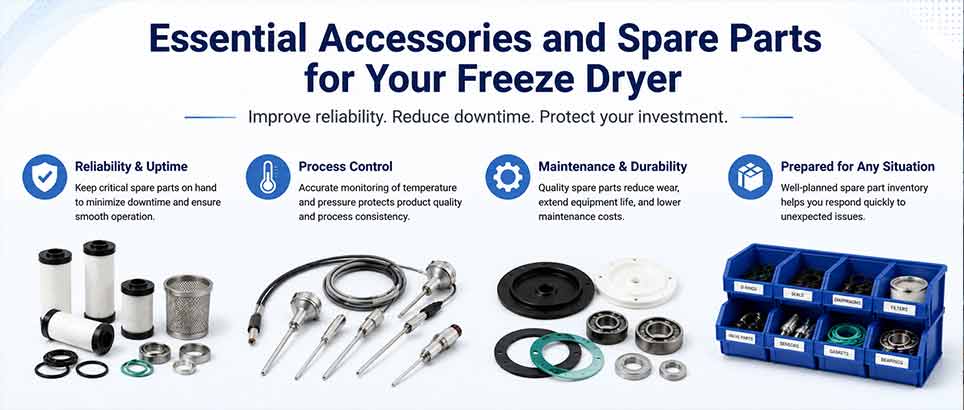
Freeze dryer accessories are not limited to trays and vacuum pump oil. A food factory may also need loading carts, product-temperature probes, calibrated vacuum instruments, seals, filters, cleaning tools, control components and a planned stock of critical freeze dryer spare parts.
The correct list depends on the machine model, food product, annual operating hours, factory utilities and the maximum downtime the business can accept. This guide helps food manufacturers separate standard equipment, optional freeze drying accessories, routine supplies and production-critical spare parts before approving a quotation.
Scope: This is a commercial and industrial food-production guide. It does not cover household tray lids, silicone mats, storage bags or brand-specific home freeze dryer accessories.
Technical review: Zheng Wei, Founder & Freeze-Drying System Engineer | Updated June 28, 2026
Quick answer: A commercial freeze dryer normally requires food-contact trays, loading equipment, a correctly sized vacuum system, pressure and temperature instruments, control and data-recording functions, defrost and drainage provisions, and model-specific maintenance items. The buyer should also request a separate list of consumables, recommended two-year spare parts and lead times for every production-critical component.
Request a Model-Specific Accessories and Spare Parts List
Food manufacturers can provide the product type, wet batch weight, planned freeze dryer model, destination country, available utilities and expected annual operating hours. The engineering team can review this information and prepare a recommended supply boundary, model-specific accessory list, two-year spare-parts scope and lead-time risk summary for the project.
Separate Four Groups Before Comparing Prices
The term “accessories” is often used too broadly. A useful quotation separates the following four groups because they have different purposes, replacement cycles and purchasing decisions.
1. Standard Equipment
Standard equipment includes the complete drying chamber and shelf assembly, refrigeration and cold-trap system, shelf heating and heat-transfer system, vacuum system, product trays and loading equipment, valves, sensors, control hardware, and the included cold-trap defrost and drainage system.
2. Optional Accessories
Items selected according to the product, workflow or factory layout may include additional loading carts, extra product-temperature probes for representative trays, remote monitoring, pre-freezing racks or mobile tray carts for projects using a separate freezing room, and an alternating external cold-trap arrangement.
3. Consumables and Service Supplies
Items used or replaced during normal maintenance, including approved vacuum pump oil, oil filters, exhaust filters, selected seals, cleaning materials and lubrication products specified by the component manufacturer.
4. Critical Spare Parts
Model-specific parts that can stop production and may not be available locally, such as door seals, pressure sensors, product-temperature probes, valve seals, actuator diaphragms or manufacturer-specified service kits, control modules and selected refrigeration or electrical components.
Quick Checklist of Commercial Freeze Dryer Accessories
1. Trays and Product Loading Equipment
Trays are among the most visible freeze dryer accessories, but quantity alone is not enough. The buyer should confirm tray material, usable area, internal dimensions, edge height, weight, cleaning method and compatibility with the machine’s loading system.
Tray questions that affect production
- Usable area: Is capacity based on actual tray area or nominal shelf area?
- Product depth: Can the tray safely hold the intended liquid depth or solid loading thickness?
- Food-contact material: Is the material suitable for the intended food and cleaning procedure?
- Handling: Can operators load, move and unload trays without spilling or damaging the product?
- Batch turnover: Are enough trays supplied for loading, pre-freezing, drying, unloading and cleaning without delaying the next batch?
A factory processing liquid extracts, milk, egg, soup or other pumpable products may need different tray edge heights and handling procedures from a factory processing fruit slices or meat pieces. Extra trays can improve workflow, but buying more trays does not increase dryer capacity unless shelf area, condenser load and vapor-removal capability can support the added product.
For tray dimensions, loading capacity and buyer checks, see the detailed commercial freeze dryer trays guide.

2. Vacuum System Accessories and Maintenance Supplies
The vacuum pump, chamber, condenser, valves and piping form one system. Freeze drying accessories for the vacuum side must therefore be selected by pressure range, pumping speed, vapor exposure, pipe conductance and service requirements—not by connection size alone.
Common vacuum-side items
- Backing pump, Roots booster or liquid-ring pump components, depending on the installed system
- Vacuum valves, non-return valves, isolation valves and service kits
- Flexible connectors, flanges, clamps and model-specific sealing elements
- Inlet filters, exhaust filters and oil-mist filters where required
- Approved vacuum pump oil and replacement oil filters for oil-sealed pumps
- Cooling-water accessories, strainers and flow protection where applicable
Using the wrong oil, filter or seal can reduce vacuum performance or damage the pump. Maintenance frequency should be based on operating hours, product vapor exposure, oil condition and the pump manufacturer’s instructions. Leybold’s technical guidance similarly notes that oil-change requirements depend on operating conditions and contamination rather than a universal fixed interval.[8]
The buyer should request a leak-isolation kit, not only pump oil. A practical kit may include approved door and line seals, valve seals, actuator diaphragms or manufacturer-specified service kits, clamps, blanking plates and the correct vacuum grease for the installed design. The exact contents must follow the machine drawing and seal-material specification.[1]
Related resources: vacuum pump selection for freeze dryers and freeze dryer vacuum pump oil and maintenance. For an external maintenance reference, review Leybold’s rotary-vane vacuum pump oil guidance.

3. Vacuum Gauges, Product-Temperature Probes and Data-Recording Accessories
A displayed pressure value is not enough to confirm process control. The measurement system should have a suitable pressure range, documented accuracy, a defined sensor location and a practical calibration or replacement plan.
Measurement items to confirm
- Chamber pressure sensor type, range and accuracy
- Sensor behavior in water-vapor conditions
- Product temperature probe quantity and placement
- Shelf, heating-medium and cold-trap temperature sensors
- Alarm history, trend recording and batch data export
- Calibration documentation and local service options
- Spare sensors or probes for production-critical measurements
Vacuum gauge calibration matters because drying decisions depend on reliable pressure measurements. NIST explains that vacuum gauge calibration should address uncertainty and traceability to calibration standards.[7] Published equipment guidance also treats temperature measurement, vacuum measurement, alarms, historical records and replaceable probes as parts of one control system.[2] Buyers should ask what can be calibrated, where it can be serviced and whether a replacement sensor requires scaling, wiring or control-system reconfiguration.
For technical background, see NIST’s vacuum gauge calibration resource and the site’s guide to freeze dryer vacuum chamber checks.
4. Cold Trap, Defrost and Refrigeration Spare Parts
The cold trap captures sublimated water vapor as ice. Its total ice capacity, hourly capture rate, temperature, surface area and vapor-path design affect vacuum stability and drying time. A laboratory-unit study showed that uneven vapor distribution can concentrate ice near the inlet and create an “ice blockage”; the exact result is design-specific, but it demonstrates why nominal ice capacity alone is insufficient.[3]
Items commonly reviewed with the manufacturer
- Cold-trap temperature sensors and approved replacements
- Defrost valves, heaters or hot-gas components used by the specific design
- Drain valves, hoses and water-management accessories
- Refrigeration pressure controls and protection devices
- Specified contactors, relays, solenoid coils and control components
- Cooling-water strainers, flow switches and tower-related interfaces
Refrigeration parts should not be stocked by name alone. Document the manufacturer, exact model, voltage, refrigerant and oil compatibility, setpoint or control parameters, approved substitute and replacement procedure. Fault analysis has identified filters, pressure-control components, relays and compressor service parts as distinct failure points; stocking a generic “refrigeration kit” is therefore not enough.[4] For condenser selection and defrost planning, read the freeze dryer condenser guide.


5. Food-Contact and Cleaning Accessories
Trays, product-contact tools, seals and cleaning accessories should be selected for the food, cleaning chemistry and operating conditions. The U.S. FDA explains that food-contact substances can include processing equipment and food-preparation surfaces, not only packaging.[6]
Practical checks for food factories
- The material of trays and other product-contact items should be documented.
- Removable items should be checked for effective cleaning and drying before the next batch.
- Replacement door and product-contact seals should be kept in protected storage.
- Separate handling tools should be used where allergen or flavor carryover is a concern.
- The cleaning procedure should not leave water in the chamber, condenser or vacuum lines before evacuation.
- Cleaning procedures should be matched to sticky, high-sugar, oily or protein-rich products.
A strawberry-processing case study traced microbial contamination to hard-to-clean cutting spaces and incompletely cleaned stainless-steel trays.[5] The practical purchasing lesson is to review drainability, disassembly, blind spots and the ability to verify cleaning—not to copy one disinfectant recipe across foods or markets.
Regulatory requirements differ by market and application. Buyers serving the United States can review the FDA’s overview of food packaging and other food-contact substances and confirm the final material and cleaning procedure with their own compliance team.
6. Packaging Equipment Is Related—but Not a Freeze Dryer Accessory
Freeze-dried food can quickly absorb moisture after leaving the chamber. Packaging is therefore essential to the complete production line, but the packaging machine, barrier pouch, oxygen-control method and labeling system should be listed separately from the freeze dryer accessories.
The packaging scope may include a heat sealer, vacuum packaging machine, nitrogen-flushing system, high-barrier pouches, moisture and oxygen control, metal detection and labeling equipment. The correct choice depends on the product, residual moisture, oxygen sensitivity, package size, target shelf life and local food regulations.
This separation prevents a common purchasing error: assuming that a freeze dryer quotation automatically includes the equipment required to protect the product after unloading. See the full commercial freeze-dried food packaging guide.
7. Which Freeze Dryer Spare Parts Can Stop Production?
A practical spare-parts plan ranks components by production impact, local availability and replacement time.
Level 1: Keep on Site
Low-cost or frequently serviced parts that can stop a batch and are straightforward for trained personnel to replace.
- Door and vacuum seals
- Approved pump oil and routine filters
- Common fuses, relays and contactors
- Frequently serviced valve seal kits
- Selected temperature probes and pressure sensors
Level 2: Keep Regionally Available
Higher-value components that should have a confirmed supplier, lead time and replacement procedure.
- Vacuum pump service components
- Control modules and HMI-related parts
- Selected refrigeration controls
- Specialized valves and actuators
- Spare vacuum gauges, pressure transmitters and temperature sensors
Level 3: Planned Maintenance Items
Parts or upgrades normally ordered for scheduled work rather than emergency stock.
- Additional loading carts
- Extra trays beyond the quantity required for normal batch turnover
- Monitoring upgrades
- Non-critical structural components
- Optional automation additions
Level 4: Manufacturer-Supported Components
Major or software-dependent items that require manufacturer coordination, configuration or specialist replacement.
- Compressors and major refrigeration components
- PLC program-dependent hardware
- Major pump or booster assemblies
- Custom heat-transfer components
- Safety-control modifications

8. How to Check Accessory Compatibility
“It can be installed” does not mean “it is suitable for production.” Before third-party freeze dryer supplies or replacement parts are ordered, the purchasing team should verify the complete specification.
- The purchasing team should identify the exact freeze dryer model and serial number. Parts may change between production versions.
- The purchasing team should confirm chamber, shelf and tray dimensions. Nominal area does not guarantee physical fit.
- The flange and sealing standard should be checked. Diameter, clamp type and elastomer material all matter.
- Pressure, temperature and chemical exposure should be reviewed. Food vapors, cleaning agents and heat can affect materials.
- The electrical data should be confirmed. Voltage, frequency, phase, coil voltage, signal type and protection rating must match.
- Sensor output and control compatibility should be checked. A similar range does not guarantee the same signal or calibration.
- Refrigeration compatibility should be verified. Refrigerant, oil, pressure rating and control logic must be documented.
- Warranty and software implications should be confirmed. Unapproved substitutions may affect support or require control changes.
9. What Should Be Included in a Freeze Dryer Quotation?
A useful quotation should show the complete supply boundary. It should not list only the chamber area, machine price and nominal power.
Already Comparing Freeze Dryer Quotations?
A low equipment price may exclude trays, cooling equipment, commissioning, critical spares or production support. Purchasing teams can submit the product, target output and supplier scope for an engineering review of major omissions and compatibility risks.
10. Recommended Accessory Packages by Production Scale
Lab and Pilot Systems
- Flexible tray selection for product trials
- Additional product-temperature probes for representative trays
- Reliable data recording and export
- Spare seals and routine pump supplies
- Sample packaging and moisture-testing plan
Commercial Systems
- Extra trays for continuous batch preparation, together with loading carts
- Vacuum pump maintenance stock
- Common sensors, seals and electrical spares
- Packaging equipment matched to daily output
- Remote support and production records
Industrial Systems
- Multiple loading carts and planned workflow
- Critical system spares and regional service plan
- Remote monitoring and longer data retention
- Redundancy review for vacuum and refrigeration
- Two-year or operating-hour-based spare package
11. How to Build a Two-Year Spare-Parts Package
A useful package is based on operating conditions rather than a fixed list sold to every customer. The manufacturer should review:
- Expected batches and operating hours per year
- Product moisture, sugar, oil, acidity and particle exposure
- Vacuum pump type and service interval
- Local availability of filters, oil, seals and electrical components
- International shipping time and customs risk
- How long the factory can accept production downtime if the freeze dryer stops
- The maximum acceptable production interruption
- Maintenance capability of the local engineering team
The final document should list the part name, part number, installed quantity, recommended stock, replacement trigger, storage requirements, shelf life where relevant and normal lead time. High-value components do not always need to be stored on site, but their supplier and delivery route should be confirmed before production begins.
12. Questions to Ask a Freeze Dryer Manufacturer
- Which freeze dryer accessories are included in the quoted price?
- Which items are optional, and why would this product need them?
- How many trays, racks and loading carts are supplied?
- Which consumables require routine replacement?
- Which spare parts should be stored at the factory?
- What are the exact part numbers and normal delivery times?
- Can routine parts be sourced locally without affecting the warranty?
- How are vacuum and temperature instruments calibrated or replaced?
- Which components require manufacturer programming or commissioning?
- Are installation, operator training and first-batch support included?
- Is a two-year or operating-hour-based spare-parts package available?
- Can the list be adjusted after pilot testing the actual food product?
Frequently Asked Questions
What accessories are essential for a commercial freeze dryer?
Essential items normally include food-contact trays, loading equipment, the complete vacuum system, valves and piping, pressure and temperature sensors, control and data-recording functions, defrost and drainage provisions, and routine maintenance supplies. The exact scope must be confirmed in the quotation.
Can any vacuum pump be connected to a freeze dryer?
No. The pump must match chamber volume, operating pressure, evacuation time, pipe conductance, condenser performance, vapor exposure and available utilities. A refrigeration service pump is not automatically suitable for continuous food freeze-drying production.
Which freeze dryer spare parts should be kept on site?
Factories commonly keep door and vacuum seals, approved pump oil and filters, frequently serviced valve parts, common electrical protection components and selected sensors on site. The final list should be based on the machine model, operating hours and local delivery time.
How often should vacuum pump oil and filters be replaced?
There is no universal interval. Replacement depends on operating hours, water-vapor carryover, product contamination, oil condition and the pump manufacturer’s instructions. Evacuation time, oil appearance and pressure stability should be trended as part of preventive maintenance.
Can accessories from different manufacturers be used together?
Sometimes, but compatibility must be confirmed. Dimensions, materials, pressure ratings, electrical data, sensor signals, control logic and warranty implications should all be checked before substitution.
Should a factory order a one-year or two-year spare-parts package?
The period should reflect operating hours, local service capability and delivery time. For internationally supplied equipment or factories that cannot accept extended downtime, a two-year critical-spares plan is often more practical than ordering parts only after failure.
Final Buyer’s Decision Check
Plan the Machine, Accessories and Spare Parts as One System
The most reliable quotation is not the one with the longest accessory list. It is the one that matches the food product, batch load, vacuum system, factory workflow, maintenance capability and acceptable downtime.
Food manufacturers can submit the product type, target daily output, preferred machine size, destination country and available utilities to request a model-specific equipment and spare-parts recommendation.
Evidence and Technical References
The numbered sources below support the specific vacuum, control, condenser, refrigeration and cleaning claims cited in the article. Findings from pharmaceutical or laboratory equipment are used only for the relevant engineering principle and are not presented as universal food-production specifications.
- [1] 何听. 冻干机真空系统常见故障的分析与解决方法[J]. 机电信息, 2022(9): 73–76. DOI: 10.19514/j.cnki.cn32-1628/tm.2022.09.020.
- [2] 郑效东. 冻干机的控制与结构[J]. 机电信息, 2004. DOI: 10.19514/j.cnki.cn32-1628/tm.2004.15.019.
- [3] 李筱泉. 真空冷冻干燥机凝结器的改进[J]. 龙岩学院学报, 2007, 25(6): 87–88+92. DOI: 10.16813/j.cnki.cn35-1286/g4.2007.06.029.
- [4] 何听, 陈鹏. 冻干机制冷系统常见故障的分析与处理[J]. 机电信息, 2021(9): 20–21. DOI: 10.19514/j.cnki.cn32-1628/tm.2021.09.008.
- [5] 郭俊华. 草莓冻干设备消毒清洗剂的应用初探[J]. 中国洗涤用品工业, 2021(10): 52–56. DOI: 10.16054/j.cnki.cci.2021.10.007.
- [6] U.S. Food and Drug Administration. Food Packaging and Other Substances That Come in Contact with Food.
- [7] Abbott, P. J. The Calibration of Vacuum Gauges. National Institute of Standards and Technology, 2006.
- [8] Leybold. Rotary Vane Vacuum Pump Maintenance and Oil Change.

About the Author
Zheng Wei — Founder & Freeze-Drying System Engineer
Zheng Wei participates in the company’s food freeze-drying projects, including product testing, equipment selection, vacuum-system configuration, refrigeration planning, installation guidance and drying-process optimization.