
Freeze Dried Food Machine and Equipment for Commercial Food Production
A freeze dried food machine is only one part of a reliable production system. Food manufacturers also need pretreatment, pre-freezing, vacuum drying, condenser capacity, packaging, utilities, and process support to turn raw materials into stable commercial products.
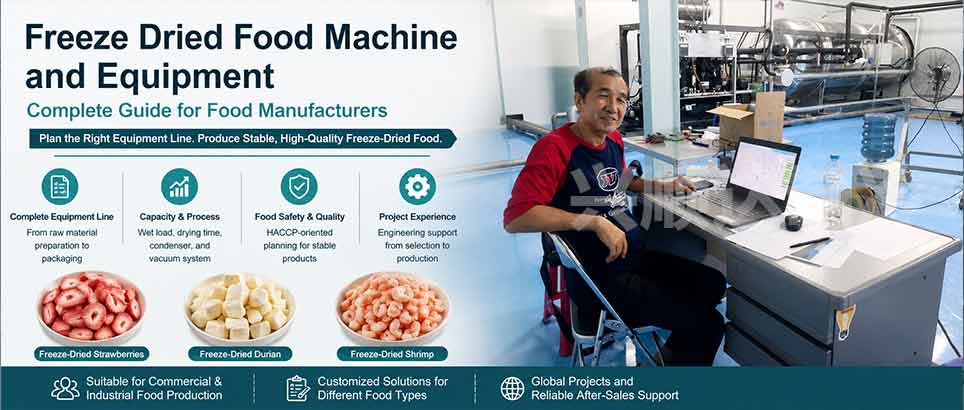
Many buyers search for freeze dried food machine, freeze dried food equipment, or food freeze drying equipment when they want to start or expand a freeze-dried food project. However, the real purchase decision is rarely about a single machine. A factory must confirm the food product, wet load, drying time, condenser load, vacuum system, packaging method, floor space, power supply, and operator workflow before choosing equipment.
This guide explains how a food manufacturer should plan a commercial freeze-dried food production line. It is written for buyers who need a practical configuration plan, not a home freeze-drying tutorial. It also shows when a buyer should choose a lab or pilot unit, a commercial freeze dryer, or an industrial freeze dryer.
1. What Equipment Is Needed to Make Freeze-Dried Food?
A commercial freeze-dried food project usually needs more than a food freeze dryer machine. The exact configuration depends on the raw material, product form, and daily output target. In most food factories, the equipment line includes several modules.
Pretreatment
Washing, peeling, slicing, cooking, blanching, draining, or portioning equipment prepares the product before freezing. This stage controls thickness, loading density, surface water, and product consistency before the freeze dryer starts.
Freeze Drying
The freeze dryer, vacuum pumps, condenser, refrigeration system, heating system, trays, and loading carts perform the drying process. These parts must be matched as one system because a weak condenser or vacuum pump can reduce daily output.
Post-Processing
Weighing, nitrogen flushing, sealing, metal detection, labeling, and moisture-proof packaging protect the final product. Freeze-dried foods absorb moisture quickly, so packaging speed and room humidity should be planned with the dryer.
For this reason, buyers should not compare equipment only by tray count or chamber size. Instead, they should compare the complete production route from raw material receiving to final packaging.
2. Freeze Dried Food Machine vs Complete Freeze Dried Food Equipment Line
Search terms can be confusing. Different buyers use different words for the same project. Therefore, an engineering supplier should first clarify what the buyer means before giving a model recommendation.
| Buyer Search Term | Common Meaning | Engineering Interpretation |
|---|---|---|
| freeze dried food machine | One machine for making freeze-dried food | Usually refers to the freeze dryer body, but the project may need pre-freezing and packaging support. |
| freeze dried food equipment | Equipment for a full production process | May include pretreatment, freeze dryer, vacuum system, condenser, loading carts, and packaging equipment. |
| food freeze drying equipment | Commercial or industrial food processing equipment | Best matched with factory-scale planning, utility design, and process validation. |
| freeze dry food machine | A machine used to freeze dry food | Can mean home, pilot, commercial, or industrial equipment, so the required output must be confirmed. |
If the buyer only needs a general machine comparison, the food freeze dryer guide and the freeze dryer machine selection guide provide more details. This article focuses on the complete equipment system for commercial food production, so it should support the broader product and commercial dryer pages instead of competing with them.
3. Start with the Food Product, Not the Machine Size
A reliable freeze-drying project starts with the food product. A supplier cannot choose the right food freeze drying equipment from daily output alone because different foods create different water loads, drying times, textures, and packaging risks.
Before selecting a machine, buyers should confirm:
- Food type, such as fruit, vegetable, meat, seafood, cooked meal, coffee, tea, herb, candy, or pet food.
- Initial moisture content and target final moisture.
- Slice thickness, cube size, liquid depth, or portion weight.
- Required wet material capacity per day.
- Expected drying time and working hours per day.
- Packaging format, target shelf life, and storage condition.
- Factory utilities, including power supply, cooling water, steam, drainage, and compressed air.
For example, 1,000 kg of sliced fruit and 1,000 kg of soup ingredients may require very different shelf area, condenser capacity, and drying time. Therefore, the equipment plan should come after the product analysis.
4. Key Data Needed Before Choosing Freeze-Dried Food Equipment
A useful quotation should be based on process data, not only a model list. The following table gives buyers and suppliers a shared checklist for selecting the freeze dried food machine, condenser, vacuum system, trays, pre-freezing plan, and packaging line.
| Selection Data | Why It Matters | Example Buyer Input |
|---|---|---|
| Product type and form | Fruit slices, seafood, cooked meals, and liquids dry at different rates and need different loading methods. | Sliced mango, cooked shrimp, instant coffee, soup cubes, pet food pieces. |
| Initial moisture and target final moisture | The removed water load determines condenser demand, cycle time, and energy use. | Initial moisture 80%; target final moisture below 5%. |
| Thickness or liquid depth | Thickness affects heat and mass transfer. A thicker layer can extend drying time even on the same shelf area. | Fruit slices 6 mm; liquid depth 8 mm; cooked meal cubes 15 mm. |
| Wet load per batch or per day | Capacity must be calculated from wet load, not only final dry product weight. | 300 kg wet material per day or 1,500 kg wet material per day. |
| Expected working schedule | One batch per day, two batches per day, or multi-day cycles create different equipment needs. | One 16-hour drying cycle plus loading, unloading, and defrosting. |
| Packaging method | Moisture-sensitive products need fast transfer, dry packing, and suitable barrier materials. | Nitrogen flush pouches, cans, jars, or bulk bags with desiccant. |
| Available utilities | Power, cooling water, steam, compressed air, and drainage can limit model selection. | 380 V / 50 Hz / 3 phase, cooling tower available, no steam supply. |
5. Raw Material Preparation and Pre-Freezing Equipment
Pretreatment affects product quality before the freeze dryer starts. It controls thickness, surface moisture, sugar migration, oil content, microbial risk, and loading density. As a result, the same freeze dryer can deliver different results when the preparation process changes.

Fruit and Vegetable Preparation
Fruit and vegetable projects often need washing, peeling, cutting, coring, slicing, blanching, and draining. In many projects, 4-10 mm slices give a practical balance between drying speed, texture, and loading density. However, thick pieces may need a longer cycle and stronger process control.
Meat, Seafood, and Ready Meal Preparation
Meat, seafood, and cooked meal projects often require cooking, seasoning, cooling, portioning, and oil control before loading. The factory should also consider food safety controls for raw and cooked areas. For meat and seafood projects, buyers can review the freeze dryer for meat guide and the freeze-dried shrimp case study.
Coffee, Tea, Extracts, and Liquid Foods
Liquid or extract products need special control of concentration, filling depth, pre-freezing form, and tray handling. Therefore, a pilot test is useful before a large industrial purchase.
Pre-Freezing: Inside the Dryer or Separate Freezer?
| Pre-Freezing Method | Suitable For | Main Consideration |
|---|---|---|
| Freezing inside the freeze dryer | Small batches, tests, and some pilot projects | It saves separate freezer investment but uses valuable dryer time. |
| Separate blast freezer or cold room | Commercial and industrial production | It supports faster loading and better batch scheduling. |
| Product-specific molds or trays | Liquids, soups, coffee, tea, and shaped products | It controls frozen shape, thickness, and final appearance. |
When a factory wants continuous output, a separate pre-freezing plan often improves the whole line more than a larger drying chamber alone.
6. Core Freeze Dryer System: What Buyers Should Compare
The core freeze dried food machine should match the product and daily production target. A buyer should compare engineering capacity, not only brochure size. Equipment literature and field experience both show that food freeze dryer quality depends on the drying chamber, condenser, refrigeration system, vacuum system, heating system, controls, and process support working together.

Production Parameters
Production parameters show whether the machine can make enough saleable product in the buyer’s real working schedule.
- Usable shelf area
- Wet load per batch
- Tray size and loading cart design
- Recommended loading density
- Drying time by product type
System Parameters
System parameters show whether the freeze dryer can remove vapor, maintain pressure, supply heat, and control the batch repeatably.
- Condenser ice capacity and capture rate
- Vacuum pump configuration
- Refrigeration system capacity
- Heating system and shelf temperature control
- HMI records, alarms, and remote support
For commercial food projects, the engineering team usually checks shelf area, condenser load, vacuum speed, and heating control together. If one system is weak, the drying cycle becomes longer and the final product may lose appearance, texture, or moisture stability.
Need a Model Recommendation?
Send the product type, wet material per day, slice thickness, target final moisture, and local utility conditions. The engineering team can estimate shelf area, condenser load, drying cycle, model range, and budget direction before a formal quotation.
7. Capacity Calculation for Freeze-Dried Food Production
Capacity should be calculated from wet material, product thickness, drying time, and working schedule. A simple tray count cannot show real daily output.
Basic capacity formula
Daily wet material capacity = wet load per batch × batches per day
In many commercial food projects, loading density is commonly planned around 10-13 kg/m2. Typical drying time for many sliced foods is 8-15 hours, while some extract or high-load products may require up to 20 hours.
For example, if a factory loads 12 kg/m2 on a 20 m2 shelf area, one batch can load about 240 kg of wet material. If the product finishes within one batch per day after loading, drying, unloading, and defrosting, the practical daily capacity is close to 240 kg wet material. If the product needs a longer drying time, the daily capacity decreases even when the chamber size stays the same.
Buyers should also separate wet material capacity from final dry product capacity. If a fruit has 85% initial moisture and the final product has low residual moisture, the final dry weight is much lower than the wet loading weight. This is why factory planning should start with the raw material load and water removal requirement.
Energy use should also enter the capacity plan. For budget planning, buyers can read the freeze dryer electricity use guide and the industrial freeze dryer cost analysis.
8. Commercial vs Industrial Freeze Dried Food Machine
The right scale depends on testing status, sales volume, factory space, and utility conditions. A home freeze dryer is usually not suitable for commercial food production because its data, loading method, condenser system, and batch control cannot support factory planning.
| Scale | Suitable Buyer | Typical Purpose | Recommended Next Page |
|---|---|---|---|
| Lab / Pilot Freeze Dryer | R&D teams, new product developers, and pilot plants | Validate recipe, drying curve, thickness, final moisture, and product appearance. | Lab / Pilot Freeze Dryer |
| Commercial Freeze Dryer | Food startups and small to medium factories | Produce fruit, vegetables, meat, seafood, ready meals, pet food, and snack products. | Commercial Freeze Dryer |
| Industrial Freeze Dryer | Large factories and established food processors | Support higher wet material capacity, stronger utility planning, and large batch production. | Industrial Freeze Dryer |
When the process is not proven, pilot testing should come before a large order. This protects the buyer from buying an oversized machine without verified drying data.
9. Vacuum System and Condenser: The Parts Buyers Often Ignore
Many buyers first look at chamber volume. However, condenser and vacuum performance often decide whether the project can reach stable commercial output. The condenser must capture vapor fast enough, and the vacuum system must remove non-condensable gas and maintain pressure during drying.
Common Risk
A large chamber with a weak condenser or slow vacuum pump may look attractive on price. However, it can extend drying time from a normal production cycle to a much longer cycle, which increases energy cost and reduces daily output.
Condenser and Vacuum Questions to Ask
Before comparing prices, ask the supplier to explain the condenser and vacuum design. This is especially important for high-moisture foods, thick products, and large wet loads.
- Confirm condenser ice capacity per batch.
- Ask for the working condenser temperature during production.
- Check the estimated vapor capture rate for the selected product.
- Review the vacuum pump combination used for roughing and maintaining vacuum.
- Measure the empty-chamber pull-down time to the target pressure.
- Confirm how pressure is measured, displayed, recorded, and alarmed.
- Ask how defrosting is handled between batches.
Buyers should compare condenser ice capacity, condenser temperature, capture rate, vacuum pump type, vacuum reaching time, leak rate, and vacuum gauge accuracy. For deeper system evaluation, see the vacuum pump for freeze dryer guide, the freeze dryer condenser guide, and the freeze dry vacuum chamber guide.
10. Packaging Equipment and Food Safety Planning
Freeze-dried food absorbs moisture quickly after drying. Therefore, packaging should be planned together with the freeze dried food equipment line. A factory usually needs a dry packaging area, fast transfer after unloading, and moisture-proof packaging materials.
Typical Packaging Equipment
Packaging equipment protects the value created by the freeze dryer. If the product stays exposed too long after unloading, texture and shelf life can suffer.
- Weighing machine
- Nitrogen flushing machine
- Vacuum packaging or heat sealing machine
- Metal detector
- Labeling and coding system
- Desiccant or oxygen absorber handling
Food Safety Considerations
Food safety planning should cover the whole route from raw material receiving to final packing, not only the drying chamber.
- Raw and cooked area separation
- Operator hygiene and handling route
- Moisture control after drying
- Cleaning and drainage design
- Batch records and traceability
- Hazard analysis and preventive controls
The U.S. FDA explains that food facilities covered by preventive control requirements need a food safety plan with hazard analysis and risk-based preventive controls. Buyers who export or produce regulated foods should review applicable local rules and consult qualified food safety professionals. Useful references include the FDA Preventive Controls for Human Food rule, the USDA shelf-stable food safety page, and the USDA water activity reference.
11. Factory Layout, Utilities, and Equipment Cost
Factory layout affects installation, operation, and maintenance. Before ordering a freeze dry food machine, the buyer should review the available room size, door access, ceiling height, floor loading, water supply, drainage, electrical capacity, and cooling conditions.
Utility Requirements to Confirm
- Voltage, frequency, phase, and available power capacity.
- Cooling water temperature, flow, and water quality.
- Steam supply for industrial steam-heated systems when required.
- Compressed air for pneumatic valves or packaging machines.
- Drainage route for defrost water and cleaning water.
- Installation access for chamber, condenser, refrigeration unit, and vacuum system.
Cost Items Beyond the Freeze Dryer
The machine price is only one part of the investment. A realistic project budget may include pretreatment equipment, freezer or cold room, trays, carts, cooling tower or water system, packaging equipment, installation, commissioning, operator training, spare parts, and energy cost.
| Cost Item | Why It Matters | Buyer Question |
|---|---|---|
| Freeze dryer system | Core drying capacity, condenser load, vacuum performance, and control system. | Does the quoted model match the real wet load and drying time? |
| Pretreatment and pre-freezing | Controls product thickness, loading speed, and batch scheduling. | Can the upstream line feed the dryer without delays? |
| Packaging equipment | Protects moisture-sensitive products after drying. | Can the product be packed quickly in a dry area? |
| Installation and training | Reduces start-up losses and helps operators run the first batches correctly. | Does the supplier provide commissioning and process guidance? |
12. Real Food Production Case References
Real project data helps buyers avoid unrealistic capacity estimates. Different products need different loading density, drying time, and final moisture targets. The following case pages show how commercial and industrial freeze drying equipment works in actual food applications.
| Product Reference | Machine / Shelf Area | Drying Time | Final Moisture | Why It Helps Buyers |
|---|---|---|---|---|
| Freeze-dried rice | SDG350 / 10 m2 | 6 hours | 1.28% | Shows how ready-meal products can be tested with real loading and short commercial drying data. |
| Freeze-dried pineapple | SDG700 / 20 m2 | 12 hours | 2.31% | Gives a fruit production reference for slice thickness, loading density, cycle planning, and final moisture. |
| Freeze-dried blueberries | SDG1100 / 30 m2 | 13 hours | 1.97% | Highlights why pretreatment matters for whole fruits with skins and slow vapor release. |
| Freeze-dried shrimp | SDG6000 / 200 m2 | 8 hours | 1.68% | Provides an industrial seafood reference for large wet load planning and protein product moisture control. |
Ready Meals
Freeze-dried rice case study shows a cooked food application using a commercial-scale freeze dryer.
Fruit Production
Freeze-dried pineapple, blueberries, and apples show different fruit process conditions.
Protein Products
Freeze-dried meat and freeze-dried shrimp show how protein products require careful pretreatment and moisture control.
For broader product selection, the article what foods can be freeze dried helps buyers compare common food categories before equipment selection.
13. Common Buying Mistakes
Most costly mistakes happen before the order. Buyers can reduce risk by checking the following points before signing a contract.
- Buying by tray quantity only. Tray quantity does not show real wet load, condenser load, or drying time.
- Ignoring condenser capacity. A weak condenser can slow vapor capture and extend the drying cycle.
- Comparing price without energy cost. A lower purchase price can become expensive if each batch takes longer.
- Using a home machine for commercial orders. Home units usually cannot provide factory-scale data, hygiene design, or stable output.
- Skipping pilot testing. New products need process validation before large equipment investment.
- Forgetting packaging humidity. Freeze-dried food can absorb moisture quickly during unloading and packing.
- Buying without start-up support. Installation, training, and first-batch commissioning reduce early product loss.
Request a Freeze-Dried Food Equipment Configuration Plan
To recommend the right freeze dried food machine and equipment line, the engineering team needs product and factory information. Send your product data and receive a preliminary estimate for shelf area, condenser load, drying cycle, model range, utilities, and budget direction.
Send Product Data
- Food type and product photos
- Initial moisture and target final moisture
- Slice thickness, cube size, or liquid depth
- Wet material per batch or per day
- Target packaging format and market
Send Factory Data
- Local voltage and frequency
- Available power capacity
- Cooling water condition
- Factory space and door access
- Destination country and installation plan
FAQ About Freeze Dried Food Machine and Equipment
What is the difference between a freeze dried food machine and a food freeze dryer?
In many buyer searches, both terms refer to the same core equipment. However, a complete freeze-dried food project may also need pretreatment equipment, pre-freezing, loading carts, condenser and vacuum systems, packaging machines, and factory utility planning.
What equipment is needed to start a freeze-dried food business?
A basic commercial project usually needs preparation equipment, a commercial freeze dryer, trays and carts, vacuum and refrigeration systems, packaging equipment, and food safety controls. The final list depends on the product type and daily output target.
Can one machine process fruit, meat, seafood, and ready meals?
One freeze dryer can process different food categories if the materials, trays, cleaning process, and drying recipes are managed correctly. However, each product needs its own loading thickness, drying curve, final moisture target, and packaging plan.
Is a home freeze dryer suitable for commercial food production?
A home freeze dryer may support small personal batches, but it usually does not meet the capacity, workflow, documentation, condenser load, or long-term production needs of a commercial food factory. Commercial and industrial equipment should be evaluated for business production.
How should a buyer choose between commercial and industrial food freeze drying equipment?
The buyer should compare daily wet material capacity, drying time, available utilities, packaging speed, factory space, and confirmed sales volume. Commercial machines fit small and medium production, while industrial machines fit large daily output and stronger utility infrastructure.
Does freeze-dried food equipment include packaging equipment?
Some suppliers quote only the freeze dryer system. A complete line may also need weighing, nitrogen flushing, sealing, metal detection, coding, and humidity-controlled packing. Buyers should ask whether the quotation covers only the dryer or the whole production line.

About the Author
Zheng Wei is the Founder & Freeze-Drying System Engineer of Fuzhou Xing Shun Da Refrigeration Facility Project Co., Ltd. He has participated in food freeze-drying projects involving fruits, vegetables, cooked meals, seafood, meat, herbs, and industrial production lines. His recommendations are based on equipment selection, vacuum system configuration, refrigeration planning, installation support, and process optimization experience.