
Freeze Dryer Machine for Food Production: Capacity, Systems and Buyer Checks
A freeze dryer machine for food production should be selected from the food type, prepared wet load, water-removal requirement, condenser performance, vacuum control, heating method, loaded-cycle evidence, utilities, and factory constraints. This guide helps food manufacturers compare pilot, commercial, and industrial freeze drying equipment on the same engineering basis before requesting a quotation.
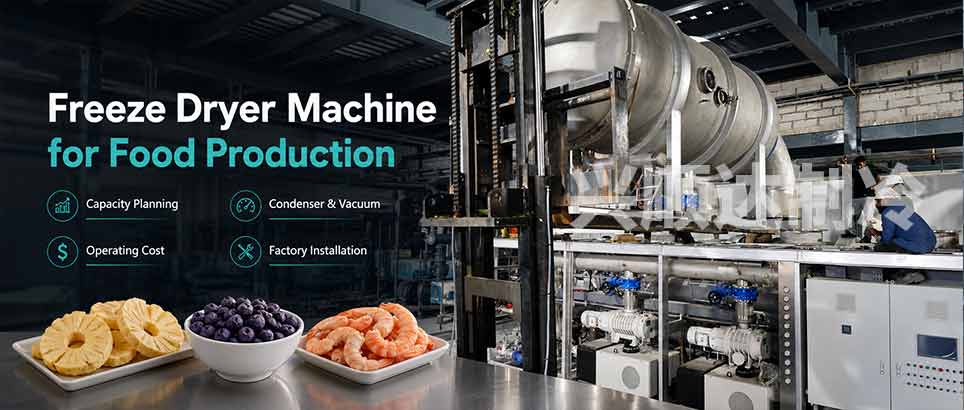
What a Freeze Dryer Machine Must Do in Food Production
A food freeze dryer machine is more than a vacuum chamber with trays. The complete system must freeze or receive a frozen load, provide controlled heat for sublimation, move water vapor through the chamber, capture that vapor on the condenser, maintain the required absolute pressure, and repeat the process across commercial batches.
Buyers should therefore compare the complete freeze drying system rather than one headline specification. The freeze drying working principle guide explains the process physics; this page owns the equipment-evaluation intent and focuses on machine fit, supplier evidence, and purchase checks.
Start With the Product Before Comparing Machine Models
Machine selection begins with the food, not the model number. Whole berries, 8 mm fruit slices, cooked rice, seafood, dairy liquids, extracts, and pet food create different freezing, heat-transfer, vapor-flow, and loading conditions.
Product Geometry
Slice thickness, piece size, liquid fill depth, and tray loading change the path that heat and vapor must travel through the product.
Water to Remove
Initial moisture and target final moisture determine how much ice must be removed from every batch and captured by the condenser.
Required Output
Daily wet input, operating hours, batch turnaround, and utilization determine whether a pilot, commercial, or industrial system is appropriate.
For sliced fruit, 8 mm is a useful practical starting reference in selected projects, but it is not a universal specification. A laboratory study on Hanfu apple slices also found that thickness, heating conditions, and absolute pressure affected final moisture, colour, and crispness, supporting representative product trials before scale-up.[3]
Freeze Dry Machine Capacity: What Must Be Defined
Freeze dryer machine capacity should not be reduced to an unsupported kilogram label. A comparable quotation states the prepared wet product, loading basis, usable shelf area, expected water removed, complete loaded batch cycle, and practical production target. This connects the advertised machine size to the food and output the factory actually needs.
| Capacity Input | Why It Matters | What the Quotation Should State |
|---|---|---|
| Wet material per batch | Defines the real incoming load rather than a nominal machine size. | Food type, kg/batch, product form, and loading pattern. |
| Effective shelf area | Defines the usable loading surface. | Actual tray dimensions, count, and usable area. |
| Loading density | Connects kilograms to area and product thickness. | kg/m² or liquid fill depth for the stated product. |
| Water removed | Defines the condenser ice load for the batch. | Initial moisture, target moisture, and calculated water removal. |
| Complete batch cycle | Determines practical kg/day rather than theoretical kg/batch. | Loading, freezing strategy, pump-down, drying, unloading, defrosting, and turnaround. |
For selected food projects, approximately 10–13 kg of wet material per m² can be used as an early engineering screening range. It is not an industry standard or a guaranteed machine rating. The detailed capacity calculation, including kg/batch-to-kg/day conversion, should be completed using the batch capacity methodology.
Condenser Performance Can Limit the Whole Machine
During primary drying, ice inside the food becomes water vapor. That vapor must travel to the condenser and freeze on the cold surface. Therefore, increasing tray area without increasing vapor-capture capability can lengthen the cycle instead of increasing saleable daily output.

Total Ice Capacity
It should accommodate the calculated batch water load with an appropriate engineering margin.
Peak Capture Rate
It should support the highest vapor load during primary drying, not only the final kilograms of ice stored.
Loaded Temperature
Condenser behavior under vapor load is more meaningful than an extremely low no-load temperature.
For preliminary engineering screening, selected projects may use a condenser water-capture reference of at least 2 kg H₂O/m²·h and an operating reference around −35°C. These are first-party engineering references, not universal industry standards. Final design depends on the product, water load, vapor pressure, refrigeration system, and required production rate.
Buyers comparing freeze drying equipment should request the condenser-area definition, total usable ice capacity, loaded operating condition, refrigeration configuration, defrost method, and the test basis behind any kg/h claim. Additional engineering detail is available in the freeze dryer condenser guide.
Vacuum Performance: Compare Loaded Control, Not Only Ultimate Vacuum
The vacuum system should evacuate the chamber in a reasonable time, remove non-condensable gases, and maintain the process pressure while the condenser captures most of the water vapor. Consequently, the lowest advertised ultimate vacuum is not the most useful comparison.
For selected food projects, 26–100 Pa absolute pressure can be used as an engineering process reference. The final set point depends on product temperature, shelf heat, dry-layer resistance, vapor load, and condenser behavior.
As an equipment-performance reference, the commercial and industrial systems used by the engineering team are designed to reach 133 Pa in less than 18 minutes under the specified test condition. A supplier should state the chamber condition, instrument, load state, start pressure, and acceptance criterion together with the result.
The vacuum pump selection guide covers pump configuration in more detail, while the temperature and pressure guide explains why lower pressure is not automatically better.
Heating Uniformity and Product Temperature Must Be Evaluated Together
Shelf heat drives sublimation, but excessive product temperature can damage structure or cause uneven drying. As the dried layer grows, resistance to heat and mass transfer increases during primary drying, so loading thickness and heat-transfer conditions must be considered together.[1]
A useful supplier comparison therefore includes shelf construction, heating method, product-probe strategy, temperature uniformity, and the loaded test basis. An unloaded shelf-temperature claim alone does not prove that the center and edge of a real food load will dry at the same rate.
The same principle applies to cycle endpoint. Pisano, Barresi, and Fissore evaluated pressure-rise-based monitoring for food products in trays and individually quick-frozen materials, supporting process monitoring as a stronger endpoint basis than relying on elapsed time alone.[2]
Pilot, Commercial or Industrial Freeze Dryer Machine?
The correct equipment level depends on production demand and how much of the process has already been validated. A product still under development should not be scaled from an assumed commercial cycle. Representative trials should establish loading density, thickness, endpoint, quality target, and drying behavior before a larger machine is selected.
| Project Stage | Equipment Direction | Evidence Needed Before Quotation | Relevant Page |
|---|---|---|---|
| R&D / pilot | SDG60 / SDG90 | Product form, tray loading, target endpoint, quality criteria, and a representative trial plan. | Lab & pilot freeze dryers |
| Commercial production | SDG350 / SDG700 / SDG1100 | Prepared wet kg/batch, water removed, loaded cycle, batches per day, and utility limits. | Commercial freeze dryers |
| Industrial factory | SDG1600 / SDG3000 / SDG6000 | Validated load basis, condenser duty, factory utilities, installation plan, FAT, and SAT criteria. | Industrial freeze dryers |
When the product is not yet validated, the food R&D and pilot testing guide explains what should be established before scale-up. This prevents a nominal machine size from being mistaken for proven daily production.
Real Production Evidence Is More Useful Than Catalog Claims
Catalog data describe machine construction. Project records show whether the machine can produce a repeatable food result under a stated loading and cycle. Therefore, a strong supplier should be able to connect specifications with representative production evidence.
Pear Slices
100 m² shelf area
8 mm slices
12 h drying time
2.21% final moisture
Strawberry Slices
11 h 55 min drying time
Final moisture was checked after the production test instead of relying only on the programmed timer.
These are project-specific engineering records, not universal cycle or capacity guarantees. Product variety, maturity, pretreatment, loading, freezing profile, endpoint method, and target moisture can change the result.
Factory Utilities and Installation Can Change the Final Machine Choice
A freeze dryer machine that fits the process may still be unsuitable for the factory if power, cooling, steam, drainage, access, or maintenance space is inadequate. These requirements should be confirmed before the equipment specification is frozen.

Utility Review
- Voltage, frequency, and available electrical capacity
- Cooling-water temperature and seasonal conditions
- Steam availability where the heating design requires it
- Drainage and condenser-defrost water handling
- Ambient temperature and ventilation
Installation Review
- Door and corridor dimensions
- Rigging and crane access
- Floor loading and foundation
- Service clearance around pumps and refrigeration equipment
- Material flow and hygienic access

Food manufacturing also requires appropriate sanitation, equipment, facilities, and production controls. The FDA Current Good Manufacturing Practices overview provides general regulatory context for food facilities.
Freeze Dry Machine Supplier Comparison Checklist
- Product basis: the quotation states the food, dimensions, pretreatment, and intended daily wet input.
- Capacity basis: wet load, usable shelf area, loading density, and water removed are linked to the same product.
- Condenser basis: total ice capacity and peak vapor-capture capability are stated with the test condition.
- Vacuum basis: pump-down and pressure stability are stated with the chamber condition and measurement method.
- Heating basis: shelf design, temperature control, and loaded uniformity are explained.
- Cycle evidence: the supplier provides a complete batch timeline rather than only a drying timer.
- Product evidence: similar food projects or representative pilot tests support the proposal.
- Factory fit: utilities, installation access, sanitation, and service space are reviewed before order confirmation.
- Acceptance evidence: FAT/SAT criteria are agreed before manufacturing is completed.
For detailed equipment acceptance planning, the food freeze dryer FAT/SAT guide explains how to separate empty-machine checks from loaded process evidence.
Frequently Asked Questions About Freeze Dry Machines
How should a food factory choose a freeze dryer machine?
Start with the food, prepared daily wet input, product dimensions, water removed, complete loaded batch cycle, condenser requirement, vacuum control, utilities, and factory constraints. Select the model only after those inputs and the required acceptance evidence are defined.
Is a larger shelf area always better?
No. More shelf area helps only when the condenser, refrigeration, vacuum system, heating, and cycle design can support the corresponding water load.
What is the difference between a commercial and industrial freeze dryer machine?
Commercial systems are typically selected for regular small-to-medium production, while industrial systems are designed for larger wet loads, more demanding utilities, installation planning, and factory-scale operation.
Should a new food product be pilot tested before machine purchase?
Pilot testing is recommended when loading density, thickness, endpoint, quality target, or cycle conditions are still unknown. Scale-up is more reliable after those variables are established on a representative product.
Does a lower vacuum pressure always mean faster drying?
No. The correct absolute pressure depends on product temperature, heat input, dry-layer resistance, vapor load, and condenser behavior. Lower pressure is not automatically better.
Request a Freeze Dryer Machine Technical Review
Send the food type, prepared wet kg per batch or day, initial and target moisture, slice thickness or liquid fill depth, target output, available utilities, and factory dimensions. The engineering team can then screen machine fit, water load, condenser duty, pilot-test needs, and the evidence required in the quotation.
- Product and machine-fit review
- Wet-load and condenser-load screening
- Vacuum, heating, and cycle-basis review
- Utility and installation requirement check
- Pilot test or FAT/SAT recommendation
Research References
- Ratti, C. Freeze drying for food powder production. In: Handbook of Food Powders. 2013:57–84. https://doi.org/10.1533/9780857098672.1.57
- Pisano, R., Barresi, A. A., & Fissore, D. Innovation in Monitoring Food Freeze Drying. Drying Technology. 2011;29(16):1920–1931. https://doi.org/10.1080/07373937.2011.596299
- 孟宪军,高琨,李斌,颜廷才,崔晓雅,阎婷. 响应面法优化寒富苹果真空冷冻干燥工艺[J]. 食品科学,2013,34(10):92–97. https://doi.org/10.7506/spkx1002-6630-201310020
Research citations support only the claims marked in the article. First-party engineering references and project records are application-specific and should not be treated as universal performance guarantees.

Technical Review: Zheng Wei
Zheng Wei is a freeze-drying systems engineer working with food projects from pilot testing through commercial and industrial scale-up. His engineering work covers chamber loading, heat transfer, vacuum systems, condenser sizing, refrigeration, cycle development, and factory installation.
Engineering organization: Fuzhou Xing Shun Da Refrigeration Facility Project Co., Ltd. Project data in this article are presented as application-specific engineering references rather than universal equipment guarantees.