
Industrial Freeze Dryer Manufacturers Guide for Food Production
Choosing between industrial freeze dryer manufacturers is not only about price. Instead, it is a decision about refrigeration design, condenser capacity, vacuum stability, food safety, installation support, and long-term production reliability.
This guide helps food manufacturers compare real factory capability, technical design, project cases, service support, and quotation details before choosing an industrial freeze dryer manufacturer.
This is a manufacturer evaluation guide, not a model catalog or price list. Therefore, buyers who already know the required daily wet material capacity can compare industrial freeze dryer models, while buyers who are still comparing suppliers can use this checklist first.
If you are comparing suppliers, use this page as a checklist. However, if you already know your target daily output, compare our SDG1600, SDG3000 and SDG6000 industrial freeze dryer models first.
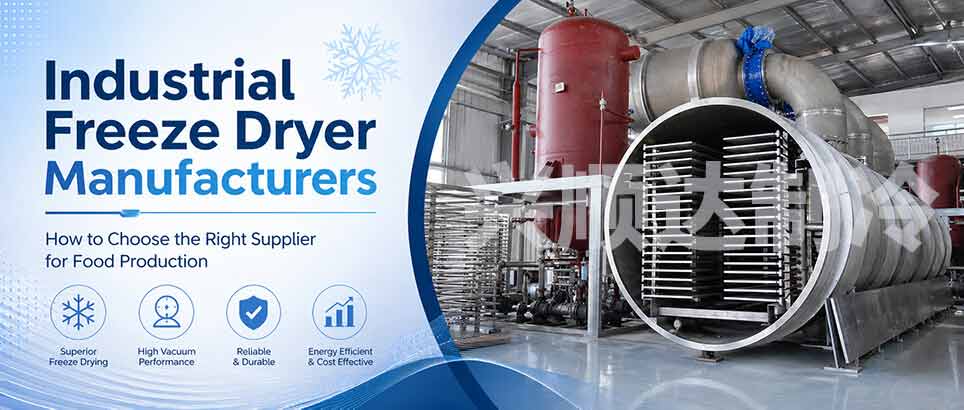
How Should Buyers Compare Industrial Freeze Dryer Manufacturers?
Buyers should compare industrial freeze dryer manufacturers by factory capability, condenser design, vacuum system configuration, refrigeration performance, heating uniformity, control records, food project experience, installation support, operator training and spare parts service.
Moreover, a reliable manufacturer should ask about product type, moisture content, slice thickness, loading density, daily wet material capacity, final moisture target and factory utilities before recommending a model.
Check Real Factory Capability
Ask for chamber production, condenser manufacturing, welding quality, assembly photos and shipment records. In practice, real evidence is stronger than brochure claims.
Review System Design
Compare refrigeration design, condenser water capture, vacuum stability, heating uniformity and control records. As a result, buyers can judge performance more accurately.
Confirm Project Service
Finally, check layout support, installation guidance, operator training, spare parts and long-term troubleshooting before placing an industrial order.

What Is an Industrial Freeze Dryer Manufacturer?
An industrial freeze dryer manufacturer designs and produces freeze-drying equipment for commercial and industrial production. Compared with a home or laboratory unit supplier, this type of manufacturer must understand larger batch loads, longer operation time, food production requirements, and project installation.
More Than Equipment Assembly
System Design
A real manufacturer should match the chamber, condenser, refrigeration system, vacuum pump group, heating system, control system, and utility requirements.
Food Process Support
In addition, the team should ask about product type, thickness, moisture, loading density, final moisture, and drying time before recommending a model.
Project Delivery
Finally, the manufacturer should support factory layout, shipping, installation, commissioning, operator training, maintenance planning, and spare parts.


Manufacturer vs Supplier vs Trading Company
Buyers often see different companies using similar words. However, a manufacturer, a general supplier, and a trading company may provide very different levels of technical support.
Compare the Actual Role
| Company Type | Typical Capability | Main Risk for Buyers |
|---|---|---|
| Real Manufacturer | Designs, manufactures, tests, installs and supports industrial freeze dryers. | Needs careful evaluation, but usually provides stronger technical responsibility. |
| General Supplier | May sell machines from one or more factories and provide basic quotation support. | Technical answers may be limited if the supplier does not control design or manufacturing. |
| Trading Company | Mainly connects buyers with factories and handles communication or export work. | After-sales support, spare parts, and process troubleshooting may depend on another factory. |
How to Check the Difference
Ask for Technical Details
For example, ask how the condenser capacity is calculated, how the vacuum system is selected, and how the drying curve changes for different foods. A real manufacturer should answer with engineering logic.
Ask for Real Project Evidence
In addition, request factory photos, installation photos, food production cases, and project data. Case evidence is usually more useful than a simple product brochure.
Why Choosing the Right Industrial Freeze Dryer Manufacturer Matters
The manufacturer affects production capacity, drying quality, energy cost, maintenance difficulty, and service response. Therefore, the lowest machine price is not always the lowest project cost.
Production and Quality Risks
Insufficient Daily Output
If the machine is undersized, the factory cannot reach the planned wet material capacity. As a result, the cost per kilogram may increase.
Uneven Drying
Poor heat transfer, weak vapor removal, or unstable vacuum may cause uneven final moisture. Therefore, product quality becomes difficult to control.
Higher Operating Cost
A low-priced system can become expensive if it dries slowly, uses more energy, requires frequent maintenance, or needs long defrosting time.
Service and Maintenance Risks
Training Affects Operation
Even a good machine can perform poorly if operators do not understand loading, recipe control, drying judgment, cleaning, and maintenance. Consequently, training should not be treated as an optional service.
Spare Parts Affect Downtime
Moreover, industrial production needs spare parts planning for pumps, valves, sensors, seals, electrical components, and refrigeration parts. Without a plan, downtime can become expensive.
How to Verify Factory Capability Before Buying
Factory capability matters because an industrial freeze dryer is a complete system. Small design differences inside the system can affect drying speed, energy use, vacuum stability, and product quality.


Manufacturing Evidence to Request
Production Photos
Ask for chamber, condenser, refrigeration unit, control cabinet, frame, and assembly photos. In addition, check whether the photos match the model being quoted.
Installation Cases
Real installation photos show whether the manufacturer has delivered large equipment before. Therefore, they are more useful than generic catalog images.
Testing Records
Request vacuum, condenser, refrigeration, electrical, and control test records before shipment. As a result, hidden problems are easier to find early.


Project Capability to Confirm
| Capability | Why It Matters | What to Ask |
|---|---|---|
| Layout Support | Industrial systems need space for installation, loading, unloading and maintenance. | Can the manufacturer provide a factory layout and utility plan? |
| Process Support | Different foods need different loading and drying curves. | Can the manufacturer discuss your product before model selection? |
| Commissioning | Large systems need on-site or remote commissioning support. | Who will guide installation, startup, testing and training? |
| After-Sales | Long-term production requires spare parts and troubleshooting support. | What support is provided after delivery? |


Industrial Freeze Dryer Manufacturer Evaluation Scorecard
A clear scorecard helps buyers compare suppliers beyond price. Therefore, use the following areas to judge whether the manufacturer can support a real food production project.
| Evaluation Area | What to Check | Why It Matters |
|---|---|---|
| Factory Capability | Chamber manufacturing, condenser production, welding quality, assembly photos and test records. | It shows whether the supplier controls real manufacturing, not only sales communication. |
| Condenser Design | Water capture capacity, condenser surface area, vapor path and defrosting method. | The condenser affects vacuum stability, drying speed and daily output. |
| Vacuum System | Pump group configuration, vacuum-down time, leakage control and pressure stability. | Stable vacuum supports sublimation and repeatable product quality. |
| Refrigeration Performance | Cooling method, compressor configuration, condensing temperature and cold trap stability. | Refrigeration design affects energy use and continuous production stability. |
| Food Project Experience | Similar cases for fruit, seafood, meat, pet food, soup ingredients, herbs or extracts. | Similar cases reduce process risk before investment. |
| Installation and Training | Layout plan, utility requirements, commissioning, operator training and spare parts plan. | Industrial equipment needs project support after delivery, not only machine shipment. |
8 Key Factors to Compare Industrial Freeze Dryer Manufacturers
Many machines look similar from the outside. However, refrigeration design, condenser matching, vacuum control, heating uniformity, materials, and service support can create a major difference in real production.
Food Experience and Production Scale
Food Industry Experience
A manufacturer should understand fruit, vegetable, seafood, meat, pet food, herbs, extracts, and ready meals. Therefore, similar case experience is important.
Buyer check: Ask for real drying cases with similar product type, drying time, final moisture and product photos.
- Ask for food-specific drying cases.
- Check drying time and final moisture data.
- Review product photos before and after drying.
Batch Capacity and Scale
The right manufacturer should calculate capacity by wet material, water removal, drying cycle, and batch plan. In contrast, tray area alone is not enough.
Buyer check: Ask whether the quoted capacity is based on wet material per 24 hours or final dried product weight.
- Confirm kg or tons of wet material per 24 hours.
- Check expected water removal per batch.
- Compare commercial and industrial scale boundaries.
Refrigeration, Condenser and Vacuum Design
Refrigeration System Capability
Refrigeration stability affects condenser performance and energy use. Moreover, the manufacturer should explain cooling method, compressor selection, and cold trap temperature logic.
Buyer check: Ask for cooling method, compressor configuration, condenser temperature stability and maintenance access.
Condenser Water Capture
The condenser captures sublimated vapor. If it is too small, vacuum becomes unstable and drying time increases. Therefore, capture capacity should be checked carefully.
Buyer check: Ask for kg H₂O/m²/h capture rate, condenser surface area, vapor path design and defrosting time.
Vacuum System Stability
Fast vacuum-down speed is useful. However, stable vacuum during drying is more important for production quality and drying efficiency.
Buyer check: Ask for pump group configuration, vacuum-down time, leakage control and pressure records during drying.

Energy, Materials and Control
Energy Consumption
Buyers should compare electricity, steam, drying time, defrosting time, and real operating cost. As a result, lifecycle cost becomes clearer than price alone.
Buyer check: Ask for energy references based on similar food products, not only installed power.
Material and Cleaning Design
Food production needs corrosion resistance and cleanable surfaces. Therefore, chamber, condenser, trays, frame, and product-contact areas should be checked.
Buyer check: Ask for material details, weld quality photos, tray material and cleaning design.
Control and After-Sales Service
A useful control system should store recipes, record process data, and support operator training. In addition, after-sales service should include spare parts and troubleshooting.
Buyer check: Ask for HMI functions, recipe storage, data records, remote support and spare parts plan.


Industrial Project Evidence Buyers Should Request
Manufacturer claims should be supported by project evidence. Therefore, buyers should request documents and photos that prove manufacturing, testing, delivery and training capability.

| Project Evidence | What It Proves | Why Buyers Need It |
|---|---|---|
| Installation Photos | The manufacturer has delivered large equipment before. | It reduces the risk of buying from a company with only catalog experience. |
| Similar Product Cases | The supplier understands food-specific drying behavior. | Fruit, seafood, meat, herbs and extracts need different drying curves. |
| Testing Records | The machine was checked before shipment. | Vacuum, refrigeration, control and electrical problems are easier to find early. |
| Training Records | The supplier supports real operation after installation. | Operator training affects loading, recipe control, cleaning and troubleshooting. |


Red Flags When Comparing Industrial Freeze Dryer Suppliers
These red flags do not always mean the supplier is unreliable. However, they should make buyers ask more questions before making a purchase decision.
Technical Red Flags
Only Talks About Price
If a supplier only discusses price and tray area, it may not understand real freeze-drying performance.
No Condenser Data
A supplier should explain water capture capacity, condenser area, vapor path, and defrosting method.
No Product Questions
If no one asks about your product, moisture, thickness, or capacity, the recommendation may be too generic.
No Energy Discussion
Energy cost matters for industrial production. Therefore, the supplier should discuss electricity and steam demand.
Service Red Flags
No Similar Cases
Without similar cases, it is difficult to verify drying time, product quality, and delivery experience.
No Layout Support
Industrial equipment needs factory planning. Otherwise, installation problems may appear after delivery.
No Training Plan
Operators need hands-on training. In addition, written manuals and videos should support daily operation.
No Spare Parts Plan
Spare parts availability affects downtime. As a result, buyers should confirm service support before ordering.
Questions to Ask Before Choosing an Industrial Freeze Dryer Manufacturer
Good questions help buyers separate real engineering support from simple sales communication. Therefore, use the following checklist before comparing quotations.
Questions About Product and Capacity
Product Questions
- Have you dried a similar product before?
- What loading density do you recommend?
- What drying time can be expected?
- What final moisture is realistic?
Capacity Questions
- Is the quoted capacity based on wet material or dry product?
- How many batches are expected per day?
- How much water is removed per batch?
- Which model is recommended for future expansion?
Questions About System Design and Service
System Design Questions
- What is the condenser capture capacity?
- What vacuum pump group is used?
- What refrigeration design is used?
- What heating method is recommended?
Service Questions
- Who provides installation and commissioning?
- How will operators be trained?
- Which spare parts should be stocked?
- How is after-sales troubleshooting handled?
What Information Should You Send to a Manufacturer?
A reliable quotation should be based on real product and factory data. Therefore, send the following information before asking an industrial freeze dryer manufacturer to recommend a model.
Product and Capacity Information
Factory and Utility Information
Recommended Buying Path for Food Manufacturers
The safest process is to confirm product data first, then compare manufacturers, then review machine models and factory requirements.
From Supplier Check to Project Delivery
| Stage | Buyer Action | Recommended Resource |
|---|---|---|
| 1. Product Validation | Confirm product type, moisture, thickness, loading density and drying quality. | Pilot Lab Freeze Dryer |
| 2. Manufacturer Evaluation | Compare factory capability, refrigeration design, condenser capacity and service support. | Manufacturer Comparison Checklist |
| 3. Model Selection | Choose the right capacity by wet material load and daily production target. | Industrial Freeze Dryer Models |
| 4. Selection Guide | Confirm product type, daily wet material capacity, condenser load and factory utilities. | Industrial Food Freeze Dryer Selection Guide |
| 5. Cost Evaluation | Estimate electricity, steam, labor, drying time, defrosting and maintenance cost. | Freeze Drying Cost Analysis |
| 6. Budget Planning | Compare reference budget ranges and quotation logic by production scale. | Industrial Freeze Dryer Price Guide |
| 7. Case Verification | Review similar food projects before final configuration and contract discussion. | Customer Case Studies |
Final Recommendation
Choose the Manufacturer Behind the Machine
Industrial freeze-drying is a complete production system. Therefore, a good manufacturer should not only sell a machine, but also help buyers evaluate product behavior, capacity, condenser design, energy cost, installation, training and long-term service.
If your product process and daily capacity target are already clear, the next step is to compare industrial freeze dryer models and request a project-based configuration.
FAQ About Industrial Freeze Dryer Manufacturers
These answers help buyers compare manufacturers, suppliers, factory capability, quotation quality and after-sales support. In addition, the subheadings below make the FAQ easier to scan before a project discussion.
Manufacturer Capability and Supplier Comparison
What should industrial freeze dryer manufacturers provide?
They should provide equipment design, refrigeration and vacuum configuration, condenser matching, factory layout support, installation guidance, operator training, spare parts planning and after-sales service.
How do I know whether a supplier is a real manufacturer?
Ask for factory photos, production videos, technical drawings, test records, installation cases and technical explanations. In addition, ask direct questions about condenser capacity, vacuum system and refrigeration design.
Why should I not choose only by price?
A low price may hide weak refrigeration, small condenser area, poor materials, longer drying cycles, higher energy use and limited service. Therefore, lifecycle cost should be compared with purchase price.
What technical factors should I compare first?
Compare wet material capacity, condenser water capture capacity, refrigeration stability, vacuum system configuration, heating uniformity, food-grade materials, control records and after-sales support.
Should the manufacturer ask about my product before quoting?
Yes. A serious manufacturer should ask about product type, moisture content, thickness, loading density, target final moisture, daily capacity, factory space, power and steam conditions.
What is the difference between a manufacturer and a trading company?
A manufacturer controls machine design, production, testing and technical support. A trading company may help with communication and export, but it may not control engineering decisions or after-sales service directly.
How can customer cases help me compare manufacturers?
Customer cases show real product types, batch loads, drying time, final moisture and project delivery experience. As a result, they help buyers verify whether the supplier has handled similar food products before.
Factory Visit, Delivery Documents and Training
Should buyers visit the factory before ordering an industrial freeze dryer?
A factory visit is helpful for large projects because buyers can check manufacturing capability, assembly quality, condenser design, control cabinet layout, testing records and installation cases.
What documents should a manufacturer provide before delivery?
Buyers should request configuration details, layout suggestions, utility requirements, vacuum and refrigeration test records, operation guidance, spare parts list and installation notes before delivery.
Why is operator training important after installation?
Industrial freeze drying depends on loading, recipe control, drying judgment, cleaning and maintenance. Therefore, hands-on training can reduce failed batches and improve production stability.