
How to Choose an Industrial Food Freeze Dryer for Food Production
Choosing an industrial food freeze dryer is not just a machine purchase. Instead, it is a production decision that affects drying time, energy cost, product quality, factory layout, and return on investment.
Therefore, this guide helps food manufacturers evaluate product type, daily wet material capacity, condenser performance, vacuum stability, drying time, energy use, supplier capability, and after-sales support before buying.
This is a selection guide, not a model catalog. For buyers with a clear daily wet material target, compare SDG1600, SDG3000 and SDG6000 on the industrial freeze dryer product page. However, if the product process, drying time, condenser load, utilities or supplier support are still unclear, use this guide first.
Once your target daily output is clear, compare our SDG1600, SDG3000 and SDG6000 industrial freeze dryer models. However, if you are still evaluating the project, continue reading this selection guide first.
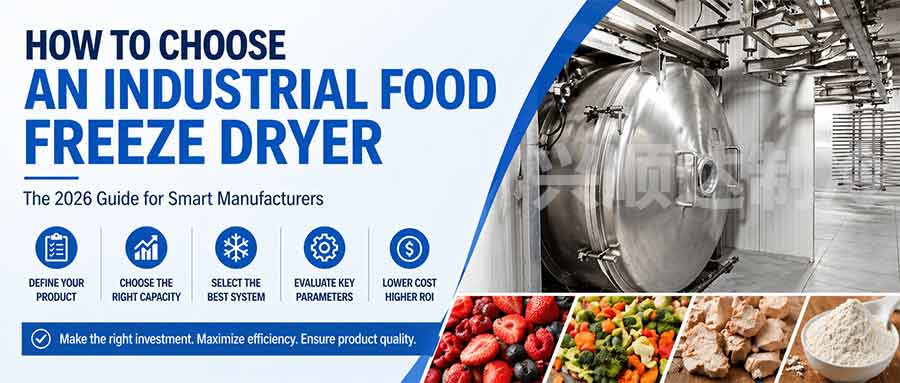
How Should Buyers Choose an Industrial Food Freeze Dryer?
Buyers should first define product type, raw moisture content, slice thickness, target final moisture, and daily wet material capacity. Then they should compare condenser load, vacuum stability, heating uniformity, energy use, steam demand, factory utilities, and supplier support.
When the product process has not been tested, start with pilot testing. For a daily wet material target of 340 kg–1.36 tons, compare commercial models. For a target of 1.2–8 tons per 24 hours, compare industrial models.
This page helps buyers decide the right production scale. For detailed SDG1600, SDG3000 and SDG6000 specifications, use the industrial freeze dryer models page. For budget ranges, use the industrial freeze dryer price guide.
Industrial Food Freeze Dryer Selection Matrix
| Buyer Situation | Recommended Action | Best Next Page |
|---|---|---|
| Product process is not validated yet | Run pilot testing first | Pilot Lab Freeze Dryer |
| Daily wet material target is 340 kg–1.36 tons | Choose commercial production scale | Commercial Freeze Dryer |
| Daily wet material target is 1.2–8 tons | Compare industrial models | Industrial Freeze Dryer Models |
| Budget is the main concern | Review purchase price and configuration factors | Industrial Freeze Dryer Price Guide |
| Operating cost is unclear | Estimate electricity, steam, labor and drying time | Freeze Drying Cost Analysis |
When Should You Choose an Industrial Food Freeze Dryer?
Generally, an industrial food freeze dryer is suitable when the product has moved beyond small testing. At this stage, the buyer needs stable batch production, higher daily output, factory installation planning, and predictable operating cost.
Factory-Level Output
As a result, industrial systems are designed for large wet material loads, repeated batch operation, and planned daily production. Therefore, they are more suitable for food factories than small laboratory units.
Stable Product Quality
Moreover, freeze-dried food quality depends on freezing, shelf temperature, vacuum stability, condenser capture capacity, drying curve, and final moisture control. As a result, stable engineering matters more than appearance.
Complete Project Planning
In addition, industrial freeze-drying projects require steam, electricity, water, drainage, floor load, installation access, unloading space, and operator training.
Define Your Product Type Before Choosing the Machine
For this reason, different foods behave very differently during freeze drying. Therefore, the product type should be confirmed before the machine model, condenser size, loading density, and drying curve are selected.
Fruit Products
Control Sugar, Moisture and Shape
For example, fruits often contain high sugar and high moisture. Because of this, they can collapse, shrink, or become sticky if the product temperature rises too quickly during drying.
- Confirm slice thickness before loading.
- Use a stable drying curve to protect color and shape.
- Test high-sugar fruits before full-scale production.
Match Process to Product Structure
For example, apple slices, pear slices, berries, pineapple, and durian need different cutting, freezing, and drying settings. Therefore, sample testing helps reduce risk.
- Check shrinkage after drying.
- Review texture and color stability.
- Confirm rehydration or snack quality.
Vegetable and Herb Products
Use Uniform Loading
Meanwhile, vegetables usually dry more evenly than high-sugar fruits. However, leafy materials have low bulk density, so tray loading must be controlled.
- Control tray loading density.
- Distribute material evenly on each tray.
- Confirm final moisture according to packaging needs.
Protect Color and Active Components
Meanwhile, herbs and plant slices may require lower product temperature and gentler drying. As a result, the drying curve should be validated before production.
- Confirm cutting thickness.
- Avoid overheating sensitive materials.
- Check final moisture and storage stability.
Meat, Seafood and Pet Food Products
Validate Thickness and Core Drying
In contrast, meat, seafood, and pet food need careful preparation. For example, excess fat, large bones, and oversized chunks can extend drying time and reduce product quality.
- Remove excess fat and unnecessary bones.
- Validate chunk size through sample testing.
- Check drying uniformity in the product center.
Balance Speed and Product Texture
In addition, shrimp, fish, and seafood ingredients need stable vacuum and condenser performance. Otherwise, drying may become slow and uneven.
- Confirm product size before freezing.
- Check texture after drying.
- Evaluate final moisture for packaging.
Liquid Extracts and Ready Meals
Control Solid Content and Layer Thickness
For liquid products, soup, tea extract, coffee extract, and ready meals may foam, crack, or collapse. Therefore, solid content, layer thickness, and freezing condition should be confirmed before production.
- Measure solid content before freezing.
- Control layer thickness on trays.
- Test texture, rehydration, and final moisture.
Check Formula and Rehydration
Moreover, ready meals contain mixed ingredients. Because of this, formula adjustment may be needed before the drying curve becomes stable.
- Test rehydration time.
- Check ingredient separation.
- Confirm final texture after packaging.
Calculate Required Capacity by Wet Material, Not Dried Product
However, many buyers confuse wet material capacity with final dried product capacity. In freeze drying, final output depends on the moisture content of the raw material.
Match Capacity to Production Stage
| Production Stage | Typical Wet Material Capacity | Recommended Page | Best For |
|---|---|---|---|
| Pilot Testing | 60–120 kg / 24h | Pilot Lab Freeze Dryer | Product testing, sample validation, trial production |
| Commercial Production | 340 kg–1.36 tons / 24h | Commercial Freeze Dryer | Small and medium food factories, brand production, regional sales |
| Industrial Production | 1.2–8 tons / 24h | Industrial Freeze Dryer Models | Large food factories, seafood, pet food, fruit, ready meals, herbs |
Quick Model Selection Table
| Model Group | Typical Daily Wet Material Capacity | Recommended For | Selection Note |
|---|---|---|---|
| SDG60 / SDG90 | 60–120 kg / 24h | Sample testing, pilot production, small food batches | Use this range when the product process is still being validated. |
| SDG350 / SDG700 / SDG1100 | 340 kg–1.36 t / 24h | Commercial fruit, vegetable, seafood, pet food, and prepared meal production | Choose this range when the factory needs repeatable commercial batches. |
| SDG1600 / SDG3000 / SDG6000 | 1.2–8 t / 24h | Large-scale food factories and industrial freeze-dried ingredient production | Confirm steam, power, factory height, installation route, and operator training before ordering. |
Capacity Questions Before Model Selection
Questions About Production Demand
- How many kilograms of fresh material need to be processed per day?
- How many batches will run per day?
- What is the moisture content before drying?
- What final moisture is required?
- How much future capacity expansion is needed?
Engineering Insight
For example, oversizing increases investment and wastes energy during low-load operation. On the other hand, undersizing limits production and increases cost per kilogram.
Therefore, a reliable supplier should provide capacity modeling, not only a nominal tray area. The right model should match the real daily wet material target.
Commercial vs Industrial Boundary
Choose Commercial Scale When Output Is Lower
If the project needs 340 kg–1.36 tons of wet material per 24 hours, a commercial freeze dryer may be enough. In addition, this option usually needs less site space and simpler utilities.
View Commercial Freeze DryerChoose Industrial Scale for Factory Projects
However, if the target is 1.2–8 tons per 24 hours, an industrial system is more suitable. It also requires steam, stronger power planning, installation access, and operator training.
View Industrial Freeze DryerChoose Pilot, Commercial or Industrial Scale
Most food manufacturers should choose the equipment scale by project maturity and wet material capacity. The goal is not to buy the largest machine first, but to reduce process risk before factory-scale investment.
| Equipment Type | Best For | Selection Note |
|---|---|---|
| Pilot freeze dryer | Unvalidated products, sample testing, recipe development and small trial production. | Use pilot testing when thickness, loading density, final moisture or drying time is still uncertain. |
| Commercial freeze dryer | Food brands and factories that need 340 kg–1.36 tons wet material per 24 hours. | Suitable when the product process is clear, but the project does not yet need steam-supported industrial scale. |
| Industrial freeze dryer | Large food factories that need 1.2–8 tons wet material per 24 hours. | Choose this level only after confirming steam, power, floor load, factory height, drainage, installation access and operator training. |
Batch or Continuous Freeze Dryer?
| Type | Best For | Selection Note |
|---|---|---|
| Batch freeze dryer | Most food factories, mixed products and staged investment. | Usually safer for fruit, seafood, meat, pet food, herbs, ready meals and liquid extracts because each product can use its own drying recipe. |
| Continuous freeze dryer | Very large, standardized single-product production. | Only suitable when upstream processing, drying recipe, packaging flow and order volume are already stable. |
Evaluate the Technical Parameters That Affect Real Performance
In practice, buyers should not judge an industrial food freeze dryer only by appearance or chamber size. Instead, real performance depends on heat transfer, vapor capture, vacuum stability, refrigeration design, and control accuracy.
Condenser Capacity
Why the Condenser Matters
In practice, the condenser is often the bottleneck of the system. If vapor capture is too slow, vacuum becomes unstable and drying time increases.
- Review maximum moisture capture rate.
- Compare condenser surface area.
- Confirm defrosting method and cleaning access.
What to Ask the Supplier
Therefore, buyers should ask for condenser capacity data, not only cold trap temperature. In addition, the supplier should explain how vapor moves from the chamber to the condenser.
- Ask about kg H₂O/m²/h capture rate.
- Check the vapor path design.
- Review defrosting downtime.
Vacuum and Refrigeration System
Vacuum Stability
Likewise, the vacuum system should reach and maintain the required pressure during sublimation. Although fast vacuum-down speed is helpful, stability during drying is more important.
- Review pump group configuration.
- Measure vacuum-down time to 133 Pa.
- Verify leakage control and pressure records.
Refrigeration Performance
Refrigeration design affects cold trap temperature, condenser stability, and energy use. Therefore, industrial systems should be selected according to actual food process needs.
- Compare cooling method and compressor configuration.
- Review condenser temperature stability.
- Avoid chasing unnecessarily low temperatures.

Heating, Materials and Control System
Heating Plate Uniformity
Moreover, large tray areas need stable and uniform heat transfer. Otherwise, poor heating uniformity creates uneven drying, longer cycles, and unstable final moisture.
- Review plate structure and heating medium.
- Compare temperature difference across tray areas.
- Confirm real drying performance with samples.
Food-Grade Materials
Also, the drying chamber, condenser, frame, and product-contact parts should match high-humidity, low-temperature, and cleaning conditions. As a result, material choice affects long-term reliability.
- Prefer stainless steel for chamber and condenser.
- Check corrosion resistance in defrosting conditions.
- Inspect welding quality and cleaning design.
Control and Records
Industrial freeze-drying needs clear operation control and data records. In addition, operators should monitor shelf temperature, product temperature, vacuum, and condenser status.
- Review HMI and PC control functions.
- Confirm recipe storage and process records.
- Evaluate remote monitoring options.
Technical Questions Buyers Should Ask Before Choosing
| System | Why It Matters | Question to Ask |
|---|---|---|
| Condenser | Controls vapor capture and vacuum stability. | What is the kg H₂O/m²/h capture rate under real loading? |
| Vacuum system | Affects sublimation stability and drying cycle. | How fast can the chamber reach 133 Pa, and how stable is it during drying? |
| Heating system | Affects drying uniformity and product quality. | How is shelf temperature controlled across large tray areas? |
| Refrigeration | Affects condenser temperature, energy use and continuous operation. | Is the system air-cooled, water-cooled or evaporative-cooled? |
| Control system | Supports repeatable production and batch records. | Can operators store recipes, record vacuum and review condenser data? |
Estimate Energy and Operating Cost Before Buying
Although the purchase price is important, it is only one part of the project cost. For industrial production, electricity, steam, labor, maintenance, downtime, and drying time can affect profit more than the initial price.
Why Low Price Can Become Expensive
Lifecycle Cost Matters
At first, a cheap machine may look attractive. However, longer drying cycles, weak condenser capacity, poor vacuum stability, and high energy use can increase lifecycle cost.
Therefore, the buyer should compare real drying time, utility demand, service support, and production stability before making a decision.
Read the industrial freeze dryer cost analysisKey Cost Components
- Electricity for refrigeration, vacuum, pumps, and controls.
- Steam or heating energy for shelf heating and defrosting.
- Labor for loading, unloading, cleaning, and monitoring.
- Maintenance cost for compressors, pumps, valves, sensors, and seals.
- Downtime cost caused by unstable drying or long defrosting.
- Packaging and storage cost after drying.
Cost Factors Buyers Should Ask About
| Cost Factor | Why It Matters | What Buyers Should Ask |
|---|---|---|
| Drying Time | Longer cycles reduce daily output and increase energy cost. | Can the supplier provide real case drying time for similar products? |
| Condenser Capacity | Weak vapor capture extends drying and destabilizes vacuum. | What is the maximum moisture capture capacity? |
| Steam Use | Large systems often use electricity plus steam. | What steam pressure and peak demand are required? |
| Final Moisture | Over-drying wastes time and energy. However, under-drying affects shelf life. | What final moisture target is realistic for the product? |
| Maintenance | Industrial systems need long-term stable operation. | Which spare parts and service support are available? |
Evaluate the Supplier, Not Only the Machine
Therefore, a good industrial food freeze dryer supplier should understand refrigeration, vacuum, heat transfer, product testing, installation, training, and long-term service. Buyers should evaluate both the equipment and the project support.
Manufacturing and Engineering Capability
Manufacturing Capability
First, check whether the supplier can manufacture key systems, control material quality, manage welding, and provide real production photos or installation cases.
Process Experience
Next, the supplier should ask about product type, moisture content, slice thickness, loading density, final moisture, and target drying time before recommending a model.
Project Delivery
Finally, industrial equipment needs layout support, utility planning, shipping coordination, installation guidance, commissioning, and operator training.
How to Verify Real Experience
Ask for Industrial-Scale Cases
For example, a 200㎡ seafood project, a 100㎡ soup ingredient project, and a 50㎡ liquid extract project should not use the same process assumptions. Therefore, industrial-scale customer cases are more useful than small commercial examples.
View Customer CasesReview Supplier Evaluation Points
In addition, buyers should compare refrigeration design, condenser structure, vacuum pump configuration, material choice, and training support before choosing a supplier.
Read Supplier Guide

Industrial Case References for Freeze Dryer Selection
Instead, industrial freeze dryer selection should be supported by large-batch project data, not only by small product samples. Therefore, buyers should compare drying area, batch load, utility consumption, vacuum range, final moisture, product structure, and factory conditions before choosing a model.
| Industrial Case | Model and Drying Area | Batch Load | Drying Result | Selection Insight |
|---|---|---|---|---|
| Freeze-dried shrimp | SDG6000, 200㎡ | Approx. 2,320 kg/batch | 8 h drying, 1.68% final moisture, 1.02 kWh electricity + 1.41 kg steam/kg raw material | Large seafood and instant food projects need strong condenser capacity, stable vacuum, fast batch scheduling, and industrial utility planning. |
| Freeze-dried instant tea powder | SDG1600, 50㎡ | Approx. 600 kg/batch | 12 h drying, 2.31% final moisture, 1.12 kWh electricity + 1.62 kg steam/kg raw material | Liquid extract and powder projects should confirm solid content, concentration level, layer thickness, and water removal load before model selection. |
| Freeze-dried mushroom soup ingredients | SDG3000, 100㎡ | Approx. 1,200 kg/batch | 11.5 h drying, 2.09% final moisture, 1.05 kWh electricity + 1.45 kg steam/kg raw material | Soup ingredient projects should be evaluated by loading density, shape retention, rehydration performance, and condenser load. |
| Freeze-dried white peony root slices | SDG3000, 100㎡ | Approx. 1,220 kg/batch | 13 h drying, 1.16% final moisture, product temperature below 60°C | Thin medicinal root slices require careful temperature control, uniform loading, low final moisture, and process validation before scale-up. |
Factory Conditions to Confirm Before Buying
Importantly, industrial freeze dryers are not plug-and-play household appliances. Therefore, buyers should confirm site conditions before final model selection, shipping, and installation planning.
Space and Installation Access
- Available floor space and workshop height.
- Door width, crane access, and unloading route.
- Maintenance space around chamber, pumps, and refrigeration units.
Utilities and Energy Supply
- Power supply voltage and transformer capacity.
- Steam availability and steam pressure for large industrial models.
- Cooling water, evaporative cooling, drainage, and compressed air conditions.
Production Flow
- Pre-freezing, loading, unloading, and packaging layout.
- Cleaning process and defrosting water discharge.
- Operator training, spare parts storage, and service access.
Common Mistakes When Buying an Industrial Food Freeze Dryer
In practice, these mistakes often lead to slow drying, unstable product quality, higher energy use, and delayed return on investment. Therefore, they should be checked before signing a purchase contract.
Mistakes Related to Price and Capacity
Choosing by Price Only
A low initial price can hide weak refrigeration, smaller condenser area, poor materials, and limited service.
Confusing Wet and Dry Output
Instead, capacity should be calculated by wet material load. Final product output depends on raw material moisture.
Undersizing the Condenser
A small condenser becomes the bottleneck. As a result, it can extend drying time and reduce production efficiency.
Over-Chasing Low Temperature
A colder condenser is not always better. In many cases, it raises energy use while providing limited drying speed improvement.
Mistakes Related to Process and Service
Ignoring Product Testing
Without sample testing, buyers may choose the wrong loading density, slice thickness, or drying curve.
Forgetting Factory Conditions
Steam, power, height, drainage, unloading space, and maintenance access must be confirmed before delivery.
Skipping Training
Operators need hands-on training for loading, recipe use, drying judgment, cleaning, and troubleshooting.
No Spare Parts Plan
Industrial production needs spare parts planning for pumps, seals, valves, sensors, and control components.
What Information Should Buyers Send Before Choosing a Model?
Therefore, a correct quotation should be based on your product and production target. Before requesting an industrial food freeze dryer recommendation, send the following information.
Product and Capacity Information
Factory and Project Information
Recommended Buying Path for Food Manufacturers
Overall, the safest buying process is to confirm the product first, then confirm capacity, and then compare machine models and factory requirements.
From Testing to Industrial Production
| Stage | Buyer Action | Recommended Resource |
|---|---|---|
| 1. Product Validation | Test sample quality, drying time, final moisture, and rehydration. | Pilot Lab Freeze Dryer |
| 2. Commercial Production | Confirm repeatable batch output and market demand. | Commercial Freeze Dryer |
| 3. Industrial Scale-Up | Plan daily capacity, steam, power, layout, installation, and training. | Industrial Freeze Dryer |
| 4. Cost Evaluation | Estimate electricity, steam, labor, maintenance, and cycle time. | Freeze Dryer Cost Analysis |
| 5. Budget Planning | Compare reference budget ranges by production scale and configuration. | Industrial Freeze Dryer Price Guide |
| 6. Supplier Check | Evaluate manufacturer experience, engineering support, and project cases. | Supplier Evaluation Guide |
Final Recommendation
Focus on Process, Not Only Equipment
Ultimately, choosing an industrial food freeze dryer should start with real product data. The right machine should match product type, wet material capacity, drying time, condenser performance, energy use, factory layout, and operator training.
If the product process is already confirmed and the daily capacity target is clear, the next step is to compare industrial freeze dryer models and request a project-based configuration.
FAQ About Choosing an Industrial Food Freeze Dryer
These answers help buyers understand capacity, drying time, energy use, and model selection before requesting a quotation.
Capacity, Drying Time and Model Choice
What is an industrial food freeze dryer?
In simple terms, an industrial food freeze dryer is a large freeze-drying system used for food production. It removes moisture from frozen food under vacuum while protecting color, shape, nutrition, and rehydration quality.
How do I choose the right industrial food freeze dryer capacity?
First, start with daily wet material capacity, not final dried product weight. Next, confirm product moisture, loading density, drying time, number of batches per day, and future expansion needs.
What is the typical drying time for industrial freeze-dried food?
Many food products dry within 8–15 hours under suitable loading and process conditions. However, actual drying time depends on product type, thickness, moisture content, freezing condition, and final moisture target.
Why is condenser capacity important?
The condenser captures water vapor during sublimation. If the condenser is undersized, vacuum becomes unstable and drying time increases. Therefore, condenser design directly affects production efficiency.
Should I choose a commercial or industrial freeze dryer?
Generally, choose a commercial freeze dryer for 340 kg–1.36 tons wet material per 24 hours. However, choose an industrial freeze dryer for 1.2–8 tons wet material per 24 hours when the project needs steam, large site planning, and industrial installation support.
Quotation, Testing and Supplier Evaluation
What information is needed before quotation?
Before quotation, send product type, daily wet material capacity, raw moisture, target final moisture, material thickness, factory space, power supply, steam condition, project location, and production goal.
Can one industrial freeze dryer process different foods?
Yes, a batch industrial food freeze dryer can process different foods. However, each product may need a different loading density, thickness, freezing method, drying curve, and final moisture target.
What is the biggest mistake when buying an industrial food freeze dryer?
The biggest mistake is choosing only by price or tray area. Instead, buyers should evaluate condenser capacity, vacuum stability, drying time, energy consumption, factory conditions, supplier experience, and after-sales training.
What size industrial food freeze dryer do I need?
The right size depends on daily wet material capacity, product moisture content, loading density, drying time, and the number of batches planned per day. Therefore, buyers should calculate capacity from fresh material weight, not final dried product weight.
Is sample testing necessary before buying?
Yes. Sample testing helps confirm thickness, loading density, drying time, final moisture, texture, color, and rehydration quality before full-scale investment. As a result, it reduces the risk of choosing the wrong model.
How should I compare industrial food freeze dryer suppliers?
Finally, compare condenser capacity, vacuum system configuration, heating method, control system, material quality, installation support, operator training, spare parts availability, and similar food production cases.