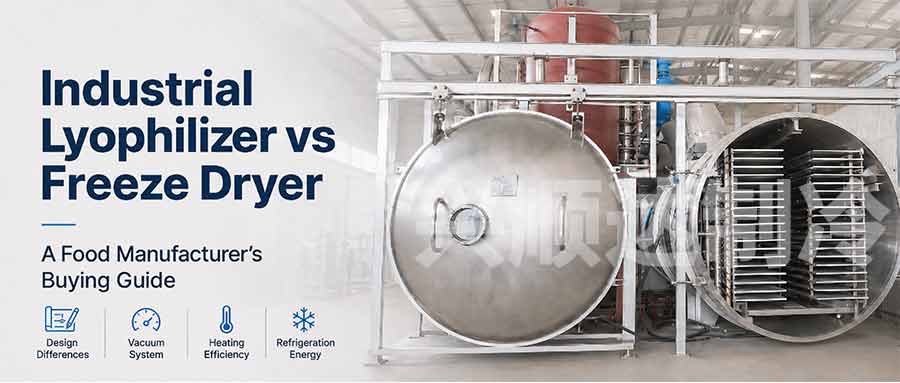
Industrial Lyophilizer vs Freeze Dryer: A Food Manufacturer’s Buying Guide

Industrial lyophilizer vs freeze dryer buying guide for food manufacturers
Industrial lyophilizer and food freeze dryer comparison for production capacity, vacuum system, heating efficiency, and refrigeration energy.
Table of contents Show

Many food manufacturers search for an industrial lyophilizer when they plan to enter the freeze-dried food market. However, they often face one basic question first: is a lyophilizer the same as a freeze dryer?

The short answer is yes. A lyophilizer and a freeze dryer use the same basic process. The product is frozen first. Then, under vacuum, ice is removed by sublimation instead of liquid evaporation.

However, the equipment design can be very different. A laboratory lyophilizer, a pharmaceutical lyophilizer, and an industrial food freeze dryer are not built for the same purpose. Therefore, choosing the right industrial lyophilizer requires more than comparing machine names.

Therefore, food manufacturers should not choose a machine only by name or price. Instead, they should evaluate capacity, cold trap performance, drying time, energy use, vacuum pump set, heating system, refrigeration design, loading method, and supplier support.

For commercial food production, the real question is not only “What is a lyophilizer?” The better question is: Can this machine support stable, efficient, and profitable food production?


What Is an Industrial Lyophilizer?

An industrial lyophilizer is a large-scale freeze-drying machine used to remove moisture from frozen products under vacuum. It is designed for production rather than small laboratory testing.

The term “lyophilizer” is more common in laboratory, pharmaceutical, and biotechnology fields. In food processing, the same type of equipment is usually called a freeze dryer or industrial freeze dryer.

A complete lyophilizer machine usually includes:

  • A drying chamber
  • Heating shelves or radiant heating plates
  • A refrigeration system
  • A cold trap or condenser
  • A vacuum pump set
  • A control system
  • Loading and unloading components

For food manufacturers, these parts must work together. If one part is undersized, the whole drying process can slow down.

For example, a large chamber does not guarantee high output. If the cold trap cannot capture enough water vapor, drying time will increase. As a result, daily production capacity will be lower than expected. This is why an industrial lyophilizer should be evaluated as a complete production system, not as a single drying chamber.


Is a Lyophilizer the Same as a Freeze Dryer?

Yes. A lyophilizer and a freeze dryer are based on the same freeze-drying principle. The difference is mainly in industry language and equipment design.

In scientific and pharmaceutical settings, people often use the word “lyophilizer.” In food processing, buyers usually search for “freeze dryer,” “commercial freeze dryer,” or “industrial freeze dryer.”

TermCommon UseMain Focus
LyophilizerLaboratory, pharmaceutical, biotechnologyPrecision, sterility, validation
Freeze dryerFood, pet food, coffee, fruit, mealsCapacity, drying cost, production efficiency
Industrial lyophilizerLarge-scale productionThroughput, cold trap capacity, automation, ROI

The process is similar. However, the machine design is not always the same.

A pharmaceutical lyophilizer may focus on vial handling, sterile design, and validation. A food industrial freeze dryer focuses more on batch capacity, energy cost, hygiene, and long-term production stability.

Therefore, food manufacturers should not only ask whether a machine is a lyophilizer or a freeze dryer. They should ask whether the machine is suitable for food production.


Laboratory Lyophilizer vs Industrial Food Freeze Dryer

A laboratory lyophilizer is mainly used for research, testing, and small sample drying. It is suitable for universities, laboratories, R&D centers, and pilot tests.

However, a lab freeze dryer is not designed for stable commercial food production.

ItemLaboratory LyophilizerIndustrial Food Freeze Dryer
Main UseTesting and researchCommercial food production
Batch SizeSmall samplesMedium to large batches
Main ConcernFlexibility and precisionCapacity and efficiency
Loading MethodManual loadingTray cart, rack, or automated loading
Buyer FocusSample qualityOutput, cost, and ROI

A laboratory freeze dryer can help test recipes and product quality. For example, it can be used to test strawberries, coffee, pet food, or prepared meals before investing in a larger system.

However, it cannot replace an industrial lyophilizer or industrial freeze drying machine. Commercial production requires higher water removal capacity, stronger refrigeration, larger tray area, and more stable vacuum control.

Therefore, food manufacturers should treat lab testing as the first step, not the final production solution.


Pharmaceutical Lyophilizer vs Food Industrial Freeze Dryer

A pharmaceutical lyophilizer and a food industrial freeze dryer use the same basic freeze-drying principle. However, their design logic is very different.

The difference is not only caused by industry standards. It also comes from two deeper factors: the product development path and the physical form of the product.

Different Product Development Priorities

Pharmaceutical products are usually sold in small doses with high unit value. In many cases, freeze-drying cost and energy consumption account for only a small part of the final product value.

Also, many medicines are not optional consumer goods. Patients need them for treatment, so the market demand already exists. Therefore, pharmaceutical freeze-drying equipment is designed first around safety, sterility, validation, and product efficacy.

This is especially important because many freeze-dried medicines enter the human or animal body directly. Some products may even enter the bloodstream. As a result, contamination control, microbial safety, and active ingredient stability are the most important design priorities.

Food products are different.

Freeze-dried food is usually consumed in larger portions. Its unit selling price is much lower than that of pharmaceutical products. Also, freeze-dried food is often not a daily necessity for consumers.

Therefore, food manufacturers must control production cost, energy consumption, labor cost, and final selling price. Of course, product quality must still be protected. However, cost efficiency is a major factor in whether a freeze-dried food product can compete in the market.

This is one reason why food industrial freeze dryers continue to evolve. Their design must support larger capacity, lower energy cost, faster loading, and better production efficiency.

Different Product Forms Before Freeze Drying

The second major difference is product form.

Most pharmaceutical products are prepared as dilute solutions before freeze drying. After freezing, they become compact ice blocks inside vials or trays. These frozen products have close contact with the container surface.

Solid food products are different.

After cutting and loading, fruits, vegetables, meat, seafood, and pet food are usually loose materials placed on trays. There are many air gaps between the food pieces. Under vacuum, heat conduction through these gaps becomes very weak.

This difference directly affects heat transfer, pre-freezing method, chamber design, and operating temperature.

Heat Transfer Design

In pharmaceutical lyophilizers, products are often placed in vials or trays directly on heating and cooling shelves. Because frozen liquid products have close contact with the vial or tray, shelf heat transfer can work effectively.

For this reason, pharmaceutical lyophilizers usually require very flat and smooth shelves. Some systems use drawer-type trays so that vials can be placed directly on the shelves. Good surface contact helps improve heat transfer uniformity.

Food industrial freeze dryers often use a different approach.

Since solid food is loosely stacked on trays, direct contact heat transfer is limited. In vacuum, the air between food pieces cannot provide effective heat conduction. Therefore, many food freeze dryers use radiant heating plates above and below suspended trays.

This design is often more suitable for solid food. It can heat the product more evenly and support faster drying. In this case, the flatness requirement of the heating plate is not as strict as that of pharmaceutical shelves.

However, the distance between the food, tray support, and radiant heating plates must be properly designed. If the gap is too large, heating efficiency may drop. If the gap is too small, loading and product clearance may become problems.

Pre-Freezing Method

Pharmaceutical freeze drying usually completes the whole process inside the lyophilizer chamber. The product is loaded, frozen, dried, and unloaded with minimal exposure to people or the external environment.

This design helps reduce contamination risk. It also supports sterile production and process validation.

Food freeze drying usually follows another process route.

Most industrial food products are pre-frozen in a separate freezer or cold room before entering the freeze dryer. This design is more practical for food production.

There are several reasons.

First, if a radiant-heating food freeze dryer also performs pre-freezing inside the drying chamber, the system needs both cooling and heating functions in the same space. This increases equipment complexity.

Second, switching between cooling and heating inside the same chamber may create unnecessary energy loss. In simple terms, cooling and heating systems can work against each other during process transition.

Third, a separate freezer or cold room is much cheaper than a freeze dryer. By pre-freezing food outside the drying chamber, the expensive freeze dryer can spend more time drying products instead of freezing them.

Therefore, external pre-freezing can improve equipment utilization and reduce total production cost.

Working Temperature Differences

Pharmaceutical products may have very low eutectic or collapse temperatures. Some formulations require shelf temperatures of about -50°C to -55°C during freezing. In these cases, the cold trap evaporation temperature may need to reach about -55°C to -60°C.

Food products usually have different requirements.

For many solid foods, when the temperature drops to around -25°C, a large portion of free water has already frozen. The remaining unfrozen water is often more closely bound within the product structure.

Also, solid food pieces already have their own shape. In many cases, they are less likely to collapse like sensitive pharmaceutical formulations.

Therefore, for many solid food applications, a pre-freezing temperature around -30°C can be enough. The cold trap evaporation temperature is often designed around -35°C to -45°C, depending on product type and process requirements.

However, liquid foods such as coffee extract, orange juice, and other high-solids liquids may require special analysis. Their freezing behavior can be closer to solution-based products, so the process temperature must be confirmed through testing.

Key Design Comparison

Design FactorPharmaceutical LyophilizerFood Industrial Freeze Dryer
Main ProductMedicines, vaccines, biologicsFruit, meat, seafood, meals, pet food
Product FormDilute solution in vials or traysLoose solid food pieces on trays
Main PrioritySterility, validation, product efficacyCapacity, energy cost, product quality, ROI
Heat TransferShelf contact heating and coolingRadiant heating for suspended trays
Pre-FreezingUsually inside the lyophilizerUsually in a separate freezer or cold room
Typical Freezing RequirementOften lower temperatureUsually less demanding for solid foods
Cost SensitivityLower relative to product valueMuch higher relative to product value
Design FocusGMP, CIP/SIP, vial handling, validationThroughput, cold trap capacity, energy efficiency

What This Means for Food Manufacturers

Food manufacturers should not choose a pharmaceutical lyophilizer only because it looks more advanced.

A pharmaceutical system may include expensive features that are not necessary for food production. At the same time, it may not offer the best loading efficiency, drying speed, or energy performance for solid foods.

For food production, the better choice is usually a freeze dryer designed around food characteristics. The machine should match product form, loading thickness, water removal load, cold trap capacity, heating method, vacuum system, refrigeration design, and factory workflow.

In short, pharmaceutical lyophilizers are designed to protect medicine safety and efficacy. Food industrial freeze dryers are designed to produce stable food quality at a competitive cost.

Both machines are professional. However, they are optimized for different production goals.


When Do Food Manufacturers Need an Industrial Lyophilizer?

Food manufacturers need an industrial lyophilizer when small-scale drying is no longer enough.

This usually happens when the company needs:

  • Stable daily production
  • Larger batch capacity
  • Better product consistency
  • Shorter production cycles
  • Lower drying cost per kilogram
  • Longer shelf life
  • Higher-value food products
  • Export or retail packaging

Industrial freeze drying is widely used for:

  • Freeze-dried fruit
  • Freeze-dried vegetables
  • Freeze-dried meat
  • Freeze-dried seafood
  • Freeze-dried pet food
  • Instant coffee
  • Instant tea
  • Ready meals
  • Functional food ingredients

Freeze drying can help preserve product shape, color, aroma, and nutritional quality better than many high-temperature drying methods. However, it also requires higher equipment investment and better process control.

Therefore, it is more suitable for products with higher market value or strong consumer demand.


Research Evidence: Why Freeze Drying Is Used for High-Value Food Products

Food manufacturers often choose freeze drying for premium products because it can better preserve quality than many heat-based drying methods.

Ginger Study: Freeze Drying Preserved More Bioactive Compounds

The freeze-dried ginger retained the highest antioxidant properties among the dried samples. The reported values included ABTS of 51.88 mgTE/g db, CUPRAC of 95.51 mgTE/g db, DPPH of 132.95 mgTE/g db, and FRAP of 95.32 mgTE/g db.

It also retained total phenolic content of 118.70 mg GAE/g db and total flavonoid content of 98.94 mg CE/g db. In addition, the study reported that freeze drying preserved microstructure and more volatile compounds than the other drying methods.

Tilapia Study: Better Color, Structure, and Protein Stability

The results showed that vacuum freeze drying or vacuum microwave drying produced better color, chromatic aberration, shrinkage ratio, and microstructure.

The nonthermal vacuum freeze-dried samples also had higher total essential amino acid content of 31.16% and higher α-helical structure of 28.06%, which indicated better protein stability.

What These Studies Mean for Food Manufacturers

However, these studies also show an important trade-off. Freeze drying is quality-focused, but it is not always the lowest-cost drying method.

In the ginger study, relative humidity convective drying achieved the lowest energy consumption rate of 7.88 kWh/kg and shorter drying time than freeze drying.

In the tilapia study, vacuum microwave drying showed strong potential when efficiency, quality, and energy consumption were considered together.

Therefore, food manufacturers should view freeze drying as a premium preservation process, not simply as a low-cost drying method. It is especially suitable for products where color, shape, aroma, nutrition, rehydration, and market positioning can justify the higher production cost.


Key Specifications Food Manufacturers Should Check Before Buying

Choosing an industrial lyophilizer is an engineering decision. The buyer should not compare only chamber size, machine price, or a single technical parameter.

The following specifications have a direct impact on output, drying time, energy cost, and product quality.

Tray Area and Batch Capacity

Tray area is one of the first specifications buyers check. However, tray area alone is not enough.

Food manufacturers should also calculate:

  • Product loading thickness
  • Product water content
  • Fresh product weight per batch
  • Final moisture target
  • Drying cycle time
  • Number of batches per day

For example, 100 square meters of tray area may not produce the same output for strawberries, chicken breast, shrimp, or cooked rice. Each product has different water content, structure, and drying behavior.

Therefore, a supplier should calculate capacity based on the actual product, not only on tray size.

Water Removal Capacity

Water removal capacity is one of the most important indicators of an industrial freeze dryer.

During freeze drying, most of the removed weight is water. Therefore, the machine must remove and capture a large amount of water vapor during each cycle.

Food manufacturers should ask:

  • How many kilograms of water can the machine remove per batch?
  • How many kilograms of water can it remove per hour?
  • Is the cold trap capacity matched to the product load?
  • What drying time is expected for the target product?

A machine with a large chamber but weak water removal capacity may look attractive. However, it may produce fewer batches per week.

As a result, the real cost per kilogram of finished product may become higher.

Cold Trap / Condenser Capacity

The cold trap is also called the condenser. It captures water vapor from the drying chamber and turns it into ice.

For industrial food freeze drying, the cold trap must match the sublimation load. If it is too small, vapor removal will be limited. Then, chamber pressure may become unstable, and drying speed may decrease.

Buyers should not judge the cold trap only by temperature. A very low cold trap temperature does not always mean better production efficiency.

A better design balances:

  • Cold trap temperature
  • Ice holding capacity
  • Heat transfer area
  • Vapor flow path
  • Defrosting method
  • Refrigeration efficiency

For food factories, this balance is often more important than chasing the lowest possible cold trap temperature.


Vacuum Pump Set and Pump-Down Efficiency

Vacuum performance is not only about the lowest pressure a freeze dryer can reach. For food manufacturers, the more practical question is whether the vacuum system can remove air and non-condensable gases efficiently and keep the chamber pressure stable during drying.

A well-designed vacuum system helps shorten preparation time, improve drying stability, and protect product consistency. However, the best vacuum design is not always the fastest one. It should balance pump-down efficiency, investment cost, energy consumption, and long-term reliability.

Common Vacuum Pump Set Options

In industrial food freeze dryers, two vacuum pump set designs are commonly used.

Both designs have been used by major freeze dryer manufacturers for many years. Therefore, the choice is not simply about which design is “better.” It depends on the buyer’s budget, local energy cost, maintenance preference, and factory conditions.

Vacuum Pump SetMain AdvantageMain Limitation
Rotary vane pump + Roots pumpLower energy consumptionHigher price and maintenance cost
Water ring pump + Roots pumpLower purchase and maintenance costHigher energy consumption

For many food processors, the pump set should be evaluated together with total ownership cost. A cheaper system may reduce initial investment. However, it may increase long-term electricity use.

Rotary Vane Pump + Roots Pump

The first option is a rotary vane pump with a Roots pump.

This solution usually has a higher purchase price and higher maintenance cost. However, it often has lower energy consumption during long-term operation.

Therefore, this pump set may be more suitable for factories that care more about long-term energy cost than initial equipment cost.

Water Ring Pump + Roots Pump

The second option is a water ring pump with a Roots pump.

This solution usually has a lower purchase price and lower maintenance cost. However, it often consumes more energy.

Therefore, this pump set may be more suitable for buyers who want to control initial investment and simplify maintenance.

Pump-Down Time Matters

Another key indicator is pump-down efficiency.

A practical benchmark is the time required to reduce chamber pressure from atmospheric pressure to 133 Pa. If the vacuum pump set is well matched to the chamber volume and piping design, this can often be done in less than 20 minutes.

For many medium and large industrial freeze dryers, reaching the working pressure usually only takes around ten to twenty minutes. Therefore, faster is not always better.

A general reference is:

Pump-Down Time from Atmospheric Pressure to 133 PaEvaluation
Less than 20 minutesStrong vacuum configuration
20–25 minutesAcceptable configuration
Around 30 minutesWeak or undersized configuration

Why Faster Is Not Always Better

If a buyer requires an extremely short pump-down time, the supplier may need to use a much larger vacuum pump set, larger valves, and larger piping.

This can significantly increase the initial equipment cost. It can also increase energy consumption during operation.

Therefore, the vacuum system should be designed for a reasonable pump-down time, not for the fastest possible number on paper.

This does not mean every machine must use the largest pump set. The correct design should match chamber volume, product load, vapor load, piping diameter, valve size, leak rate, and cold trap performance.

However, if the vacuum pump set is too small, the system may take too long to reach working pressure. It may also remove non-condensable gases less effectively during drying.

As a result, vapor flow can be restricted, chamber pressure can become unstable, and the drying cycle can become longer.

Questions to Ask the Supplier

Food manufacturers should not only ask for the ultimate vacuum level. They should ask the supplier for the pump set configuration, pump-down time, and expected pressure stability during real production.

A professional supplier should be able to explain:

  • Which pump set is used
  • Why this pump set is selected
  • How long it takes to reach 133 Pa
  • How the system removes non-condensable gases
  • Whether the pipe diameter and valves match the pump capacity
  • How vacuum stability is controlled during primary drying

For an industrial lyophilizer, the vacuum system should be judged by real production performance, not only by the lowest vacuum number on a specification sheet.


Heating System and Energy Consumption

The heating system provides the energy required for ice sublimation. Without enough heat input, the product dries slowly. However, if the heating system is poorly controlled, product temperature may rise too fast and affect quality.

Why Industrial Freeze Dryers Use Indirect Heating

Large industrial food freeze dryers usually use an indirect heating system.

In this design, steam or electric heaters first heat a circulating medium. Then, a pump sends the heated medium into the heating shelves or radiant heating plates.

Common heating methods include:

  • Electric heating
  • Steam heating
  • Thermal oil circulation
  • Hot water circulation

This design helps provide more stable and uniform heat during long drying cycles.

Electric Heating vs Steam Heating

For small and pilot freeze dryers, electric heating is simple and easy to control. However, for large food freeze dryers, electric heating can create high electricity consumption.

Therefore, many industrial food freeze dryers use steam heating, especially in factories that already have a boiler system.

Steam heating is often more suitable for large-scale production because it can provide stable heat at a lower operating cost. It also reduces the electrical load of the whole freeze-drying system.

Heating Medium: Oil, Water, or Deionized Water

The circulating medium is also important. Some systems use thermal oil, while others use water or deionized water.

For food freeze dryers, deionized water can be a better heating medium in many applications. Compared with oil, water has better thermal performance. Its specific heat capacity is much higher, and its thermal conductivity is also higher.

In addition, deionized water is much cheaper than heat transfer oil.

This means a water-based heating system can transfer heat more efficiently and reduce the cost of the circulating medium. It can also improve temperature response during the drying process.

Design Factors That Affect Heating Efficiency

The system design must consider freezing protection, corrosion control, sealing, pump selection, and temperature range.

Therefore, the best heating medium depends on the required shelf temperature, heating stability, maintenance plan, and factory utility conditions.

For food manufacturers, the heating system should not be evaluated only by maximum temperature. A better question is whether the system can provide stable, uniform, and energy-efficient heat during long drying cycles.

Heating Questions to Ask the Supplier

Before buying an industrial lyophilizer, buyers should ask the supplier:

  • Is the system heated by electricity or steam?
  • What circulating medium is used?
  • Is the heating medium oil, water, or deionized water?
  • How uniform is the shelf or radiant plate temperature?
  • What is the heating energy consumption per batch?
  • Can the heating system match the sublimation load?
  • Is the system easy to maintain?

For industrial food freeze drying, the heating system directly affects drying speed, energy cost, and product consistency.

A well-designed system should provide enough sublimation heat while avoiding unnecessary energy waste.


Refrigeration System, Cold Trap Temperature, and Energy Consumption

The refrigeration system is one of the most important parts of an industrial food freeze dryer. It affects cold trap temperature, water vapor capture, drying speed, energy consumption, and long-term machine stability.

For food manufacturers, refrigeration performance should not be judged only by the lowest temperature. A better design should balance cold trap capacity, evaporation temperature, condensing temperature, compressor efficiency, and real production cost.

Cold Trap Temperature Is Not Always “The Lower, the Better”

The cold trap captures water vapor from the drying chamber and turns it into ice. Therefore, its temperature must be low enough to create a strong vapor pressure difference between the product and the cold trap.

However, a lower cold trap temperature does not always mean a much faster drying cycle.

For many food freeze-drying applications, the cold trap temperature only needs to be low enough to maintain effective vapor capture. In practical design, a cold trap temperature about 8°C lower than the product’s eutectic point or critical freezing requirement is often enough for many products.

Once the cold trap is already cold enough, further lowering the temperature brings smaller gains in drying speed. However, it can sharply increase compressor load and electricity consumption.

For example, many solid food products can be pre-frozen at about -30°C. Their cold trap evaporation temperature is often designed around -35°C to -45°C, depending on product type, moisture load, and drying target.

This is different from some pharmaceutical products. They may require much lower freezing and cold trap temperatures because of low eutectic or collapse temperatures.

Therefore, food manufacturers should not simply ask for the lowest cold trap temperature. They should ask whether the cold trap temperature matches the actual product and water removal load.

Condensing Temperature Directly Affects Power Consumption

Cold trap temperature affects the low-pressure side of the refrigeration system. Condensing temperature affects the high-pressure side.

The larger the temperature difference between evaporation and condensation, the harder the compressor must work. As a result, electricity consumption increases.

In simple terms:

Lower evaporation temperature increases refrigeration difficulty. Higher condensing temperature also increases refrigeration difficulty.

Therefore, refrigeration energy consumption depends not only on the cold trap temperature. It also depends on the condensing temperature.

If two freeze dryers use the same cold trap evaporation temperature, the system with a lower and more stable condensing temperature usually consumes less power.

This is why condenser selection is important in large industrial freeze dryers.

Air-Cooled Condenser

An air-cooled condenser is simple to install. It does not require cooling water, a water tank, or a cooling tower.

However, its condensing temperature is strongly affected by ambient temperature. In hot weather, the condensing temperature can rise significantly. This increases compressor pressure ratio and power consumption.

Therefore, air-cooled systems are usually more suitable for small or medium systems, cooler climates, or factories where cooling water is not available.

Water-Cooled Condenser

A water-cooled condenser can usually keep condensing temperature lower and more stable than an air-cooled condenser.

This is useful for medium and large industrial freeze dryers. It can reduce compressor workload and improve energy efficiency, especially in hot climates or high-load production.

However, the factory needs a cooling water system. This may include a water tank, pump, cooling tower, water treatment, and regular maintenance.

Evaporative Condenser

An evaporative condenser can provide good heat rejection efficiency for large refrigeration systems.

It combines water evaporation and air movement to remove heat. Therefore, it can often achieve better condensing performance than simple air cooling.

However, it also requires good water quality control, cleaning, and maintenance. Otherwise, scale, corrosion, or biological contamination may reduce efficiency.

For large food freeze dryers, evaporative condensers can be a good option when the factory has suitable maintenance ability and water conditions.

Condensing Method Comparison

Condensing MethodMain AdvantageMain Limitation
Air-cooled condenserSimple installation, no cooling water neededHigher condensing temperature in hot weather
Water-cooled condenserLower and more stable condensing temperatureRequires cooling water system and water treatment
Evaporative condenserGood efficiency for large systemsHigher maintenance and water quality requirements

For large food freeze dryers, condenser selection should be based on local climate, water availability, electricity price, maintenance ability, and production scale.

Why Refrigeration Energy Must Be Evaluated by Real Load

Some buyers compare refrigeration systems only by compressor power. This can be misleading.

A better evaluation should include:

  • Cold trap evaporation temperature
  • Condensing temperature
  • Compressor configuration
  • Cooling method
  • Water removal load
  • Defrosting method
  • Control strategy
  • Actual kWh per kg of water removed

For example, a system with a lower nominal temperature may look stronger. However, if it runs with a very high condensing temperature, its energy consumption may be much higher.

Also, an oversized refrigeration system increases initial investment. An undersized system limits drying speed and cold trap capacity.

Therefore, the best refrigeration system is not necessarily the coldest or the largest one. It should match the product, batch size, water removal rate, and factory utility conditions.

Modular Compressor Design Can Improve Efficiency

For medium and large food freeze dryers, a modular refrigeration design can be useful.

Instead of using one large compressor at all times, the system can use multiple compressors. During peak sublimation, more compressors operate. During lower-load periods, some compressors can stop or remain as backup.

This design can help:

  • Match refrigeration output to real process load
  • Reduce unnecessary energy consumption
  • Improve system reliability
  • Provide backup capacity
  • Extend compressor service life

However, modular design must be controlled properly. Poor control logic can reduce the benefit of using multiple compressors.

Refrigeration Questions to Ask the Supplier

Before buying an industrial lyophilizer, food manufacturers should ask the supplier several refrigeration-related questions.

These questions help buyers judge whether the refrigeration system is matched to real production needs, rather than only looking at the lowest temperature on the specification sheet.

Buyers should ask:

  • What is the cold trap evaporation temperature?
  • Why is this temperature suitable for the product?
  • What is the cold trap ice capacity?
  • What is the water capture rate per hour?
  • What condensing method is used?
  • What is the expected condensing temperature?
  • How does local ambient temperature affect energy use?
  • What is the estimated kWh per kg of water removed?
  • Does the system use modular compressors?
  • How does the system handle peak sublimation load?
  • How long does defrosting take?
  • Is continuous or alternating defrost available?

A professional freeze dryer supplier should not only provide a cold trap temperature. It should also explain how evaporation temperature, condensing temperature, condenser type, compressor configuration, and water removal load affect real energy consumption.

For food manufacturers, this information is more useful than a simple “lowest temperature” claim. It helps buyers choose a refrigeration system that can support stable production at a reasonable operating cost.


Loading and Unloading Method

Loading and unloading may seem simple. Yet, it affects labor cost, hygiene, and production efficiency.

Small machines often use manual tray loading. However, larger food freeze dryers may use:

  • Tray racks
  • Trolleys
  • Overhead rail carts
  • Automatic loading systems
  • Conveyor-based systems

For industrial production, loading time is part of total production time. If workers spend too much time loading and unloading trays, daily output will decrease.

Therefore, buyers should evaluate the whole workflow, not only the freeze dryer itself.


Defrosting Method

After a drying cycle, ice must be removed from the cold trap. This process is called defrosting.

There are two common approaches:

Defrost TypeAdvantageLimitation
Batch defrostSimple structureDowntime between batches
Continuous or alternating defrostHigher productivityMore complex design

For small production, batch defrost may be acceptable.

However, for large factories, defrost downtime can reduce weekly output. In this case, a continuous or alternating cold trap system may improve production efficiency.

Before choosing a system, buyers should ask the supplier how defrosting affects total cycle time.


Industrial Lyophilizer Price: Why the Cheapest Machine May Cost More

Many buyers search for lyophilizer price before they understand their real production needs. This is risky.

The price of an industrial lyophilizer depends on many factors, including:

  • Chamber size
  • Tray area
  • Cold trap capacity
  • Refrigeration system
  • Vacuum system
  • Heating method
  • Control system
  • Material selection
  • Automation level
  • Installation requirements
  • After-sales support

A lower purchase price may look attractive at first. However, it can create higher long-term costs if the system has slow drying, high energy use, poor temperature uniformity, or weak after-sales support.

For food manufacturers, the real cost should include:

  • Equipment purchase cost
  • Energy consumption
  • Labor cost
  • Drying time
  • Product loss
  • Maintenance cost
  • Downtime
  • Installation cost
  • Training cost

Therefore, the cheapest machine is not always the lowest-cost machine.

A more useful approach is to calculate the cost per kilogram of water removed and the cost per kilogram of finished product.


How to Choose a Reliable Freeze Dryer Supplier

A reliable freeze dryer supplier should provide more than an industrial lyophilizer quotation. It should also help buyers evaluate capacity, energy use, installation conditions, and long-term operating cost.

For food production, the supplier should understand refrigeration, vacuum, heat transfer, cold trap design, food hygiene, and production workflow.

Before buying, food manufacturers should ask the supplier these questions:

QuestionWhy It Matters
What is the real water removal capacity?It affects drying speed and output.
What is the cold trap capacity?It affects vapor capture and cycle stability.
What is the expected drying time?It affects daily production capacity.
What is the energy use per batch?It affects long-term operating cost.
Can the supplier test the product?It reduces investment risk.
Can the supplier support installation?It reduces startup problems.
Are spare parts available?It reduces downtime.
Is operator training included?It improves production stability.

A professional supplier should also help calculate:

  • Product loading quantity
  • Water removal load
  • Cold trap load
  • Drying cycle
  • Energy consumption
  • Factory utility requirements
  • Layout plan
  • Loading and unloading method

Common Mistakes When Buying an Industrial Lyophilizer

Buying an industrial lyophilizer is a major investment. The following mistakes can lead to low output, high cost, and delayed ROI.

Mistake 1: Choosing by Chamber Size Only

A large chamber does not always mean high production capacity.

If the cold trap, refrigeration system, heating system, or vacuum system is not strong enough, the machine may dry slowly.

Therefore, buyers should compare real water removal capacity, not only chamber volume.

Mistake 2: Ignoring Cold Trap Capacity

The cold trap is a production bottleneck in many freeze-drying systems.

If it cannot capture vapor fast enough, the drying process will slow down. In serious cases, pressure may become unstable.

Therefore, buyers should always check cold trap capacity and defrosting design.

Mistake 3: Comparing Only Purchase Price

A low-cost machine may have higher energy use, longer drying cycles, and more downtime.

As a result, the real cost may be higher over several years.

Food manufacturers should compare total ownership cost, not only purchase price.

Mistake 4: Using a Lab Freeze Dryer for Commercial Production

A lab lyophilizer is useful for testing. However, it is not designed for large-scale food production.

Commercial production needs stable output, strong refrigeration, large cold trap capacity, and efficient loading.

Therefore, lab testing should support production planning, not replace industrial equipment.

Mistake 5: Skipping Product Testing

Different foods dry differently.

Strawberries, mangoes, chicken breast, shrimp, coffee, and cooked meals all have different moisture content, structure, and drying behavior.

Therefore, sample testing is important before final equipment selection.

A test can help estimate loading thickness, drying time, final moisture level, product quality, and energy consumption.


Food Safety and Final Product Quality

Freeze drying can help produce shelf-stable food. However, equipment alone does not guarantee food safety.

Food manufacturers should also control:

  • Raw material quality
  • Pre-freezing conditions
  • Product thickness
  • Final moisture level
  • Water activity
  • Packaging
  • Storage conditions
  • Cleaning procedures

For industrial food companies, this means machine selection and process control must work together.


FAQ About Industrial Lyophilizers and Freeze Dryers

Is a lyophilizer the same as a freeze dryer?

Yes. A lyophilizer and a freeze dryer use the same basic freeze-drying principle. However, equipment design differs by industry and application.

What is the difference between a laboratory lyophilizer and an industrial freeze dryer?

A laboratory lyophilizer is used for small sample testing and research. An industrial freeze dryer is designed for commercial production, larger batch capacity, and long-term operation.

Can a lab freeze dryer be used for food production?

A lab freeze dryer can be used for recipe testing and sample development. However, it is not suitable for stable commercial food production.

What is the difference between a pharmaceutical lyophilizer and a food freeze dryer?

A pharmaceutical lyophilizer focuses on sterility, GMP, vial handling, and validation. A food freeze dryer focuses on capacity, drying cost, hygiene, energy use, and ROI.

How much does an industrial lyophilizer cost?

The cost depends on tray area, chamber size, cold trap capacity, refrigeration system, vacuum system, automation level, and installation requirements. Buyers should compare total ownership cost, not only purchase price.

What vacuum pump set is commonly used in industrial food freeze dryers?

Two common options are rotary vane pump plus Roots pump, and water ring pump plus Roots pump. The rotary vane solution usually has lower energy consumption but higher purchase and maintenance cost. The water ring solution usually has lower purchase and maintenance cost but higher energy consumption.

How fast should an industrial freeze dryer reach working pressure?

A well-matched vacuum pump set can often reduce chamber pressure from atmospheric pressure to 133 Pa in less than 20 minutes. However, faster is not always better. Overly fast pump-down may require a larger pump set, higher initial cost, and higher energy use.

Is a lower cold trap temperature always better?

No. Once the cold trap is cold enough to capture water vapor effectively, further lowering the temperature may bring limited drying improvement but much higher refrigeration energy consumption.

Why does condensing temperature affect freeze dryer energy consumption?

A higher condensing temperature increases compressor workload. Therefore, if two systems have the same cold trap evaporation temperature, the system with lower and more stable condensing temperature usually consumes less power.

How should food manufacturers choose a freeze dryer supplier?

Food manufacturers should choose a supplier that can provide product testing, capacity calculation, cold trap matching, energy analysis, installation support, operator training, and after-sales service.


Conclusion: Choose the Machine Based on Production Needs

An industrial lyophilizer and an industrial freeze dryer use the same core freeze-drying process. However, the right machine depends on the application.

For food manufacturers, equipment selection should focus on production needs, not only machine names.

A suitable industrial freeze dryer should match the product, batch capacity, drying cycle, water removal load, cold trap capacity, vacuum pump set, heating system, refrigeration design, energy cost, and factory workflow.

Therefore, buyers should not choose only by price. They should work with a supplier that understands both freeze-drying technology and food production requirements.

CTA

Planning a freeze-dried food production project?

A suitable machine can improve product quality, reduce operating cost, and support long-term production growth.

Scroll to Top