
How to Freeze Dry Blackberries for Commercial Production: Process, Drying Time & Scale-Up
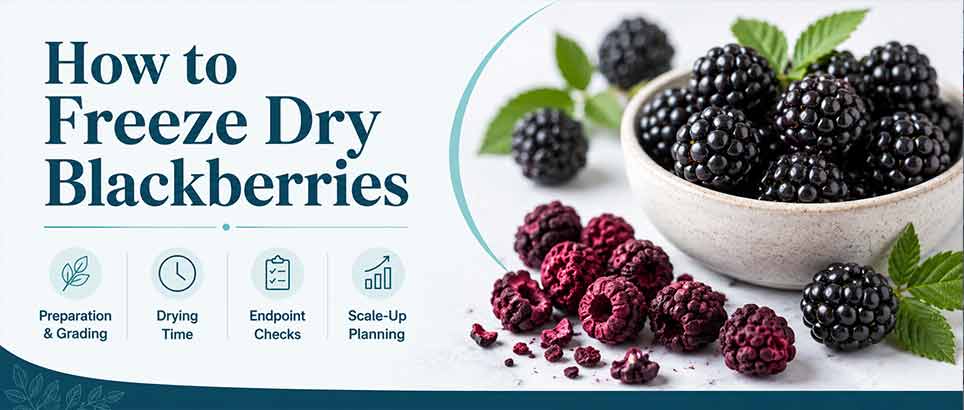
Learning how to freeze dry blackberries for commercial production requires more than copying a household recipe. Whole berries, opened fruit, pieces, and powder feedstocks have different vapor paths, handling risks, packaging needs, and release criteria. A dependable process starts with a defined product format, a representative pilot, measured product response, and a repeatable endpoint.
How to Freeze Dry Blackberries: Commercial Process at a Glance
- Sort and grade sound fruit. Remove moldy, crushed, or leaking berries and reduce excessive size variation.
- Wash under the facility’s validated procedure and drain well. Uncontrolled surface water adds avoidable ice load.
- Choose one repeatable product format. Whole, opened, cut, or powder-route fruit should not be mixed as though they dry identically.
- Freeze the product completely. Control the product condition and transfer time before primary drying begins.
- Run a documented cycle. Record wet loading, product temperature, absolute pressure, heating profile, drying response, and condenser behavior.
- Verify the endpoint and package promptly. Check representative berries for internal dryness and the validated final-moisture specification before sealing in a suitable moisture-barrier package.
Drying time should come from a representative pilot, not from a household recipe.
Can Blackberries Be Freeze-Dried?
Yes. Blackberries are suitable for freeze-drying when the processor controls incoming fruit, freezing, vapor removal, final dryness, and post-drying moisture exposure. Freeze-drying removes ice by sublimation under vacuum, while processing in the frozen state can help preserve structure and quality.[2] The broader commercial fruit freeze-drying guide explains the shared fruit-processing framework.
Food safety still requires its own validated control system. Freeze-drying should not be treated as the microbiological kill step for incoming fruit. For U.S. processors handling cut or opened fruit, FDA fresh-cut produce guidance provides useful context on supplier controls, sanitation, preventive practices, and records.[4] The internal freeze-drying and microbiology guide provides additional process context.
The finished product should be defined before cycle development. A premium whole-fruit snack has different appearance and breakage requirements from a blackberry inclusion for cereal, bakery, chocolate, or powder production.
Why Blackberries Need Their Own Freeze-Drying Process
Blackberries should not automatically inherit the settings used for strawberries, blueberries, or raspberries. Berry size, maturity, solids, juice loss, surface water, product geometry, and vapor path can all change drying behavior.
A review of plant-based freeze-drying describes the outer cuticle as a possible moisture barrier. This is a general plant-food mechanism, not a direct blackberry production trial.[2] It is one reason a processor should validate whole, opened, cut, or perforated fruit rather than treat those formats as interchangeable. The site’s commercial blueberry guide provides a related whole-berry example.
Whole Blackberries, Pieces, or Powder: Choose the Product First
| Product format | Typical commercial use | What the pilot must verify |
|---|---|---|
| Whole blackberries | Premium snack, garnish, retail fruit mix | Internal dryness, appearance, breakage, batch uniformity, packaging protection |
| Pieces or opened fruit | Cereal, bakery, chocolate, snack blends, inclusions | Piece-size consistency, juice loss, drying uniformity, handling damage |
| Powder route | Beverage, flavoring, color, ingredient systems | Drying endpoint, milling behavior, moisture pickup, package barrier |
Whole fruit may preserve the most recognizable shape, but it can create a longer or less uniform vapor path than a deliberately prepared smaller format. The correct choice should come from the finished-product specification.
Step 1: Sort, Wash, and Prepare the Blackberries
Commercial consistency starts before the freeze dryer. A practical preparation specification should define fruit maturity, size range, damage limits, washing, drainage, maximum handling delay, and product geometry.
- Remove damaged, moldy, or leaking berries. Crushed fruit can release juice and increase tray-to-tray variation.
- Use the facility’s validated food-safety procedure. For U.S. cut or opened fruit operations, FDA fresh-cut produce guidance is a relevant hygiene and process-control reference.[4]
- Drain surface water consistently. Excess wash water becomes additional ice and can distort pilot-to-production comparisons.
- Standardize size where practical. A narrower size range reduces the risk of dry surfaces around wet centers.
- Define one test geometry. Whole, opened, cut, or milled fruit should be tested as separate process conditions.
Step 2: Freeze the Blackberry Load Completely
Blackberries can be frozen outside the dryer or within an integrated cycle. In either case, the load should enter primary drying in a reliably frozen condition.
Freezer-air temperature alone does not describe product state. The production record should focus on product condition, loading pattern, transfer time, and repeatability. Excessive warming during transfer can make a production batch behave differently from the pilot even when the same control-screen recipe is selected.
Step 3: Develop the Blackberry Freeze-Drying Cycle
A useful pilot record captures more than final clock time. It should include prepared wet batch mass, usable tray area, loading distribution, product-temperature trend, absolute chamber pressure, heating profile, condenser or vapor-removal behavior, total elapsed time, endpoint checks, and final quality.
- Shelf temperature is not product temperature. The heating surface can be warmer than the frozen berry.
- Programmed time is not a validated endpoint. The batch is complete only when the required product condition is demonstrated.
Freeze-drying process-design literature also shows why scale-up cannot rely on a pressure number or tray area alone. Vapor flow and condenser capability can limit equipment response, and different dryer scales can respond differently to the same sublimation load.[3] That paper is based mainly on pharmaceutical vial systems; this article uses its engineering boundary principle, not its numerical setpoints.
A processor developing a new blackberry product can use the lab and pilot freeze-dryer guide to structure the test before committing a large production batch.
How Long Does It Take to Freeze Dry Blackberries?
There is no reliable universal answer to how long it takes to freeze dry blackberries. Drying time changes with berry size, whole-versus-cut format, solids, freezing history, load per unit area, heat transfer, chamber pressure, vapor-removal capacity, and the required final endpoint.
The same study reported water activity values of approximately 0.30–0.32 under its specific laboratory treatments.[1] Water activity is cited here only as a reported research measurement. This article does not use it as the standard commercial release method for blackberry production.
For capacity planning, the processor should establish a validated cycle on representative product and convert that result into complete batches per day. The site’s freeze-drying time chart provides general planning context, but it does not replace a blackberry pilot.
How to Know When Blackberries Are Fully Freeze-Dried
A visual check alone is not sufficient for commercial release. A berry can look dry on the surface while retaining moisture internally. Representative sampling should include the largest berries and the locations most likely to finish last.
Useful release and process checks can include:
- internal or center dryness of representative whole berries or pieces;
- a validated final-moisture specification for the finished product;
- expected mass loss or water removal as a process cross-check;
- texture, structural condition, color, and visible quality;
- comparison across trays or zones for batch consistency;
- rehydration or finished-use performance when relevant; and
- packaging and shelf-life validation for the intended market.
The release specification should be established during product development and applied consistently. A powder ingredient and a premium whole-fruit snack may need different acceptance criteria.
Commercial Blackberry Pilot-Test Matrix
A pilot becomes commercially useful when its variables and results are tied to decisions. The following matrix captures the information needed for repeatability and later equipment sizing.
| Variable | What to record | Decision supported |
|---|---|---|
| Product format | Whole, opened, pieces, or powder route | Vapor path, appearance, handling, packaging |
| Raw material | Variety, maturity, size range, damage limit, solids or moisture when available | Controls batch variation before changing the cycle |
| Wet load | Prepared kg/batch, kg/m², tray distribution, surface-water condition | Connects testing to water load and capacity |
| Freezing | Method, product condition, transfer time | Improves repeatability |
| Product response | Product temperature, absolute pressure, heating profile, condenser behavior | Shows product response rather than only machine settings |
| Time | Freeze, primary drying, secondary drying, total turnaround | Supports production scheduling |
| Final condition | Final moisture, internal dryness, texture, color, finished-use test | Defines the release endpoint |
| Yield and damage | Finished mass, leakage, breakage, rejects | Connects technical success to saleable output |
The food freeze-dryer validation guide can help structure production-scale acceptance checks after the product and cycle have been developed.
Calculate Yield and Water Removal Before Equipment Sizing
A processor should know how much finished product a batch creates and approximately how much water the freeze dryer must remove. These values are more useful for equipment selection than simply stating that the factory processes blackberries.
The process record should also note trims, leakage, surface water, and material excluded from finished mass. This avoids overstating the water balance and improves the accuracy of capacity planning.
Scale Up the Process and Size the Freeze Dryer From Validated Data
Scale-up should preserve the process relationships that made the pilot successful. Increasing chamber size without controlling product geometry, loading density, heat transfer, water load, vacuum behavior, and endpoint criteria can change the cycle.
- validate a repeatable blackberry format;
- record prepared wet loading per unit tray area;
- verify freezing and product-temperature response;
- measure final condition, yield, and damage;
- calculate water removed per batch;
- select usable production area, condenser duty, and utilities from the validated load; and
- confirm the result with a production-scale acceptance run.
Equipment size then follows from validated kg/m², usable production area, complete cycle and turnaround time, required daily throughput, and water removal per batch. Condenser capture, refrigeration, vacuum configuration, defrost, loading, unloading, and packaging can all become bottlenecks.
Two machines with similar tray area can still perform differently. Condenser capacity, heat transfer, vacuum configuration, and defrost strategy affect usable production capacity. The freeze-dryer condenser guide explains the vapor-capture side, while the commercial freeze-dryer capacity guide remains the owner for generic equipment-selection intent.
Planning a Commercial Blackberry Freeze-Drying Project?
A preliminary review can start with blackberry format, prepared fresh-material throughput, kilograms per batch or per day, intended finished product, operating hours, utilities, and any pilot data.
With those inputs, the engineering team can identify pilot requirements, data gaps, tray-area assumptions, water-load checks, cycle risks, and a realistic capacity range. Any recommendation remains conditional until the product is validated.
Request a Blackberry Capacity ReviewInformation to Prepare for a Capacity Review
- country and installation location;
- whole blackberry, opened fruit, pieces, or powder route;
- variety, maturity, size range, and prepared fresh kilograms per day;
- target kilograms per batch, if known;
- existing pilot or drying-time data;
- target final moisture, texture, appearance, and finished-use requirements;
- planned operating hours per day and expected batches;
- packaging format and time between unloading and sealing; and
- available electrical, cooling-water, steam, or other utility information.
Common Blackberry Freeze-Drying Problems
| Symptom | Possible cause | What to check |
|---|---|---|
| Some berries remain wet inside | Size variation, restricted vapor path, excessive load, non-uniform heat transfer | Largest berries, loading pattern, cold locations, endpoint samples |
| Different trays finish at different times | Uneven loading or thermal distribution | kg/m² by tray, tray placement, product temperature by zone |
| Juice leaks before drying | Damaged fruit, inconsistent thawing, unsuitable preparation | Incoming quality, drainage, transfer time, condition before vacuum |
| Excessive breakage | Fragile structure, rough handling, unsuitable package geometry | Unloading, transfer, filling method, package headspace |
| Product softens after unloading | Residual internal moisture or ambient moisture pickup | Endpoint verification, exposure time, seal integrity, package barrier |
| Pressure rises during primary drying | High vapor release, condenser overload, leakage, inadequate vacuum capacity | Water load, condenser behavior, leakage rate, vacuum-system performance |
Package Freeze-Dried Blackberries Promptly
Freeze-dried blackberries have a porous dry structure and can pick up moisture after unloading. Packaging should therefore be treated as part of the production process, not as a separate warehouse task.
The processor should limit exposure between the chamber and final sealing, use a barrier suitable for the intended shelf life, and protect fragile whole berries from crushing. USDA FSIS notes that freeze-dried foods require moisture-proof, hermetically sealed packaging for shelf stability.[5]
For a broader packaging framework, see the commercial freeze-dried food packaging guide and freeze-dried food storage guide.
Frequently Asked Questions
Can whole blackberries be freeze-dried?
Yes. Whole blackberries can be freeze-dried, but the processor should verify internal dryness and batch uniformity because whole-fruit geometry can change drying behavior.
Should blackberries be cut or perforated before freeze-drying?
Not automatically. Whole, opened, cut, or perforated formats should be compared in a controlled pilot because each can affect drying, appearance, juice loss, and yield.
How long does it take to freeze dry blackberries?
There is no universal commercial time. A representative pilot is more reliable than a household recipe because product format, loading, heat transfer, pressure, vapor removal, and endpoint all affect cycle duration.
Can frozen blackberries be freeze-dried?
Yes, provided the frozen fruit condition is controlled, uncontrolled thawing during transfer is avoided, and the raw material meets the finished-product specification.
Does freeze-drying make blackberries microbiologically safe?
Freeze-drying should not replace hygienic handling, hazard analysis, preventive controls, or market-specific validation.
How can a processor tell when the berries are finished?
The endpoint should be confirmed with representative internal-dryness checks and a defined final-moisture specification rather than surface appearance alone.
What size freeze dryer is needed for commercial blackberry production?
Size depends on validated wet loading per unit area, water removed per batch, complete cycle time, required daily throughput, condenser duty, and the operating schedule.
Conclusion
The most reliable way to learn how to freeze dry blackberries for commercial production is to treat the product as a process-development project, not a fixed recipe. Standardize the fruit condition and format, document the pilot load, observe product response, verify the endpoint, calculate water removal, protect the dried product during packaging, and scale the validated result to production.
That method helps a food processor protect product quality while creating the data needed for realistic scheduling and equipment selection.
References and Authoritative Guidance
- Oliveira, Natália Leite; Alexandre, Ana Cláudia Silveira; Silva, Sérgio Henrique; Figueiredo, Jayne de Abreu; Rodrigues, Adrise Aparecida; de Resende, Jaime Vilela. Drying efficiency and quality preservation of blackberries (Rubus spp. variety Tupy) in the near and mid-infrared-assisted freeze-drying. Food Chemistry Advances. 2023;3:100550. DOI: 10.1016/j.focha.2023.100550.
- Bhatta, Sagar; Stevanovic Janezic, Tatjana; Ratti, Cristina. Freeze-Drying of Plant-Based Foods. Foods. 2020;9(1):87. DOI: 10.3390/foods9010087.
- Tchessalov, Serguei; Maglio, Vito; Kazarin, Petr; Alexeenko, Alina; Bhatnagar, Bakul; Sahni, Ekneet; Shalaev, Evgenyi. Practical Advice on Scientific Design of Freeze-Drying Process: 2023 Update. Pharmaceutical Research. 2023;40(10):2433–2455. DOI: 10.1007/s11095-023-03607-9.
- U.S. Food and Drug Administration. Guidance for Industry: Guide to Minimize Microbial Food Safety Hazards of Fresh-cut Fruits and Vegetables. FDA guidance.
- U.S. Department of Agriculture, Food Safety and Inspection Service. Does freeze-drying make food shelf stable? Updated December 17, 2024. USDA FSIS source.

Technical author and reviewer
Zheng Wei is a freeze-drying engineer with experience in commercial and industrial food freeze-dryer selection, product-trial evaluation, process review, capacity planning, vacuum and refrigeration system matching, installation, and project scale-up.
Equipment specifications, commercial proposals, and final project documents are issued by Fuzhou Xing Shun Da Refrigeration Facility Project Co., Ltd. according to the confirmed blackberry product, utilities, selected configuration, test basis, and contractual scope.