
Freeze Drying Food Preservation: A Commercial Control Plan for Food Manufacturers
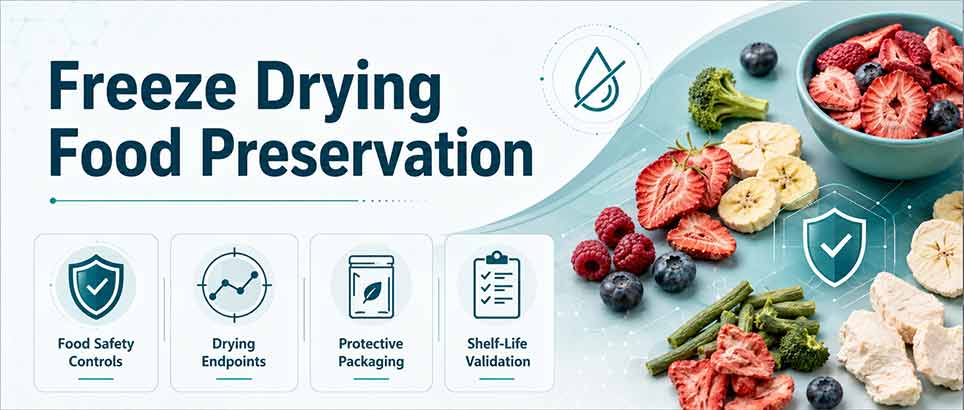
Freeze drying food preservation removes water from a frozen product under vacuum, but commercial preservation does not end when the drying cycle stops. A defensible system also controls raw-material hazards, pretreatment, batch uniformity, the drying endpoint, exposure after unloading, packaging, storage, and shelf-life validation.
This guide helps food manufacturers turn those connected controls into a pilot plan. If the reader only needs the definition, the separate guide explains what freeze drying is. For detailed process mechanics, use the guide on how industrial freeze drying works.
Have a Product but Not a Preservation Specification?
Send the formula, prepared form, initial moisture or solids, piece thickness or fill depth, wet batch target, package concept, intended shelf life, and sales market. The first review can identify missing tests and define what a pilot run must prove before equipment sizing.
Request a Product Feasibility ReviewWhat Freeze Drying Food Preservation Controls—and What It Does Not
During primary drying, ice sublimes and leaves a porous dry structure. Secondary drying removes part of the remaining bound water. That structure can support low weight and useful rehydration, but the result depends on formulation, freezing history, thickness, pressure, heat input, and the endpoint. Excessive product temperature can cause shrinkage or collapse; insufficient heat can extend the cycle and raise cost.[1]
| Freeze drying can help control | Freeze drying does not prove by itself | Evidence needed before release |
|---|---|---|
| Available water in a properly dried product | Pathogen destruction | Food-safety plan, validated kill step where required, sanitation, and microbiological controls |
| Shape, porosity, and rehydration potential | That every product retains the same quality | Product-specific texture, color, aroma, rehydration, and sensory criteria |
| Finished weight by removing water | Commercial profitability | Yield, cycle time, labor, utilities, packaging, breakage, and market-value model |
| A dry format suitable for protective packaging | A universal multi-year shelf life | Package barrier, seal integrity, storage profile, and real-time shelf-life validation |
Water activity and moisture content are related but not interchangeable. The U.S. Food and Drug Administration explains water activity as a measure of the water available for microbial and chemical activity and notes that the required level must be achieved at the end of drying and maintained during storage.[5] Where water activity is required by a manufacturer’s food-safety plan, customer specification, or applicable regulatory framework, it should be measured with an appropriate validated method or qualified laboratory.
For freeze-drying equipment and process evaluation, the engineering team normally focuses on practical indicators such as final moisture, centre dryness, mass stability, sensory quality, rehydration, batch consistency, and packaging or shelf-life performance. The final release specification should therefore distinguish between food-safety or regulatory tests and the engineering checks used to confirm drying performance.
The Five-Control Commercial Preservation Chain
Safety Before Drying
Approve raw materials, pretreatment, allergen controls, and any required cooking or other kill step.
Uniform Product
Standardize formulation, piece size, layer depth, pre-freezing, and tray loading.
Verified Endpoint
Use representative samples and defined final-condition tests rather than appearance alone.
Protected Transfer
Limit exposure to humidity, oxygen, and contamination from unloading through sealing.
Validated Shelf Life
Test the finished food and package under the intended storage and distribution conditions.
1. Food Safety Must Be Designed Before the Cycle
The plan may require approved suppliers, washing, blanching, cooking, pasteurization, hygienic zoning, environmental monitoring, allergen controls, or other measures appropriate to the food and destination market. FDA current good manufacturing practices also address personnel hygiene, equipment, sanitation, facilities, and production controls.[6] A qualified food-safety professional should define the applicable controls. The separate guide on whether freeze drying kills bacteria explains this boundary in more detail.
2. Uniform Preparation Makes the Batch Testable
Two trays with the same wet weight can dry differently if their piece size, skin condition, fill depth, solids, sugar, fat, or loading pattern differs. Define the commercial product as it will enter the dryer: formulation, pretreatment, dimensions, wet loading per square metre, and pre-freezing condition.
3. The Endpoint Needs More Than a Visual Check
A dry surface can hide wetter centres or tray-to-tray variation. For engineering evaluation, practical checks may include final moisture, centre dryness, mass stability, sensory condition, rehydration, and batch consistency. Where the manufacturer’s food-safety plan or customer specification requires additional laboratory measurements, such as water activity or microbiological testing, those should be handled with the appropriate validated method. The detailed freeze-dried food shelf-life guide owns the full claim-validation process.
4. Packaging Begins Before the Door Opens
Porous freeze-dried foods can take up moisture quickly, and oxygen can limit fat-containing or aroma-sensitive products. Prepare the transfer route, room conditions, filling method, barrier package, oxygen-control strategy where justified, and seal checks before unloading. For material and line decisions, use the commercial packaging guide.
5. Validate the Finished Product, Not the Technology Name
Shelf life belongs to the actual formula, drying endpoint, package, seal, distribution route, and storage conditions. A competitor’s label, one low moisture result, or a successful first batch cannot establish the claim for a new product.
Product Risk and Preservation Suitability
For a freeze drying food preservation project, product fit must be judged from the value created and the risks that still require control. This matrix is a first screen, not a food list. The page on foods that can be freeze dried owns category examples and expected processing differences.
| Product profile | Preservation opportunity | Main risk to test | Initial action |
|---|---|---|---|
| Fruit or vegetable pieces sold for crispness and recognizable shape | Porous structure, light weight, and premium appearance may create value | Browning, skin resistance, uneven thickness, breakage, and moisture pickup | Standardize cut and pretreatment; test the package with the product |
| High-sugar, sticky, or high-solids formula | Premium powder, extract, or soluble ingredient format may be possible | Collapse, stickiness, caking, slow mass transfer, and poor reconstitution | Use the final formulation and layer depth in pilot work |
| Meat, seafood, egg, dairy, or mixed meal | Low weight and rehydration may support specialist channels | Pathogens, fat oxidation, wet centres, and ingredient-to-ingredient variation | Define safety, oxidation, and component-sampling controls first |
| Low-value commodity where customers mainly buy on price | Limited unless freeze drying changes the product or distribution model | Process cost cannot be recovered through price, yield, or logistics | Compare hot-air, spray, vacuum, or frozen distribution before pilot scale-up |
A full-text fruit study found that strawberries, apples, and pears responded differently to the same freezing and shelf-temperature combinations; higher-temperature conditions that may accelerate drying can also increase collapse or other quality loss in a susceptible product.[2] The transferable lesson is not a universal temperature. It is that product composition and structure must be tested before a cycle is transferred or scaled.
What a Commercial Release Specification Should Measure
- Safety controls: document raw-material approval, pretreatment, sanitation, allergen controls, and the validated kill step where the product requires one.
- Drying performance: define final moisture, centre dryness, mass stability, sampling locations, acceptance limits, and retest rules appropriate to the product.
- Additional food-safety or regulatory tests: where required by the manufacturer’s food-safety plan, customer specification, or applicable regulation, define validated laboratory measurements such as water activity or microbiological criteria separately from equipment-process checks.
- Uniformity: sample the thickest pieces, centre locations, difficult trays, and repeated batches rather than only one convenient sample.
- Customer-use quality: measure the attribute that creates value—crispness, shape, aroma, colour, rehydration, dissolution, powder flow, or another agreed result.
- Oxidation and microbiology: select product-specific tests for meat, seafood, dairy, eggs, meals, high-fat foods, and ready-to-eat products where applicable.
- Package performance: verify barrier suitability, seals, leaks, puncture risk, headspace or oxygen control where relevant, and exposure time before sealing.
- Shelf-life evidence: connect real-time and, where justified, accelerated studies to the intended temperature, humidity, light, and distribution profile.
Acceptance criteria should be written before the pilot so a failed result cannot be redefined after the fact. This also makes supplier, laboratory, and internal quality discussions more efficient.
A Pilot Acceptance Plan Before Equipment Sizing
A freeze drying food preservation pilot should produce an auditable decision record, not only an attractive sample. Record the test article, loading basis, cycle, endpoint, quality result, and packaging exposure together.
| Record | Why it matters | Decision it supports |
|---|---|---|
| Final formulation, pretreatment, and product dimensions | Creates a repeatable test article | Whether the result represents the commercial product |
| Prepared wet load, tray area, and loading density | Connects quality data to a scalable loading basis | Preliminary capacity and water-load calculations |
| Freezing, product temperature, pressure, and endpoint record | Explains how the result was produced | Cycle repeatability and scale-up risk |
| Final moisture, centre dryness, mass stability, and difficult-location samples | Checks drying performance and within-batch variation | Batch-release method and further development needs |
| Additional laboratory tests where required | Supports food-safety, customer, or regulatory specifications | Whether separate water activity, microbiological, oxidation, or other validation is needed |
| Texture, colour, aroma, rehydration, or functional test | Measures the benefit the customer will buy | Whether the quality advantage justifies freeze drying |
| Packaging exposure, seal, and storage observations | Tests the whole preservation system | Package development and shelf-life study design |
Use a food freeze-drying pilot test to resolve product and cycle questions. Use the separate food freeze-dryer validation guide for equipment acceptance and FAT/SAT planning. Product acceptance and machine acceptance are related, but they are not the same test.
When Freeze Drying Is Not the Right Preservation Choice
Do not advance directly to equipment procurement when:
- the product is already stable in its intended format and freeze drying adds no customer-valued benefit;
- a lower-cost drying or frozen-distribution method meets the required quality;
- the formula, piece size, pretreatment, package, or target shelf life is still changing;
- food-safety controls and regulatory responsibilities have not been assigned;
- the market cannot repay the complete process, packaging, labor, energy, and maintenance cost; or
- the pilot has no written endpoint and acceptance criteria.
A full-text review of food freeze-drying innovations concludes that time, energy, and cost depend on the product, equipment configuration, process variables, factory capacity, and cycle duration. Many proposed acceleration technologies remain supported mainly at research scale.[3] For buyers, that means a generic “fast cycle” or “energy-saving” claim should be checked against the actual product, load, endpoint, and system boundary.
For the technology trade-off itself, read the dedicated advantages and disadvantages of freeze drying. For direct alternatives, compare a dehydrator vs freeze dryer, freeze-dried vs frozen food, or a spray dryer vs freeze dryer.
When the Preservation Plan Is Ready for Equipment Selection
Move from product development to equipment sizing only after the pilot provides a credible loading basis, water-removal requirement, cycle record, endpoint, quality result, and packaging plan. Then compare usable shelf area, condenser duty, refrigeration, vacuum stability, controllable heat input, product monitoring, defrost, sanitation, batch records, and factory utilities.
The commercial food freeze dryer selection guide owns those equipment decisions. This page owns the earlier question: what must the preservation system prove before machine capacity is selected?
Turn the Preservation Goal Into a Testable Project Brief
Provide the product and formula, pretreatment, initial moisture or solids, dimensions or fill depth, wet load, required quality, safety responsibilities, target shelf life, package concept, market, and factory location.
Fuzhou Xing Shun Da Refrigeration Facility Project Co., Ltd. can use those inputs to discuss product fit, missing pilot data, preliminary water-load and tray-area assumptions, major equipment questions, and whether further testing should come before a model recommendation.
Request a Preservation & Pilot Review Review Equipment Selection InputsFrequently Asked Questions
Is freeze drying a method of food preservation?
Yes. Freeze drying food preservation removes water from a frozen food mainly by sublimation and can support a stable dry format. Commercial preservation still depends on safety controls, a repeatable endpoint, protective packaging, and validated storage conditions.
Does freeze drying kill bacteria in food?
No reliable assumption should be made that freeze drying is a kill step. Pathogens may survive, so the manufacturer must define raw-material, cooking or other lethality controls, sanitation, prevention of recontamination, packaging, and intended-use instructions as applicable.
Is freeze-dried food automatically shelf stable?
No. Shelf stability and shelf life depend on the actual product, final drying condition, microbial and oxidation risks, package barrier and seal, storage conditions, intended use, and supporting validation.
Does freeze drying preserve all nutrients and quality?
No universal retention claim applies. Low-temperature moisture removal can protect selected heat-sensitive and structural attributes, but outcomes depend on the food, pretreatment, freezing, cycle, oxygen exposure, packaging, and storage.
What should be tested before buying a food freeze dryer?
Test the representative formula, thickness or fill depth, loading, cycle, endpoint, final moisture, centre dryness, customer-use quality, difficult locations, packaging exposure, and product-specific safety or stability risks. Where required, add validated laboratory measurements such as water activity or microbiology. Use the results to define capacity and equipment requirements.
References and Authoritative Sources
Peer-Reviewed References
- Nowak D, Jakubczyk E. The Freeze-Drying of Foods—The Characteristic of the Process Course and the Effect of Its Parameters on the Physical Properties of Food Materials. Foods. 2020;9(10):1488. https://doi.org/10.3390/foods9101488.
- Khalloufi S, Ratti C. Quality Deterioration of Freeze-dried Foods as Explained by their Glass Transition Temperature and Internal Structure. Journal of Food Science. 2003;68(3):892–903. https://doi.org/10.1111/j.1365-2621.2003.tb08262.x.
- Waghmare RB, Choudhary P, Moses JA, Anandharamakrishnan C, Stapley AGF. Trends in Approaches to Assist Freeze-Drying of Food: A Cohort Study on Innovations. Food Reviews International. 2022;38(S1):552–573. https://doi.org/10.1080/87559129.2021.1875232.
Authoritative Regulatory and Extension Sources
- Vollmer L, Dziedzic A. Freeze-drying Food Preservation. Purdue University Extension, FS-160-W. May 2025. DOI: not applicable.
- U.S. Food and Drug Administration. Water Activity (aw) in Foods. Content current as of August 27, 2014. DOI: not applicable.
- U.S. Food and Drug Administration. Current Good Manufacturing Practices (CGMPs) for Food and Dietary Supplements. Content current as of April 24, 2024. DOI: not applicable.