
Food-production equipment guide
Food Freeze Dryer for Sale: How to Choose a Production System
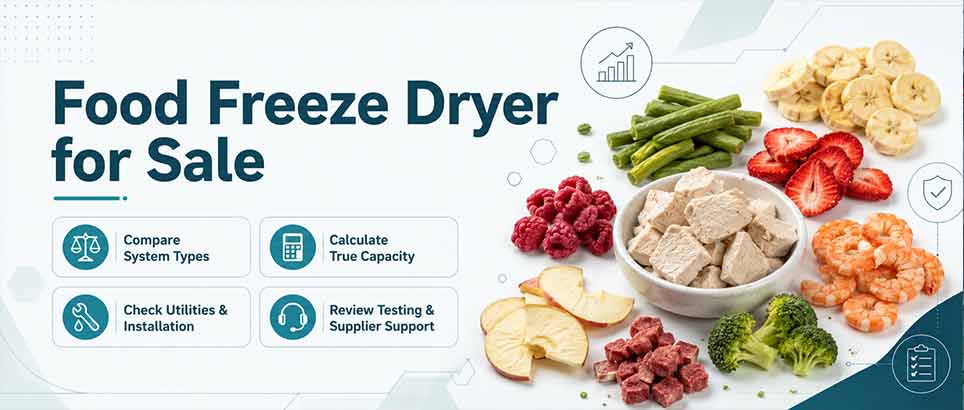
A food freeze dryer for sale should be selected by the production result it can repeat: prepared wet load, water removed, complete cycle time, utilities, product quality and service scope. This guide helps food manufacturers compare commercial and industrial systems before requesting a project quotation.
A buyer should not compare machines by tray count alone. A stronger quotation identifies the tested product, water load and cold-trap sizing basis. It also defines the complete cycle and every service excluded from the quoted price.
Who This Guide Is For
- Food producers moving from samples to repeatable commercial batches.
- Factories comparing new commercial and industrial freeze-drying equipment.
- Engineering and purchasing teams preparing a capacity or utility specification.
- Processors of fruit, vegetables, meat, seafood, meals, dairy, coffee, tea, extracts or pet food.
Step 1 · Match the project stage
What Types of Food Freeze Dryers Are Available for Sale?
The phrase freeze dryer for sale covers very different systems. A team planning to buy a food freeze dryer should begin with the project stage and required production schedule, not with the largest stated batch weight.
| System type | Available model range | Best-fit use | Primary selection evidence |
|---|---|---|---|
| Lab and pilot | SDG60 and SDG90 | Recipe development, product testing, process validation and pilot sales | Temperature control, sample capacity, data records and repeatability |
| Commercial | SDG350, SDG700 and SDG1100 | A commercial freeze dryer for sale for regular food-factory batches, new product lines and regional production | Prepared wet load, complete cycle output, utilities and service scope |
| Industrial | SDG1600, SDG3000 and SDG6000 | An industrial freeze dryer for sale for high-throughput, multi-shift and integrated factory projects | Scale-up basis, water load, plant utilization, installation and acceptance testing |
The model pages provide the equipment-level specifications:
Lab and pilot systems Commercial systems Industrial systems
Step 2 · Define the purchase route
New vs. Used Freeze Dryers for Food Production
When comparing a food freeze dryer for sale, used equipment can reduce the initial purchase price, while a new system can be configured around the actual product, utility conditions and acceptance test. The correct choice depends on the buyer’s ability to inspect, repair and revalidate the machine.
New Equipment
- Designed for the destination voltage, frequency and utility conditions.
- Model and cold-trap sizing can be tied to a documented product basis.
- Factory acceptance testing can be agreed before shipment.
- Installation, commissioning, training and critical spares can be included.
- Warranty and technical responsibility are easier to define.
Used Equipment
- Vacuum leakage, pump wear and condenser performance require testing.
- Refrigeration components and refrigerants may be difficult to support locally.
- Controls, sensors and software may be obsolete or undocumented.
- Electrical conversion, dismantling, freight and recommissioning add cost.
- Original product history and hygienic condition may be incomplete.
Step 3 · Compare the same performance basis
Quick Comparison of Food Freeze-Drying Equipment for Sale
Listings for freeze drying equipment for sale often publish tray count, fresh-food capacity, minimum temperature and installed power. Those numbers are useful only when the test product, loading conditions and measurement boundary are also stated.
| Common listing claim | Evidence the quotation should add | Why it matters |
|---|---|---|
| Fresh food per batch | Prepared wet load, initial moisture, target final moisture and water removed | Two equal wet loads can create very different vapor loads. |
| Number of trays | Usable product area, tray dimensions, layer thickness and kilograms per square metre | Tray quantity does not prove usable loading capacity. |
| Drying time | Product, pretreatment, thickness, endpoint method and complete turnaround | Production planning must include loading, pull-down, unloading, defrost and cleaning. |
| Cold-trap temperature | Total water capacity, peak capture rate, vapor path and frost distribution | The lowest empty-system temperature does not prove loaded performance. |
| Installed power | Measured batch energy and the included utility boundary | Connected load is not energy per batch or per kilogram of water removed. |
| Machine price | Freight, utilities, installation, commissioning, training, spares and exclusions | The lowest machine price may not deliver the lowest installed cost. |
For a broader explanation of food applications and machine selection, the project team can also review the food freeze dryer selection guide.
Step 4 · Convert product data into capacity
How to Size a Food Freeze Dryer by Real Production Output
Real capacity starts with water removal and full-cycle output, not tray count. Product thickness, loading density, heat input and chamber pressure affect drying behavior, so the proposal must state those assumptions.[1][3] The detailed capacity and water-load selection guide covers model comparison in greater depth.
Dry solids = prepared wet load × (1 − initial moisture fraction)
Estimated final product = dry solids ÷ (1 − target final moisture fraction)
Water removed = prepared wet load − estimated final product
Illustrative calculation
For 1,000 kg of prepared fruit at 85% initial moisture and a 2% final-moisture target, estimated dry output is about 153 kg. Therefore, the system must remove approximately 847 kg of water. That load must be checked against the condenser and cycle design.
Step 5 · Understand the price boundary
What Determines Food Freeze Dryer Price?
A project-scale food freeze dryer machine for sale rarely has one meaningful universal price. The quotation changes with the chamber, usable area, condenser, refrigeration, vacuum system, heating method, control scope, materials and local installation requirements.
The commercial freeze dryer price guide explains budget factors. Larger projects should also apply the industrial freeze dryer cost framework to compare installed and operating costs.
Step 6 · Require a complete supplier response
Food Freeze Dryer for Sale: What Should the Supplier Quote Include?
A useful quote allows engineering, purchasing and management teams to compare the same project boundary. It should not stop at a model name and FOB machine price.
- Recommended model and usable product area
- Prepared wet load and loading density
- Initial and target final moisture assumptions
- Calculated water removal per batch
- Cold-trap temperature and capacity basis
- Vacuum system configuration and gauge type
- Expected pull-down and cycle assumptions
- Heating method and control range
- Installed power and other utilities
- Machine dimensions, weight and access needs
- Electrical voltage, frequency and standards
- Export packing, freight term and insurance boundary
- Installation and commissioning responsibility
- Factory and site acceptance-test scope
- Training, documents and recipe-transfer scope
- Critical spares, warranty and support response

For a preliminary recommendation: the engineering team requires the food name, prepared wet kilograms per day, moisture or solids, thickness, target final moisture, destination and available utilities.
Step 7 · Verify specifications
Specifications That Require Test Evidence
This section identifies the evidence needed during purchase. The detailed freeze dryer specification checklist covers the complete technical specification in a separate guide.
NIST maintains pressure and vacuum calibration services. Therefore, the specification should identify gauge technology, range and traceability instead of presenting an unexplained vacuum number. Review NIST calibration information.
Applicable food facilities must also manage hygienic production and preventive controls; equipment does not replace hazard analysis or sanitation procedures. Review FDA CGMP information. Research supports evaluating pressure, heat input, product resistance and endpoint together.[2] Product-specific quality limits remain necessary because process conditions can change color and structure.[4]
Step 8 · Review comparable project evidence
Real Food Freeze-Drying Project Examples
Project cases help a buyer evaluate whether the supplier can connect product preparation, loading density, cycle time, final moisture and equipment scale. They are evidence of prior work, not universal guarantees.
Commercial Meat Project
SDG350 · 10 m² · Mongolia
Approximately 121 kg of 10 mm meat chunks per batch at 12.1 kg/m². The reported drying time was 12 hours and final moisture was 1.49%.
Industrial Pear Project
SDG3000 · 100 m² · Oregon, USA
Approximately 1,200 kg of 8 mm pear slices per batch at 12 kg/m². The reported drying time was 12 hours and final moisture was 2.21%.
Large-Scale Shrimp Project
SDG6000 · 200 m² · Kochi, India
Approximately 2,320 kg of shrimp per batch at 11.6 kg/m². The reported drying time was 8 hours and final moisture was 1.68%.
Move From Catalogue Capacity to a Project Shortlist
The engineering team can use product and production data to prepare a preliminary model range, water-load basis, utility list and testing path.
Step 9 · Confirm the factory can support the machine
Factory Utilities and Installation Requirements
A commercial or industrial freeze dryer affects the building, utilities and material flow. These requirements should be checked before the purchase contract is finalized.
| Installation item | Information required | Risk if omitted |
|---|---|---|
| Electrical supply | Voltage, frequency, phase, connected load, protection and cable distance | Power conversion, delayed commissioning or unstable operation |
| Heat rejection | Ambient design temperature, ventilation or cooling-water supply and return | High-pressure refrigeration trips and reduced capacity |
| Drainage and defrost | Defrost-water volume, drain location, slope and sanitation requirements | Long turnaround, standing water or hygiene problems |
| Access and floor loading | Door openings, unloading route, lifting plan, foundation and service clearance | Installation obstruction or unsafe maintenance access |
| Production flow | Pre-freezing, tray loading, clean/dirty separation and packaging route | Product exposure, excessive handling and bottlenecks |

Large machines should normally be planned at ground level unless a structural engineer confirms the floor, vibration, access and lifting conditions. The separate freeze dryer installation guide provides a fuller planning checklist.
Step 10 · Define acceptance before payment
FAT and SAT Before Final Acceptance
A factory acceptance test (FAT) verifies the agreed machine functions before shipment. A site acceptance test (SAT) confirms installation, utilities and loaded operation at the buyer’s factory. The contract should define the product, load and pass criteria before either test begins.
Factory Acceptance Test
- Chamber leak test and vacuum pull-down
- Cold-trap pull-down and capture basis
- Shelf or plate heating and temperature control
- Controls, recipes, trends, alarms and interlocks
- Electrical and safety checks
- Agreed sample or loaded performance test
- Documents, drawings and spare-parts review
Site Acceptance Test
- Installation and utility verification
- Vacuum and refrigeration performance on site
- Loaded production cycle
- Final moisture and product-center dryness
- Tray-position and batch consistency
- Operator and maintenance training
- Signed handover and open-item list
The food freeze dryer FAT and SAT guide explains how to document acceptance criteria and retained evidence.
Step 11 · Verify the supplier
How to Compare Freeze Dryer Suppliers
A technically detailed quotation is only one part of supplier selection. The buyer should confirm that the organization can manufacture, test, document, install and support the proposed system.
| Supplier check | Evidence to request |
|---|---|
| Manufacturing capability | Factory address, chamber fabrication, refrigeration assembly, control-panel work and test facilities |
| Comparable projects | Food type, machine size, loading basis, cycle result, destination and customer-approved evidence |
| Engineering transparency | Capacity calculation, utility list, layout, foundation, electrical and piping drawings |
| Testing capability | Sample testing, FAT protocol, calibrated instruments, retained trends and test report |
| Installation and training | Scope, travel assumptions, commissioning sequence, training plan and first-batch support |
| Long-term support | Warranty, remote support, response time, critical spares and component availability |
The separate freeze dryer supplier checklist provides a deeper due-diligence framework without repeating the capacity guidance on this page.
Step 12 · Submit enough information for a useful answer
Information Needed for an Accurate Freeze Dryer Quote
A useful request combines product data with the factory and supply boundary, allowing a calculated recommendation instead of a catalogue guess.
- Food, ingredients, pretreatment and product dimensions
- Prepared wet kilograms per batch and per day
- Initial moisture or solids and target final moisture
- Planned shifts and annual production days
- Destination, electrical supply and available utilities
- Existing pre-freezing and packaging equipment
- Installation, training and quality requirements
- Delivery schedule and trade term
Frequently Asked Questions
Price, Capacity and Equipment Choice
How much does a food freeze dryer for sale cost?
Compact machines may have a public price. Project pricing depends on usable area, water load, refrigeration, vacuum, controls, utilities, delivery and service. Compare installed scope and saleable output, not machine price alone.
What is the difference between a commercial and industrial freeze dryer?
The labels are not standardized capacity guarantees. Commercial systems usually support regular batch production; industrial systems require greater throughput, plant integration and formal acceptance. Calculated water load and annual output should decide the scale.
Can a freeze dryer be sized from finished dry weight?
Not reliably. Sizing also requires prepared wet load, moisture, thickness, loading density, water removal, full cycle and utilization.
Is a used freeze dryer suitable for food production?
A used machine can work when the chamber, refrigeration, vacuum, controls, hygiene, documents and spare parts pass inspection. It also needs a loaded test and a realistic recommissioning budget.
Cycle, Utilities and Quotation
How long does commercial food freeze drying take?
There is no universal cycle. Product, thickness, loading, heat input, pressure, condenser performance and endpoint affect time. Production planning must also include handling, defrost and cleaning.
What utilities does a commercial freeze dryer require?
Typical requirements include three-phase power, heat rejection or cooling water, drainage and service space. Larger systems may also need thermal utilities or compressed air. Confirm a model-specific list before purchase.
What information should be sent with a quotation request?
Use the product, capacity, utility and supply-scope checklist above. Those data allow a calculated sizing basis instead of a catalogue guess.
Request a Project-Based Food Freeze Dryer Recommendation
The engineering team can review the product, water load, required output and factory conditions listed above. The response can then define a preliminary system range, utility basis and testing path.
Scientific References
- Ratti C. Freeze drying for food powder production. In: Handbook of Food Powders. Woodhead Publishing; 2013:57–84. DOI: 10.1533/9780857098672.1.57.
- Pisano R, Barresi AA, Fissore D. Innovation in Monitoring Food Freeze Drying. Drying Technology. 2011;29(16):1920–1931. DOI: 10.1080/07373937.2011.596299.
- Nowak D, Jakubczyk E. The Freeze-Drying of Foods—The Characteristic of the Process Course and the Effect of Its Parameters on the Physical Properties of Food Materials. Foods. 2020;9(10):1488. DOI: 10.3390/foods9101488.
- Khalloufi S, Ratti C. Quality Deterioration of Freeze-dried Foods as Explained by Their Glass Transition Temperature and Internal Structure. Journal of Food Science. 2003;68(3):892–903. DOI: 10.1111/j.1365-2621.2003.tb08262.x.
Reference scope: published numerical findings are not presented as universal machine performance. The article uses the sources to support process principles, monitoring requirements and product-specific validation.