
Advantages of Freeze Drying: Benefits and Disadvantages for Food Plants
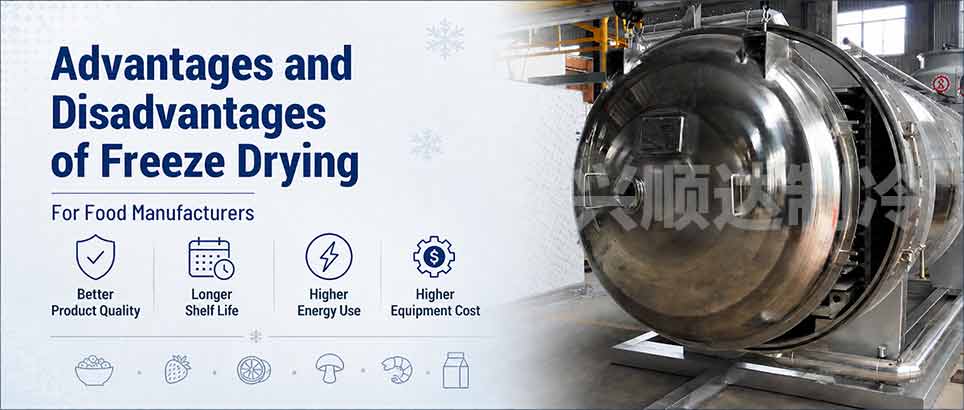
The advantages of freeze drying can justify the process when a food gains measurable value from retained shape, low-temperature moisture removal, a porous structure, rehydration performance, or a premium shelf-stable format. The disadvantages of freeze drying are the other half of the decision: high capital cost, long batch turnaround, demanding utilities, product-specific cycle development, packaging risk, and more maintenance than simpler drying methods.
For a manufacturer, the useful question is not “Is freeze drying good?” It is “Will the quality and market upside of this product repay the extra process, packaging, and factory burden?” This guide helps a project team screen that trade-off before requesting equipment specifications.
Freeze Drying Advantages and Disadvantages at a Glance
| Potential advantage | Condition that creates it | Related disadvantage or test |
|---|---|---|
| Limited shrinkage and recognizable shape | The product stays below its critical temperature and the cycle avoids collapse | Requires product-specific freezing, heat input, pressure, and endpoint control |
| Protection of some heat-sensitive quality attributes | Raw material, pretreatment, oxygen exposure, cycle, and storage are controlled | “Preserves 100% of nutrients” is not a defensible universal claim |
| Porous structure and useful rehydration | Ice-crystal and pore structure suit the formulation and intended use | Freezing history, solids, thickness, and collapse can change the result |
| Lower finished mass after water removal | The product starts with enough removable water to create a logistics benefit | Actual weight reduction must be calculated from the product moisture balance |
| Premium snack, ingredient, meal, or pet-food format | The target market pays for the quality or convenience difference | Low-margin products may not absorb the process and packaging cost |
| Potential ambient distribution after validated drying and packing | Final condition, barrier package, seal, storage, and shelf life are validated | Freeze drying alone does not prove safety or a long shelf life |
Freeze drying removes ice from a frozen product under reduced pressure, followed by removal of part of the remaining bound water. The process is commonly described as freezing, primary drying, and secondary drying.[1] The FDA describes the same three stages in its parenteral inspection guide, although that guide is not a food-processing standard.[5] Readers who need the underlying process rather than a trade-off analysis should use the separate guide to what freeze drying is.
The 6 Main Advantages of Freeze Drying for Food Production
1. Shape and Structure Can Be Retained
Because water is removed while much of it remains frozen, a well-controlled cycle can limit the liquid flow and shrinkage associated with many higher-temperature processes. Sublimated ice leaves pores in the dried matrix. If product temperature rises above the material’s safe limit, however, melting or structural collapse can reduce porosity, damage appearance, and slow rehydration.[1]
This advantage has commercial value for fruit pieces, vegetables, seafood, meat, prepared-food components, and pet treats when recognizable shape or a crisp texture is part of the product promise. It is not an automatic result of buying a freeze dryer; it depends on formulation, pretreatment, piece size or layer depth, freezing, loading, and the drying cycle.
2. Low-Temperature Processing Can Protect Sensitive Quality
Hot-air drying is economical, but heat and oxygen can alter color, structure, aroma compounds, and some nutrients. Freeze drying uses low product temperatures and reduced oxygen in the chamber, so it can reduce some of those losses in suitable foods.[2] The correct wording is “can improve retention under the tested conditions,” not “preserves all nutrients.”
The result still depends on the raw material and the full production chain. A weak raw material, damaging pretreatment, poor endpoint, permeable package, or warm storage can erase part of the process advantage. For a focused review of this issue, see freeze drying and nutrient retention.
3. Pore Structure Can Support Rehydration
The ice crystals created during freezing become part of the pore network after sublimation. In a study of concentrated coffee and gum-arabic systems, formulation and freezing conditions changed pore structure and reconstitution behavior; the two materials did not respond identically.[3] That product-specific result is more useful than the broad promise that every freeze-dried food rehydrates quickly.
For instant coffee, meal components, soups, sauces, ingredients, and foods intended for reconstitution, the buyer should define a measurable rehydration target. Pilot work can then compare wetting, breakup, dissolution, texture after rehydration, and preparation time.
4. Removing Water Reduces Finished Mass
Water removal can reduce the mass stored and shipped, which may help export products, emergency meals, outdoor foods, and ingredients. The saving is not a fixed percentage: it follows the actual initial water content, solids content, and final target condition. Use a mass balance rather than a universal “90% lighter” statement.
5. It Can Create a Different, Higher-Value Product
The strongest commercial case is often not “the same dried food at a higher processing cost.” It is a distinct format: a recognizable fruit piece, a crisp snack, a lightweight meal component, a rapidly reconstituted ingredient, or a premium pet treat. That difference can support pricing, distribution, or convenience that another drying method cannot reproduce in the same way.
6. Validated Dry Products May Reduce Cold-Chain Dependence
When a freeze-dried food reaches its validated final condition and is sealed in packaging that controls moisture and oxygen exposure, some products can be stored and distributed without continuous frozen storage. This can simplify logistics for selected export foods, emergency meals, outdoor foods, ingredients, and other products where cold-chain costs are significant.
However, freeze drying alone does not prove ambient stability. The manufacturer still needs an appropriate final-moisture target, packaging barrier, seal integrity, storage conditions, and shelf-life validation. The separate food freeze-drying applications guide covers the broader range of products that may be considered for the process.
The 8 Main Disadvantages of Freeze Drying
1. Capital Cost Is High
A production freeze dryer combines a vacuum-tight chamber, refrigeration, vapor capture or a condenser, vacuum generation, heat input, sensors, controls, and supporting utilities. Installation also needs access for loading, drainage, defrosting, service, and safe maintenance. Because capacity and configuration vary widely, a generic online price range is not a reliable project budget.
Budget-stage readers should use the commercial freeze dryer price guide for cost categories while keeping this page focused on the trade-off decision.
2. Batch Turnaround Is Long
Drying time is a major cost driver. The dried layer grows during primary drying and increases resistance to water-vapor movement; insufficient heat slows the batch, while excessive heat can raise product temperature and cause collapse.[1][2]
Factory scheduling must include preparation, loading, freezing, vacuum pull-down, primary drying, secondary drying, unloading, defrosting, cleaning, and the next setup. Do not equate “drying hours” with batches per day. For cycle interpretation, use the dedicated freeze-drying time guide.
3. Utilities and Energy Management Are Demanding
The plant must refrigerate the product and condenser, maintain vacuum, supply sublimation heat, capture vapor, and remove ice between batches. Freeze drying is therefore an energy- and equipment-intensive operation, and its higher operating cost tends to restrict it to products whose value supports the process.[2]
Compare projects by wet feed, kilograms of water removed, complete batch turnaround, utilization, local energy tariffs, and annual output—not by connected motor power alone. The freeze dryer electricity guide explains the inputs needed for a site estimate.
4. Process Development and Scale-Up Are Complex
Product temperature, shelf temperature, pressure, freezing history, dry-layer resistance, condenser loading, and endpoint interact. Laboratory and production equipment also differ in geometry, tray contact, radiation, and batch uniformity, so a laboratory cycle cannot simply be copied into a larger machine.[2]
A credible scale-up plan defines critical quality attributes, operating limits, sensor positions, endpoint evidence, sampling, and acceptance criteria. The related monitoring and batch-record guide covers that control layer.
5. Some Formulations Are Difficult
High-solids, sugar-rich, viscous, dense, or thick products can behave very differently from cut fruit or a thin liquid layer. Solids and freezing conditions affect ice formation, pore pathways, mass transfer, and rehydration.[3] High-fat foods add oxidation and storage concerns. “Technically possible to dry” does not mean “commercially attractive at the required quality and throughput.”
6. The Dry Product Is Vulnerable After Unloading
A porous product can absorb moisture rapidly, and fragile pieces may crack or powder during handling. Oxygen, light, temperature, seal integrity, and water-vapor transmission can also limit quality. Final moisture alone is not enough to establish stability; product state, package, and storage environment matter.[1]
Define the package and validation plan before equipment sizing is finalized. The commercial freeze-dried food packaging guide owns barrier-material and line-design details, while the freeze-dried food shelf-life guide covers claim planning and storage validation.
7. Freeze Drying Is Not a Kill Step
A shelf-life or food-safety claim therefore needs product-specific validation. Do not use a dry texture, low moisture reading, or the existence of a freeze-drying step as proof that pathogens were eliminated. For a focused review of microbial survival and process limits, see the guide to whether freeze drying kills bacteria and viruses.
8. Defrosting and Maintenance Reduce Available Output
Water removed from the product becomes ice on the condenser or vapor-capture surface. That ice must be removed, and vacuum pumps, seals, refrigeration, valves, sensors, and controls require planned service. Capacity calculations should include this downtime plus cleaning and batch changeover, not only tray area and nominal drying time.
Where the Advantages Outweigh the Disadvantages
This first-screen matrix is a discussion tool, not a purchase recommendation. Confirm the decision with product tests, market data, a moisture balance, and a realistic production model.
| Project situation | Why freeze drying may fit | Main evidence still needed | Initial view |
|---|---|---|---|
| Premium fruit, vegetable, or herb pieces | Appearance, crispness, aroma, or sensitive quality can support differentiation | Pre-browning control, piece-size standard, cycle, breakage, package barrier | Pilot candidate |
| Instant coffee, extracts, or soluble ingredients | Porosity and reconstitution can be central product attributes | Solids, viscosity, collapse limit, loading, dissolution target | Process-development candidate |
| Seafood, meat, or prepared meals | Lightweight format and rehydration may create channel value | Food-safety plan, thickness, fat oxidation, endpoint, sensory test | Test before sizing |
| Premium pet treats | Recognizable pieces and dry texture can support premium positioning | Raw-material controls, nutrition, pathogen plan, breakage, packaging | Commercial screen required |
| Low-value commodity with very high throughput | Quality upside may be too small to recover process cost | Side-by-side quality and cost comparison with other dryers | Compare alternatives first |
If the primary decision is freeze drying versus hot-air dehydration, use the dedicated dehydrator vs freeze dryer comparison. This page should not compete for that comparison keyword.
Need a Feasibility Screen Before Equipment Sizing?
Share the product, initial moisture or solids, piece thickness or layer depth, wet kilograms per batch, and the quality target. The first discussion can identify the missing test data and the assumptions needed for a preliminary water-load and capacity review.
Discuss the Product and Target OutputA 7-Question Decision Framework
- Which attribute creates customer value? Name the required shape, texture, color, aroma, ingredient activity, rehydration, or convenience benefit.
- What is the material? Define formulation, pretreatment, physical form, initial moisture or solids, and seasonal variability.
- What is the production target? State wet kilograms per batch and per 24 hours, operating days, and expected utilization.
- What is the product geometry? Record piece dimensions or liquid layer depth and the loading standard.
- What endpoint must be validated? Define final moisture, center dryness, weight stability, rehydration, sensory, packaging, and shelf-life criteria as applicable. If the customer’s own QA system separately specifies water activity, include it as an additional product requirement.
- Can the market repay the complete cost? Include raw material, yield, labor, utilities, packaging, breakage, maintenance, downtime, and financing—not only machine price. Use the separate freeze-dryer business-case guide for the full return-on-investment screen.
- Can the factory support the process? Check power, cooling, drainage, access, floor loading, cleanability, maintenance space, material flow, and packaging conditions.
Proceed to pilot work when…
The product has a defined quality target, plausible premium or channel advantage, repeatable raw material, and a realistic path to equipment utilization.
Compare another method when…
The quality difference is small, the product competes mainly on low cost, or throughput and factory constraints dominate the decision.
How Manufacturers Can Reduce the Disadvantages
Test the Actual Product Before Sizing
Use the final or representative formulation, thickness, pretreatment, and target package. Record loading, product-temperature history, pressure, endpoint evidence, final condition, rehydration, sensory observations, and defects. A sample that “looks dry” is not enough for capacity or shelf-life decisions.
Standardize Thickness and Loading
Dry-layer resistance and product thickness affect mass transfer and cycle time.[1][2] Define cutting, filling, or spreading tolerances and use a loading density proven by tests, rather than the maximum weight that physically fits on a tray.
Size Vapor Capture From the Water Load
Calculate the water removed per batch from initial mass, solids, and final condition. Condenser or cold-trap capacity, refrigeration performance, heat transfer, and vacuum conductance must support that load throughout primary drying.
Use a Verified Endpoint
Adding fixed hours “for safety” reduces output and wastes energy; ending too early risks nonuniform moisture. Build endpoint evidence and acceptance checks into the product-specific cycle, then confirm performance across the load and across repeated batches.
Include Turnaround and Maintenance in Capacity
Model preparation, loading, unloading, defrost, cleaning, changeover, preventive maintenance, and expected utilization. A realistic daily-output model is more valuable than a large tray-area number without a batch schedule.
What to Prepare Before Requesting a Proposal
A supplier can make a more useful preliminary recommendation when the inquiry includes:
- Product name, ingredients, formulation, and pretreatment
- Initial moisture or total solids, plus seasonal or batch variation
- Piece dimensions or liquid layer depth
- Wet kilograms per batch and required wet-feed kilograms per 24 hours
- Target final moisture and the test method; if the customer’s own QA specification includes water activity, provide it as an additional product requirement
- Required texture, appearance, aroma, rehydration, or other quality target
- Food-safety and shelf-life validation expectations
- Proposed packaging format and storage/distribution conditions
- Available power, cooling, drainage, access, floor loading, and maintenance space
Turn Product Data Into a Testable Equipment Brief
Send your product, formulation, initial moisture or solids, piece thickness or layer depth, wet-feed target, required final condition, quality target, and factory utilities.
Fuzhou Xing Shun Da Refrigeration Facility Project Co., Ltd. can use those inputs to discuss product fit, estimated water load, preliminary loading and tray-area assumptions, major condenser/refrigeration/vacuum requirements, and whether a pilot test should come before equipment selection.
Request a Product & Capacity Review Compare Commercial Equipment OptionsFrequently Asked Questions
What are the biggest advantages of freeze drying?
The main advantages are the potential to retain shape and porous structure, reduce some heat-related quality losses, support useful rehydration, lower finished mass by removing water, and create premium food formats. Each advantage must be confirmed for the actual product and package.
What are the main disadvantages of freeze drying?
The main disadvantages are high equipment investment, long batch turnaround, demanding utilities, product-specific cycle development, scale-up risk, strict packaging needs, maintenance downtime, and the fact that freeze drying is not a microbial kill step.
Does freeze drying preserve all nutrients?
No. Low-temperature processing can reduce some losses compared with higher-temperature methods, but retention depends on the food, pretreatment, cycle, oxygen exposure, packaging, and storage. A universal percentage is not credible without product-specific data.
Does freeze drying guarantee a long shelf life?
No. Shelf life depends on the final product condition, water activity, package barrier and seal, oxygen and moisture exposure, storage temperature, formulation, microbial controls, and validation. Freeze drying is one step in the preservation system.
When should a food manufacturer choose another drying method?
Compare another method when freeze drying creates little customer-visible quality benefit, the product competes mainly on low price, required throughput is very high, or the factory and packaging system cannot support the process. For pumpable feeds being evaluated against freeze drying, compare spray drying with freeze drying before pilot testing. A side-by-side product and cost test is more reliable than a generic technology ranking.
References and Authoritative Sources
- Nowak D, Jakubczyk E. The Freeze-Drying of Foods—The Characteristic of the Process Course and the Effect of Its Parameters on the Physical Properties of Food Materials. Foods. 2020;9(10):1488. https://doi.org/10.3390/foods9101488.
- Ratti C. Freeze drying for food powder production. In: Bhandari B, Bansal N, Zhang M, Schuck P, eds. Handbook of Food Powders. Woodhead Publishing; 2013:57–84. https://doi.org/10.1533/9780857098672.1.57.
- Malik N, Gouseti O, Bakalis S. Effect of freezing on microstructure and reconstitution of freeze-dried high solid systems. Food Hydrocolloids. 2018;83:473–484. https://doi.org/10.1016/j.foodhyd.2018.05.008.
- Utah State University Extension. Can I Freeze-Dry That? A Practical Guide to Safe and Effective Freeze-Drying. Accessed July 19, 2026. DOI: not applicable.
- U.S. Food and Drug Administration. Lyophilization of Parenteral (7/93). Used only for general process stages; this inspection guide is not a food-processing standard. DOI: not applicable.