
Large Capacity Freeze Dryer Calculator: How to Size a Food Freeze Dryer
A large capacity freeze dryer should be selected by wet material load, usable tray area, solids content, cycle time and water-removal demand—not by a single advertised kilogram figure. This guide gives food manufacturers a practical calculator, transparent formulas and real project data for preliminary equipment sizing.
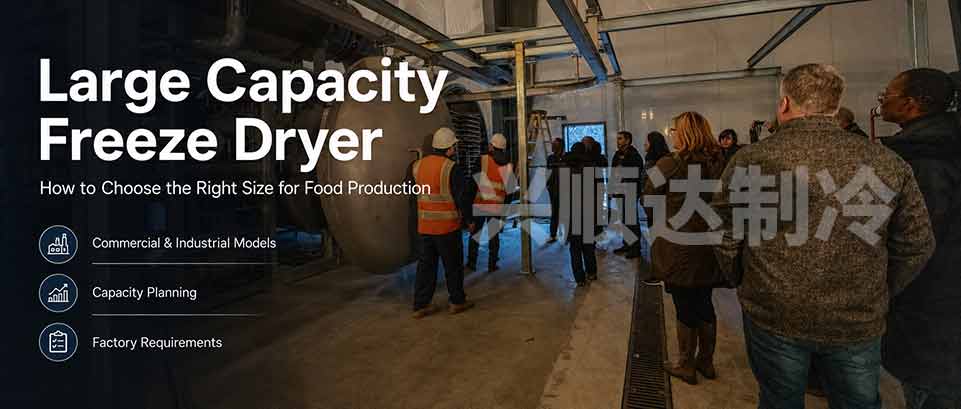
Quick Answer: What Large Capacity Freeze Dryer Does a Food Plant Need?
The correct starting point is the required daily wet material capacity. However, the final selection must also pass three checks: required tray area, water-removal load and complete cycle time. A machine can appear large enough by kilograms per day but still be undersized when the product dries slowly or requires a low loading density.
The ranges below are the manufacturer’s published wet-material capacity references for its model families under representative food-production conditions. Actual output varies with solids content, loading density, preparation and complete cycle time.
| Reference wet material demand | Equipment level | Typical application | Next action |
|---|---|---|---|
| 60–120 kg/24 h | Lab / pilot | Process testing, new-product development and small output | Review pilot models |
| 340 kg–1.36 t/24 h | Commercial | Food brands and medium-scale batch production | Compare commercial models |
| 1.2–8 t/24 h | Industrial | Multi-ton production with factory utility planning | Compare industrial models |
These ranges are preliminary references rather than universal guarantees. Fruit slices, cooked meals, seafood, dairy liquids and concentrated extracts can have different loading densities, solids contents and drying times. A large home freeze dryer is a different equipment category and should not be used as the capacity basis for a food factory.
What Does Freeze Dryer Capacity Actually Mean?
Supplier quotations often use the word “capacity” without defining the unit. Before comparing a large freeze dryer, the buyer should confirm whether the number means wet material per batch, wet material per day, finished product, tray area or condenser ice capacity.
Wet Material Capacity
The weight loaded before freeze-drying. This is the most useful basis for production planning.
Finished Product Output
The dried product weight after water removal. It depends on raw-material solids and target final moisture.
Usable Tray Area
The real area available for loading food. It must be combined with kilograms per square meter.
Water-Removal Load
The amount of ice that must sublime and be captured by the condenser during the batch.
Batch Capacity
The wet material processed in one complete batch under defined loading and product conditions.
24-Hour Capacity
The practical daily output after drying, loading, unloading, defrosting and preparation time are included.
Food freeze-drying is a coupled heat-and-mass-transfer process. Dry-layer resistance rises as drying proceeds, while shelf contact, tray condition, radiation and equipment geometry can make a commercial batch behave differently from a laboratory test. Published scale-up work also emphasizes that a drying recipe must be transferred against the characteristics of the receiving equipment. Therefore, production sizing should be based on the product and validated process—not chamber dimensions alone.[1][5]
Large Capacity Freeze Dryer Calculator
Enter the planned daily wet material output and known product data. The calculator estimates the wet load per batch, usable tray area, finished product, water removal, average vapor load and a preliminary model category.
Preliminary Food Freeze Dryer Sizing
The model direction is only a first screen against the published model ranges on this site. Fractional batch equivalents represent a multi-day production average; each machine still completes full batches. Final design must confirm product thickness, freezing route, peak sublimation rate, usable condenser ice capacity, minimum controllable pressure, utilities and factory layout.
Step 1: Calculate Wet Load per Batch
Batch wet load starts with usable tray area and loading density. The correct loading density depends on product shape, layer thickness, solids content, freezing method and the acceptable drying time.
Across the pear, blueberry, cooked-rice and shrimp projects cited in this guide, measured loading densities ranged from 11.6 to 12.5 kg/m². A broader 10–13 kg/m² range may be used only for preliminary screening of similar products. Thick products, whole fruits, liquids, extracts and temperature-sensitive materials require product-specific pilot data.
Tray dimensions also matter. The calculation should use the real loading surface rather than the outside dimensions of a tray or rack. The freeze dryer tray guide explains how tray size, loading depth and handling affect usable area.
Step 2: Calculate the Required Tray Area
When the target wet load per batch is known, required area can be calculated directly.
Example: 500 kg of Sliced Fruit per Batch
If a pilot run for the same sliced product supports 12 kg/m², the preliminary area is:
This does not mean that every 42 m² machine will complete the batch at the required time. The condenser, vacuum system, heating area and product thickness must still be checked.
Example: 1,200 kg of Pear Slices per Batch
An Oregon pear project used 100 m² of drying area and a loading density of 12 kg/m²:
The batch was dried in 12 hours to 2.21% final moisture. Read the full 100 m² pear freeze-drying case study.
Step 3: Calculate Finished Product and Water Removal
A food factory does not only need to know how many kilograms fit on the trays. It must also estimate how much water the condenser and refrigeration system need to handle.
Example: 1,000 kg Raw Material at 15% Solids
If the target final moisture is 2%, the estimated result is:
- Finished product: approximately 153 kg
- Water removed: approximately 847 kg
This calculation explains why two foods with the same wet weight can create different condenser loads. A concentrated product with higher solids contains less removable water than a low-solids fruit or liquid.
Step 4: Adjust Capacity for the Complete Cycle Time
Drying time is only one part of production. A realistic daily capacity calculation also includes loading, unloading, vacuum preparation, defrosting, cleaning and any product transfer between pre-freezing and the drying chamber. Published food-tray work also shows that endpoint signals and measured drying time can vary with cycle setup, loading and product type, so a brochure time should not be treated as a universal cycle.[2]
| Complete cycle | Theoretical cycles in 24 h | Practical interpretation |
|---|---|---|
| 8 hours | 3.0 | Possible only when product, loading and turnaround support a short cycle. |
| 12 hours | 2.0 | Exactly two complete cycles only if every turnaround step fits inside the 12-hour total. |
| 15 hours | 1.6 | Equivalent to 1.6 cycles/day only as a multi-day planning average; a single machine still runs complete batches. |
| 20 hours | 1.2 | Equivalent to 1.2 cycles/day as a multi-day planning average, not 1.2 completed batches in one calendar day. |
The food freeze-drying time chart provides examples for planning a pilot. Final timing should come from an endpoint method and product-quality checks, not from the table alone.
Step 5: Check Condenser Capacity and Vapor Load
A large commercial freeze dryer can have enough tray area but still underperform if the condenser cannot capture the sublimated water fast enough. Inadequate capture can destabilize chamber pressure, lengthen the cycle and increase product risk.
Treat this result only as a mass-balance average. Equipment research shows that maximum sustainable sublimation rate and minimum controllable pressure are dryer-specific; condenser overload or choked vapor flow can prevent the system from holding its pressure setpoint. Those published tests used pharmaceutical vial loads, so the engineering principle is relevant but the numerical limits must not be transferred to food equipment.[4]
Buyers can review the separate freeze dryer condenser guide before comparing equipment quotations.
Step 6: Add a Practical Capacity Safety Margin
A food plant should not size equipment exactly at the forecast average. The calculator starts with a 20% planning assumption, but this is not a universal engineering rule. Replace it with a margin based on demand variability, measured process spread, planned downtime and expansion policy.
- Seasonal changes in raw-material moisture
- Variation in slice thickness and product shape
- Non-uniform tray loading
- Longer cycles for new products
- Defrosting, cleaning and maintenance downtime
- Future production growth
Oversizing also has a cost. A machine that is consistently underloaded can increase capital cost, site requirements and utility demand. Therefore, the safest solution is not simply “buy the largest machine”; it is to select the smallest system that meets the validated capacity and process margin.
Commercial or Industrial Large Capacity Freeze Dryer?
| Selection factor | Commercial freeze dryer | Industrial freeze dryer |
|---|---|---|
| Typical production stage | Stable batch production and growing food brands | Multi-ton factory production |
| Utility planning | Mainly three-phase power, cooling water and drainage | Power, steam, cooling water, drainage and factory-level planning |
| Installation level | Commercial equipment installation | Industrial rigging, access, logistics and production-line integration |
| Recommended location | Ground-level installation with suitable foundation and access | Ground-level industrial installation due to weight, support load and maintenance requirements |
Commercial models SDG350, SDG700 and SDG1100 cover increasing daily wet material demand. Industrial models SDG1600, SDG3000 and SDG6000 support multi-ton production with steam-supported factory planning. For a large scale freeze dryer, utility capacity, ground-level installation, rigging access and maintenance space must be evaluated together with production output. Model selection should begin with the calculator result, then be checked against the detailed commercial freeze dryer specifications or industrial freeze dryer specifications.
Real Food Project Examples: Area, Load and Drying Time
These projects show why tray area cannot be evaluated without loading density, process preparation and cycle time.
Pear Slices: 100 m²
A large fruit project that demonstrates direct conversion from tray area to batch wet load.
View pear project dataBlueberries: 30 m²
Perforation was used because the blueberry skin can restrict moisture movement.
View blueberry project dataCooked Fried Rice: 10 m²
A prepared-food example with a shorter measured drying cycle under the tested conditions.
View rice project dataShrimp: 200 m²
A factory-scale seafood project used for instant noodle topping production.
View shrimp project dataThese values are project-specific and should not be copied to a different food without testing. They are evidence that capacity should be documented with product name, preparation, loading density, cycle time, final moisture and utility use.
Common Large Freeze Dryer Capacity Mistakes
- Using dried product weight as wet material capacity. These are different figures.
- Comparing tray count instead of usable area. Tray dimensions and loading surface must be confirmed.
- Ignoring raw-material solids. Solids determine finished output and removable water.
- Using drying time as the complete cycle. Loading, unloading and defrosting reduce daily throughput.
- Ignoring peak condenser load. Average water removal alone is not sufficient.
- Scaling directly from a home freeze dryer. Heat transfer, vapor flow and control conditions can change at larger scale.
- Buying by maximum advertised capacity. The stated number may depend on a short cycle or a specific product.
- Skipping product testing. Whole berries, extracts, meat and cooked foods do not share one drying curve.
- Ignoring factory utilities and access. Power, steam, cooling water, drainage, rigging and ground-level installation must be planned.
- Selecting only by purchase price. An undersized condenser or slow vacuum system can increase cycle time and cost.
Information Required for an Accurate Capacity Recommendation
A useful quotation should be based on process data rather than a one-line request for “a large freeze dryer.”
- Food product name and photos
- Daily wet material target
- Initial moisture or solids content
- Target final moisture
- Cut size, thickness or layer depth
- Expected loading density
- Known drying or pilot-test time
- Working hours per day
- External or internal freezing route
- Available factory space
- Voltage and frequency
- Steam availability and pressure
- Cooling-water conditions
- Destination country and installation access
- Planned future expansion
When the process is not yet validated, a pilot freeze-drying test can establish loading density, drying time, product temperature behavior and final moisture before commercial scale-up.
Request a Project-Based Freeze Dryer Capacity Calculation
Send the product, daily wet material target, solids content, thickness, target moisture and factory utilities. The engineering team can provide a preliminary tray-area calculation, water-removal estimate and model direction before preparing a quotation.
FAQ About Large Capacity Freeze Dryers
What does kg capacity mean on a freeze dryer?
It should identify whether the number means wet material per batch, wet material per 24 hours, dried product or water-removal capacity. Buyers should not accept an unspecified kilogram figure.
How many kilograms can a commercial freeze dryer process per day?
The published commercial range is approximately 340 kg to 1.36 tons of wet material per 24 hours. Actual output depends on loading density, water content and complete cycle time.
How much tray area is required for 1,000 kg of food?
At a pilot-verified 12 kg/m², one 1,000 kg batch requires about 83.3 m². A daily target must first be converted into the required load per complete batch.
Does larger tray area always mean higher capacity?
No. Higher output also requires enough refrigeration, condenser capture, vacuum stability, heat transfer and handling capacity. Tray area alone can overstate real production performance.
How does moisture content affect freeze dryer size?
Lower-solids material contains more removable water. This increases condenser load and may increase cycle time even when the wet loading weight is unchanged.
Is one large freeze dryer better than two smaller machines?
One large unit can simplify operation; two smaller units can improve scheduling and maintenance redundancy. The decision depends on batch size, product mix, downtime risk and utilities.
Final Selection Principle
The safest choice is the smallest commercial or industrial system that meets validated wet-load, tray-area, cycle-time, water-removal and condenser requirements with a practical margin. Before purchase, confirm the result through product trials, equipment data and the site conditions in the commercial freeze dryer installation guide.

Zheng Wei
Founder & Freeze-Drying System Engineer
Fuzhou Xing Shun Da Refrigeration Facility Project Co., Ltd.
Zheng Wei participates in food freeze-drying trials, equipment selection, vacuum-system configuration, refrigeration planning, installation guidance and drying-process optimization. His project experience covers fruit, vegetables, prepared meals, seafood, meat, herbs and liquid products.
View manufacturing and engineering experienceTechnical References
- [1] Ratti C. Freeze drying for food powder production. In: Handbook of Food Powders: Processes and Properties. 2013:57–84. Freeze Drying for Food Powder Production — DOI: 10.1533/9780857098672.1.57
- [2] Pisano R, Barresi AA, Fissore D. Innovation in Monitoring Food Freeze Drying. Drying Technology. 2011;29(16):1920–1931. Innovation in Monitoring Food Freeze Drying — DOI: 10.1080/07373937.2011.596299
- [3] Bhatta S, Stevanovic Janezic T, Ratti C. Freeze-Drying of Plant-Based Foods. Foods. 2020;9(1):87. Freeze-Drying of Plant-Based Foods — DOI: 10.3390/foods9010087
- [4] Tchessalov S, Maglio V, Kazarin P, et al. Practical Advice on Scientific Design of Freeze-Drying Process: 2023 Update. Pharmaceutical Research. 2023;40:2433–2455. Practical Advice on Scientific Design of Freeze-Drying Process: 2023 Update — DOI: 10.1007/s11095-023-03607-9
- [5] Fissore D, Pisano R, Barresi AA. Scale-up and Process Transfer of Freeze-Drying Recipes. Drying Technology. 2011;29(14):1673–1684. Scale-Up and Process Transfer of Freeze-Drying Recipes — DOI: 10.1080/07373937.2011.597059