
Vacuum Oven vs Freeze Dryer: Which Is Better for Food Production?
The vacuum oven vs freeze dryer decision depends on how moisture must leave the product and which finished-product qualities the food manufacturer must protect. This engineering guide compares process principle, product quality, throughput, utilities, cost, scale-up and purchase criteria so the selected system fits a real product—not simply the lowest quotation.
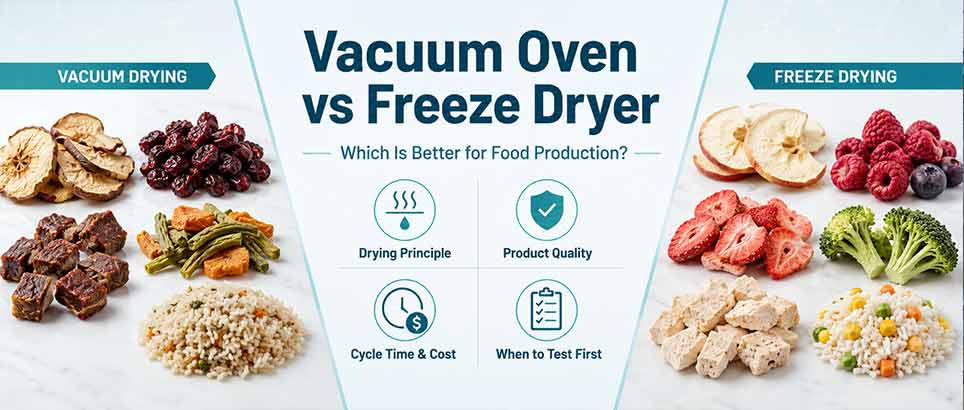
Quick Answer
A vacuum oven usually costs less and removes liquid water or solvent by evaporation under reduced pressure. A freeze dryer freezes the product first and removes ice by sublimation.[1] Evaluate vacuum drying when moderate shrinkage and slower rehydration are acceptable; evaluate freeze drying when retained shape, open pores, crispness or rapid rehydration defines the product. Controlled studies show that results still depend on the food, quality metric and drying technology.[2] The final decision should use matched trials and cost per kilogram of acceptable finished product.
product trial + quality target + unit cost
Is a Freeze Dry Oven the Same as a Vacuum Oven?
No. Freeze dry oven and freeze dryer oven are informal search terms, not precise equipment names. In many enquiries, they refer to a freeze dryer because the machine has a chamber, trays and heated shelves. The search phrase vacuum dryer vs freeze dryer often describes the same evaporation-versus-sublimation decision, although industrial vacuum dryers can use designs other than a batch oven. A standard vacuum oven does not become a freeze dryer merely because it reaches low pressure.
A true freeze-drying system needs four coordinated functions: complete product freezing, controlled heat input, stable vacuum and a condenser that captures the water vapor released during primary drying.[3] The product must remain below its collapse or melting limit while ice sublimes.[5] A vacuum oven generally heats material under reduced pressure so liquid water or solvent evaporates at a lower temperature.
How a Vacuum Oven and Freeze Dryer Remove Moisture
Vacuum Oven: Evaporation Under Reduced Pressure
Reduced pressure lowers the boiling temperature of water or another volatile component, while shelves, walls or trays provide heat for evaporation. Because moisture leaves mainly from a liquid phase, capillary forces can produce a denser or more shrunken structure.
This may be acceptable for ingredients that will be milled, dissolved or used where appearance and rapid rehydration are not primary targets.
Freeze Dryer: Sublimation From Frozen Product
Freeze drying starts with a completely frozen product. Controlled heat supplies sublimation energy, vacuum supports vapor movement and a colder condenser captures the released water vapor. Secondary drying then reduces part of the remaining bound moisture.
Because ice leaves without first becoming bulk liquid water, the process can preserve more of the frozen structure. Sublimed ice crystals leave pores, but pore size and resistance to collapse still depend on the food composition and process conditions.[1] For a deeper process explanation, see how freeze drying works and the guide to freeze-drying temperature and pressure.
Vacuum Oven vs Freeze Dryer Comparison Table
| Comparison point | Vacuum oven | Freeze dryer |
|---|---|---|
| Main moisture-removal mechanism | Evaporation of liquid water or solvent under reduced pressure | Sublimation of ice followed by secondary drying |
| Product freezing | Usually not required | Required before primary drying |
| Product temperature | Usually higher, but product-specific | Controlled to protect the frozen structure during sublimation |
| Shrinkage | Often more visible | Usually lower when the cycle is properly developed |
| Porous structure | Limited or product-dependent | Often pronounced because ice crystals leave pores |
| Rehydration | Often slower or less complete | Often faster because of the porous structure |
| Initial investment | Generally lower | Generally higher because refrigeration, condenser, vacuum, heat and control systems must work together |
| System complexity | Lower | Higher |
| Typical food use | Heat-tolerant ingredients, powders, intermediates and products where shrinkage is acceptable | Premium fruit, vegetables, meat, seafood, instant meals, extracts and products requiring shape or rehydration |
| Best selection method | Compare the same formulation, thickness, loading and final specification in controlled trials | |
10 Key Differences Between a Vacuum Oven and a Freeze Dryer
1. Drying Mechanism
A vacuum oven normally removes liquid water by evaporation, while a freeze dryer removes frozen water by sublimation. That phase difference affects structure, vapor flow, heat transfer and equipment design.
2. Product Temperature
Vacuum lowers the boiling temperature, but product temperature still depends on pressure, heat transfer, moisture movement and drying resistance. During primary freeze drying, the product must remain below its collapse or melting limit; pressure changes can also affect structure through product temperature.[1] A shelf setting or no-load vacuum value alone cannot compare two systems.
3. Shape and Shrinkage
Liquid movement and capillary forces can pull an evaporating product inward. Freeze drying can reduce this effect because much of the water leaves while the product remains frozen. Excessive product temperature can still cause shrinkage or collapse, so pressure must be interpreted with the product’s critical temperature.[1]
4. Porosity and Rehydration
Sublimed ice crystals can leave a porous network that supports rehydration, but product type and freeze-drying pressure also influence porosity and mechanical strength.[1] Compare rehydration time, absorbed-water ratio and post-rehydration texture rather than assuming every freeze-dried product behaves alike.
5. Flavor, Aroma and Heat-Sensitive Qualities
Freeze drying often protects heat-sensitive qualities because the product stays cold during much of the cycle, but it does not guarantee that every measured attribute will be superior. In one Jonathan apple study, freeze-dried slices best retained appearance, color and volatile aroma, while a combined hot-air and microwave-vacuum process produced the preferred crisp texture and overall sensory result.[2] This is evidence for product-specific testing—not proof that an ordinary vacuum oven will produce the same result.
6. Final Moisture and Endpoint Verification
Both systems can leave residual moisture in the center after the surface appears dry. The manufacturer’s routine project approach uses final moisture content, product-center dryness, mass stability, sensory evaluation, rehydration performance and batch consistency. Apply the same release criteria to both trial methods.
7. Drying Time and Throughput
Vacuum drying may be faster for thin, heat-tolerant products, but batch time alone does not define output. Compare wet loading, water removed, acceptable yield, loading, defrosting, cleaning and realistic batches per week. Selected manufacturer projects were completed in approximately 6–13 hours after process development; these first-party records are not universal cycle promises.
8. Energy and Utilities
A vacuum oven normally requires heat and vacuum. A freeze dryer also needs refrigeration, condenser duty, a matched vacuum system, controlled heat transfer and defrosting; industrial units may use cooling water and steam. Compare measured kWh per batch, kWh per kilogram of water removed and acceptable finished kilograms per batch. One process-control review reports roughly 0.4 kg of water removed per kWh as a literature reference, not a universal equipment guarantee.[4]
9. Initial Investment and Maintenance
A vacuum oven is normally simpler and less expensive to purchase. A freeze dryer adds condenser, refrigeration, vacuum, heating, control and defrosting systems. The added cost is justified only when product quality, yield, selling price or market position can support it.
10. Scale-Up and Batch Consistency
Scale-up can change heat transfer, vapor flow, product temperature and batch uniformity.[3] A useful lab or pilot freeze-drying test records thickness, loading density, product temperature, chamber pressure, condenser load, heat input, endpoint and acceptable yield so the production basis can be reproduced.
When Is a Vacuum Oven the Better Choice?
A vacuum oven can be the more rational investment when the product does not need the structural advantages of freeze drying. Typical conditions include:
- The product can tolerate the selected drying temperature.
- Moderate shrinkage or density change is acceptable.
- Fast or complete rehydration is not a sales requirement.
- The material will be milled, dissolved or used as an intermediate.
- The main objective is residual moisture or solvent reduction.
- The product value cannot support freeze-drying cost.
- Controlled trials show that vacuum drying meets the final specification.
When vacuum drying meets the quality target at a lower verified unit cost, it is the better business choice. A vacuum oven can replace a freeze dryer only when both methods meet the same final moisture, sensory, rehydration, appearance, yield and shelf-life requirements.
When Is a Freeze Dryer the Better Choice?
A freeze dryer is more likely to justify its higher cost when the product’s market value depends on qualities that are difficult to retain through liquid-phase evaporation. Common examples include:
- Premium fruit and vegetable snacks that require shape and crisp texture
- Meat, seafood and pet-food products that require controlled structure
- Cooked rice, soup ingredients and prepared meals that need rapid rehydration
- Coffee, tea and botanical extracts with aroma or heat sensitivity
- Products sold whole rather than ground after drying
- Products that collapse or harden during vacuum evaporation
- Projects where side-by-side trials show a clear commercial quality advantage
Food manufacturers evaluating the complete system can review the food freeze dryer selection guide. For a comparison with hot-air dehydration rather than vacuum drying, see the separate dehydrator vs freeze dryer guide.
Food Product Selection Matrix
| Product type | Vacuum oven may fit when | Freeze dryer may fit when | Trial factors |
|---|---|---|---|
| Fruit slices | The output will be powdered or used as a lower-cost ingredient | Whole shape, color, crispness and premium appearance are required | Sugar level, thickness, stickiness, shrinkage and finished texture |
| Vegetables | The product is a powder or formulation ingredient | Piece identity, color and rehydration are important | Blanching, cut size, loading, color and center dryness |
| Meat and seafood | Structure is less important and the final use tolerates denser material | The product is a premium snack, instant meal or pet-food component | Fat, cooking state, piece thickness, loading and oxidation control |
| Cooked meals and rice | The dried material will be milled or used as an industrial ingredient | Fast rehydration and recognizable components are required | Oil content, recipe, fill depth, separation and rehydration time |
| Coffee, tea and extracts | The formula is heat-tolerant and cost is the main target | Aroma, solubility and premium product positioning are important | Solids, viscosity, freezing behavior, foaming and tray depth |
| Herbs and botanical material | The target is a standard dried ingredient | Color, aroma or heat-sensitive quality is commercially important | Marker quality, sensory limits, pretreatment and packaging |
Which System Is Cheaper per Kilogram of Finished Product?
The purchase price answers only one part of the question. The correct comparison uses acceptable finished product, not chamber size or wet loading alone.
A useful cost comparison should record:
- Wet material loaded per batch
- Initial moisture and water removed
- Acceptable finished kilograms
- Complete batch time and turnaround time
- Electricity, steam and cooling-water demand
- Labor for loading, unloading, defrosting and cleaning
- Breakage, collapse, discoloration or off-specification losses
- Expected selling price and contribution margin
A vacuum oven may have lower operating and ownership cost, but an inferior finished product can create a higher cost per saleable kilogram. Conversely, a visually superior freeze-dried product is not commercially attractive when the market will not pay for the added quality. The freeze-drying cost analysis explains how to calculate energy, labor, maintenance, depreciation and water-removal cost.
How to Test Both Processes Before Buying Equipment
- Define the product specification. Record formulation, cut size or fill depth, initial moisture, target final moisture, appearance, texture, aroma and rehydration requirements.
- Prepare matched samples. Use the same raw-material lot, pretreatment, thickness and loading basis for both processes.
- Record the complete process. Measure actual product temperature, pressure, drying time, loading, utilities and all operator interventions.
- Use the same release checks. Compare final moisture, product-center dryness, mass stability, sensory result, rehydration and batch consistency.
- Calculate acceptable yield. Exclude collapsed, burned, discolored, under-dried or broken product when comparing cost.
- Model production scale. Convert trial results into wet material per batch, water removed, realistic cycles per week and finished kilograms per month.
A pilot test is especially important for high-sugar fruit, high-fat foods, thick meat pieces, extracts and complex prepared meals. These products can behave very differently even when their initial moisture appears similar.
Information a Supplier Needs Before Recommending a Freeze Dryer
A reliable recommendation cannot be made from “kilograms per day” alone. The supplier needs the formulation, initial moisture, thickness or fill depth, wet loading, target final moisture, quality and rehydration requirements, available electricity, cooling water or steam, factory access and packaging target. These inputs define water load, usable area, condenser duty, cycle time and site requirements.
Use the Same Quotation Basis for Both Systems
| Supplier data | Why the buyer needs it |
|---|---|
| Usable tray area, fill depth and wet loading | Prevents chamber volume from being mistaken for production capacity. |
| Water removed per batch and condenser capacity | Shows whether vapor capture matches the proposed load. |
| Product-temperature and pressure records | Allows the buyer to compare thermal exposure and process control. |
| Complete cycle, defrost, cleaning and turnaround time | Converts batch time into realistic weekly output. |
| Measured batch energy and acceptable finished yield | Supports unit-cost calculation using saleable output. |
| Release tests and acceptance criteria | Defines what “dry,” “rehydrated” and “acceptable” mean before purchase. |
Once the process is confirmed, the buyer can compare a commercial freeze dryer for medium production or an industrial freeze dryer for factory-scale output and utility integration.
Common Vacuum Oven vs Freeze Dryer Selection Mistakes
Comparing Only Chamber Volume
Chamber volume does not reveal usable shelf area, tray loading, vapor path or condenser capacity. Capacity should be based on the real product and water-removal load.
Assuming All Vacuum Drying Is Freeze Drying
Low pressure alone is not enough. True freeze drying requires frozen product, sublimation control and effective vapor capture.
Comparing Only the Lowest Temperature
No-load chamber or condenser temperature does not prove product performance under a full water load.
Using Rated Power as Energy Cost
Connected power is not the same as batch energy consumption. Actual use must be measured across the full cycle.
Ignoring Defrost and Turnaround
Loading, unloading, condenser defrost, cleaning and maintenance affect weekly output and labor cost.
Buying Before Product Testing
A catalog cannot predict collapse, stickiness, center dryness, aroma or rehydration for an untested formulation.
Final Decision: Vacuum Oven or Freeze Dryer?
Choose a Vacuum Oven When
The product tolerates heat, moderate shrinkage is acceptable, rehydration is not critical and controlled trials confirm the required quality at a lower unit cost.
Choose a Freeze Dryer When
Shape, porous structure, crispness, aroma protection, premium appearance or rapid rehydration creates enough commercial value to justify the system.
Run Trials First When
The product is high in sugar or fat, contains multiple components, is processed as an extract, has a thick loading layer or lacks a confirmed quality specification.
FAQ About Vacuum Ovens and Freeze Dryers
Is a vacuum oven the same as a freeze dryer?
No. A vacuum oven generally removes liquid moisture or solvent by evaporation under reduced pressure. A freeze dryer freezes the product and removes ice by sublimation while a cold condenser captures the vapor.
What is a freeze dry oven?
“Freeze dry oven” is an informal search term often used for a freeze dryer. A buyer should confirm that the machine includes controlled freezing or frozen loading, heat input, vacuum control and a condenser designed to capture the expected water load.
Can a vacuum oven be used for freeze drying?
A standard vacuum oven is not normally a complete freeze-drying system. Without proper freezing, sublimation control and vapor capture, it performs vacuum drying rather than a repeatable commercial freeze-drying process.
Is vacuum drying faster than freeze drying?
It can be faster for some thin, heat-tolerant products. However, the comparison should include acceptable finished yield, loading, turnaround, defrosting and cleaning—not drying time alone.
Is a vacuum oven cheaper than a freeze dryer?
It is generally cheaper to purchase and simpler to maintain. The correct business comparison is cost per acceptable finished kilogram because product shrinkage, quality loss or poor rehydration can reduce saleable yield.
Which drying method is better for food products?
Neither method is universally better. Vacuum drying can be suitable for heat-tolerant ingredients and cost-sensitive products. Freeze drying is often better for high-value foods that require shape, porous structure, premium texture or rapid rehydration. Product trials should decide.
Technical References
- Oikonomopoulou VP, Krokida MK. Structural Properties of Dried Potatoes, Mushrooms, and Strawberries as a Function of Freeze-Drying Pressure. Drying Technology. 2012;30(4):351–361. Structural Properties of Freeze-Dried Foods as a Function of Pressure — DOI: 10.1080/07373937.2011.639475
- Ferenczi S, Czukor B, Cserhalmi Z. Evaluation of Microwave Vacuum Drying Combined with Hot-Air Drying and Compared with Freeze- and Hot-Air Drying by the Quality of the Dried Apple Product. Periodica Polytechnica Chemical Engineering. 2014;58(2):111–116. Evaluation of Microwave Vacuum, Freeze and Hot-Air Drying of Apple — DOI: 10.3311/PPch.7082
- Ratti C. Freeze drying for food powder production. In: Bhandari B, Bansal N, Zhang M, Schuck P, editors. Handbook of Food Powders: Processes and Properties. Woodhead Publishing; 2013:57–84. Freeze Drying for Food Powder Production — DOI: 10.1533/9780857098672.1.57
- Barresi AA, Pisano R. Process intensification and process control in freeze-drying. Proceedings of the 21st International Drying Symposium. 2018. Process Intensification and Process Control in Freeze-Drying — DOI: 10.4995/ids2018.2018.7652
- U.S. Food and Drug Administration. Lyophilization of Parenteral (7/93). Accessed July 4, 2026.
- U.S. Food and Drug Administration. Draft Guidance for Industry: Hazard Analysis and Risk-Based Preventive Controls for Human Food, Chapter 4 (Draft—Not for Implementation). Accessed July 4, 2026.
References [1] and [2] are product-specific food studies; [3] and [4] are engineering sources. Reference [5] is pharmaceutical guidance cited only for general freeze-drying mechanism and process-control principles. Reference [6] is draft food-safety guidance. These sources define mechanisms and comparison questions, not guaranteed performance for a new recipe or machine.