
Do You Have to Defrost a Freeze Dryer Between Batches?
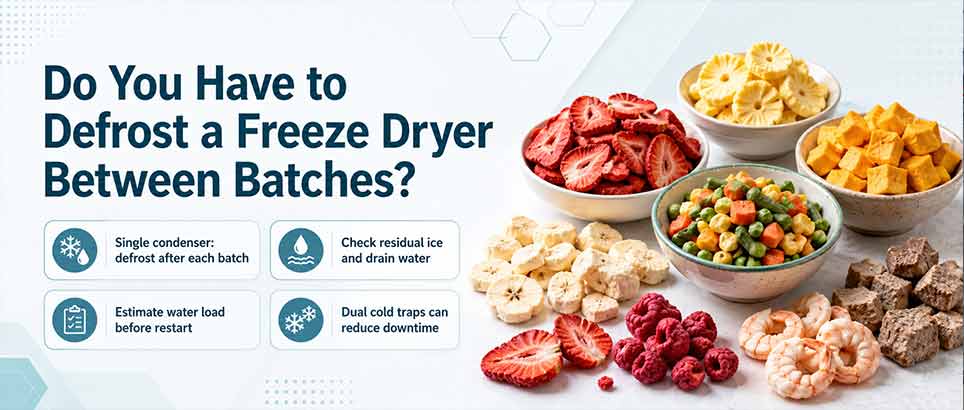
A practical decision guide for food processors comparing residual ice, condenser capacity, batch turnaround and single- versus dual-cold-trap systems.
For a single-condenser food freeze dryer, defrosting, draining and checking the cold trap after each batch is the safest operating default. Do not start the next batch with residual ice or standing water unless the manufacturer permits it and the plant’s approved SOP defines the remaining ice capacity, valve positions and restart checks.
A system with independently isolated cold traps may collect vapor on one trap while another defrosts. However, this arrangement reduces condenser waiting time; it does not eliminate unloading, inspection, cleaning, loading or maintenance.
People searching “do you have to defrost a freeze dryer between batches?” often see conflicting answers because a home unit, a laboratory condenser and an industrial food freeze dryer may have very different vapor paths and ice capacities. The correct decision is based on the machine design and verified water load, not simply on whether the vacuum pump can still run.
When Do You Have to Defrost a Freeze Dryer Between Batches?
| Condition after the batch | Next action | Reason |
|---|---|---|
| Single condenser with a normal food load | Defrost, drain and inspect | The next load should begin with the verified cold-trap capacity available. |
| Ice remains, distribution is uneven, or the vapor entrance is restricted | Do not restart | Total ice mass alone does not show how much effective cold surface and flow area remain. |
| Standing water remains after defrost | Drain, dry and investigate | Water, drain-valve position or a wet seal can delay pump-down and imitate a vacuum fault. |
| Low-moisture product and a proposed multi-batch procedure | Use only after documented verification | Product name or visual judgment is not a substitute for measured water load and remaining capacity. |
| Two genuinely independent cold traps | Alternate only under the approved sequence | Isolation, drainage, switching stability and maintenance access must all be demonstrated. |
Model instructions remain decisive. For example, the Yamato DC801 operating manual gives a model-specific defrost and drain sequence.[4] The food plant should use the procedure for its actual machine rather than copying a time or temperature from another brand.
Why Residual Condenser Ice Can Affect the Next Batch
During primary drying, the cold trap captures water vapor as ice. This reduces the vapor load reaching the vacuum pump and helps the chamber maintain low pressure.[1]


Available capacity is not just “empty volume”
Ice can accumulate unevenly. In a small external-coil condenser study, vapor concentrated near the inlet, built a local ice blockage and left more distant cold surface underused.[2] The practical lesson is scoped but useful: operators should inspect ice distribution and vapor-path restriction, not only estimate total ice mass.
Residual water changes restart conditions
Defrosting converts ice to water; drainage and drying return the system to a known starting condition. The heat source, drain path, valve sequence and restart checks must therefore be evaluated as one operating procedure. A method approved for one machine should not be copied to another model.
Estimate Whether the Cold Trap Can Accept Another Batch
If initial and final moisture are both expressed on a wet basis, estimate the water removed as:
Use measured moisture values and the actual loaded mass. Then compare the result with the manufacturer’s usable ice capacity under the proposed product and cycle—not only a nominal chamber volume. Also ask for the peak water-capture rate, because a cold trap may have enough total capacity yet struggle during the highest sublimation load.
Do not invent a universal safety margin. Product variability, defrost completeness, ice distribution, refrigeration performance and the supplier’s test method determine the appropriate allowance.
For condenser sizing and terminology, use the site’s freeze dryer condenser guide as the topic owner. This page should remain focused on the between-batch decision.
Single Cold Trap vs Dual Cold Trap Defrosting
| Design | What happens during defrost | What the buyer must verify |
|---|---|---|
| Single cold trap | Vapor capture stops while the trap warms, drains and returns to operating temperature. | Loaded defrost time, complete drainage, restart temperature and full-cycle turnaround. |
| Multiple independently isolated cold traps | One trap may capture vapor while another is defrosted and serviced. | Isolation valves, pressure stability during switching, cross-leakage, drainage, controls and safe maintenance access. |
A food process engineering reference describes large freeze-drying systems that use two condensers alternately, allowing one condenser to collect vapor while the other is isolated for defrosting.[3] That establishes the engineering concept; it does not prove that every “dual cold trap” offered by a supplier provides uninterrupted production.
Ask for a loaded switching demonstration. A no-load animation cannot show whether chamber pressure remains stable, whether the traps are truly isolated or how meltwater is controlled.
Include Defrost Time in Real Daily Capacity
Brochures often emphasize drying time. A factory schedules the complete interval from one loaded start to the next:
Divide scheduled operating time by the complete cycle, then round down to whole batches and apply packaging, maintenance and labor constraints. A complete calculation covering wet load, water removal, usable shelf area and start-to-start cycle time is available in the large-capacity freeze dryer sizing guide and calculator.
Performance confirmation should turn brochure claims into repeatable tests. Food equipment needs product-specific acceptance limits, with the test condition, measurement method and pass criterion defined in the FAT/SAT or purchase agreement. The food freeze dryer validation guide explains how to structure these checks without treating a no-load demonstration as proof of production capacity.
Recommended Defrost, Drain and Restart Sequence
- Confirm the batch endpoint, unload the product and move it to the defined inspection and moisture-protective packaging step.
- Break vacuum using the manufacturer’s procedure and verify that access is safe.
- Run only the approved defrost method. Do not copy another machine’s water, steam, electric or hot-gas procedure.
- Route meltwater to the designed drain or collection point; prevent backflow toward the vacuum path.
- Inspect the cold surface, vapor entrance, hidden low points and drain path for remaining ice or water.
- Return isolation and drain valves to their required positions, inspect seals and confirm alarm status.
- Record defrost duration, unusual ice distribution, drainage faults and corrective action in the batch or maintenance record. The site’s freeze dryer monitoring and batch-record guide explains which operating data should be retained.
Defrosting is not cleaning or sanitizing. Defrosting melts ice; cleaning removes soil; sanitizing is applied to a clean surface where the food-safety program requires it. For U.S. human-food facilities, 21 CFR 117.35 addresses sanitary operations and the cleaning of food-contact surfaces.[5] See the site’s food freeze dryer cleaning guide for the separate chamber, tray, condenser and drainage workflow.
Questions Buyers Should Ask About the Defrost System
- What usable ice capacity and peak capture rate were demonstrated for a comparable loaded product?
- How is ice distribution inspected, and what prevents local inlet blockage?
- What defrost method, utilities, drain capacity and safety interlocks are supplied?
- What is the loaded defrost-to-restart time, including drainage and re-cooling?
- If traps alternate, how are isolation and chamber pressure verified during switching?
- Can operators access hidden surfaces, valves and drains for inspection and maintenance?
- Does the quoted daily output include unloading, defrosting, required cleaning and reloading?
- Will FAT/SAT record pump-down time, leakage, loaded cold-trap performance and complete turnaround?
Also confirm utilities, access and floor drainage before ordering. The commercial freeze dryer installation guide covers these site inputs.
Conclusion: Start Each Batch From a Verified Condition
So, do you have to defrost a freeze dryer between batches? For a single-condenser food freeze dryer, normally yes: defrost, drain and inspect unless the manufacturer and the plant’s approved SOP explicitly permit another sequence.
For equipment selection, compare usable ice capacity, peak capture rate, ice distribution, drainage, switching stability and the complete start-to-start cycle. These checks are more useful than a claim that a machine can still “pull vacuum” with ice remaining.
Request a Condenser and Batch-Turnaround Review
Buyers can provide the product, wet mass per batch, measured initial moisture or solids, target final moisture, drying time, defrost time, planned hours, utilities and destination country. The engineering team will return a focused list of capacity, cold-trap and acceptance-test questions for the buyer’s supplier comparison.
Frequently Asked Questions
Do you need to defrost a freeze dryer after every batch?
For a single-condenser food freeze dryer, defrosting, draining and inspecting after every batch is the safest default. Use a different schedule only when the manufacturer allows it and the site has verified remaining capacity and restart conditions.
Can a new batch start while ice remains in the condenser?
Not by visual judgment alone. Residual ice reduces available capacity and may restrict the vapor entrance even when unused cold surface remains elsewhere.
How long should a freeze dryer take to defrost?
There is no universal time. Ice load, geometry, defrost method, drainage and re-cooling all matter. Ask for loaded data from a comparable machine and product.
Does a dual cold trap eliminate downtime?
No. It may reduce condenser waiting time, but unloading, inspection, cleaning, loading, packaging and maintenance can still control the complete cycle.
Why can pump-down take longer after defrosting?
Possible causes include residual water, an open or poorly seated drain valve, wet or contaminated seals, an isolation-valve error or another vacuum leak. Follow the machine’s leak-check sequence.
Is defrosting the same as cleaning?
No. Defrosting melts condenser ice. Cleaning removes residue and soil. Sanitizing is a separate step used where the food-safety program requires it.
References
- [1] 王立业, 谢国山. 真空冷冻干燥机的开发现状与发展趋势[J]. 化工装备技术, 2003, 24(6): 8–11. DOI: 10.16759/j.cnki.issn.1007-7251.2003.06.003.
- [2] 李筱泉. 真空冷冻干燥机凝结器的改进[J]. 龙岩学院学报, 2007, 25(6): 87–88+92. DOI: 10.16813/j.cnki.cn35-1286/g4.2007.06.029.
- [3] Berk Z. Freeze Drying (Lyophilization) and Freeze Concentration. In: Food Process Engineering and Technology. 2nd ed. Elsevier; 2013: 567–581. DOI: 10.1016/B978-0-12-415923-5.00023-X.
- [4] Yamato Scientific Co., Ltd. Freeze Dryer DC801 Instruction Manual. Equipment operating manual. DOI: Not applicable. View official manual.
- [5] Electronic Code of Federal Regulations. 21 CFR 117.35—Sanitary Operations. Current U.S. regulation. DOI: Not applicable. View current regulation.
About the Author
Zheng Wei is the Founder and Freeze-Drying System Engineer at Fuzhou Xing Shun Da Refrigeration Facility Project Co., Ltd. He participates in food freeze-drying projects involving product trials, equipment sizing, vacuum-system configuration, refrigeration planning, installation guidance and process optimization.
His project work covers fruit, vegetables, cooked foods, seafood, meat, herbs and food ingredients. Equipment recommendations are based on product data, measured loading, water removal, complete batch turnaround, factory utilities and practical maintenance access.
Technical note: This article provides a selection and operating framework. It does not replace the equipment manual, site risk assessment, food-safety plan, lockout/tagout procedure or local regulatory requirements.